Summary
- The story
- Benchling is good for unstructured R&D. Its founders built it in 2012 as a productivity tool for academic scientists,¹⁰ starting with DNA editing software that academics used free,¹¹ and it has since given free access to more than 200,000 of them.¹² It is still built around the registered entity and the notebook entry linked to it,² and Benchling says its research packages are designed for “flexible, unstructured workflows”.¹³ It calls its registry configuration codeless,¹⁴ yet says enterprise rollouts may take several months,² with its own design and configuration services and certified partners who “know the data model”.⁷⁸ Once a result schema holds data, adding a required field is restricted, and Benchling suggests a new version of the schema.⁶ Its AI, launched in October 2025, and its agents, launched in August 2026, draft entries, register molecules and process results, and can order from CROs and run instruments through its automation.³⁴⁵ If your process will not change and you can afford months of configuration, it can work well. That is rare, and rarer now that the work changes so fast.
1What Benchling offers.
Its notebook standardises entries with templates and schemas and links results to samples.¹⁵ Its registry records biomolecules, small molecules, cell lines, animals and reagents with their lineage,¹⁴ its molecular biology tools design primers and CRISPR guides, plan cloning and align sequences,¹⁶ and Inventory tracks lab samples by barcode and location.¹⁷ Bioprocess is a separate package for process development, with recipes in an ISA-88-compatible model and guided batch execution.¹³ In November 2025 Benchling said its lab execution system would be extended to GMP environments such as QC in 2026.¹⁸ Science Foundries, in preview since October 2026,⁵ are teams of agents that run a complete R&D workflow, guided by scientists.¹
2Neil does the paperwork across Benchling. You sign.
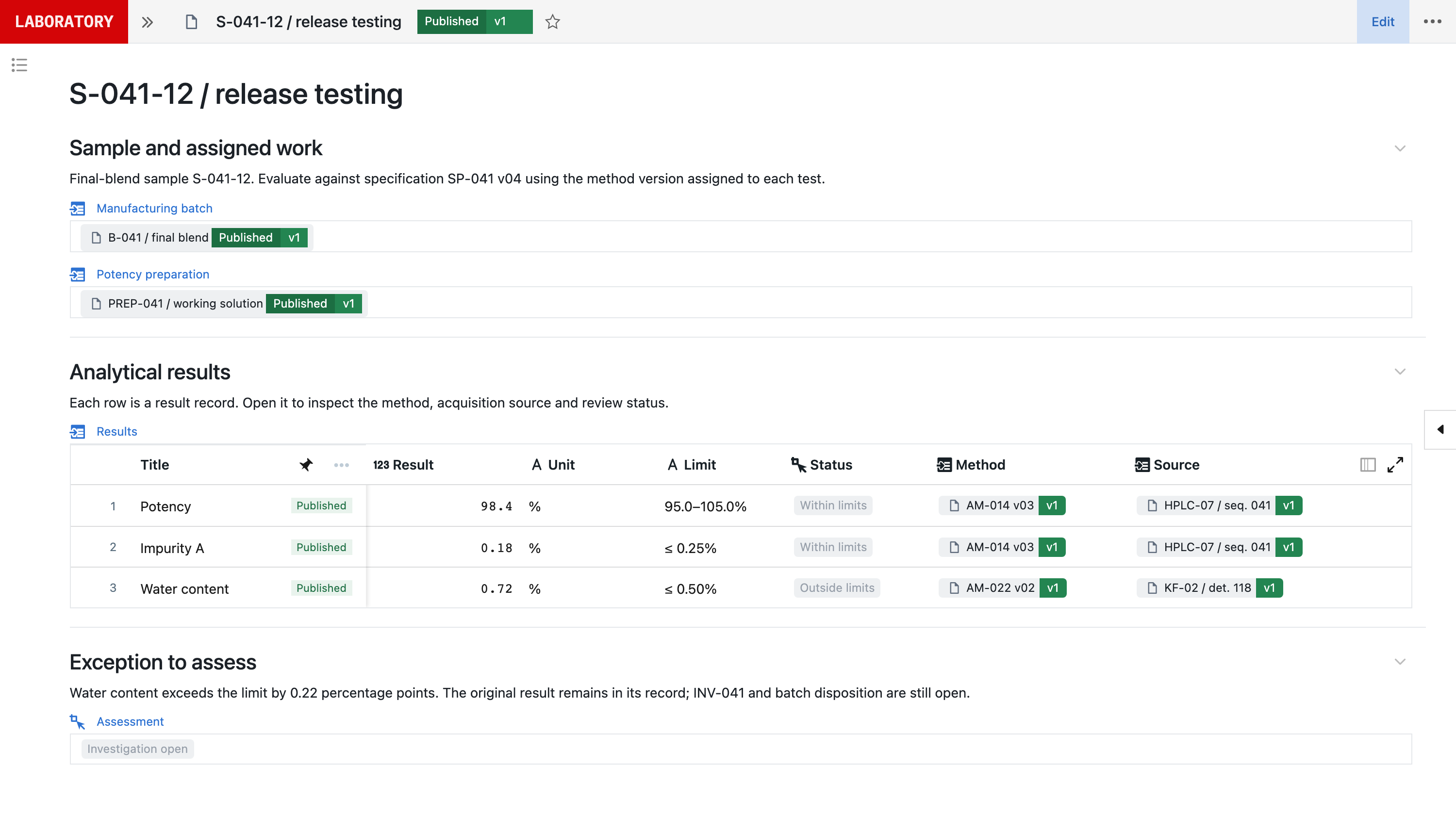
You can keep Benchling as your source of truth. Seal’s Benchling library references selected Registry entities and Notebook entries in Seal through a dedicated Benchling app with read access to the projects you choose. It does not write to Benchling, and original links open with the reader’s own permissions.
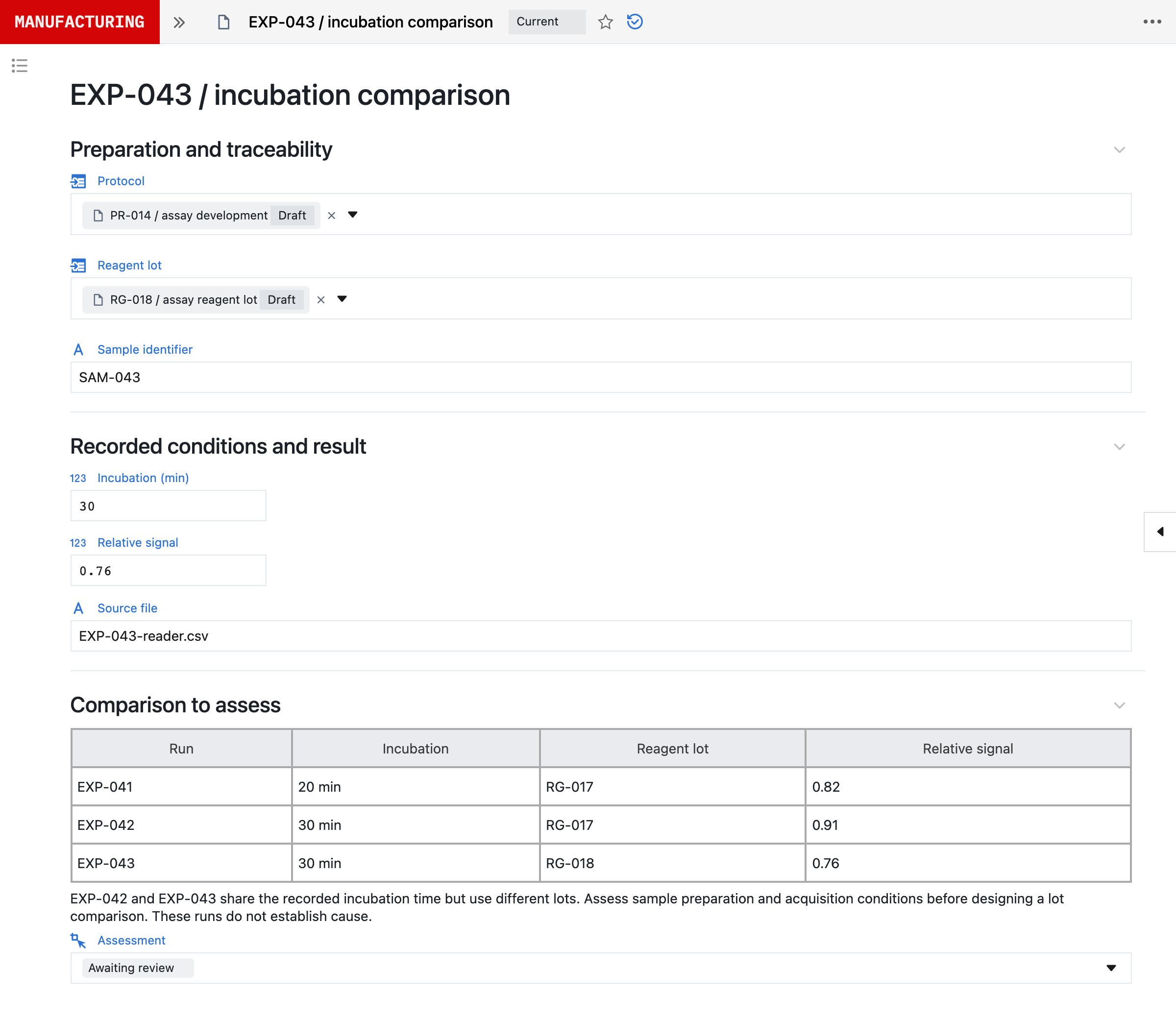
With entities shared, Neil, your AI agent, can compare them and summarise the differences in their recorded fields, separating recorded differences from missing values and keeping the entity, schema and registry references with the comparison. Your team reviews and approves what it prepares. Neil is not used in GMP execution.
3Start beside Benchling.
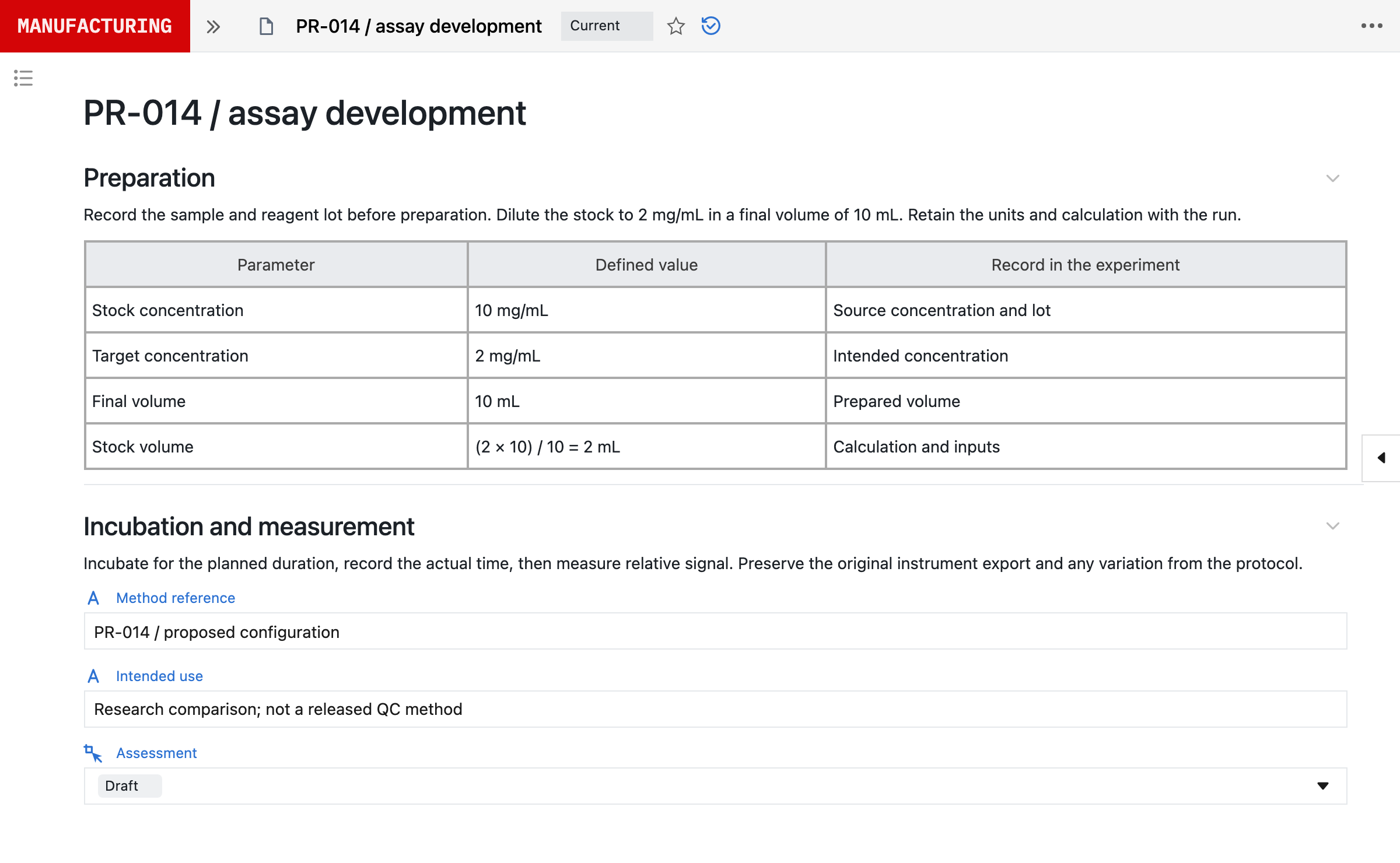
- Choose the first controlled job: a method approaching transfer, a release test, or a development assay repeated often enough to need fixed inputs and calculations.
- Bring the protocol, a few representative runs and the files behind their results. Start with sample material, or arrange an NDA first.
- Neil configures the protocol from your procedure, and your scientists check the inputs, units and calculations. Once the scope is agreed and the inputs received, Seal prepares the first working process and its validation pack to evaluate within 48 hours. Production timing then depends on scope, interfaces, migration and your release requirements.
- Share the Benchling entities and entries the process uses, then test a normal run, missing data, a deliberate variation and a changed protocol before you rely on it.
- If records move later, scope exports, attachments, metadata, permissions and history first, and keep gaps visible.
References
- 1Infinite program team for R&D (home page), Benchling. https:/
/ www. benchling. com/ (read 5 November 2026) - 2The digital workspace for biotech’s greatest innovators (Benchling Bioresearch), Benchling. https:/
/ www. benchling. com/ bioresearch (read 5 November 2026) - 3Introducing Benchling AI, Benchling, 7 October 2025. https:/
/ www. benchling. com/ news/ introducing- benchling- ai (read 5 November 2026) - 4Introducing Benchling Agents, your infinite program team, Benchling, 27 August 2026. https:/
/ www. benchling. com/ blog/ introducing- benchling- agents- your- infinite- program- team (read 5 November 2026) - 5Here’s what we launched at Benchtalk 2026, Benchling, 15 October 2026. https:/
/ www. benchling. com/ blog/ what- we- launched- at- benchtalk- 2026 (read 5 November 2026) - 6Configure Result schemas, Benchling Help Center, updated 28 May 2026. https:/
/ help. benchling. com/ hc/ en- us/ articles/ 39954802087949- Configure- Result- schemas (read 5 November 2026) - 7Professional Services, Benchling. https:/
/ www. benchling. com/ services (read 5 November 2026) - 8Partner Program, Benchling. https:/
/ www. benchling. com/ partnerships (read 5 November 2026) - 9Benchling Product Overview, Benchling. https:/
/ www. benchling. com/ product- overview (read 5 November 2026) - 10From the Bench to Benchling, GEN, 22 October 2020. https:/
/ www. genengnews. com/ topics/ drug- discovery/ from- the- bench- to- benchling/ (read 5 November 2026) - 11SV Angel-Backed Benchling Is Modernizing Software For Biotech Labs, TechCrunch, 20 February 2014. https:/
/ techcrunch. com/ 2014/ 02/ 20/ sv- angel- backed- benchling- is- modernizing- software- for- biotech- labs/ (read 5 November 2026) - 12Benchling for Academics, Benchling. https:/
/ www. benchling. com/ academic (read 5 November 2026) - 13End-to-end process development platform (Benchling Development), Benchling. https:/
/ www. benchling. com/ bioprocess (read 5 November 2026) - 14Biologics Sample Registration System for Large Molecules (Registry), Benchling. https:/
/ www. benchling. com/ registry (read 5 November 2026) - 15Online Lab Notebook (ELN) Software, Benchling. https:/
/ www. benchling. com/ notebook (read 5 November 2026) - 16Benchling Molecular Bio Software: Build, Share & Record DNA Sequences, Benchling. https:/
/ www. benchling. com/ molecular- biology (read 5 November 2026) - 17Sample Management Software (Inventory), Benchling. https:/
/ www. benchling. com/ inventory (read 5 November 2026) - 18Here’s everything we released at Benchtalk 2025, Benchling, 6 November 2025. https:/
/ www. benchling. com/ blog/ heres- everything- we- released- at- benchtalk- 2025 (read 5 November 2026)
AQuestions and answers
Is Seal better than Benchling?
Yes. Benchling is good for unstructured R&D. Its founders built it in 2012 as a productivity tool for academic scientists, starting with DNA editing software that academics used free, and it has since given free access to more than 200,000 of them. It is still built around the registered entity and the notebook entry linked to it, and Benchling says its research packages are designed for “flexible, unstructured workflows”. It calls its registry configuration codeless, yet says enterprise rollouts may take several months, with its own design and configuration services and certified partners who “know the data model”. Once a result schema holds data, adding a required field is restricted, and Benchling suggests a new version of the schema. Its AI, launched in October 2025, and its agents, launched in August 2026, draft entries, register molecules and process results, and can order from CROs and run instruments through its automation. If your process will not change and you can afford months of configuration, it can work well. That is rare, and rarer now that the work changes so fast. Seal has no fixed model of one kind of work. It is built from primitives: record types, the relationships between them, and the steps and checks that use them, which your own team composes into your process, with Neil able to prepare each change for approval. So one platform runs process development, the laboratory, manufacturing, batch release and the quality system, and each change becomes a new version, released once its selected tests pass, while earlier runs keep theirs. Moving from paper, MiAlgae cut documentation time by 75% and went from the laboratory to commercial production on one platform.
Do we have to leave Benchling?
No. Research records can stay in Benchling, and Seal’s Benchling library references selected Registry entities and Notebook entries where a Seal workflow needs them. Seal then carries the method into QC, manufacturing and release.
What does Seal’s Benchling connection read?
Selected Registry entities and Notebook entries from projects the installed Benchling app can read. Attachments, Results tables, linked-resource contents and sequence data are excluded. The library does not write to Benchling; any write-back is a separate integration with its own controls.
Does Benchling have a quality system?
Its product list names no CAPA, change control, document control or training management. In Seal, deviations, CAPA, change control, document control and training run on the same records as the laboratory and batch work they concern.
How does Benchling’s AI compare with Neil?
Benchling’s agents research internal data and literature, compose notebook entries, register molecules, process results and can order from CROs, working from Benchling’s records. Neil prepares changes to the process itself, configured from your procedures across Seal’s laboratory, manufacturing and quality records, for people to approve, and never releases a change on its own. Neil is not used in GMP execution.
How long does it take to start with Seal?
Once the scope is agreed and the inputs received, Seal prepares a first working process and its validation pack to evaluate within 48 hours, configured from one of your protocols or procedures. Production timing then depends on scope, interfaces, migration and your release requirements.