Summary
- In short
- CDD Vault organises discovery data around registered entities and assay protocols, so teams and their partners can compare compounds and decide what to make next. Seal organises controlled work around samples, batches, versioned methods and specifications, with laboratory, manufacturing and quality on one ontology and each change released with its acceptance tests.
- When it fits
- You run small-molecule or biologics discovery, need registration and structure–activity analysis, collaborate with CROs and academic partners in shared Vaults, or want AI tools for similarity search, bioisosteres and structure prediction.
- When Seal fits
- Your candidate is moving into development and GMP work, and you need release methods, specifications, batch records and quality on the same records, with Neil configuring methods and assembling investigations for your team to approve.
1CDD Vault and Seal, side by side.
CDD Vault and Seal both organise experimental data around defined protocols, so results can be compared rather than reread. They serve different questions. CDD Vault is a hosted platform for drug discovery data: registration of chemical and biological entities, assay protocols and their readouts, structure–activity analysis, an ELN, inventory and AI tools for molecular design.¹ In Seal, teams configure laboratory, manufacturing and quality workflows on one platform around a shared ontology, for the development, release testing and production work that follows a candidate.
| CDD Vault | Seal | |
|---|---|---|
| What it is | Discovery data platform and ELN | GxP operating system for biopharma |
| Owner | Collaborative Drug Discovery Inc. | Opvia Ltd., trading as Seal |
| Central record | Registered entity and its assays | Sample, batch, method and result |
| Protocols | Assay readouts for SAR | Methods with limits and review gates |
| Analysis | Curves, visualisation, SAR | Neil compares runs, with sources |
| AI | Similarity, bioisosteres, QSAR | Neil proposes; your team approves |
| Collaboration | Partitioned Vaults for partners | Shared records with set access |
| Integrations | REST API, parsers, OpenAPI | Connectors, REST API and Scripts |
| Getting started | 90-minute guided onboarding | A 48-hour evaluation on one process |
2What CDD Vault is built for.
CDD Vault is built for discovery teams, in biotech, pharma, CROs and academia, that need chemistry and biology data in one place and need to share it securely with partners.
Collaborative Drug Discovery was established in 2004, when its founder and chief executive, Barry Bunin, was an entrepreneur in residence at Eli Lilly; CDD describes itself as a spin-out from Lilly, with UCSF as its first customer. Over time it added biologics registration and modules for AI, automation, curve fitting and inventory.² CDD Vault is fully hosted software as a service, so customers run no servers.¹
The platform is a set of connected modules:¹
- Registration records small molecules, antibodies, ADCs, nucleic acids and plasmids, peptides, custom monomers, cell lines, reagents and mixtures, with parent, batch and sample identifiers, user-defined fields and properties calculated on registration. Entities can be registered in bulk through an import wizard with a row-by-row QC report, or from the stoichiometry table of an ELN entry.³
- Activity lets a team define protocols that standardise data input, capture raw data, normalise results, fit dose-response curves and review assay QC metrics such as plate statistics. Custom calculated readouts apply formulas with conditional statements, custom parsers ingest instrument files, and protocols can be cloned within and between Vaults.⁴
- The ELN documents synthesis and assay development in text, tables and files, with templates and versioning, witnessing and audit trails, R-group parallel synthesis and in-browser Office editing, and CDD says it supports 21 CFR Part 11 requirements.⁵
- The AI tools run similarity searches across 41.2 million compounds from ChEMBL, SureChEMBL, CDD Public and Enamine, suggest bioisosteres, predict protein structures with AlphaFold2, ESM and Boltz-2, dock molecules, and run automated QSAR models that update as data arrives.⁶
CDD Vault’s security model is designed for collaboration across company boundaries: data stays in a central database with access restrictions and an audit trail instead of being emailed between partners, and an organisation can restrict web access to itself, excluding CDD support staff. CDD maintains a SOC 2 Type 2 report.⁷ It also hosts public drug discovery datasets that anyone can mine with a free account.⁸
3Assay protocols for SAR and test methods for release.
Both products use the word protocol for a structure that standardises data. In CDD Vault, a protocol shapes discovery data so that compounds can be ranked. In Seal, a method shapes controlled work so that a batch can be released.
In CDD Vault, a protocol defines the readouts an assay produces. Runs bring in raw data through parsers, calculated readouts transform it, curves are fitted and flagged, and the results join each registered entity’s batch and calculated properties in one table for structure–activity analysis.⁴³ The questions are comparative: which analogue is more potent, which series is worth making next.
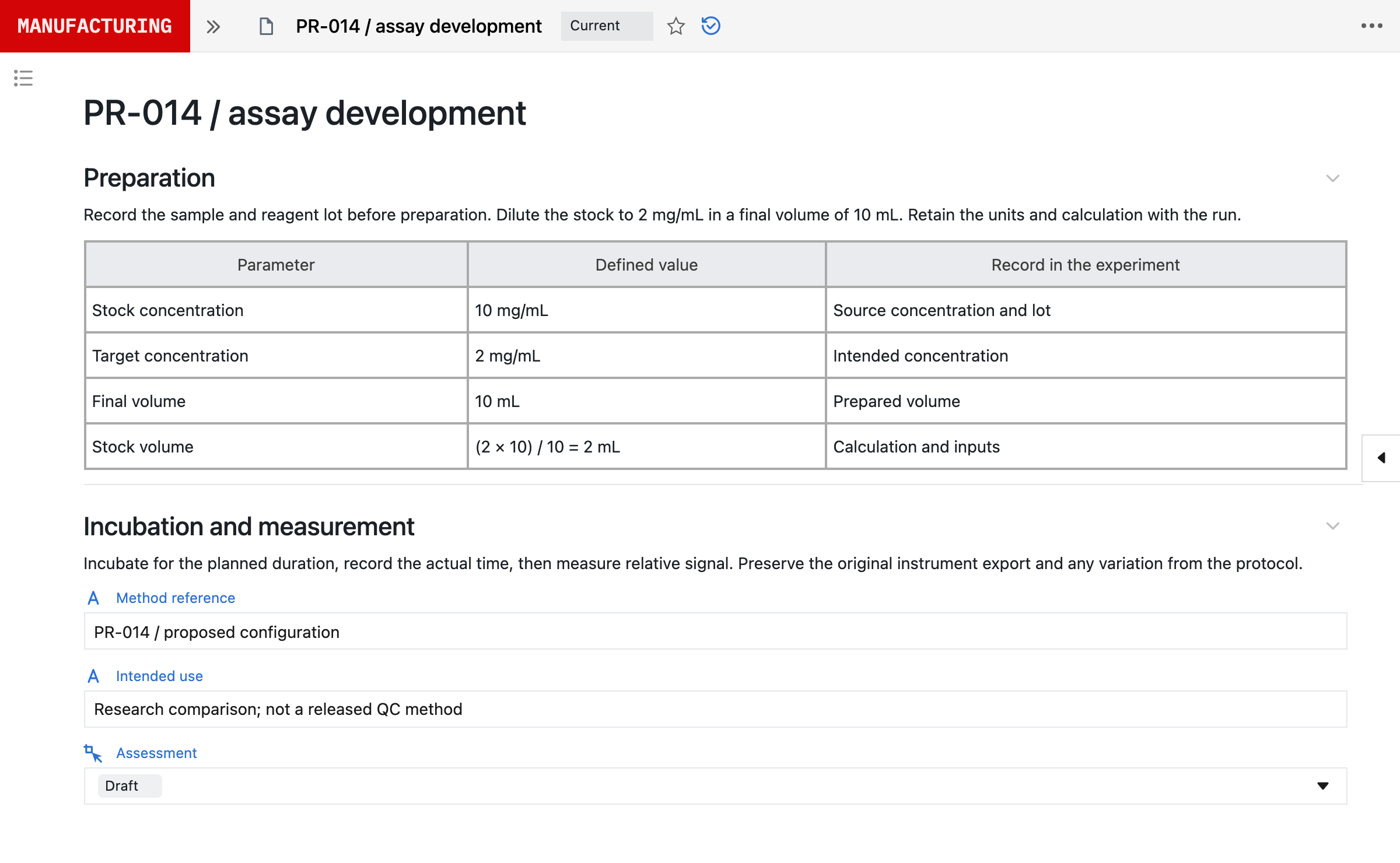
In Seal, a test method carries its specification, its suitability requirements and the route an outside-limit result must take. In Seal’s LIMS blueprint, Neil configures a potency release test from an approved method and specification. In the blueprint’s example records, method AM-014 v03 is tested against specification SP-041 v04, whose limits include potency of 95.0–105.0% and impurity A of no more than 0.25%. Your team checks the preparation calculation, the required system-suitability records and the assigned limits against the source, and tests that an outside-limit result follows the investigation route and that missing evidence prevents completion. A later revision, AM-014 v04, is proposed as a changeset carrying its requirement and verification, and the runs on v03 keep the version they used. An out-
The two meet when a candidate leaves discovery. The registered entity and its discovery assays explain why it was chosen; the release method and its specification decide whether a batch can be used.
4Where CDD Vault is the better fit.
CDD Vault is the better fit for discovery teams that live in structure–activity data and share it with partners.
- You register small molecules, biologics, conjugates and mixtures and need parent, batch and sample identity across internal and external chemistry.³
- You run screening and assay programmes and want parsers, calculated readouts, curve fitting and structure–activity analysis in one hosted system.⁴
- You collaborate with CROs, academic groups or pharma partners and want data partitioned into Vaults and projects with access restricted to your organisation.⁷⁴
- You want AI for molecular design: similarity search over public and commercial compound collections, bioisostere suggestions, structure prediction and docking.⁶
- You are a small discovery team that wants a short guided onboarding, which CDD puts at 90 minutes, and no servers to run.⁹¹
5Where Seal is the better fit.
Seal is the better fit from the point where a candidate needs controlled methods, batches and a quality system.
- You need release and stability testing against versioned specifications, with outside-limit results routed to investigation on the same records as the batch.
- You want development, QC, manufacturing and quality workflows on one ontology, so a result can be followed to its sample, method version, lot and instrument file.
- You want each change to a method, calculation or limit released with its specifications, acceptance tests and approvals, while earlier runs keep the version they used.
- You want Neil to configure methods from approved documents and assemble investigation evidence for qualified people to assess. In line with the EU’s draft GMP Annex 22 on AI, Neil is not used in GMP execution. It helps set up configuration, which your team verifies and releases under change control.
6Running Seal alongside CDD Vault.
Discovery can stay in CDD Vault while development and GMP work starts in Seal. Seal has no dedicated CDD Vault connector. Where a system is not on Seal’s integrations list, Seal’s REST API reads and writes records from another system, and Scripts, versioned Python edited in a changeset, tested and published like other Seal records, can call an external service after an event or on a schedule. CDD provides a documented, bidirectional REST API with OpenAPI documentation.¹⁰
Start with read access, such as bringing a registered entity’s identifier and key discovery results into the Seal record for its first development batch. Treat any write-back to CDD Vault as a separate decision with defined actions, review gates and audit evidence. Agree identifiers and mappings, test missing, delayed and duplicate records, reconcile what arrives against the source, and record which system is the source of truth: typically CDD Vault for the registered structure and discovery data, Seal for batches, methods and results under GxP.
7Moving from CDD Vault to Seal.
Discovery data can stay in CDD Vault. Start Seal on the first controlled process instead.
- Choose the first controlled job: a release or stability test, a development method approaching transfer, or the first batch record for the candidate.
- Bring the approved method or procedure, its specification and a representative run with the files behind it. Start with sample material, or arrange an NDA before sharing confidential records.
- Neil configures the workflow from the method and specification, and your team checks it against the source. Once the scope is agreed and the inputs received, Seal prepares the first working process and its validation pack within 48 hours. Production timing then depends on scope, interfaces, migration and your release requirements.
- Exercise a passing result, an outside-limit result, missing evidence and a changed limit before you approve release.
- Link the Seal batch to the CDD Vault entity by its registered identifier, and move discovery records only if a development decision needs them, keeping the source records in CDD Vault.
Retention obligations continue for the records that stay in CDD Vault. The LIMS blueprint and ELN blueprint show the method and experiment models in detail.
References
- 1CDD Vault: Collaborative Informatics Software for Research, Collaborative Drug Discovery. https:/
/ www. collaborativedrug. com/ cdd- informatics- platform (read 8 October 2026) - 2About Us, CDD Vault. https:/
/ www. collaborativedrug. com/ about (read 8 October 2026) - 3Chemical Registration System, CDD Vault. https:/
/ www. collaborativedrug. com/ registration (read 8 October 2026) - 4Activity, CDD Vault. https:/
/ www. collaborativedrug. com/ activity (read 8 October 2026) - 5Electronic Lab Notebook (ELN) Software, Collaborative Drug Discovery. https:/
/ www. collaborativedrug. com/ electronic- lab- notebook (read 8 October 2026) - 6AI Drug Discovery, CDD Vault. https:/
/ www. collaborativedrug. com/ ai- drug- discovery (read 8 October 2026) - 7Security, CDD Vault. https:/
/ www. collaborativedrug. com/ security (read 8 October 2026) - 8Public Access, CDD Vault. https:/
/ www. collaborativedrug. com/ public- access- cdd- vault (read 8 October 2026) - 9Scientific Data Management System & ELN Software, CDD Vault. https:/
/ www. collaborativedrug. com/ (read 8 October 2026) - 10Automation, CDD Vault. https:/
/ www. collaborativedrug. com/ automation (read 8 October 2026)
AQuestions and answers
Is Seal an alternative to CDD Vault?
Partly. CDD Vault is designed for discovery registration, assay data and structure–activity analysis, which Seal does not set out to replace. Seal is the alternative for what follows: development, QC, manufacturing and quality work under GxP, where methods, specifications and batch records share one ontology.
Who makes CDD Vault?
Collaborative Drug Discovery Inc., established in 2004 by its founder and chief executive, Barry Bunin, as a spin-out from Eli Lilly. CDD Vault is offered as fully hosted software as a service.
Can Seal work alongside CDD Vault?
Yes. Seal has no dedicated CDD Vault connector, but its REST API and Scripts can connect a system that is not on its integrations list, and CDD offers a documented bidirectional REST API. A natural split keeps registered structures and discovery data in CDD Vault and batches, methods and GxP results in Seal.
What is the difference between a CDD Vault protocol and a Seal method?
A CDD Vault protocol defines the readouts and calculations for an assay, so discovery results can be compared across compounds. A Seal method defines the preparation, suitability requirements, specification limits and investigation route for controlled testing, and each revision is released with its acceptance tests while earlier runs keep their version.
How long does it take to start with Seal?
Once the scope is agreed and the inputs received, Seal prepares a first working process and its validation pack within 48 hours, configured from one of your protocols or procedures. Production timing then depends on scope, interfaces, migration and your release requirements.