Summary
- In short
- SciSure, formerly eLabNext and SciShield, combines a notebook, sample tracking and inventory with chemical safety, training and inspections, in the cloud, a private cloud or on-premises. In Seal, laboratory, manufacturing and quality work share one ontology, materials are checked at the point of use, and every configuration change carries its own test evidence.
- When it fits
- Your safety team and your researchers should work in one platform, you need an on-premises or offline installation, you want Marketplace add-ons or your own SDK extensions, or you run many independent research labs.
- When Seal fits
- The work around your experiments is GMP work, you want material eligibility checked when it is used, and you want Neil configuring workflows and proposing changes for your team to verify and approve.
1eLabNext and Seal, side by side.
eLabNext, now part of SciSure, and Seal both connect experiments to the samples and materials they use. They connect them to different neighbours. SciSure joins eLabNext’s notebook, sample management and inventory with SciShield’s environmental health and safety software, so research sits beside chemical safety, training and inspections.¹² In Seal, teams configure laboratory, manufacturing and quality workflows on one platform around a shared ontology, so research sits beside QC, batch records, deviations and change control.
| eLabNext (SciSure) | Seal | |
|---|---|---|
| What it is | ELN, LIMS, inventory and EHS | GxP operating system for biopharma |
| Owner | SciSure, backed by Strattam Capital | Opvia Ltd., trading as Seal |
| Joined to | Safety, training, inspections | QC, batch records and quality |
| Samples | Sample types as templates | Containers checked at point of use |
| Templates | Required fields, variables, formulas | Versioned fields and calculations |
| Hosting | Cloud, private cloud, on-premises | Hosting region agreed at onboarding |
| Extensions | 40+ add-ons, API and SDK | Connectors, REST API and Scripts |
| AI | Add-ons from the Marketplace | Neil proposes; your team approves |
| Getting started | Free trial | A 48-hour evaluation on one process |
2What eLabNext is built for.
eLabNext is built for research laboratories, and since 2025 for the safety and operations teams around them. eLabNext, based in Groningen in the Netherlands, made a digital lab platform combining an ELN and LIMS; its products have included eLabJournal and eLabInventory.¹³ In January 2025 it merged with SciShield, a Boston-based environmental health and safety software company, and the combined company was renamed SciSure. SciSure is backed by Strattam Capital, and in September 2025 it acquired Labfolder and Labregister from Labforward.¹² SciSure calls the combination a Scientific Management Platform.⁴
The research side covers experiment documentation, sample tracking and inventory:
- Experiments start from scratch or from a template with required fields, link directly to samples, reagents and consumables, embed images and data sheets, and are sent for review and approval with witness signing and audit trails. Procedures can carry dynamic fields, with variables and formulas. SciSure says the notebook supports GxP and 21 CFR Part 11 requirements.⁵
- Samples are stored by sample type, which SciSure describes as a template for sample information. Changing a sample type’s fields leaves existing samples unaffected, and data in a removed field stays available.³
- The safety side adds chemical inventory with safety data sheets, role-based training records, inspections, incident reporting, and registrations and approvals, including for higher-risk work.²
SciSure offers three hosting models: its cloud, a dedicated private cloud with network restrictions and single sign-on, and an on-premises installation managed by the customer. Its safety capabilities are available only on the private cloud.⁶ Records export as PDF, HTML, XML or JSON, and an on-premises installation can run without an internet connection.³ The platform is extended through a Marketplace of more than 40 add-ons, an API and an SDK for custom add-ons, which customers can develop themselves or with SciSure’s team.²⁷ Marketplace add-ons include label printing, custom approval workflows, environmental monitoring from Elemental Machines, an AI support assistant and connections to an organisation’s chosen AI environment.⁸
3Samples and materials at the point of use.
Both products link an experiment to what it used. Seal adds two things: it decides at the moment of use whether a container may be used, and it versions each template change with its evidence.
In SciSure, the sample type defines the fields recorded for a sample, experiments link to samples, reagents and consumables, and inventory tracks them from receipt to disposal with barcodes.⁵² When a sample type changes, the change applies to the entry form and existing samples keep their data.³
In Seal, eligibility is decided when the material is used. Seal’s inventory blueprint records each physical container with its quantity, status, commitments, location history and actual use, and evaluates shelf life, retest, open life and use-by rules at the moment of use. In its example, a container opened on 6 September at 14:00 has 48 hours of open life; a use on 9 September is blocked by the date rule, even though the printed expiry is 21 days away. Passing a date check does not by itself authorise use, and the execution record keeps the exact container and quantity consumed. In the ELN blueprint, the run records the actual reagent lot, so when lot RG-018 is questioned a scientist can follow it to every experiment that used it.
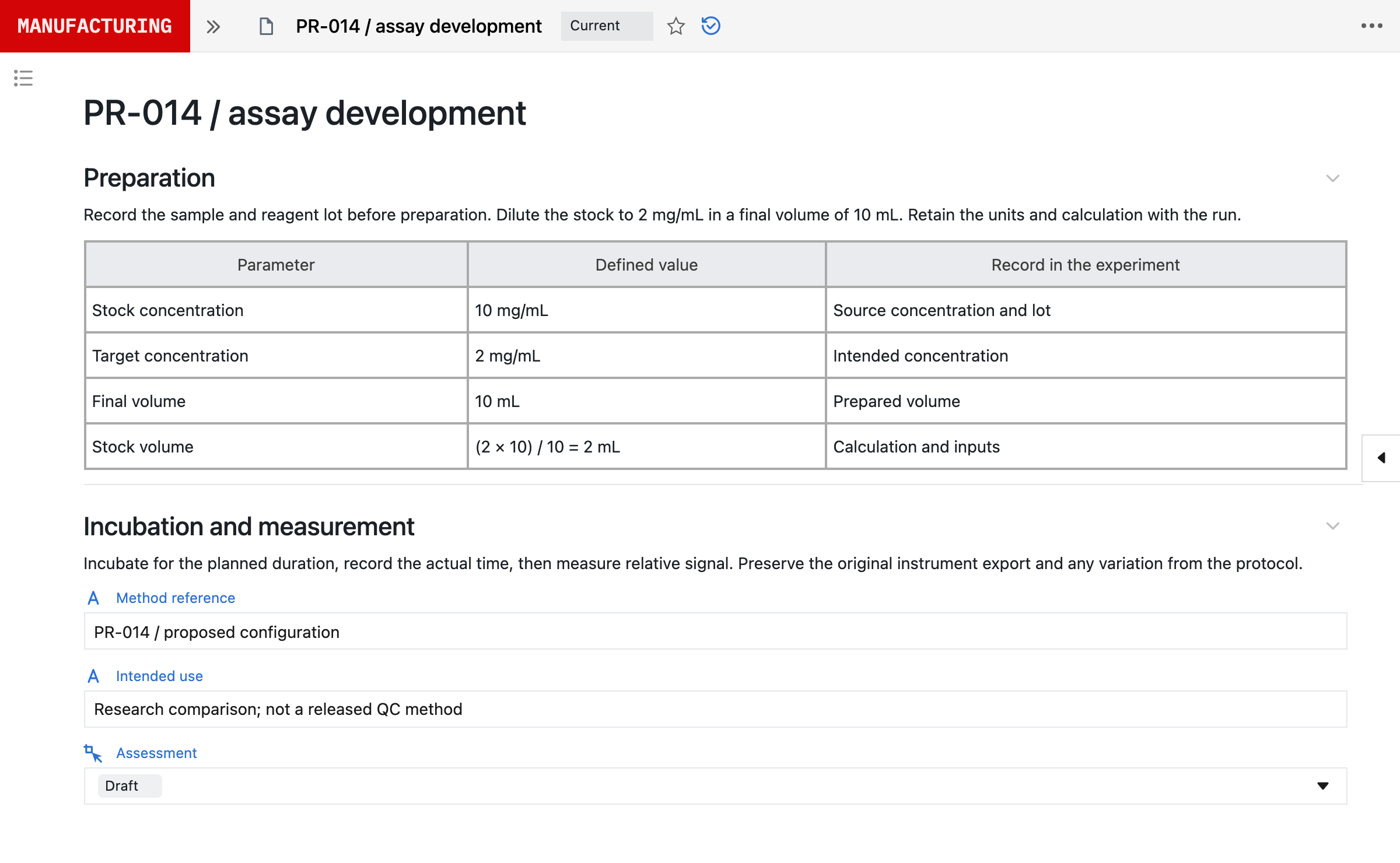
Template changes are versioned with their evidence. A new version of protocol PR-014 is released through a changeset carrying its specifications and selected acceptance tests, and runs on the earlier version keep it, so a comparison across versions shows which fields and calculations each run actually had.
4Where eLabNext is the better fit.
eLabNext, as SciSure, is the better fit for research institutions and companies that want research and lab safety on one platform.
- Your safety team manages chemical inventories, safety data sheets, training, inspections and registrations for the same labs whose experiments you document.²
- You need an on-premises installation, including one that runs without an internet connection, or a dedicated private cloud.⁶³
- You want to extend the platform with Marketplace add-ons, or write your own with the SDK.⁷⁸
- You are an academic or research organisation with many independent labs, a group SciSure serves alongside biotech and pharma.²
- You already run Labfolder and want to stay with its new owner.²
5Where Seal is the better fit.
Seal is the better fit when the work around the experiment is GMP work: QC testing, batch records and quality.
- You want a development protocol to become a controlled QC method or batch step on the same records, with its acceptance criteria, transfer evidence and training defined and the development runs still linked.
- You need material eligibility checked at the point of use and traced through the batches and tests that consumed it.
- You want each configuration change released with its specifications, acceptance tests and approvals, and corrective actions released as verified changes to the workflow.
- You want Neil to configure workflows from your procedures, trace a lot through its recorded use and propose changes for your team to approve. In line with the EU’s draft GMP Annex 22 on AI, Neil is not used in GMP execution. It helps set up configuration, which your team verifies and releases under change control.
6Running Seal alongside eLabNext.
You can keep research and lab safety in SciSure and run one controlled process in Seal. Seal has no dedicated eLabNext or SciSure connector. Where a system is not on Seal’s integrations list, Seal’s REST API reads and writes records from another system, and Scripts, versioned Python edited in a changeset, tested and published like other Seal records, can call an external service after an event or on a schedule. SciSure provides an API for connecting its platform to other software.⁷
Start with read access, such as reading the sample or reagent record a Seal workflow references. Treat any write-back as a separate decision with defined actions, review gates and audit evidence. Agree identifiers and mappings, test missing, delayed and duplicate records, reconcile what arrives against the source, and record which system is the source of truth for each record. Instrument files can come to Seal directly through the installable Seal IoT agent, which watches an export folder and uploads supported files to a configured Seal record.
7Moving from eLabNext to Seal.
Move one process first. SciSure stays the record for research and safety until you decide otherwise.
- Choose a process where material eligibility or controlled change matters: a QC test, a buffer or media preparation, or a method approaching transfer.
- Bring the procedure, a few representative runs and the files behind their results, and list the samples and materials the process uses. Start with sample material, or arrange an NDA before sharing confidential records.
- Neil configures the workflow from your procedure: required inputs, units, calculations and material links. Your team checks it against the work. Once the scope is agreed and the inputs received, Seal prepares the first working process and its validation pack within 48 hours. Production timing then depends on scope, interfaces, migration and your release requirements.
- Test a normal run, missing data, an ineligible material and a changed protocol.
- If records move, use SciSure’s JSON or XML exports where you can, map sample types and fields, preserve the source records and keep gaps visible.³
Retention obligations continue for the records that stay in SciSure. The ELN blueprint shows the protocol and experiment model in detail.
References
- 1SciShield and eLabNext Merge to Create SciSure and Deliver the Future of Scientific Research Management, SciSure. https:/
/ www. scisure. com/ blog/ scishield- and- elabnext- merge- to- launch- scisure- 0942d (read 8 October 2026) - 2About SciSure, formerly eLabNext & SciShield, SciSure. https:/
/ www. scisure. com/ about- us (read 8 October 2026) - 3FAQs, SciSure (formerly eLabNext & SciShield). https:/
/ www. scisure. com/ faq (read 8 October 2026) - 4Lab Management Software for Modern Labs, SciSure. https:/
/ www. scisure. com/ (read 8 October 2026) - 5Electronic Lab Notebook (ELN) Software, SciSure. https:/
/ www. scisure. com/ eln (read 8 October 2026) - 6SciSure Hosting Options: Cloud, Private Cloud & On-Premises, SciSure. https:/
/ www. scisure. com/ hosting (read 8 October 2026) - 7SciSure Developer Hub (formerly eLabNext & SciShield), SciSure. https:/
/ www. scisure. com/ developer- hub (read 8 October 2026) - 8SciSure Marketplace: Lab add-ons & integrations, SciSure. https:/
/ www. scisure. com/ marketplace (read 8 October 2026)
AQuestions and answers
What happened to eLabNext?
In January 2025 eLabNext merged with SciShield, an environmental health and safety software company, and the combined company was renamed SciSure. SciSure, backed by Strattam Capital, acquired Labfolder and Labregister in September 2025.
Is Seal an alternative to eLabNext or SciSure?
For GMP laboratory, manufacturing and quality work, yes. Seal runs those workflows on one ontology, checks materials at the point of use and releases each change with its acceptance tests. SciSure suits research organisations that want the notebook, inventory and lab safety on one platform.
Can eLabNext be installed on-premises?
Yes. SciSure offers its cloud, a dedicated private cloud and an on-premises installation that the customer manages, and says an on-premises installation can run without an internet connection. Its safety capabilities are available on the private cloud.
Can Seal work alongside SciSure?
Yes. Seal has no dedicated SciSure connector, but its REST API and Scripts can connect a system that is not on its integrations list, and SciSure provides an API. Start with read access and agree which system is the source of truth for each record.
How long does it take to start with Seal?
Once the scope is agreed and the inputs received, Seal prepares a first working process and its validation pack within 48 hours, configured from one of your protocols or procedures. Production timing then depends on scope, interfaces, migration and your release requirements.