Summary
- The problem
- A biotech adds a tool at each stage: an ELN for research, spreadsheets to compare runs, a quality system as GMP approaches and the CDMO’s own records. A transfer decision or disputed result then means rebuilding the evidence by hand before a CDMO or reviewer can rely on it.
- Seal’s approach
- One ontology from the first experiment to clinical manufacture. Programme decisions link to the runs, samples, methods and source records behind them, and controls are added to the same records as the intended use matures, so exploratory and controlled work stay connected without being governed identically.
- Neil
- Seal’s AI agent compares runs, drafts the transfer-gap assessment and proposes the next study or process configuration. Scientists and process owners decide what it supports. About Neil.
- What it covers
- Experiments, materials, samples, process and analytical development, laboratory testing, quality, technology transfer, CDMO oversight and CMC evidence.
- Evidence
- MiAlgae, running ELN, quality and electronic batch records from lab to commercial scale: 75% less documentation time. Skye Biologics: 40% fewer non-conformances and 35% higher production throughput.
- Where to start
- One consequential handover or disputed result, with its process, methods and source observations. Book a demo.
Start in development. Grow into manufacturing.
A biotech changes shape as its science progresses: exploratory experiments become a selected process, a CDMO transfer and a clinical manufacturing operation. Seal gives that work one ontology, so the programme can add capabilities without rebuilding the history behind its decisions.
The usual path adds a tool at each stage: a page-based ELN for research, spreadsheets to compare runs, a traditional eQMS as GMP approaches and the CDMO’s own systems for manufacture. Each handover means exporting the evidence and rebuilding its context, and the reasoning behind a decision is reassembled by hand each time it is needed.
| A tool for each stage | Seal | |
|---|---|---|
| Research records | Pages in a page-based ELN | Runs on a shared ontology |
| Comparing runs | Values copied to spreadsheets | Results kept with their conditions |
| Moving towards GMP | A new system and a migration | Controls added to the same records |
| CDMO transfer | A package rebuilt by hand | The process copied to a receiving draft |
| A disputed result | Exports gathered by hand | Links to the run, sample and method |
| AI | Text to paste elsewhere | Neil prepares work in Seal |
| Getting started | An implementation project | One handover or disputed result |
An ontology your team can build on
Define the objects that carry meaning across disciplines: a construct or cell line, material lot, process candidate, experiment, sample, analytical method and quality attribute. Configure their relationships and the fields the work requires. A result belongs to a sample; the sample belongs to a run; the run preserves the process version and actual conditions. Those relationships let scientists and Neil follow a conclusion back to the work that produced it. See how the platform is built.
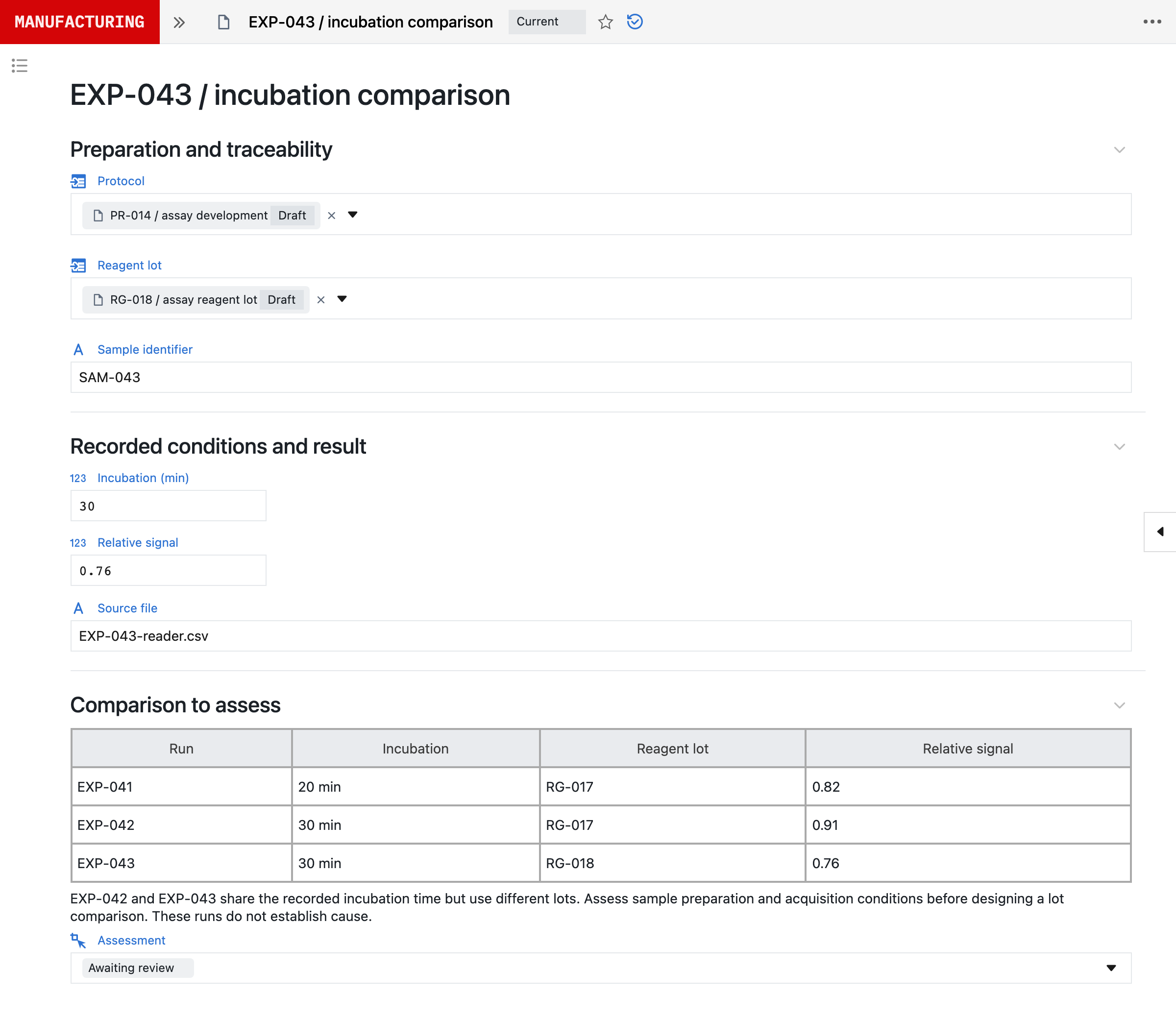
Keep definitions separate from their use. A material specification differs from a received lot. A method definition differs from an assay execution. A process candidate differs from the batches run using it: in the transfer at the top of this page, development runs PD-031 to PD-033 and engineering batch ENG-004 all use process v04, but differ in scale and assay, and each keeps its own materials, conditions, samples, results and review history. A potency result retains its value, units, reference standard, method revision and source data; the interpretation is a reviewed conclusion linked to those observations.
Build around the systems you already use
Your ELN, laboratory systems and partner repositories can remain sources. Agree which system owns each record and preserve its identifier, version and original reference when connecting it to Seal. Define how corrected results and superseding reports enter the programme, so an old extract does not remain the basis for a current decision. See all integrations.
| Where the work runs | What the programme uses | Connections include |
|---|---|---|
| ELN | Experiments, entities and protocols | Benchling, Labguru, SciNote |
| Instruments | Acquisitions and processed results | Empower, Chromeleon, Ambr 250 |
| LIMS | Samples, tests and results | LabWare, LabVantage |
| Documents | Reports, procedures and packages | SharePoint, Veeva Vault |
| An existing eQMS | Deviations, CAPAs and changes | Veeva Vault QMS, MasterControl, Qualio |
Add controls as the intended use matures
Start with the workflows the team needs now. As the intended use matures, add controlled versions, required fields, signatures, qualification checks and formal review through assessed changes. Earlier studies keep their original context. A development protocol can become the basis for manufacturing while the organisation retains how and why it arrived there.
US regulation reflects the same progression. Production of a drug for a phase 1 study is exempt from the part 211 GMP regulations, though not from statutory CGMP, and the exemption ends once the drug has been made available for a phase 2 or phase 3 study.¹ Exploratory work, early clinical supply and later manufacture can each be governed for their stage, on records that stay connected.
“With Seal, we could quickly transform our existing processes into a digital form. We didn’t need to adapt or change them, and even better, it evolves with us as we scale. The support has also been outstanding.”
Make the next experiment build on the last.
A promising result needs its operating conditions. Capture the actual equipment, material lots, interventions, sampling times and calculations with each run, compare runs from that context, then ask Neil to prepare the next study.
Capture the process as it runs
Build upstream, downstream and analytical protocols in Seal. Scientists can investigate different conditions while preserving which version and actual execution produced each observation. Record planned conditions separately from measured values and departures from the plan.
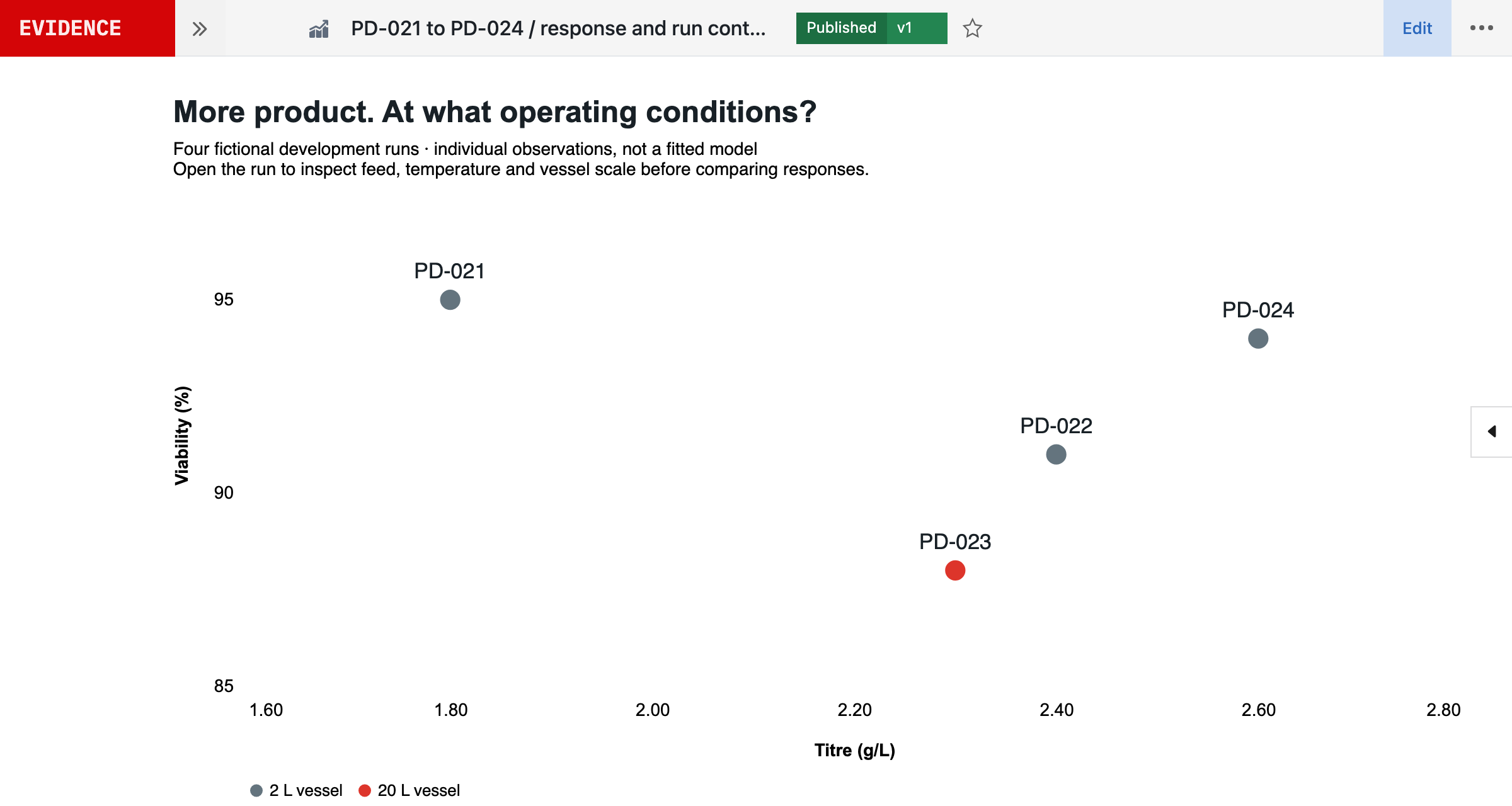
A higher response is a starting observation. In the runs above, PD-024 recorded the highest titre, 2.6 g/L at 94% viability, but its feed and temperature both changed from the PD-021 reference, and PD-023 ran in a 20 L vessel. The result identifies a candidate for study, not the cause of the improvement. Assess confounding changes, missing replicates, method differences and the limits of the scale model before it informs the next experiment.
Build the next development study from these runs. Keep actual conditions and method context with each result.
Neil
- Feed and temperature as separate factors.
- Replication and run order, for review.
- Lots and method revision with each result.
- Scale compared before the receiving study.
- PD-021 to PD-024 kept as the rationale.
- Study design (met)Prepared, with sources
- Analysis plan (not met)For the scientists
Neil’s proposal is a draft study, not a conclusion. It treats feed and temperature as separate factors, prepares replication and run order, and requires the actual conditions, material lots and method revisions with each result. The original runs keep their conditions and results; the new study references them as its rationale. Scientists review the design and analysis plan, then test the configured capture and comparison workflow.
Develop the method alongside the process
Analytical development belongs in the same assessment. A programme can appear to improve because its measurement changed. Keep sample preparation, method revision, reference-standard lot, fitting procedure and review state with the result. When an assay evolves, record the change rationale and comparison evidence with both versions. See analytical development.
In the transfer example, three development runs use assay v03 and the engineering batch uses v04. Neil identifies the missing bridge. The analytical team can define the comparison, locate suitable retained samples and document the evidence needed before the results support a transfer decision.
Carry the rationale into manufacturing
As characterisation progresses, link proposed parameter ranges to supporting studies and the quality attributes they affect. Record the product, equipment, scale, method and process version covered by each conclusion. Apply the same structure to method qualification, validation and transfer: intended use, protocol, acceptance criteria, source data, deviations and reviewed conclusion. MSAT receives the reasoning behind the range, including where it still needs to be tested. See process development.
Transfer a working process, with its reasoning intact.
Transfer the selected process with its unit operations, material requirements, parameter rationale, sampling strategy and analytical methods. Neil compares the source and the receiving site and prepares the work needed to resolve their differences.
Can we transfer process v04 to the CDMO? Compare the development runs with the engineering batch.
Neil
- PD-031 to PD-033 at 2 L: 87, 89 and 91%, assay v03.
- ENG-004 at 200 L: 94%, assay v04.
- Assay v04 changed the reference-standard lot and fitting.
- No bridging assessment or conversion factor in the package.
- Evidence (met)Assembled, with sources
- Assay bridge (not met)For analytical development
- Transfer (not met)For the transfer lead
Asked whether process v04 can move to the CDMO, Neil compares the three development runs with the engineering batch. The 200 L batch reports higher relative potency, 94% against 87% to 91%, but it was tested with assay v04, which changed the reference-standard lot and fitting procedure. The higher number does not isolate a scale effect, because the measurement changed too.
Neil does not normalise the results to one assay. The package holds no bridging assessment and no supported conversion factor, and an assumed correction would make the comparison look more certain than it is. Instead it names the missing evidence and who owns it.
| Owner | Next work |
|---|---|
| Analytical development | Locate or plan the assay bridge |
| Sample owner | Confirm retained samples and their suitability |
| Transfer lead | Reassess the package and record the decision |
No comparability conclusion, method conversion or transfer acceptance has been made. The transfer lead records that decision, with its own basis, once the analytical review is complete.
Copy the definition. Resolve the site differences.
ICH Q10 describes technology transfer as moving product and process knowledge between development and manufacturing; that knowledge forms the basis for the manufacturing process, control strategy and process validation approach.² A configured process in Seal can be copied, with permission, into a separate receiving draft. The receiving team assesses equipment assignments, scale, material grades and methods for the intended manufacturing operation. Keep each difference linked to its affected step, responsible owner, requested studies and receiving version. A delivered report contributes evidence; technical acceptance and authorisation to manufacture are recorded decisions with their own basis.
The receiving draft retains the selected process content, fields and configuration that the destination is permitted to use. Review referenced records, site equipment, roles, units and local procedures. Completed executions and checkpoint signoffs belong to their original records. The source and receiving versions remain separately identifiable.
Give Neil the source process and receiving plan. It can prepare a structured difference assessment, identify supporting studies and propose configuration changes with verification cases. The result is work the receiving team can act on: an equipment assessment, a method comparison or an adapted workflow. Assess and approve that work before the new version governs manufacturing. See technology transfer.
Own the programme, even when partners run the work.
A virtual biotech still needs an operating view of its programme. Bring the CDMO’s manufacturing, the testing laboratory’s results and your own decisions into one project, and give each partner the records its work requires.
| Record | Your team | CDMO | Testing lab |
|---|---|---|---|
| Development runs | Shared | Not shared | Not shared |
| Engineering batch | Shared | Shared | Not shared |
| Assay history | Shared | Shared | Shared |
| Transfer plan | Shared | Shared | Not shared |
In the transfer example, the CDMO receives the engineering batch, the selected assay history and the transfer plan; the testing laboratory receives the assay history. The development runs stay with your team.
Outsourcing the work does not outsource the responsibility. EU GMP expects the contract giver’s quality system to include the control and review of outsourced activities.³ Know which version each partner is using, what is due next and who can resolve an open dependency.
Make the handoffs part of the workflow
Model each partner’s scope, deliverables and dependencies. A sample shipment connects to its testing request; the result connects to the method and batch; a transfer question connects to its owner and evidence. Source timestamps and review states distinguish a received update from confirmed completion. Teams can work through a configured portal or exchange records from their existing systems.
Share the work each partner needs
Give each partner access to the selected records and actions its work requires. An analytical laboratory may need sample identities and the agreed method; a CDMO may need the receiving process and approved transfer package. Internal candidates, commercial information and unrelated programmes can stay outside that scope. Configure and verify access to the underlying records, linked files, search and exports as well as the visible portal.
Prepare updates from the programme record
Ask Neil to assemble the current milestones, missing records and unresolved commitments from permitted sources. Keep the source references with the update and let the programme lead review its content and audience. The same underlying work can support a scientific review, an operational meeting or an agreed partner update without rebuilding each report from scratch. See the CDMO operating model.
Build the CMC package as the programme progresses.
A chemistry, manufacturing and controls claim draws on product, process, analytical and stability evidence. Link each claim to the exact studies, methods and manufacturing versions behind it, and keep the work still needed in view.
Assay (%) at 30 June
| Batch | 9 months |
|---|---|
| DP-201 | 99.1 |
| DP-202 | 98.8 |
| DP-203 | 99.2 |
Assay (%) at 10 September
| Batch | 9 months | 12 months |
|---|---|---|
| DP-201 | 99.1 | 98.7 |
| DP-202 | 98.8 | 98.4 |
| DP-203 | 99.2 | Pending |
When new results arrive, the earlier evidence set stays intact. At the 30 June cut, all three batches have reviewed 9-month stability results. The 10 September refresh adds two reviewed 12-month results in a proposed revision, and DP-203 stays pending until its result is reviewed. Later observations do not rewrite the submitted set.
Keep every conclusion attached to its evidence
For a proposed process change, follow the affected material specifications, parameter ranges, analytical methods and control strategy. Identify studies and documentation that need assessment. Retain the earlier evidence set and assemble the revised package around the proposed version, with its limitations, open commitments and review decisions.
ICH Q5E expects manufacturing processes to change during development, and comparability exercises to become more comprehensive as knowledge accumulates and analytical tools develop.⁴ Keep the pre-change and post-change evidence, the methods used and the limits of each comparison with the change.
Neil can gather permitted evidence, draft the narrative and flag an assertion whose supporting record is absent or inconsistent. Scientific and regulatory reviewers decide what the evidence supports and what goes into a submission. Each accepted conclusion should remain traceable to the underlying work and the scope for which it was assessed.
Evolve the operation through controlled versions
Changes to the operating system need evidence too. Identify affected instructions, fields, calculations, review paths, access and integrations. Verify normal execution and meaningful failure cases, then approve the configuration for its intended use. Earlier executions retain the instructions and calculations they used; a new effective version governs subsequent work in its approved scope.
This lets the organisation increase rigour as a candidate moves towards the clinic. Exploratory work remains recognisable as exploratory work. A reviewed development conclusion can support a controlled process, and an unresolved question stays visible until the evidence is sufficient. The history survives the transition. See CMC evidence and controlled content.
Turn your team’s experience into AI capability.
Experience becomes more valuable when the team can apply it again. Neil’s persistent memory supplies relevant context, and versioned skills describe repeatable ways to perform the work; your team refines both from reviewed outcomes.
- Identify the source and receiving versions
- Compare scale, materials and methods
- Name missing evidence and its owner
- Produces
- A sourced assessment
- Map instructions to fields and steps
- Define units, required inputs and exceptions
- Prepare verification cases for review
- Produces
- A workflow with test cases
A skill carries the method, not the evidence. The transfer assessment can be reused by the next programme, while this programme’s assay and reference standard, its development and engineering results and its partner’s decisions stay within their authorised scope. Each new job draws on the records permitted for that job.
Give specialists a repeatable way to work
Build a library of study structures, calculations, sampling workflows and review methods. Create specialists for development, transfer assessment, validation or CMC preparation, with the instructions and permitted sources their jobs require. A transfer skill can require source and receiving versions, compare equipment and analytical methods, identify missing evidence and prepare the assessment in the team’s format. Review its output and test revisions against representative cases before wider use.
Reuse expertise within the right boundaries
Separate the reusable method from restricted programme evidence. A reviewed procedure for checking assay comparability can be shared; a partner’s proprietary assay, sequence or unpublished result remains within its authorised scope. Include remembered context, skill examples and attachments in the review. Set the memory, source access and sharing scope for each specialist; verify that restricted context stays within the intended boundary.
Improve the process that people actually run
The same learning can improve execution. Give Neil a recurring problem: inconsistent sample identifiers, a calculation rebuilt in every spreadsheet or a transfer assessment repeatedly missing the same evidence. It can prepare required references, calculations, review steps and verification cases in Seal. Your team assesses, tests and approves the proposed version.
A reviewed investigation can become a required check. An accepted reporting method can become a skill. A useful study design can become a reusable protocol. Record the component’s owner, applicability and adoption requirements so another programme can assess it in context. The next job begins with a better method while drawing its evidence from the records permitted for that job.
What Neil prepares, and what your team decides
Neil works across the same records your team does, within the permissions of the person asking, and what it produces is work in Seal: a draft study, an assessment or a proposed configuration.
| Neil prepares | Your team decides | |
|---|---|---|
| Next study | Separate factors, replicates, run order | The design and analysis plan |
| Assay change | The missing bridge and its owner | Whether the results compare |
| Transfer | Site differences and supporting studies | Technical acceptance |
| CMC narrative | A draft with each claim’s source | What goes into a submission |
| Partner update | Milestones, gaps and commitments | Its content and audience |
| Workflow change | Steps, fields, calculations and tests | Release under change control |
Nothing Neil produces takes effect until a qualified person has reviewed it. In line with the EU’s draft GMP Annex 22 on AI, Neil is not used in GMP execution. It helps set up configuration, which your team verifies and releases under change control. Customer data is not used to train AI models. See how Neil fits Annex 22 and working with Neil.
Start with the work that is holding the programme back.
Choose a decision or handover that currently takes too much effort to assemble. Bring the process, its evidence and the scientists or operational team who rely on it.
Agree the objects, identifiers, source systems, access and outcome before configuring the workflow. Neil can prepare the first configuration from your protocol or procedure; your team checks it against how the work should run.
Prove the workflow with its users
Exercise the difficult cases: a changed assay, a missing source file, an inaccessible partner record and a conclusion contradicted by later evidence. Check whether reviewers can reproduce the answer, identify its limitations and find the next work. For a migration, reconcile identities, relationships, attachments and the history required for the new intended use.
Measure time spent assembling a decision, unresolved evidence requests, repeated transcription and the effort to configure the next workflow. Expand from the foundation that proves useful, adding quality and manufacturing controls as the programme requires them.
References
- 121 CFR 210.2(c), Applicability of current good manufacturing practice regulations: investigational drugs for use in a phase 1 study. eCFR
- 2ICH Q10, Pharmaceutical Quality System (2008), section 3.1.2 (technology transfer). ICH
- 3EudraLex Volume 4, Part I, Chapter 7, Outsourced Activities (2013), section 7.4 (the contract giver). European Commission
- 4ICH Q5E, Comparability of Biotechnological/Biological Products Subject to Changes in Their Manufacturing Process (2004), section 2.4 (comparability during development). ICH
AQuestions and answers
Can we keep Benchling and our specialist analysis tools?
Yes. Scope the records needed for the programme decision and use configured connections or supplied files. Preserve the original acquisition and analysis context in its source system; link the selected evidence to the assessment and follow-up in Seal.
How is this different from an ELN and a separate eQMS?
A page-based ELN records experiments, and a traditional eQMS files quality events beside the work; moving from one to the other means exporting the evidence and rebuilding its context. In Seal, experiments, samples, methods, processes, quality events and transfers share one ontology, so a decision links to the work behind it and controls are added to the same records as the programme moves towards GMP.
Is this only useful once we manufacture under GMP?
No. Run development protocols, capture material and sample context, compare experiments and prepare the next process with Neil. Add version control, qualification, signatures and formal release requirements as the intended use matures. Earlier development work retains its original context.
What does Neil produce for a transfer?
A source-backed gap assessment, proposed follow-up and, where useful, a draft process definition or workflow. Scientists and process owners confirm the interpretation and verify the proposed configuration before operational use.
How does Neil fit the EU’s draft Annex 22 on AI?
In line with the EU’s draft GMP Annex 22 on AI, Neil is not used in GMP execution. It helps set up configuration, which your team verifies and releases under change control. Customer data is not used to train AI models, and the requester’s permissions govern what Neil can read. See how Neil fits Annex 22.
Can our team build and change its own workflows?
Yes. Give Neil a protocol, a procedure or a description of the work. It can help prepare the process steps, fields, calculations and review paths in Seal. Your team checks the proposed configuration, tests it for the intended use and approves it. Earlier executions keep the version they used.
How does this work with a CDMO?
Configure the partner’s project, deliverables, records and permitted actions. Teams can work through a scoped portal or exchange records with existing systems. Connect the receiving process, batch evidence, testing and open transfer work to the programme. Review the access to linked records and files as well as the portal itself.
Can we reuse expertise across programmes?
Yes. A reviewed study structure, calculation, process component or agent skill can become part of a reusable library. Configure Neil’s instructions, memory and permitted sources for its work. Review skill examples, remembered context and attachments before sharing them: proprietary results and partner information remain within their authorised scope. A project name alone does not establish that separation.
What should our first project be?
Start with a development protocol, a sponsor-to-CDMO transfer or a recurring programme review. Bring the people who do the work, representative records and a concrete outcome. Configure the workflow, exercise its difficult cases and measure the time to prepare a decision or carry a process into its next use.