Summary
- In short
- Dotmatics is a discovery platform: a notebook for chemistry and biology, a registry, assay analysis, the Luma low-code platform with its agent, and widely used scientific applications. Seal is designed for regulated development, QC, manufacturing and quality work, where each protocol change is released with its acceptance tests and earlier runs keep their version.
- When it fits
- Your work is small-molecule or biologics discovery, your scientists rely on Prism, SnapGene, Geneious or OMIQ, you want research teams to reconfigure their own workflows in Luma, or you plan to connect research data to Siemens software.
- When Seal fits
- Your methods are moving into controlled use and you want development, QC, batch records and quality on one set of records, with Neil preparing protocols, comparisons and changes for your team to verify and release.
1Dotmatics and Seal, side by side.
Dotmatics and Seal both store experiments as structured, queryable data, and both have an AI agent that can configure the system for a scientist to approve. They are aimed at different stages of the work. Dotmatics sells a notebook for chemistry and biology discovery, registration and assay analysis, the low-code Luma platform, and scientific applications such as GraphPad Prism, SnapGene and Geneious.¹² In Seal, teams configure laboratory, manufacturing and quality workflows on one platform around a shared ontology, for development, QC and production work that runs under GxP controls.
| Dotmatics | Seal | |
|---|---|---|
| What it is | Discovery ELN and Luma platform | GxP operating system for biopharma |
| Owner | Siemens, since July 2025 | Opvia Ltd., trading as Seal |
| Main users | Discovery chemists and biologists | Development, QC, production, QA |
| Data model | Luma data models, low-code | One shared ontology |
| Registration | Compounds, biologics, samples | Samples and lots as linked records |
| Instruments | Lab Connect, 100+ parsers | Seal IoT, any file-saving instrument |
| AI agent | Luma Agent; scientist approves | Neil proposes; your team approves |
| A workflow change | Adjusted on demand in Luma | A changeset with acceptance tests |
| Getting started | Packaged discovery solutions | A 48-hour evaluation on one process |
2What Dotmatics is built for.
Dotmatics is built for discovery research: the design, make, test and analyse cycle in small molecules and biologics, with the scientific applications researchers already use.
Siemens completed its acquisition of Dotmatics, a Boston-
The portfolio covers several layers:¹
- The Dotmatics ELN and data discovery platform, which puts chemistry and biology in one notebook. Dotmatics says 21 CFR Part 11 compliance, electronic signatures and immutable audit trails are built in, and that first-pass write-ups are generated automatically and questions can be asked in plain language.²
- Luma, an AI-native, low-code research platform. Scientists configure workflows, tasks, data models and governance settings, link tasks across the research cycle and modify processes mid-experiment.⁴⁵
- Luma Lab Connect, which ingests data from more than 100 instruments with out-of-the-box parsers, exposes it through JDBC, AWS EventBridge, Apache NiFi, GraphQL and REST, and runs on AWS, Databricks and Datadog.⁶
- Applications including GraphPad Prism, SnapGene, Geneious Prime and Geneious Biologics, Vortex, OMIQ and FCS Express for flow cytometry, and Protein Metrics. LabArchives, a separate notebook for research groups, is also part of Dotmatics.¹
Dotmatics packages these as solutions. For small-molecule discovery, chemists enumerate compound libraries and push them to the notebook to track synthesis, request analysis from the synthesis experiment, store every synthesised compound in a central registry and analyse structure–activity relationships across assay data.⁷ For biologics, vectors designed in SnapGene or Geneious Prime are linked to the notebook experiment, expression and purification are tracked through to final batches, and entities are registered from the notebook or the registration system, with sample locations in inventory.⁸
3Two agents that configure the system.
Both products now have an agent that can change the configuration, not only answer questions about the data. What differs is what an approval covers.
Dotmatics describes Luma Agent as handling the work between a question and an answer: running an analysis, generating documentation or configuring the platform itself. A scientist describes a domain in plain language and the agent sets up the data model, columns, relationships and workflows, producing a configured application with generated data flows and documented metadata. Dotmatics says every data-modifying action requires the user’s explicit approval before it executes, every step is logged, every answer is backed by a query the user can inspect and re-run, and the agent can trace an experiment’s lineage into an audit-ready report.⁹
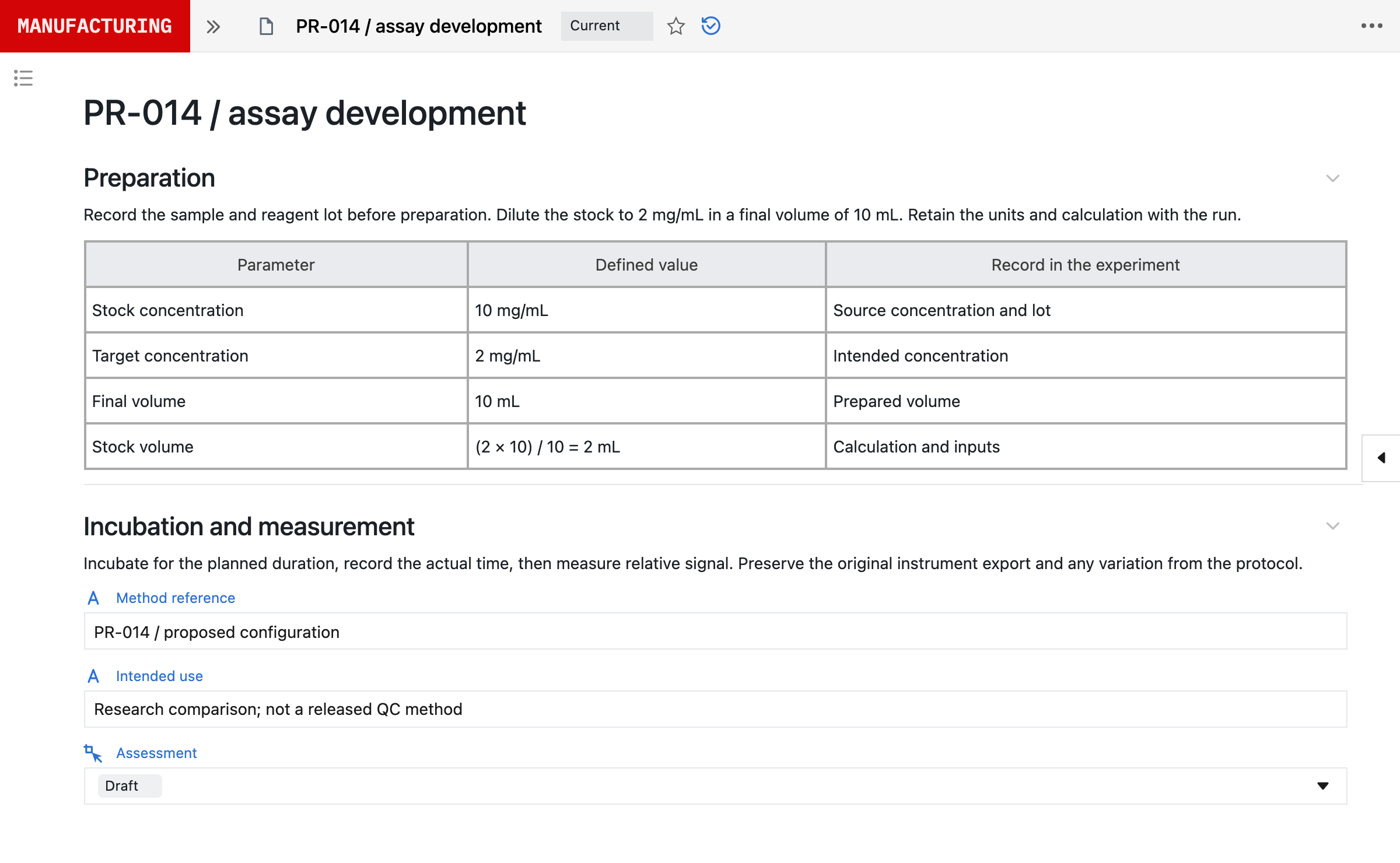
Neil works on Seal’s records within the requester’s permissions. In Seal’s ELN blueprint, a scientist describes a preparation and Neil proposes the inputs, the calculation and the sample and material links as protocol PR-014. The scientist reviews the steps, required inputs and calculations before the protocol is used. Later, asked why run EXP-043 read lower than EXP-042, Neil shows that both ran for 30 minutes but the reagent lot changed from RG-017 to RG-018, and proposes a follow-up testing both lots at 20 and 30 minutes. The four conditions are proposed work for the scientist to plan, not results.
Where the protocol supports GxP work, a change to it is prepared as a changeset carrying its specifications and verification. Its selected acceptance tests run when it is prepared for review, publication requires current passing results, and runs on the earlier version keep it. Where Dotmatics describes approval of each data-modifying action, approval of a configuration for controlled work in Seal is a release decision on the changeset and its test evidence. In line with the EU’s draft GMP Annex 22 on AI, Neil is not used in GMP execution. It helps set up configuration, which your team verifies and releases under change control. Neil never releases a change on its own, customer data is not used to train AI models under Seal’s agreements, and AI can be switched off for the whole organisation.
4Discovery records and controlled records.
Dotmatics’ notebook captures discovery data in structured form as scientists work, so experiments, results and files can be searched and compared.² Its records serve the cycle of ideas: which compound to make next, which construct to express, which hit to advance.
Seal’s records serve work that has to be repeated the same way and defended later. A protocol defines required fields, units and calculations; a reagent lot or sample is a record with its own history; each run keeps the protocol version and values it used. When a method moves into controlled use, the development runs stay linked behind the proposed QC method, and its acceptance criteria, transfer evidence and training are defined for the receiving workflow. Because laboratory testing, manufacturing execution and quality workflows share the platform, a deviation in a batch can be followed back to the method version, material lot and instrument file behind the result.
5Where Dotmatics is the better fit.
Dotmatics is the better fit for discovery organisations that want one vendor for the notebook, registration and the scientific applications around it.
- Your work is small-molecule or biologics discovery, with a registry, synthesis tracking, assay requests and structure–activity analysis.⁷⁸
- Your scientists already rely on Prism, SnapGene, Geneious or OMIQ and want them connected to the notebook.¹
- You want a low-code platform your research teams reconfigure as projects change, with an agent that sets up data models for them.⁵⁹
- You run flow cytometry and want its analysis and data management in the same platform as the notebook, through OMIQ, FCS Express and Luma.¹⁴
- You plan to connect research data with Siemens’ product lifecycle software as part of its research-
to- production digital thread.³
6Where Seal is the better fit.
Seal is the better fit once the work has to run under GxP controls and evidence has to carry from the lab to the batch.
- Your development, QC, manufacturing and quality teams should share one set of records, so an out-
of- specification investigation links back to the sample, method, instrument file and specification behind the result. - Each configuration change for controlled work should carry its requirements, specifications, acceptance tests and approvals, with earlier runs keeping the version they used.
- You want the AI agent to prepare protocols, comparisons and changes that people verify and release under change control.
- You want to start with one process. MiAlgae runs ELN, quality and electronic batch records in Seal from lab to commercial scale.
7Running Seal alongside Dotmatics.
A natural split keeps discovery in Dotmatics and starts the first controlled process in Seal. Seal has no dedicated Dotmatics connector. Where a system is not on Seal’s integrations list, Seal’s REST API reads and writes records from another system, and Scripts, versioned Python edited in a changeset, tested and published like other Seal records, can call an external service after an event or on a schedule. On the Dotmatics side, Luma Lab Connect exposes data through REST and GraphQL APIs.⁶
Start with read access: for example, read the registered entity and its development assay results into the Seal record that needs them. Treat any write-back to Dotmatics as a separate decision with defined actions, review gates and audit evidence. Agree identifiers and field mappings, test missing, delayed and duplicate records, reconcile what arrives against the source, and record which system is the source of truth for each record. Instrument files can come to Seal directly through the installable Seal IoT agent, which watches an export folder and uploads supported files to a configured Seal record.
8Moving from Dotmatics to Seal.
Move one process at the point where discovery hands over to development, and leave discovery where it is.
- Choose the first controlled job: a method approaching transfer, a release test, or a development assay repeated often enough to need fixed inputs and calculations.
- Bring the protocol, a few representative runs and the files behind their results, and decide which registered entities and lots the process must reference. Start with sample material, or arrange an NDA before sharing confidential records.
- Neil configures the protocol from your procedure, and your scientists check the inputs, units and calculations. Once the scope is agreed and the inputs received, Seal prepares the first working process and its validation pack within 48 hours. Production timing then depends on scope, interfaces, migration and your release requirements.
- Test a normal run, missing data, a deliberate variation and a changed protocol.
- If records move, scope exports, attachments, metadata, permissions and history first, map reusable fields, preserve the source records and keep gaps visible.
Retention obligations continue for the records that stay in Dotmatics. The ELN blueprint shows the protocol and experiment model in detail.
References
- 1R&D Solution for Digital Transformation (home page and product menu), Dotmatics. https:/
/ www. dotmatics. com/ (read 8 October 2026) - 2Electronic Lab Notebook, Dotmatics. https:/
/ www. dotmatics. com/ capabilities/ electronic- lab- notebook (read 8 October 2026) - 3Siemens completes acquisition of Dotmatics, Siemens AG, 1 July 2025. https:/
/ press. siemens. com/ global/ en/ pressrelease/ siemens- completes- acquisition- dotmatics (read 8 October 2026) - 4The Scientific R&D Platform Powered by AI (Luma), Dotmatics. https:/
/ www. dotmatics. com/ luma (read 8 October 2026) - 5Luma Lab Workflow Management Software, Dotmatics. https:/
/ www. dotmatics. com/ luma/ lab- workflow- management- software (read 8 October 2026) - 6Luma Lab Connect: Advanced Lab Data Integration, Dotmatics. https:/
/ www. dotmatics. com/ luma/ lab- instrument- integration- software (read 8 October 2026) - 7Small Molecule Drug Discovery Software, Dotmatics. https:/
/ www. dotmatics. com/ solutions/ small- molecule- discovery (read 8 October 2026) - 8Biologics Drug Discovery, Dotmatics. https:/
/ www. dotmatics. com/ solutions/ biologics- discovery (read 8 October 2026) - 9Artificial Intelligence for Science: Luma Agent, Dotmatics. https:/
/ www. dotmatics. com/ luma/ artificial- intelligence (read 8 October 2026)
AQuestions and answers
Is Seal an alternative to Dotmatics?
For regulated development, QC, manufacturing and quality work, yes. Dotmatics is designed for discovery chemistry and biology, with a registry, assay analysis and scientific applications, while Seal runs controlled workflows on one ontology with each change released under change control. Many teams will use Dotmatics for discovery and Seal from development onwards.
Who owns Dotmatics?
Siemens. It completed its acquisition of Dotmatics on 1 July 2025, and Dotmatics is now part of Siemens’ Digital Industries Software business. Dotmatics’ portfolio includes GraphPad Prism, SnapGene, Geneious and LabArchives.
How does Luma Agent compare with Neil?
Both can configure their platform, not only answer questions: Dotmatics says Luma Agent sets up data models and workflows, with every data-modifying action approved by the user. Neil proposes protocols, comparisons and configuration changes within the requester’s permissions, and changes for GxP work are verified and released as changesets. In line with the EU’s draft GMP Annex 22 on AI, Neil is not used in GMP execution. It helps set up configuration, which your team verifies and releases under change control.
Can Seal work alongside Dotmatics?
Yes. Seal has no dedicated Dotmatics connector, but its REST API and Scripts can connect a system that is not on its integrations list, and Dotmatics’ Luma Lab Connect offers REST and GraphQL APIs. Start with read access and agree which system is the source of truth for each record.
How long does it take to start with Seal?
Once the scope is agreed and the inputs received, Seal prepares a first working process and its validation pack within 48 hours, configured from one of your protocols or procedures. Production timing then depends on scope, interfaces, migration and your release requirements.