Summary
- The problem
- A finished test is the start of another search. The reviewer needs the sample identity, method and specification versions, original instrument data and any investigation, and those live in separate systems.
- Seal’s approach
- Each result is captured as the work runs, with its sample, preparation, method, specification and instrument file attached. Manufacturing and quality use the same records, so laboratory review feeds batch disposition without copies.
- Neil
- Seal’s AI agent turns an approved method or specification into a proposed workflow, assembles the source evidence for an investigation and drafts the controlled change. Your team checks and approves. About Neil.
- What changes
- A reviewer follows a reported value back to its inputs, standard lot and acquisition. A method change carries its impact assessment and verification, and earlier runs keep the version they used.
- What it covers
- Release testing, OOS investigations, stability, environmental monitoring, incoming inspection, certificates of analysis and instrument capture. All capabilities.
- Where to start
- One release test, incoming-inspection workflow or stability study in a 48-hour evaluation, with representative data and one connected instrument source. Book a demo.
1A traditional LIMS reports the result. Seal connects it to the batch.
A traditional LIMS is a system of record for the laboratory. It registers samples, runs tests and reports results, and it sits beside manufacturing and quality rather than sharing their records. But an analytical result is only part of a release decision. The reviewer also needs the sample identity, method, specification, original instrument data and any investigation, and when these live in separate systems, a finished test becomes the start of another search.
| A traditional LIMS | Seal | |
|---|---|---|
| Where it sits | Beside the batch | On the batch’s own records |
| Review evidence | A PDF of the final result | Original data and audit trail |
| Specification | Limits copied into the test | The assigned specification version |
| Investigation | A form filled from exports | Opens from the result |
| Batch disposition | Results copied across | Reads the laboratory review |
| Method change | A separate change project | A reviewed configuration change |
| AI | Answers from isolated documents | Neil works across linked records |
| Getting started | A replacement project | A 48-hour evaluation on one test |
Seal’s shared ontology defines the record types and relationships across laboratory, manufacturing and quality work. The sample links to the manufacturing step it informs, the result to its specification and the investigation to the affected sample and batch, so a reviewer can follow a result to the work that produced it, with its preparation, source data and investigation in view. Earlier results retain the method and specification they used, and the same platform supports development, routine testing and the changes between them.
You can start with one release test, alongside the LIMS you already run. Seal reads samples and results from LabWare, LabVantage and SampleManager without writing to them, so a batch review can draw on laboratory evidence that stays where it is. See all integrations. The advantage grows as laboratory, manufacturing and quality work on the same connected records: less reconstruction between teams, and a shorter path from a result to the decision it supports.
2Neil prepares the work. Your team decides.
Neil is Seal’s AI agent. It works across the same records your analysts and reviewers do, within the permissions of the person asking, and what it produces is work in the system: a proposed method workflow, an assembled investigation brief or a prepared configuration change. It does not hand back text to paste somewhere else.
| Neil prepares | Your team decides | |
|---|---|---|
| Method set-up | The workflow from your method | Whether it matches the source |
| Investigation | The evidence, with its sources | Cause and further testing |
| Standard lot | The batches that used the lot | What needs assessing |
| Trend review | Findings by method or instrument | What needs investigating |
| Method change | The revision and its verification | Approval and release |
Everything in the middle column is preparation. Nothing Neil produces takes effect until a qualified person has reviewed it: a proposed workflow is checked against its source before release, and a suggested cause does not close an investigation.
In line with the EU’s draft GMP Annex 22 on AI, Neil is not used in GMP execution. It helps set up configuration, which your team verifies and releases under change control. Customer data is not used to train AI models, and the requester’s permissions govern what Neil can read. See how Neil fits Annex 22 and more about Neil.
3Take the sample from receipt to a reviewed result.
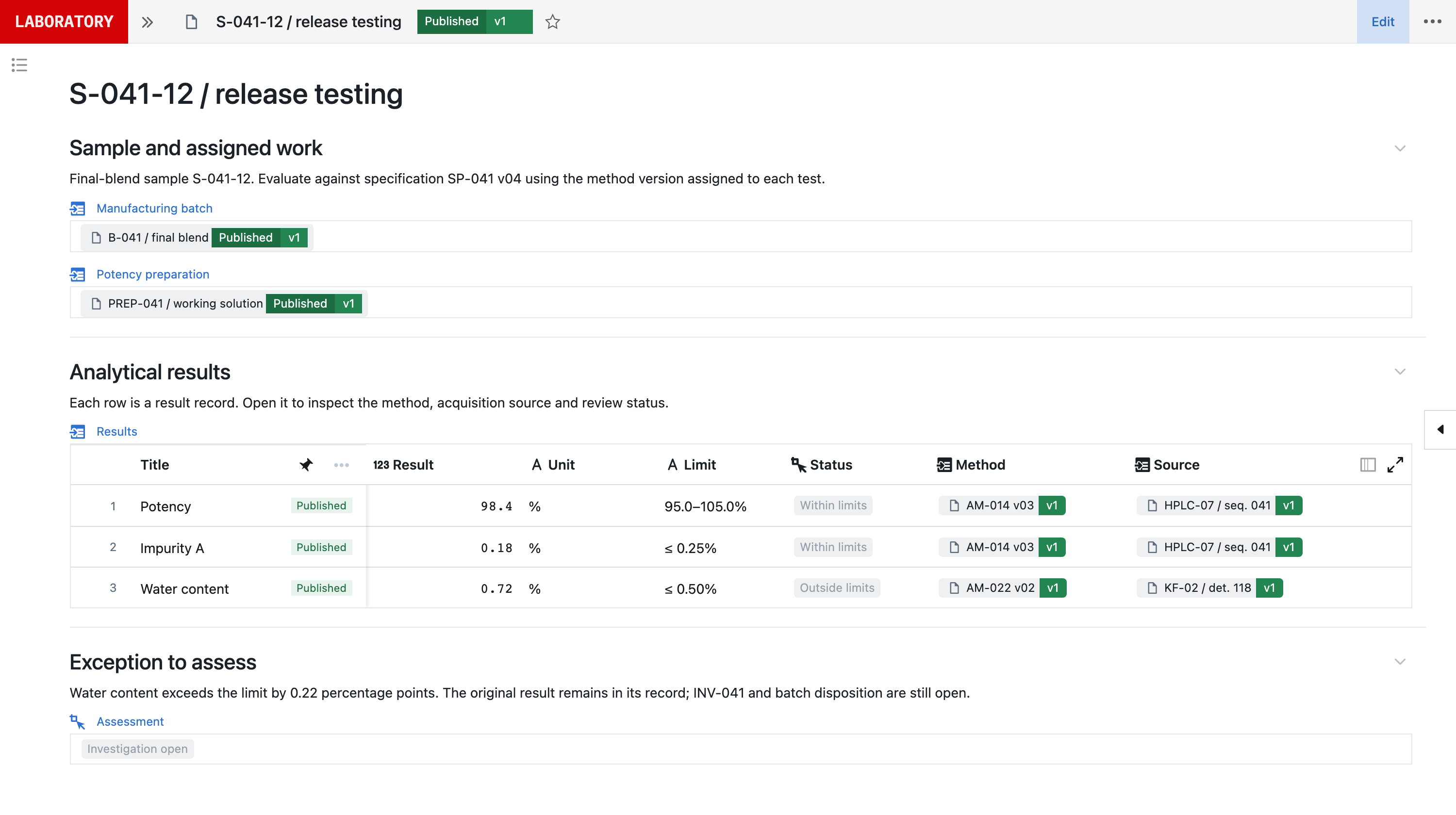
Register the sample with its material, batch, collection point and required tests, and assign the method and specification versions before execution. Completing a test is not the same as releasing a batch.
- Batch
- B-041, final blend
- Tests
- Potency, impurity A, water content
- Methods
- AM-014 v03, AM-022 v02
- Specification
- SP-041 v04
- Results (met)3 of 3 recorded
- Limits (not met)Water content outside
- Review (not met)Outstanding
Configured checks identify missing results, values outside limits and outstanding review. Manufacturing and inventory use the authorised disposition from the same record, not a copy of the result.
A result starts before the instrument run. Link the received sample to the aliquots, preparations and dilutions used for each test, with quantities, units, reagent lots, preparation time and analyst. If a preparation is repeated, keep its identity and the reason rather than blurring two preparations into one result. Configure calculations as part of the method, with explicit inputs, units and reporting rules, and verify boundary values, missing inputs, division by zero and rounding whenever the calculation changes.
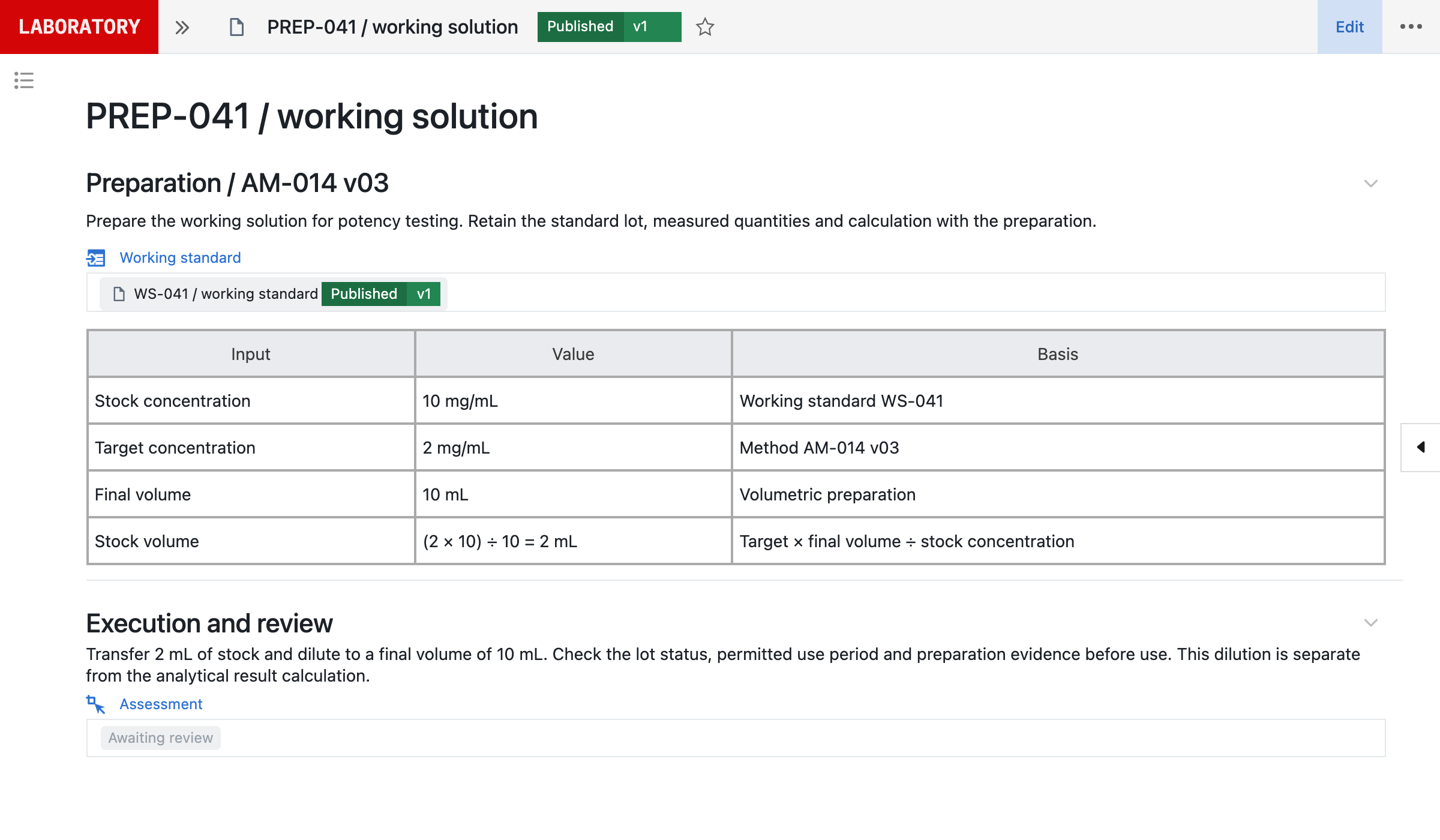
Record what was fit for use when the test ran. Connect the reference standard’s certificate, assigned value, storage requirements and permitted use period to the preparation, so an investigator can find the work affected by a standard-lot issue. Bring instrument calibration and qualification together with the analyst’s method-specific training and authorisation, and retain the evidence applicable at execution. A later training update should not obscure who was qualified for the original work.
4Check the result against the right version.
Specifications are structured, versioned records. Each result is evaluated against the version assigned to it, and keeps that version when the specification changes.
Against SP-041 v04
- Potency98.4%95.0–105.0%
- Impurity A0.18%≤ 0.25%
- Water content0.72%≤ 0.50%
Water content outside limits; INV-041 open
Keep the measured value, unit, calculation and assigned limits together. A water content result of 0.72% against a limit of ≤ 0.50% is outside limits, and the investigation must retain that result even when further testing is justified.¹
A revised specification does not silently rewrite the basis of earlier decisions. Its applicability to products, markets and work in progress is reviewed as part of the change. Historical testing retains the version used, so a reviewer can establish which limit applied and why.
5Review the evidence, not only the number.
Review the original acquisition and relevant processing history, not only a PDF of the final result.² In Seal the investigation opens on the same records as the result it concerns.
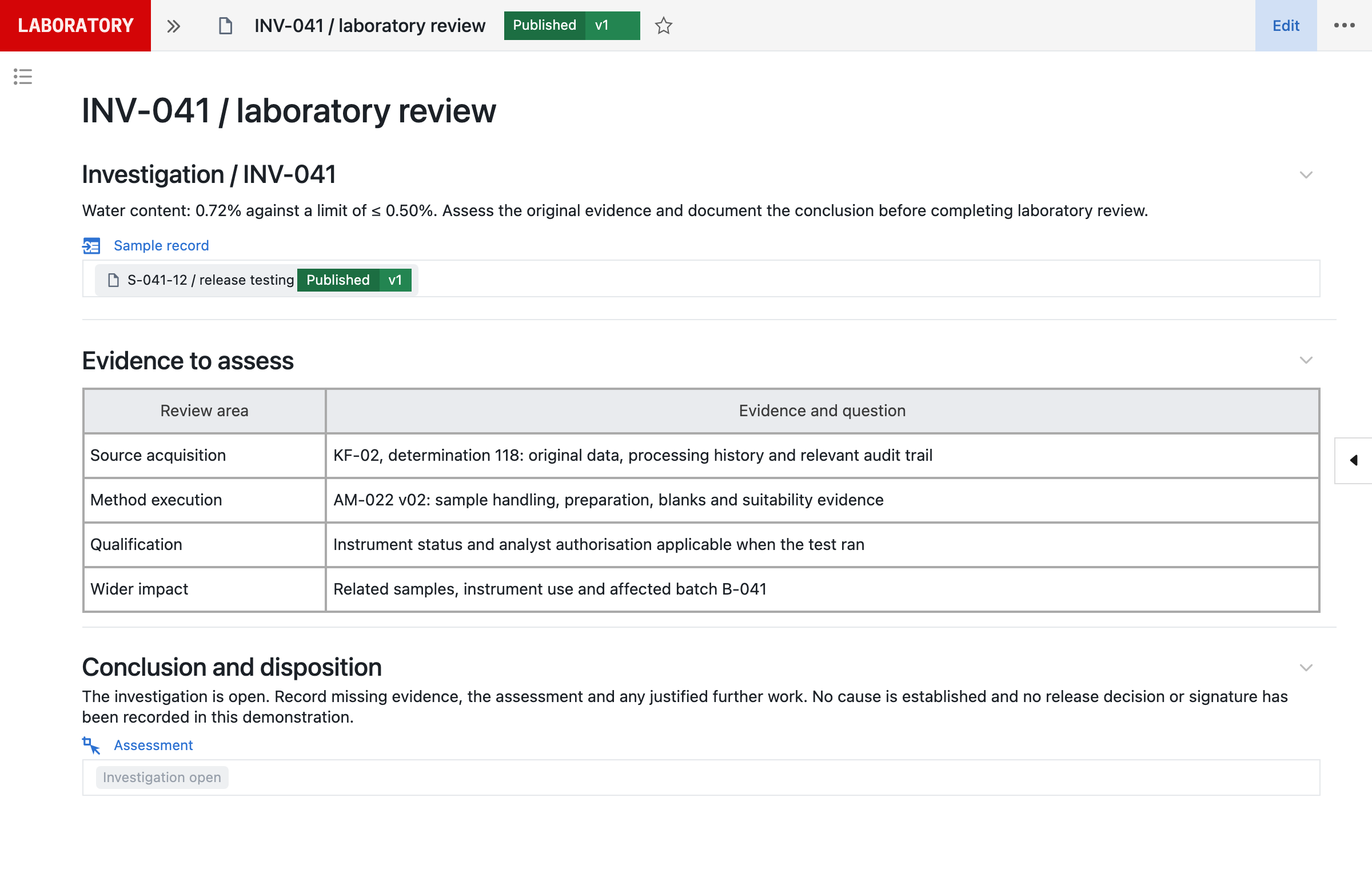
Connect the preparation, system-suitability evidence, calculations and relevant audit-trail entries, and record questions and their resolution against the work they concern. Missing evidence stays a visible gap, and the investigation records the laboratory assessment, hypotheses, further work and conclusions.
Keep three decisions distinct: whether the reported value meets its assigned limits, whether the laboratory evidence is complete and acceptable, and whether the batch can be released. Laboratory review contributes to batch disposition alongside manufacturing exceptions and quality events. Record the reviewer, signature meaning and approval against the version reviewed.³
Because the records are shared, Neil can answer questions that cross the usual boundaries: “Which batches used standard lot WS-041, and which still have an open laboratory review?” It can compare findings by product, method version, instrument or standard lot and prepare a source-backed brief that states the records compared, the pattern found and what is still unknown. Your procedure governs further testing and escalation. Neither a suggested cause nor a passing repeat result closes an investigation by itself.
Bring together the source evidence for this result. What is missing from the review?
Neil
- Water content 0.72%, from KF-02 determination 118.
- Limit of 0.50%, from SP-041 v04.
- Method AM-022 v02, as executed.
- No drift or suitability record attached.
- Evidence (met)Assembled, with sources
- Cause (not met)For the investigator
- Retest (not met)Under your procedure
6Capture instrument data once.
Capture each instrument file once, keep the original with the result it produced, and map its values into the record rather than retyping them.
Seal IoT on HPLC-07
- Watch the export folder
- Run the upload script
- Send over HTTPS
- Source
- Original file kept
- Values
- Mapped, with units
- Method
- AM-014 v03
For file-based acquisition, install Seal IoT on the instrument workstation or an appropriate local computer. Configure the watched folder, processing script and destination record. Retain the original export and map available sample identifiers, values, units and acquisition metadata into the workflow.
Other sources may use supported interfaces or APIs. Assess the model, software version and actual output, not just the manufacturer’s name, and exercise missing files, duplicates, failed transfers and recovery before relying on the connection. A file that arrives does not by itself show that the acquisition is complete or the result valid. Scientific data management explains the capture route; the instrument directory helps scope the source.
7Incoming, environmental and stability work share the same records.
Incoming inspection, environmental monitoring and stability use the same samples, methods, specifications and reviews as release testing. Each result stays linked to the material, location or study it concerns.
| Workflow | What it stays linked to |
|---|---|
| Incoming inspection | The supplier lot, its CoA and the disposition |
| Environmental monitoring | The location, sampling method and trend |
| Stability | The protocol, chamber and pull schedule |
Incoming inspection connects the supplier lot, CoA, sampling plan and analytical work. Supplier values are compared with the required tests, discrepancies are recorded for assessment, and inventory uses the authorised material disposition without copying the decision into another application.
Supplier CoA against required tests
- Identity (met)Confirmed
- Assay (met)CoA 99.8%, tested 99.6%
- Water (not met)CoA 0.2%, tested 0.6%
Discrepancy recorded; disposition pending
For environmental monitoring, retain the location, sampling method, time, conditions and result. Compare like-for-like populations and keep action limits distinct from trend signals: a rising count can warrant investigation below an action limit, but its interpretation depends on the sampling context.
Settle plates, CFU
- Each count (met)Below the action limit
- Trend (not met)Rising, review open
A stability study connects the protocol, storage conditions, pull schedule, samples and results, with each timepoint carrying its assigned method and specification. Missed pulls, chamber excursions and atypical results stay with the study evidence. Trends across batches and conditions help reviewers assess emerging changes; any extrapolation needs a scientific basis and review, and a projected trend is not a shelf-life decision.
ST-001ICH Q1A long-term, 25°C / 60% RH
- T=0, tested
- 3M, tested
- 6M, tested
- 9M, due next
- 12M, scheduled
- 18M, scheduled
- 24M, scheduled
9-month pull due in 12 days
8Change methods and configuration under control.
An analyst runs the approved method version, and the next improvement is a reviewed change rather than an edit. Earlier runs keep their original context.
- Conditions compared
- Replicate runs
- Rationale for parameters
- Parameters and calculation
- System-suitability checks
- Review requirements
- Run on S-041-12
Develop methods in Seal’s ELN, then bring the approved version into QC with defined parameters, calculations, system-suitability checks and review requirements, keeping the development evidence that explains those choices. A new column, revised calculation or updated limit becomes a reviewed configuration change with its impact and verification evidence.
Continuous validation is part of that change. Keep the user requirements, functional and design specifications, configuration specification, verification results and approval together in Seal, and update them with the configuration they describe.⁴ Automated verification and repeatable UAT checks exercise both intended behaviour and failure cases: a missing unit, an out-of-range result, an unapproved method version or an incomplete review. Your team assesses impact, reviews the evidence and approves release. The continuous validation detail explains the risk-based approach and the responsibilities.
- S-041-12
- S-039-04
- Requirement (met)URS-014
- Verification (met)TC-014 passed
- Approval (not met)Pending
9Give Neil the next method to configure.
Bring an approved specification, method or validation report. Neil turns it into a proposed workflow: test names, parameters, calculations, acceptance criteria and review gates.
Configure potency release testing from AM-014 v03 and specification SP-041 v04.
Neil
- Tests for potency and impurity A.
- The preparation calculation, from the working standard.
- System-suitability records required before results.
- Limits and units from SP-041 v04.
- Results outside a limit routed to investigation.
- Configuration (met)Proposed
- Interpretation (not met)For your team to check
- Release (not met)Under change control
Your team checks the interpretation against the source and resolves ambiguity before release. For a potency method, evaluate the preparation calculation, required system-suitability records and assigned limits, and test that an outside-limit result follows the investigation route and that missing evidence prevents completion.
Start with one release test, incoming-inspection workflow or stability study. Agree the intended use, representative sample data and acceptance criteria; connect one source and exercise the workflow. The 48-hour evaluation turns that one workflow into a working process with a validation pack to inspect. Production timing then depends on scope, interfaces, migration and your release requirements, and existing systems can continue serving the work outside that scope.
9.1What to bring to the first conversation
- The work: one method or procedure and the bottleneck you want to remove.
- The evidence: a redacted specification, representative result and instrument export.
- The decision: who reviews the configuration and what must be demonstrated before use.
When these are ready, book a demo and we will scope the evaluation with you.
References
- 1FDA, Investigating Out-of-Specification (OOS) Test Results for Pharmaceutical Production, guidance for industry, Revision 1 (2022), sections III (Phase I laboratory investigation) and IV (Phase II full-scale OOS investigation). FDA
- 221 CFR 211.194, Laboratory records: laboratory records must include complete data derived from all tests necessary to assure compliance with established specifications and standards. eCFR
- 321 CFR 11.50, Signature manifestations: signed electronic records must show the printed name of the signer, the date and time of signing, and the meaning of the signature (such as review, approval, responsibility or authorship). eCFR
- 4EudraLex Volume 4, Annex 11, Computerised Systems (2011), sections 4 (validation) and 10 (change and configuration management). European Commission
AConnected records
BQuestions and answers
Why use Seal instead of a standalone LIMS?
Laboratory work shares records with manufacturing, quality, research, training and inventory. A reviewer can follow the sample to its batch, method and investigation without assembling copies from separate applications. Neil works across the records it is permitted to access, while the same platform retains configuration changes, verification evidence and release approvals.
Can a validated workflow change after go-live?
Yes, through controlled revision. Keep the reason, impact assessment, updated requirements and configuration specification with the proposed version. Run automated verification and repeatable UAT checks for the change, then review evidence and approve release. Existing runs retain their version and history. The assurance work for software configuration does not replace the scientific evidence needed for an analytical method.
What should we test in an initial evaluation?
Bring a method, specification and representative instrument export. Exercise a complete sample, an outside-limit result, missing evidence and a proposed method change. Check source traceability, units, calculation behaviour, investigation routing and release permissions. Agree what must be demonstrated and who reviews it before extending the scope.
Is this for method development or QC?
This blueprint focuses on QC execution. Method development can run in the ELN on the same Seal platform. Bring an approved method version into QC with its defined parameters, calculations, specifications and review requirements, while retaining the development context.
How do you handle OOS investigations?
Configure the outside-limit route around your approved procedure. Link the original result, source data, method, instrument, standards and analyst records. Document laboratory and wider assessments, justified further testing and conclusions. Original results remain available; a passing repeat does not replace them.
Can we configure our own specifications?
Yes. Define versioned criteria, units and applicability for each product and test. A revision goes through impact assessment, verification and approval. Decide how it applies to new and in-progress work; historical results retain their assigned specification version.
What instruments do you integrate with?
The connection depends on the model, software version and available output or interface. Bring an example file and the workflow it supports. We assess the capture route, data mapping, units, timestamps and failure handling, then verify the connection for that intended use. The instrument catalogue lists manufacturers and models to help start that discussion.
How does incoming inspection work?
Record materials at receipt, assign the inspection plan and link supplier CoA information to the test evidence. Testing and exceptions feed the material review. Inventory uses the authorised disposition; passing a test alone does not bypass required review or release controls.
What about environmental monitoring?
Each result retains its location, sampling method, time, conditions and value on the same records used for other laboratory work. Trend review compares like-for-like populations and keeps action limits distinct from trend signals, and an investigation opens from the result with its location and sampling context linked.
How does this integrate with batch release?
The batch links to its samples, results and laboratory review. A value within limits does not complete the review by itself: missing evidence, unresolved investigations and required approvals still matter. Authorised disposition considers laboratory evidence alongside manufacturing exceptions and quality decisions in the same platform.
How does Seal support 21 CFR Part 11?
Seal provides access controls, audit history, versioned records and electronic signatures as platform capabilities. Review their configuration and evidence against your intended use. Requirements, configuration specifications and verification evidence belong with the controlled change; your team approves production release. The assurance page explains the controls and responsibilities in more detail.
How do we handle calculations, units and rounding?
Define the inputs, units, formula and reporting rules in the method configuration. Retain the calculation inputs with the result. Verify normal cases, boundary values, missing inputs, invalid units and rounding against the intended use. A formula revision follows change control; earlier work retains its method version and calculation context.
Can we trace a standard or reagent lot to the tests that used it?
Link the lot to its preparations and analytical runs, rather than recording only an unconnected lot number. Keep the certificate, assigned value and permitted use period with the lot record. Those relationships support finding affected samples and batches when a lot is questioned. Configure the required status and expiry checks for the workflow.
Do we need to replace the whole lab system at once?
Start with a defined workflow, representative records and one acquisition source. Agree which system owns each record during the transition, how identifiers map and what must reconcile. Evaluate historical records, original files, versions and review status before deciding what to migrate. Work outside the initial scope can stay in the existing system.
How does Neil help set up specifications?
Bring an approved specification, method or validation report. Neil helps turn it into a proposed configuration of test names, parameters, calculations and acceptance criteria. Your team checks the interpretation against the source, resolves any ambiguity and approves the change before release.