Summary
- The problem
- Stability studies track due dates, while missing results, pull handoffs and chamber events sit elsewhere until a trend or report exposes them.
- Seal’s approach
- Each pull records its units, times and handoffs from chamber to laboratory. A missing result stays visible as work with an owner and a source.
- Neil
- Seal’s AI agent traces a missing timepoint to its evidence, prepares the next pull and configures study templates from your protocol. Your team verifies the work and decides. About Neil.
- What changes
- Results keep their method, acquisition and physical pull, and each analysis its population and data cutoff, so a descriptive chart is not mistaken for a shelf-life model.
- Where to start
- One active study: its protocol, pull schedule and the results recorded so far. Book a demo.
A stability module schedules the pulls. Seal keeps what happened.
A traditional LIMS stability module, or the spreadsheet kept beside it, is built around the schedule. It generates the pulls a protocol makes due and stores the results that come back, while the chamber’s monitoring history and the statistics behind a shelf-life claim usually sit in other systems.
| A stability module | Seal | |
|---|---|---|
| Missing result | A blank cell | Owned work, traced to its pull |
| Physical pull | A completion date | Removal, receipt and units |
| Chamber event | Checked against today’s inventory | The placements at the time |
| Protocol amendment | A new document version | Executed pulls keep their version |
| Trend | A chart exported for the report | Values linked to their source |
| Shelf life | Fitted in a separate tool | A reviewed analysis record |
| AI | Text to paste elsewhere | Neil prepares the work |
| Getting started | A replacement project | One study, beside your LIMS |
So a study can look on time while a result is missing. A stability programme runs for years: protocols are amended, units move between chambers and laboratories, and results arrive months apart. When the schedule is kept in one place and the evidence in others, a gap is found when a trend or a report exposes it.
In Seal the protocol, each physical pull and each result are connected records, so a gap becomes owned work when it appears rather than a discovery at report time. A protocol amendment is a new version: executed pulls keep the version they followed, and ongoing placements carry forward with their owners and due dates.
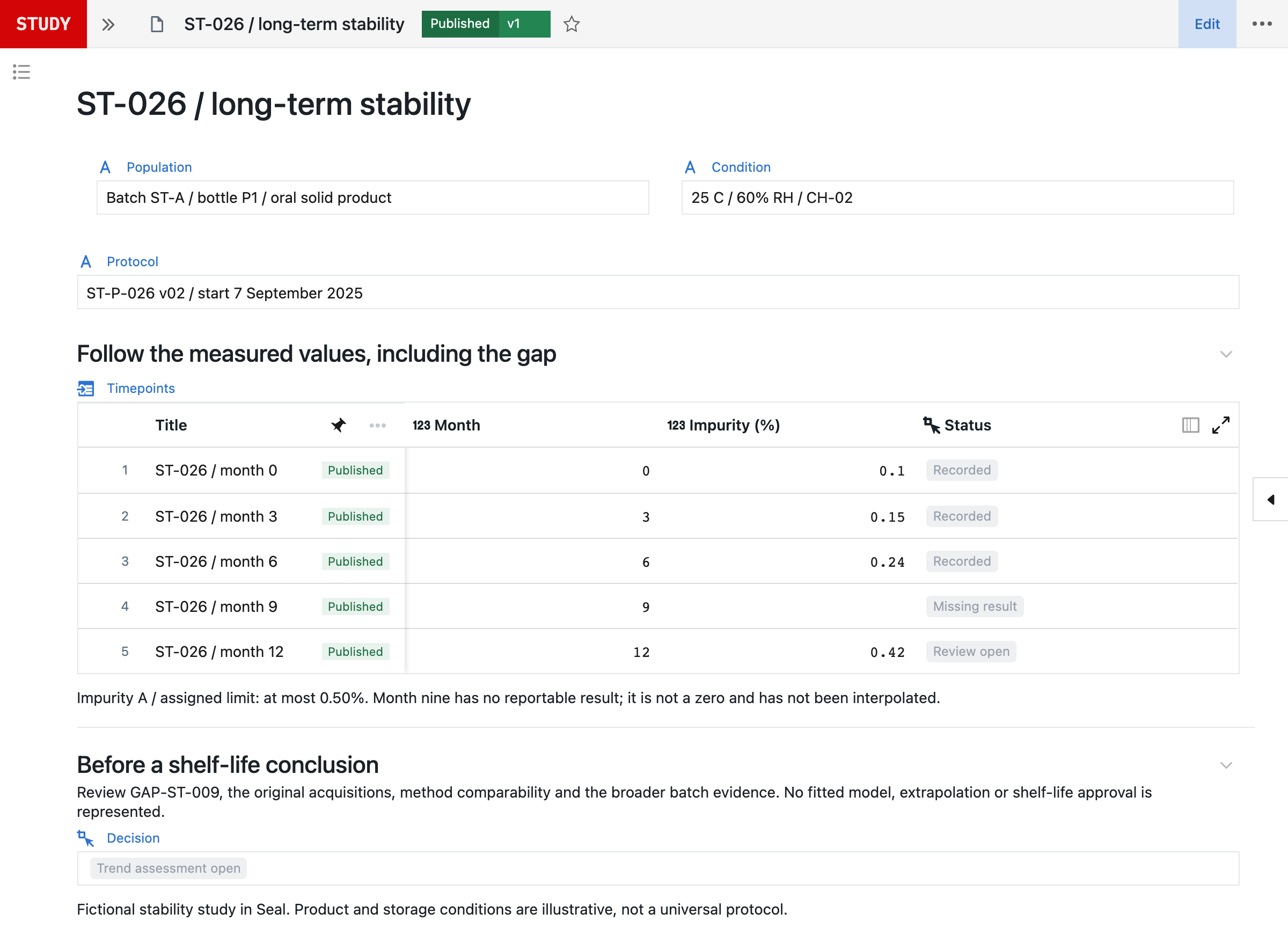
Figure 1 follows the fictional long-term study ST-026: batch ST-A in bottle P1, stored at 25 °C / 60% RH in chamber CH-02. Four impurity results sit below the assigned 0.50% limit, and each is higher than the last. Month nine has no reportable result linked. The study needs both the missing evidence and review of the values already recorded, and the sections below follow it from the protocol to the shelf-life question it cannot yet answer.
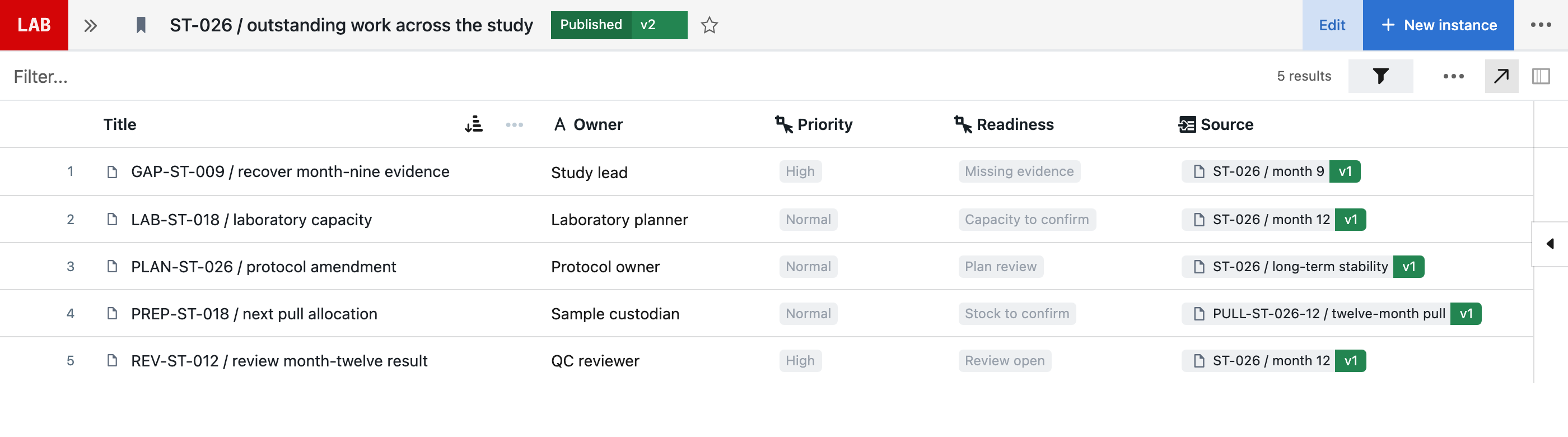
The study’s queue gives that work an owner and a source: recover the month-nine evidence, review month twelve, confirm laboratory capacity, allocate the next pull and review the protocol amendment. A missing result is not silently counted as a pass.
You can start with one study, alongside the LIMS you already run. Seal reads samples and results from LabWare, LabVantage and SampleManager without writing to them; see all integrations. The advantage grows as the laboratory, the chambers and quality work on the same connected records: fewer gaps found at report time, and a shorter path from a result to the decision it supports.
The protocol becomes the study’s structure.
A stability protocol defines what is tested, under which conditions, at which timepoints and with how many units. In Seal it is the version each study executes, not a document kept beside a calendar.
For the general case, ICH Q1A(R2) sets out these drug product conditions. For a proposed shelf life of at least 12 months, long-term testing is normally every three months in the first year, every six months in the second and annually after that.¹
| Study | Condition | Months tested |
|---|---|---|
| Long term | 25 °C / 60% RH or 30 °C / 65% RH | 0, 3, 6, 9, 12, 18, 24, yearly |
| Intermediate | 30 °C / 65% RH | At least four, e.g. 0, 6, 9, 12 |
| Accelerated | 40 °C / 75% RH | At least three, e.g. 0, 3, 6 |
Each condition carries its tolerance, ± 2 °C and ± 5% RH in the general case. Where 30 °C / 65% RH is the long-term condition there is no intermediate condition; where long-term studies run at 25 °C / 60% RH, intermediate testing is added when accelerated testing shows a significant change, such as a degradation product exceeding its acceptance criterion. At submission, Q1A(R2) looks for at least 12 months of long-term data on three primary batches, packaged in the container closure system proposed for marketing, and photostability testing on at least one primary batch where appropriate.¹
In the US, the written stability programme sets sample size and test intervals on statistical criteria for each attribute, the storage conditions, reliable and specific test methods and testing in the container-closure system in which the product is marketed.²
Seal starts a protocol from templates for ICH long-term, intermediate and accelerated studies, photostability and an annual commercial programme. They are starting points, not universal requirements: conditions, design and evaluation depend on the product, package, purpose and governing protocol, and your team confirms each one before use. A general-case template is not a compliance certificate.
The protocol defines the population, package, conditions, timepoints, sample quantities and exception rules, and each study retains the version it executed. ST-026 runs under ST-P-026 v02 in CH-02, and its timepoints at 0, 3, 6, 9 and 12 months follow the general-case pattern for the first year. Reduced designs, bracketing and matrixing, can apply where they are justified;¹ keep the justification with the protocol version that uses it.
Several protocols can apply to one product. Keep each study’s batch, package, conditions, timepoints and protocol version explicit, and compare populations only with the scientific and statistical justification the intended use requires. Methods and specifications can change during a study: each result keeps the version it used, and the effect on interpretation and comparability is assessed under the approved analysis plan rather than by overwriting the original evidence.
A pull is a physical event, not a date.
A timepoint falls due on a date. The pull is what physically happened: which units left which chamber position, when, who moved them and when the laboratory received them.
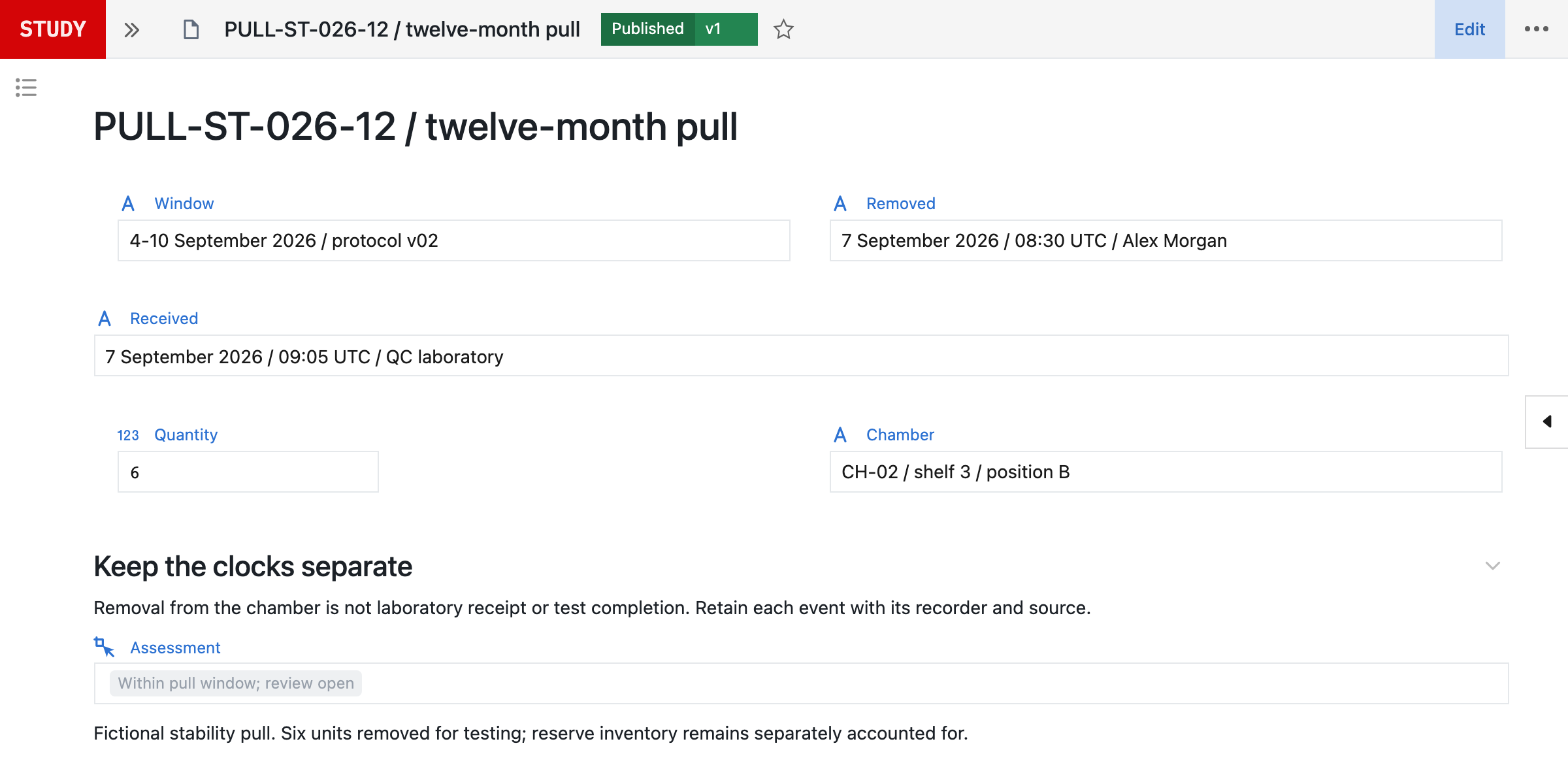
Twelve-month pull, 7 September
- Window
- 4–10 September, protocol v02
- Removed
- 08:30, CH-02 / shelf 3 / B
- By
- Alex Morgan
- Received
- 09:05, QC laboratory
- Units
- 6, reserve held separately
Within window; review open
The twelve-month pull allows removal from 4 to 10 September under protocol v02. On 7 September, Alex Morgan removes six units from CH-02, shelf 3, position B at 08:30 UTC, and the QC laboratory records receipt at 09:05. Removal and receipt are different events; neither means testing or review is complete.
Seal keeps the nominal timepoint, the allowed window, the actual removal, conditioning, transport, receipt, sample login, test start, return and destruction as separate events, each with its quantity, time, person and source. A late or missed pull is preserved as what happened, with its assessment, rather than rescheduled out of sight.
Units are finite. The inventory plan sets the units each condition, timepoint and test requires, with reserves, repeats and destructive use, and tracks the pulls, the remaining quantity and any shortage. A repeat or an investigation that needs more units draws on its own allocation, so the next pull is prepared against the units that actually remain.
When a stability pull is created, the applicable tests, methods, criteria and laboratories resolve into laboratory work without transcription, as described for specification management. The units then follow the same custody as any other sample, from receipt to the test that consumes them.
Assess a chamber event against what was inside it.
An excursion affects the units that were in the chamber while it lasted. Seal reconstructs that population from placement, movement and pull history, not from today’s inventory.
71% RH for 2 h 40 min
Set to 30 °C / 65% RH ± 5% RH
- ST-031In the chamber throughoutIn scope
- ST-033Pulled 40 minutes inIn scope
- ST-034Placed after the eventExcluded
Impact on each study open
Take a second fictional event. Chamber CH-04, set to 30 °C / 65% RH ± 5% RH, records 71% RH for 2 hours 40 minutes. ST-031’s units were in the chamber throughout. ST-033’s six-month pull left 40 minutes into the event, so those units are now in the laboratory but were exposed. ST-034 was placed after the event ended and is excluded, with the reason recorded. A map of the chamber as it stands today would include ST-034 and miss ST-033.
Use the event window and the mapped condition together with the actual placement, movement and pull history, and keep each inclusion and exclusion reason. An uncertain movement or a missing sensor interval stays an explicit gap, not an assumption. The assessment starts from the candidate population, the exposure evidence and the unresolved gaps; the impact on each study and result is a decision for its reviewer.
The chamber itself is equipment. EU GMP expects the equipment used for ongoing stability, stability chambers among it, to be qualified and maintained.³ In Seal a chamber can keep its qualification, calibration and maintenance as equipment records, so a study can show the state of its chamber while each unit was stored.
Monitoring interfaces, alarms and recovery need source-specific configuration and verification. Agree which system owns the chamber’s readings and how an alarm reaches Seal before relying on it.
Excursions outside the chamber, in shipping and handling, are a related question. Q1A(R2) notes that accelerated and, where appropriate, intermediate data can be used to evaluate the effect of short-term excursions outside the label storage conditions.¹ The cold chain blueprint follows that assessment for shipped units.
Trend the measured values. Keep the gap in view.
A trend is read from the results as measured, each linked to its method, acquisition and pull. A missing timepoint stays missing on the chart, not a zero or an interpolated point.
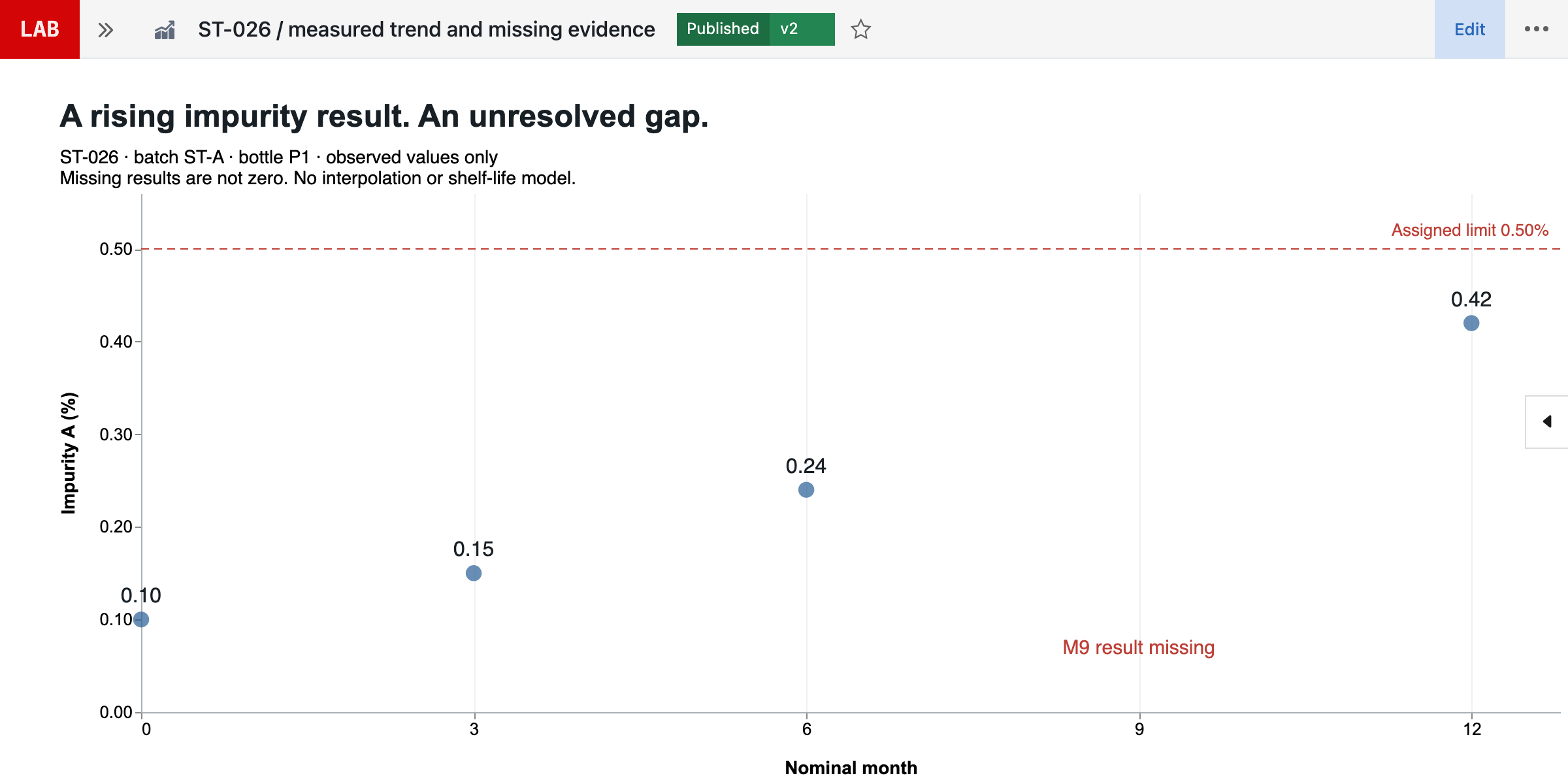
Q1E asks for the values of quantitative attributes at all timepoints to be reported as measured, in a table, chart or narrative, and for each attribute to be assessed separately.⁴ The ST-026 chart is a saved view of the published source values. It is descriptive, not a fitted model, and this one-batch example does not establish shelf life.
Month nine has no reportable result. Record whether the problem is a missed pull, a delayed test, an invalid result or absent evidence, and keep the gap and its assessment. Do not substitute zero, interpolate silently or let a later result erase the earlier event.
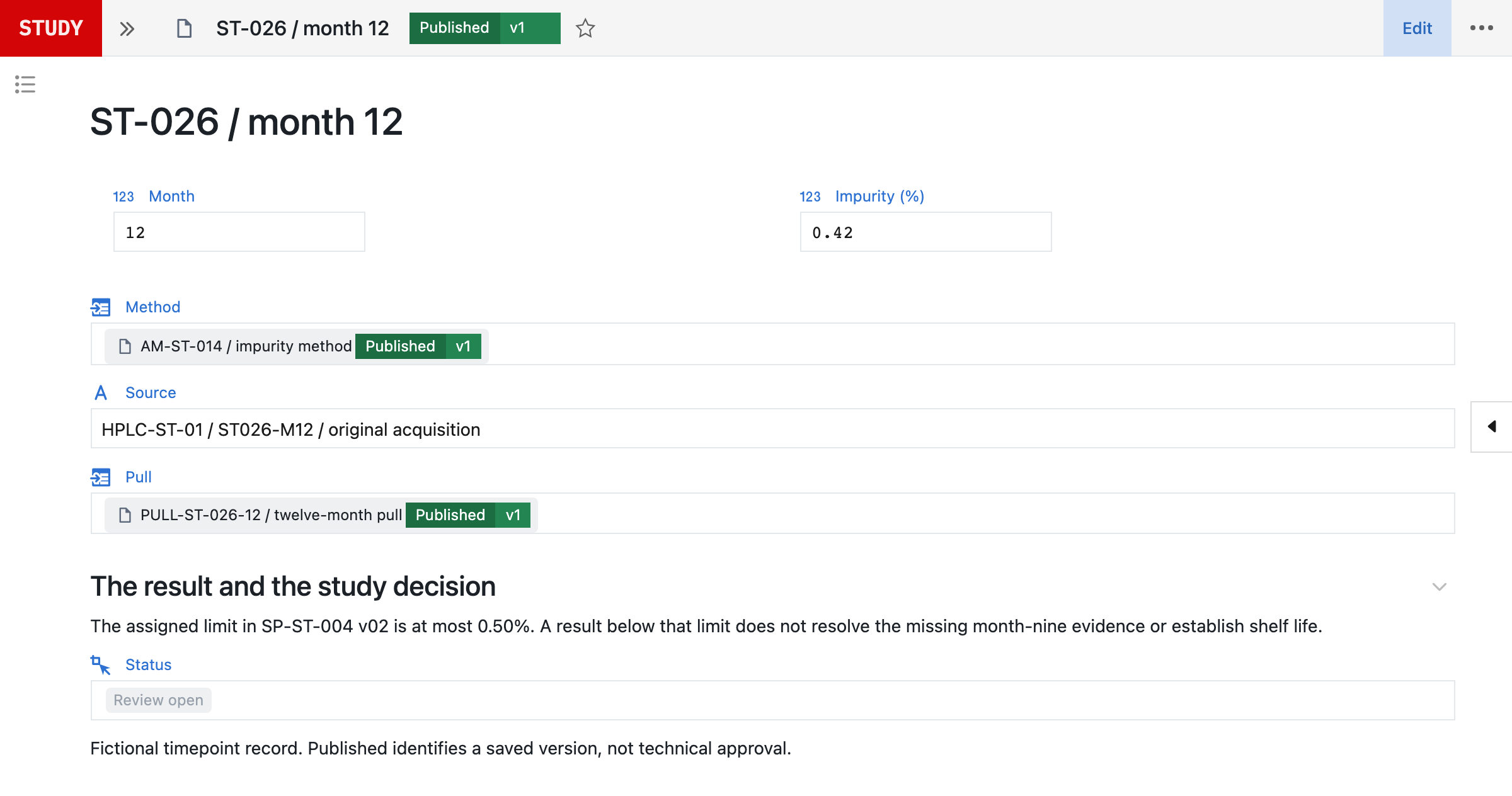
The 0.42% result identifies its method, AM-ST-014 v1, the original acquisition on HPLC-ST-01 and the physical pull it came from. The assigned limit is at most 0.50%, but a value below its limit does not close scientific review: it does not resolve the missing month-nine evidence or establish shelf life. Retain that source context when methods, specifications or processing change.
Out-of-trend results are judged against a defined expectation. Configure the trend rule with its attribute, method, timepoint, population and minimum data, and route a signal into an OOS or OOT investigation that keeps the original result. EU GMP expects out-
A shelf life is a reviewed decision, not a fitted line.
A shelf-life estimate rests on a defined population, a justified model and its uncertainty, reviewed by the people accountable for it. Seal keeps that analysis as a record linked to the results it used.
Before a shelf-life conclusion
- Population (met)Batch ST-A, bottle P1
- Data cutoff (met)Month 12
- Batches (not met)1 of 3 primary
- Month 9 (not met)No result
- Model (not met)None recorded
For a quantitative attribute that changes over time, Q1E describes estimating shelf life as the earliest time at which the 95% confidence limit for the mean intersects the acceptance criterion: the upper one-sided limit for an attribute that increases, such as a degradation product, and the lower one for an attribute that decreases.⁴ Batches are combined only after statistical tests on their slopes and intercepts, with a significance level of 0.25; where they cannot be combined, the shelf life follows the minimum time any batch can be expected to remain within its acceptance criteria.¹
Where accelerated data show no significant change, Q1E also bounds how far a proposed shelf life for a product stored at room temperature can extend beyond the period covered by long-term data.⁴
| Long-term data | Shelf life up to | And no more than |
|---|---|---|
| Little change or variability | Twice the period | 12 months beyond |
| Change, no statistical analysis | 1.5 times the period | 6 months beyond |
| Change, statistical analysis | Twice the period | 12 months beyond |
With 12 months of long-term data, no case allows more than 24 months, and each needs its justification or supporting data. A shelf life granted on extrapolation is verified by further long-term data as they arrive, and the protocol for commitment batches includes a timepoint at the end of the extrapolated period.⁴
The analysis record holds the population, transformations, model, pooling, criteria, estimates and confidence bounds, diagnostics, exclusions, the software used, the review and the conclusion. Where a statistical analysis is performed, Q1E asks for the procedure and the assumptions behind the model to be stated and justified,⁴ so they stay on the record beside the numbers. Seal does not assign a shelf life from a regression: qualified stability, statistics, quality and regulatory reviewers own the conclusion.
ST-026 shows why the record matters. Its population and data cutoff are set, but it is one batch where a registration shelf life rests on at least three primary batches,¹ month nine is missing and no model has been recorded. A chart rising toward its limit is a reason to look, not a conclusion. The regulatory submissions blueprint tests a twenty-four-month claim against the same records and finds it unsupported.
A shelf-life proposal records the product and packaging scope, the batch data, the analysis, its uncertainty and extrapolation, the storage statement, the commitments, the review and the filing. Q1A(R2) asks for a direct link between the label storage statement and the demonstrated stability of the product.¹
Neil prepares the work. Your team decides.
Neil is Seal’s AI agent. Bring it a protocol, a recurring study problem or a question about the data; it works across the records you permit it to read and prepares linked work, capture fields and review paths in Seal, not text to paste elsewhere.
| Neil prepares | Your team decides | |
|---|---|---|
| Missing timepoint | Evidence trail, candidate causes | What happened at month nine |
| Next pull | Proposed pull, units and capacity | The slot and the allocation |
| Chamber event | Units present, with sources | Impact on each result |
| Protocol | Templates, rules and test cases | Verification and release |
| Study assessment | A draft linked to its records | The scientific conclusion |
Trace month nine from its planned pull to the laboratory evidence. Explain what is missing.
Neil
- Month 9 is planned under ST-P-026 v02.
- No reportable result is linked to it.
- Four candidate causes, with the records for each.
- An evidence request for the study lead.
- Evidence request (met)Drafted, with sources
- Cause (not met)For the study lead
- Month 9 (not met)Missing until resolved
To investigate the missing timepoint, ask Neil to trace month nine from its planned pull to the laboratory evidence and to explain what is missing. It distinguishes a missed pull, a delayed test, an invalid result and an absent source, and prepares a linked evidence request and an assessment of candidate explanations, with the records needed to tell them apart. Missing data stays missing until evidence resolves it.
To prepare the next pull, ask it to check sample quantities, laboratory capacity and dependencies before proposing the schedule. Neil assembles proposed pull records and preparation tasks from the protocol and the permitted inventory and planning records, identifies shortages, conflicts and stale availability, and compares scheduling options. A proposed slot is not a confirmed reservation: the planner confirms it.
To turn a protocol into testable configuration, ask it to configure reusable study, pull and result templates, including the exception paths and verification cases. Neil authors the linked templates, required measurements, protocol-version references and review states, and stages a changeset with tests for missing readings, a late pull, insufficient units and a changed method. Your team reviews the configuration and runs the verification before publication.
Neil does not approve a shelf life, close a gap or publish a change. Proposed pulls, candidate explanations and staged template changes each wait for the responsible person: a planner confirms the slot, an analyst assesses the evidence and the team verifies the configuration before it is published.
In line with the EU’s draft GMP Annex 22 on AI, Neil is not used in GMP execution. It helps set up configuration, which your team verifies and releases under change control. Customer data is not used to train AI models, and the requester’s permissions govern what Neil can read. See how Neil fits Annex 22 and more about Neil.
Report from a frozen population. Keep the programme running.
A stability report is a frozen view of a defined population and data cutoff. The programme behind it keeps placing batches, pulling units and trending results for as long as the product is on the market.
| Study | Started by | In Seal |
|---|---|---|
| Registration | Primary batches for the dossier | A study per batch and package |
| Commitment | Data short of the shelf life | An ongoing stability commitment |
| Ongoing | Yearly, each strength and pack | The annual commercial programme |
| After a change | A significant change or deviation | A placement linked to the change |
A report records the study population, protocol, execution, deviations, data, trends, statistics, conclusions, review, signatures and source lineage as they stood at its cutoff. Prepare it with its linked results, charts, analysis versions and open issues, then review the generated package and its required submission format before approval and export. Keep exclusions, assumptions, uncertainty and open questions with the report; scientific conclusions and publication remain authorised decisions.
Where long-term data at approval do not cover the proposed shelf life, Q1A(R2) expects a commitment to continue the studies after approval: for example, to place the first three production batches on long-term studies through the proposed shelf life and on accelerated studies for six months, using the protocol of the primary batches unless otherwise justified.¹ A commitment in Seal is a placement rule with its product, package, site, process, market, triggering change, calendar, owner, evidence, report and completion.
After marketing, EU GMP expects an ongoing stability programme, described in a written protocol, that monitors the product over its shelf life. Unless otherwise justified it includes at least one batch a year of every strength and primary packaging type, and additional batches after a significant change or significant deviation to the process or package. Results are made available to key personnel, in particular the Qualified Person, and a summary of the data and interim conclusions is kept and periodically reviewed.³ The annual commercial programme places batches against those rules and carries their inventory, pulls, testing, trends, reports and replacement decisions.
Protocol amendments preserve the version already executed, and ongoing placements and report commitments keep their owners and original due dates. A multi-year programme keeps its study structure, planned and actual events, amendments and source evidence throughout. Define retention, archive, retrieval and original-data readability before the study closes.
Start with one active study.
Bring one active study: its protocol, its pull schedule and the results recorded so far. Seal connects to the systems that hold them today.
| Where the work runs | What the study uses | Connections include |
|---|---|---|
| LIMS | Samples, tests and results | LabWare, LabVantage, SampleManager |
| Chromatography | Original acquisitions | Waters Empower, Chromeleon |
| CMMS | Chamber assets and work orders | Blue Mountain RAM, IBM Maximo |
Neil prepares the protocol configuration and the study’s first linked work from that material, and your team inspects it against how the study should run. Start with sample material or arrange an NDA before sharing confidential records.
Test the complete cycle before you rely on it: a late pull, a missing timepoint, insufficient units, a changed method, a chamber excursion and a result that needs review. Verify that every physical move, result and decision can still be explained.
Agree which system owns each record, which records Seal reads and how status crosses the boundary. To scope the first study with us, book a demo.
References
- 1ICH Q1A(R2), Stability Testing of New Drug Substances and Products (2003), drug product sections 2.2.2 to 2.2.10: photostability on at least one primary batch; at least three primary batches, in the container closure system proposed for marketing; testing frequency and reduced designs; the general-case storage conditions, significant change and short-term excursions; the stability commitment; evaluation, including batch poolability at a significance level of 0.25; and a direct link between the label storage statement and demonstrated stability. ICH
- 221 CFR 211.166(a), Stability testing: a written testing programme, followed and used to determine storage conditions and expiration dates, including sample size and test intervals based on statistical criteria for each attribute, storage conditions, reliable, meaningful and specific test methods, and testing in the marketed container-closure system. eCFR
- 3EudraLex Volume 4, Part I, Chapter 6, Quality Control (2014), 6.26 to 6.36 (on-going stability programme): a written protocol; qualified and maintained equipment, stability chambers among it; at least one batch a year of every strength and primary packaging type unless otherwise justified; additional batches after a significant change or deviation; investigation of out-
of- specification results and significant atypical trends; and a summary kept under periodic review. European Commission - 4ICH Q1E, Evaluation for Stability Data (2003): each attribute assessed separately (2.1); values reported as measured, with the procedure and assumptions of any statistical analysis stated and justified (2.2); extrapolation verified by further long-term data (2.3); the extent of extrapolation at room temperature (2.4.1); and the one-sided 95% confidence limit for the mean (2.6). ICH
AConnected records
BQuestions and answers
Can we manage multiple protocols for the same product?
Yes. Keep each study’s batch, package, conditions, timepoints and protocol version explicit. Compare populations only with the scientific and statistical justification required for the intended use.
How do you handle chamber excursions?
Connect the source event to historical occupancy, movements and pulls. Prepare the candidate sample population, exposure evidence and unresolved gaps for review. Monitoring interfaces, alarms and recovery need source-specific configuration and verification.
What about ICH guidelines?
Templates can be configured around applicable guidance. Conditions, design and evaluation depend on the product, package, purpose and governing protocol; a general-case template is not a universal requirement or a compliance certificate.
Can we export data for regulatory submissions?
Prepare reports from a defined population and data cutoff, with linked results, charts, analysis versions and open issues. Review the generated package and its required submission format before approval and export.
How do you handle multi-year studies?
Preserve the study structure, planned and actual events, amendments and source evidence throughout the programme. Define retention, archive, retrieval and original-data readability requirements before the study closes.
What if a timepoint has no result?
Record whether the problem is a missed pull, delayed test, invalid result or absent evidence. Preserve the gap and its assessment. Do not substitute zero, interpolate silently or let a new result erase the earlier event.
Does Seal assign shelf life from a regression?
No. The chart on this page is descriptive and contains no fitted model. Formal evaluations need justified populations, assumptions, diagnostics and uncertainty; qualified stability, statistics, quality and regulatory reviewers own the conclusion.
How are affected samples identified?
Use the event window and mapped condition together with actual placement, movement and pull history. Retain inclusion and exclusion reasons. An uncertain movement or missing sensor interval remains an explicit gap.
Can methods or specifications change during a study?
Yes. Retain the version used by each result and assess the effect of changes on interpretation and comparability. Segment or otherwise evaluate data under the approved analysis plan without overwriting original evidence.
What can Neil prepare for the programme?
Neil can draft study assessments, linked evidence requests, pull packages and changes to templates, fields, rules and review states. It can prepare requirement links and verification cases. People verify and publish the change; Neil does not approve shelf life.