GxP operations.
Evolve with AI.
Run lab, manufacturing and quality on a platform built to change. Neil, your AI agent, configures workflows, investigates results and prepares process improvements for your team to approve.
Book a demo
Lab, manufacturing and quality, working together.
A shared ontology links batches, samples, materials and procedures. Your team and Neil can follow a result to its source and a change to the work it affects.
Post-mix hold and transfer
- Mix complete
- 10:12
- Transfer
- 11:04
- Sample
- IPC-041
Post-mix sample
- Batch
- B-041
- Taken
- 10:16
- pH
- 7.1
Extended post-mix hold
- Batch
- B-041
- Sample
- IPC-041
The ontology defines the types of records used in the work and how they relate: a sample belongs to a batch, a result comes from a test, and an investigation links to the affected work. Each record keeps its own history, and earlier runs keep the process version they used.
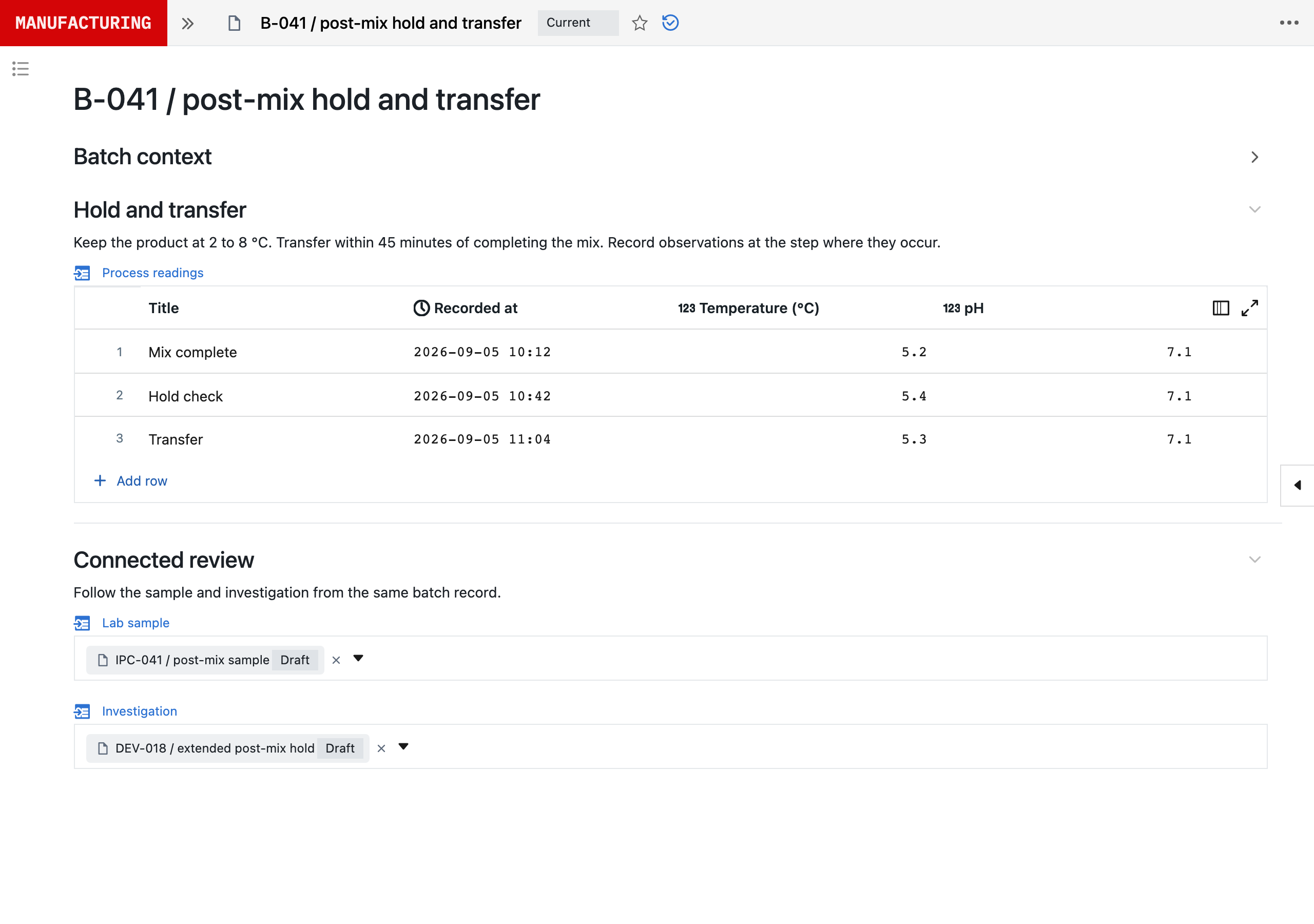
In Seal, batch B-041 carries its process readings and links to lab sample IPC-041 and investigation DEV-018. An investigation starts from the batch and the lab result themselves, not from exports of them.
Where the work runs, not where it is filed.
A traditional LIMS, MES and eQMS each keep one department’s records, and people carry the evidence and every change between them. Seal runs lab, manufacturing and quality work on one shared ontology, and improves it through controlled change.
| Compared on | Separate systems | Seal |
|---|---|---|
| Where it sits | Beside the work | In the work, or reading it directly |
| Across departments | A system each, joined by people | One ontology, linked records |
| Evidence | Exports gathered by hand | Links to the batch, sample and version |
| A finding | A document and a training task | A control in the workflow |
| Change after go-live | A revalidation project | A controlled change with verification |
| AI | Text to paste elsewhere | Neil proposes a configured change |
| Getting started | An implementation project | A 48-hour evaluation on one process |
Each traditional system was built for one part of the work. A traditional eQMS is a system of record: it files deviations and CAPAs as forms beside the work, and it cannot put a check in front of the next operator. A LIMS beside the batch reports a result without the step it governs, so a finished test becomes the start of another search. A page-based ELN keeps conditions and results in free text and disconnected files. With a traditional MES, carrying an investigation’s conclusion into the next run is another manual project.
In Seal the finding, its evidence and the response sit on the same record as the work. A corrective action can be released as a change to the workflow itself, carrying its procedure version, verification and approval, so the next batch runs the improved process instead of a revised document waiting to be applied.
You can start with one workflow alongside the systems you already have. The advantage grows as laboratory, manufacturing and quality use the same connected foundation: less reconstruction between teams, and a clearer path from a finding to an improvement that can be verified.

MiAlgae cuts documentation time by 75%.
MiAlgae brought its ELN, quality processes and electronic batch records into Seal as it scaled from lab to commercial production, replacing three separate documentation routes with one connected system.
Skye Biologics runs document control, training, batch records, supplier management, inventory, environmental monitoring and instrument integration on the same platform. Its non-conformances fell by 40%.
Read how MiAlgae and Skye Biologics use Seal.
Neil prepares the work. Your team decides.
Neil is Seal’s AI agent. It works across the same lab, manufacturing and quality records as your team, within the permissions of the person asking. What it produces is work in Seal: a configured workflow, an assembled investigation or a prepared change.
Investigate the extended hold on B-041. Bring the evidence together and draft the investigation.
Neil
- A 52-minute hold, from the B-041 batch record.
- A 45-minute limit, from MBR-014 v04.
- Sample IPC-041, which does not settle product impact.
- A request to Manufacturing for the transfer records.
- Overrun (met)7 minutes, confirmed
- Cause (not met)For the investigator
- Impact (not met)For technical review
In this example Neil confirms the overrun against the instruction that was used: the recorded hold was 52 minutes, and MBR-014 v04 permits 45. Why the transfer was delayed, and whether the extra hold affected the product, is not yet established; the lab results alone do not close that question. Neil drafts the request to Manufacturing, asking what happened between mix completion at 10:12 UTC and transfer completion at 11:04 UTC, with the equipment, transfer and handoff records that explain any delay.
| Work | Neil prepares | Your team decides |
|---|---|---|
| Set-up | The workflow from your procedure | Whether it matches the work |
| Questions | Answers with their sources | What to act on |
| Investigation | The evidence and what is still open | Cause and impact |
| Process change | The configured change and its tests | Approval and release |
| Validation | Specifications and test evidence | Whether the evidence is enough |
| Batch review | A report from the batch’s records | Disposition |
Everything in the middle column is preparation. Nothing Neil produces takes effect until a qualified person has reviewed it, and required people and signatures still control the decisions. Give Neil several jobs to work on in parallel; your team reviews the results and controls process and batch release.
In line with the EU’s draft GMP Annex 22 on AI, Neil is not used in GMP execution. It helps set up configuration, which your team verifies and releases under change control. Customer data is not used to train AI models, and the requester’s permissions govern what Neil can read. See how Neil fits Annex 22 and Neil at work.
Turn the finding into a working control.
Neil configures the change in Seal: required timestamps, a hold calculation and an exception route. Your team can build and adapt its own processes the same way.
MBR-014 v04, clause 7.2
Transfer within 45 minutes of completing the mix. Record both events against the batch.
- Capture
- Both timestamps, required
- Calculate
- Elapsed hold in minutes
- Route
- Over 45 minutes, to assessment
- Connect
- Batch, readings, investigation
Asked what it would change, Neil proposes keeping the 45-minute limit, calculating the hold from both timestamps and routing an overrun to an exception assessment. A missing timestamp is flagged as an incomplete check rather than a pass. This improves detection and escalation. It does not prove the cause of this delay or resolve the batch investigation.
On the step, the written instruction becomes behaviour. At or below 45 minutes the duration check is satisfied, and other checks and approvals still apply. Above 45 minutes the step requires an exception assessment before anyone decides how to proceed. A missing value cannot be treated as a completed check, and a transfer recorded before the end of mixing is sent back so the source values can be corrected.
Forms, calculations, dependencies and review gates define how the work runs. Permissions, signatures, audit history and process versions are shared controls across lab, manufacturing and quality, and the new fields reference the batch, its readings and the investigation as records rather than copied identifiers.
Keep improving after validation.
Test and approve each change. Earlier work keeps its version. The specifications, test evidence and approval belong to the same controlled change, so going live begins the lifecycle rather than ending it.
| Input | Expected | Before fix, v05-a | After fix, v05-b |
|---|---|---|---|
| 44 minutes | Within the limit | Passed | Passed |
| 45 minutes | Within the limit | Passed | Passed |
| 46 minutes | Exception assessment | Passed | Passed |
| Missing time | Check cannot complete | Failed | Passed |
| No authority | Cannot bypass review | Not run | Not run |
The first proposed version, v05-a, let the check complete without a start time. That failed run is kept as ANOM-006, and the corrected version, v05-b, adds a new result; it does not replace the failed run. In the example, 4 selected checks passed and 1 access-path check is not run. B-041 keeps v04, and the hold limit remains 45 minutes.
The change is not released yet. The process owner still verifies the exception route, including restricted-role and bypass checks. The quality reviewer assesses ANOM-006, its correction and its impact, because a later passing result does not close the anomaly by itself. The operations lead assesses training and cutover, and approval is recorded against the intended version.
Neil prepares the specifications and verification for a proposed configuration, so the evidence is drafted with the change rather than after it. GAMP 5 Second Edition supports risk-based lifecycle assurance, including iterative specification and verification. FDA’s CSA guidance addresses medical-device production and quality management system software. The assurance effort follows intended use and risk.
Your team assesses the configuration and supporting evidence, performs any additional user acceptance testing and approves release. Continuous validation does not mean automatic approval. See how continuous validation works.
Keep the systems you rely on.
Connect Veeva, ERP and lab systems. Ask Neil to query permitted records and prepare a source-backed report. Start with the evidence where it lives; you do not need to move everything into Seal.
| Where the work runs | What Seal uses | Connections include |
|---|---|---|
| ERP | Materials, lots and suppliers | SAP, NetSuite, Oracle Fusion, Dynamics 365 |
| LIMS | Samples, tests and results | LabWare, LabVantage, SampleManager |
| MES and process data | Batch steps and process values | Tulip, Emerson DeltaV, AVEVA PI |
| Documents | Procedures and their versions | Veeva Vault, SharePoint |
| An existing eQMS | Deviations, CAPAs and changes | Veeva Vault QMS, MasterControl, ETQ Reliance |
| Training | Courses and transcripts | Cornerstone, Docebo |
| Equipment | Calibration and maintenance | Blue Mountain RAM, IBM Maximo |
Each connection is scoped before it goes live: what Seal may read, whether anything is written back, which system stays the source of truth and how the mapping is verified. Some connections are set up per project on the vendor’s API. See all integrations.
Neil works through the same connections. A question about a batch can draw on its ERP, LIMS and MES records, with each fact traced to its source.
Start with one process. Build from there.
Adapt a blueprint to your procedures with Neil. Add the next workflow to the same platform, keeping the relationships between the work.
| Area | A first workflow | Blueprints |
|---|---|---|
| Laboratory | One release test or stability study | LIMS, ELN |
| Manufacturing | One recurring exception or procedure | MES, Batch records |
| Quality | One quality workflow | QMS, Documents, Training |
Blueprints are starting processes for LIMS, ELN, MES, QMS, document control, training and more. See all blueprints.
Before you start.
Can we change the system after it is validated?
Yes. Continuous validation means managing the validated state through change, not freezing the configuration. Keep the reason for the change, affected requirements, updated specifications, verification results and approvals together in Seal. Assess the impact and risk to determine the assurance needed. Automated checks support that assessment; they do not replace accountable review or any additional UAT your intended use requires. Read about continuous validation.
Do we need to replace our existing systems?
No. Start with a defined job and the records it needs. Neil can work with connected systems; processes you choose to run in Seal can be introduced in stages. Agree which system owns each record, what can be read or written and how the connection will be verified. See the integrations.
Is Seal a LIMS, an MES or a QMS?
Seal covers LIMS, ELN, MES and QMS on a shared ontology: defined record types and relationships across your operations. A batch links to its samples, results and quality events. Start with the processes you need and extend the same model as you add more work. Find a GxP blueprint.
What does Neil do, and what does our team control?
Neil investigates results, configures proposed workflows and prepares reports and validation evidence using the records it can access. Give it several jobs to work on in parallel. Your team reviews the results and controls process and batch release. See Neil at work.
Where is our data hosted, and is it used to train AI?
Seal agrees the hosting region at onboarding and confirms the AI provider, processing location, retention and model terms for your organisation during onboarding and supplier review. Under Seal’s agreements, customer data is not used to train AI models; the records Neil uses as working context are not training the underlying model. Review the AI and data controls.
How quickly can we evaluate our own process?
Once we agree the evaluation scope and receive the required inputs, we prepare the first working process and supporting validation pack within 48 hours. The pack includes source traceability, recorded test results and configuration history. Your team can execute the process and inspect its records. Production release follows your intended-use assessment and quality controls.
What do we need to share to get started?
A short outline of the work and a work email are enough for the first conversation. For a process evaluation, we agree the scope with its owner and use a representative procedure, batch record or form. You can start with a sample, or arrange an NDA before sharing your own material.
See your process in Seal.
Bring one of your procedures. See Neil configure a workflow in Seal, run it with your team and inspect the evidence behind a change.
Book a demo