Summary
- The problem
- Outsourcing facilities are held to CGMP, but many still run on paper batch records, spreadsheet environmental-
monitoring logs and word-processed procedures. Records that do not connect mean manual compilation before every inspection or customer audit. - Seal’s approach
- Batch records, environmental monitoring, BUD rules, testing, training and quality events share one platform. Configured controls such as component scans, qualification checks and HD room assignment act during execution, and release waits for the required results.
- Neil
- Seal’s AI agent investigates recurring problems, such as which batches an excursion reached, and configures the checks and review workflows that prevent them. Your quality unit verifies and releases each change. About Neil.
- What changes
- An excursion can be assessed against the batches made in the affected area, and the basis for each beyond-use date stays linked to the product. Inspectors and customers see records that already exist.
- Where to start
- One master formula, the cleanroom where it is compounded and its monitoring plan. Book a demo.
1Pharmacy software follows the prescription. Seal runs the CGMP batch.
Pharmacy systems are built around prescriptions and dispensing. An outsourcing facility is held to CGMP, and its work is the batch: materials must be suitable, the room and equipment ready, personnel qualified, testing arranged and the evidence available for review. Many facilities still run that on paper batch records, spreadsheet environmental-
Seal connects those dependencies to the actual work. The batch starts from a formula version, records the materials and conditions it used, and carries laboratory results, environmental evidence and exceptions into review.
| Paper and pharmacy software | Seal | |
|---|---|---|
| Unit of work | A prescription or order | A batch, from a formula version |
| Batch record | Transcribed at the end of a shift | Completed as each step runs |
| Wrong component | Found at review | Blocked by the scan |
| Environmental data | A spreadsheet reviewed weekly | Trended as results are entered |
| Beyond-use date | A date on the label | Linked to its stability basis |
| Release | Records compiled for review | Waits for the required results |
| Inspection | Compiled while FDA waits | Already organised by batch |
| AI | Text to paste elsewhere | Neil prepares a configured change |
FDA requires outsourcing facilities to comply with CGMP and inspects them on a risk-based schedule.¹ Batch production records document each significant step.² Configure the facility’s requirements in the operation itself: who can perform a step, which records it requires, what is calculated and how an exception is handled.
Output depends on more than completing the formula, and the same foundation can serve the next one. Reuse assessed components for receipt, readiness, sampling and review; retain product-specific composition, limits and dating evidence with the formula that needs them. A new approved version improves future work while earlier batches preserve their history.
2Neil prepares the work. Your quality unit decides.
Neil is Seal’s AI agent. Give it the process and the evidence behind a recurring problem. It works within the permissions of the person asking, and what it produces is work staged in Seal for review: an investigation brief, an impact assessment or the configuration behind the next version of a workflow.
| Neil prepares | Your quality unit decides | |
|---|---|---|
| Excursion | The batches in scope, with sources | Impact and disposition |
| Repeated error | Required fields and calculations | Whether the fix is right |
| Batch review | The evidence and what is missing | Release |
| Repeated delay | Where the work waited, and why | What to change |
| New formula | Reused components and checks | Fit for the product |
Make environmental review identify the batches present during the sampled interval, with the source records attached.
Neil
- Candidates from recorded activity, not today’s room list.
- Result, room history and batches in one assessment.
- Product impact and disposition as separate decisions.
- Cases to verify: a later batch, an incomplete interval.
- Draft (met)Prepared, with sources
- Verification (not met)For quality
- Release (not met)Under change control
For environmental signal EM-SIG-026, collected on 1 September between 09:10 and 09:20 UTC, Neil compares the recorded operations: batch F-041 ran from 08:55 to 09:40, transfer INT-041 from 09:12 to 09:16 and batch F-042 from 10:30 to 11:15. Timing identifies candidates; location, exposure and the wider environmental evidence determine the assessed scope. The proposed workflow starts from historical activity rather than the current room assignment, links the result, room history and batch executions in one assessment, and keeps product impact, disposition and follow-up as distinct decisions rather than letting a completed investigation task stand in for the outcome.
Its verification cases include a batch that used the room during the interval, which joins the candidate population with its activity evidence; a batch that entered after the interval, which stays visible with its timing difference while location, airflow and other evidence are assessed; and an incomplete sampling interval, which is raised for review rather than silently narrowing the scope. Earlier batches retain their formula versions, room-use history and original assessments. Quality verifies the scope logic and applies the facility’s product-specific review requirements before the new version is used.
The facility’s knowledge should become easier to apply as experience accumulates. A recurring transcription error may call for an instrument connection. A repeated review question may justify a required reference. An investigation may reveal that a cleaning, sampling or reconciliation step needs clearer acceptance criteria. Give Neil the process and the evidence behind the problem. It can help configure required fields, calculations, exception routes and review tasks, then prepare verification cases for the revised workflow. The improvement becomes part of the next approved version used by operators.
Build reusable components for the work shared across formulas: component receipt, equipment readiness, room checks, sampling, result review and distribution reconciliation. Keep product-specific ingredients, limits, dating rationales and tests in the applicable formula. Reuse the control structure only after assessing its fit for that product and process.
Persistent memory can retain relevant previous decisions, while versioned skills can describe how to prepare a batch review or evaluate a proposed configuration. A skill can require source versions, explicit missing evidence and the facility’s review format. Revise the method from reviewed work and exercise it on known examples before wider adoption.
Keep restricted customer information, personnel records and investigation details within their authorised scope. Shared skills and examples should contain information approved for that audience. Include remembered context in the review for reuse: an agent’s access to two projects does not make either project’s confidential evidence suitable for the other.
In line with the EU’s draft GMP Annex 22 on AI, Neil is not used in GMP execution. It helps set up configuration, which your team verifies and releases under change control. Customer data is not used to train AI models, and the requester’s permissions govern what Neil can read. See how Neil fits Annex 22 and more about Neil.
3Make the batch record the place the work happens.
An electronic batch record should expose an exception rather than make it disappear. Blank fields and unexplained corrections on paper records become questions during inspection; in Seal, each significant step is recorded as it is done.
| Required | 211.188(b) | In Seal |
|---|---|---|
| Dates | (1) | Recorded as each step is done |
| Major equipment | (2) | Asset and readiness checked |
| Component lots | (3) | Lot scanned at the point of use |
| Weights and measures | (4) | Entered against the target |
| In-process results | (5) | Kept with range and exceptions |
| Yield | (7) | Calculated from verified formulas |
| Who did, who checked | (11) | Signed with name, time and meaning |
Batch production and control records must document that each significant step was accomplished, including the items above.² In the illustrative batch RX-0892, a pH of 7.30 against a 6.80–7.20 range at step 09 is retained unchanged, flagged and linked to formula MF-0042 v2.1 and source reading PH-008 for assessment.
Operators follow the approved steps in sequence, and required fields must be completed before they proceed. Barcode scans check ingredient, lot and quantity, so a wrong component or expired lot is blocked at the point of use. Yields, concentrations and dilution factors are calculated from verified formulas, data are captured as the work happens rather than transcribed at the end of a shift, and critical steps carry electronic signatures recording who signed, when and with what meaning.³
Before release, the quality control unit reviews and approves the production and control records. An unexplained discrepancy or a failure to meet a specification is investigated, and the investigation extends to other batches that may have been associated with it.⁴ Because the exception, its source and the batch’s formula version are linked, that review starts from the record rather than a search.
Master formulas are controlled records. Each change goes through change control with its rationale, approval and effective date. A batch starts from the current approved version and keeps it: a later formula version does not rewrite an existing batch.
4Define the formula, then preserve what each batch actually used.
A master formula is a controlled definition; the batch is the record of what was done against it. Keep the two distinct, and a revised formula becomes a controlled change to future work.
| Record | Definition to control | Evidence captured during use |
|---|---|---|
| Master formula | Composition, process, calculations | Formula version for the batch |
| Component lot | Identity, specification, status | Lot scanned, quantity, point of use |
| Equipment or room | Intended use, readiness checks | Asset used, status, interval |
| Batch result | Method, units, limits, review | Observation, calculation, decision |
A master formula needs a controlled definition of the product, ingredients, quantities, calculation rules, process steps, equipment, sampling and release requirements. Configure references to the component specifications and methods rather than leaving their identities in free text. Keep the approved formula version and the reason for each revision available to the batch reviewer.
The batch records the actual component lots, quantities, equipment, operators and observations. Preserve the distinction between a target, an entered measurement, a calculated value and an accepted result. If a value is corrected, the record should retain the correction history and its effect on dependent calculations or review work. A component lot carries its identity, specification, supplier, status and relevant dates; a batch result carries its method, units, limits and review path, with the original observation, calculation version, exceptions and decision.
Configure calculations with explicit units, rounding and input requirements. Define how the workflow handles missing values, a changed batch size, an out-of-range result and a material that is not suitable for use. The calculation’s acceptance criteria and verification belong with the configuration; the operator should not need to reconstruct the rule in a separate spreadsheet.
This structure gives an investigation the version and inputs behind an earlier batch, even after the facility has improved its process.
5Run environmental monitoring as a programme.
Sterile compounding depends on environmental control.⁵ Seal schedules sampling from the monitoring plan, trends each result against its limits as it is entered and links it to the batches made in that area.
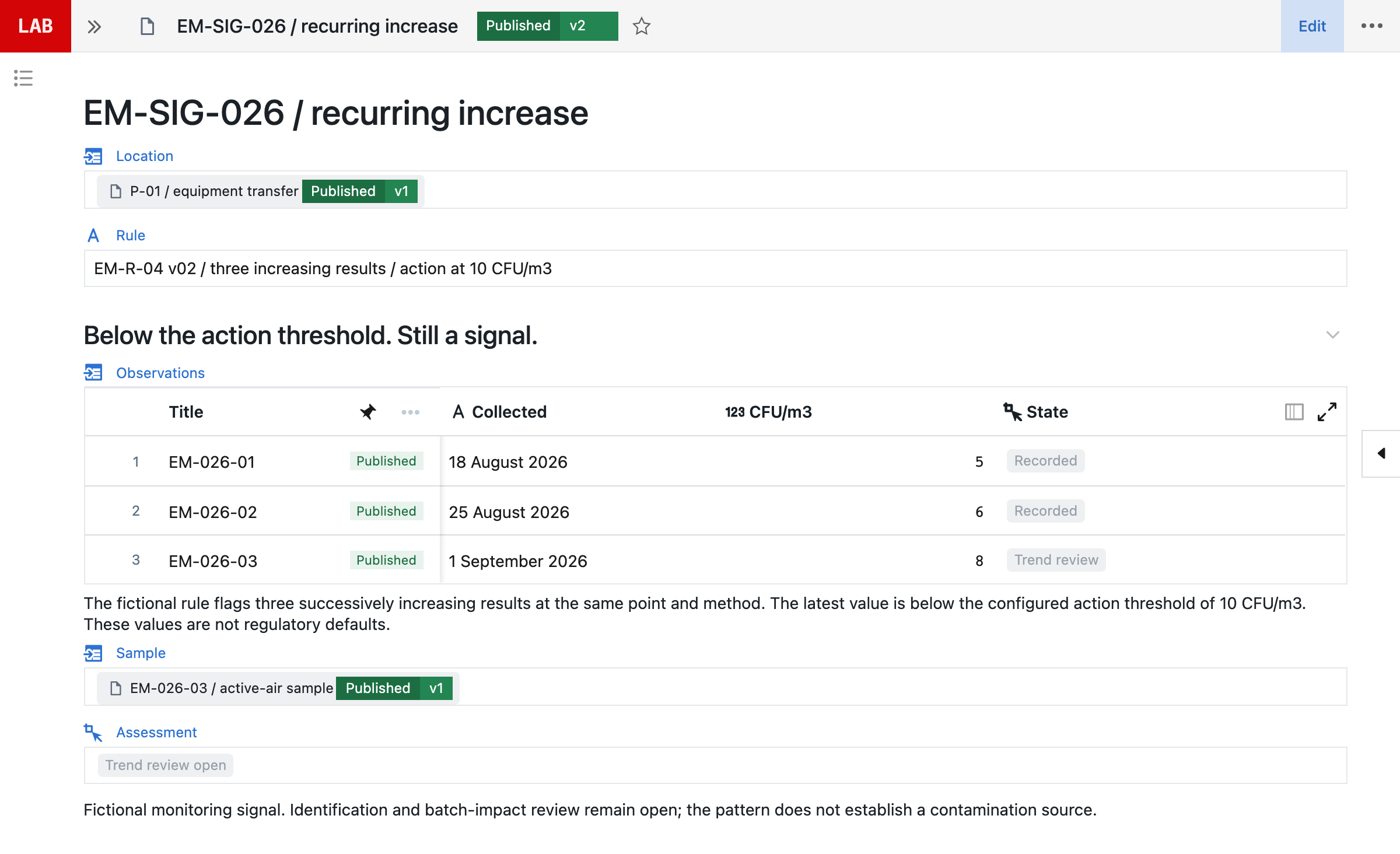
ISO 5 primary engineering controls, ISO 7 buffer rooms and ISO 8 ante rooms need viable and non-viable particle monitoring, temperature, humidity, pressure differentials, surface sampling and personnel monitoring. Many facilities collect these data but review them late: counts go into a spreadsheet reviewed weekly, and by the time a count exceeds the action limit, the conditions behind it may have existed for some time.
Technicians see what is due and overdue. Results plot on trend charts as they are entered. Alert and action limits are defined by location and sample type: a result at the alert limit raises a notification, and a result beyond the action limit opens an investigation. Because environmental data link to batch records, an excursion can be assessed against the batches made in the affected area during the event.
Cleaning belongs to the same programme. Classified-area cleaning tasks are scheduled and tracked, the configured rotation prompts for the correct agent, including sporicidal treatment, and surface sampling results link to the cleaning events they verify.
5.1Relate an excursion to the work in its scope.
The current room assignment cannot say which batches an excursion reached; the activity recorded during the sampled interval can.
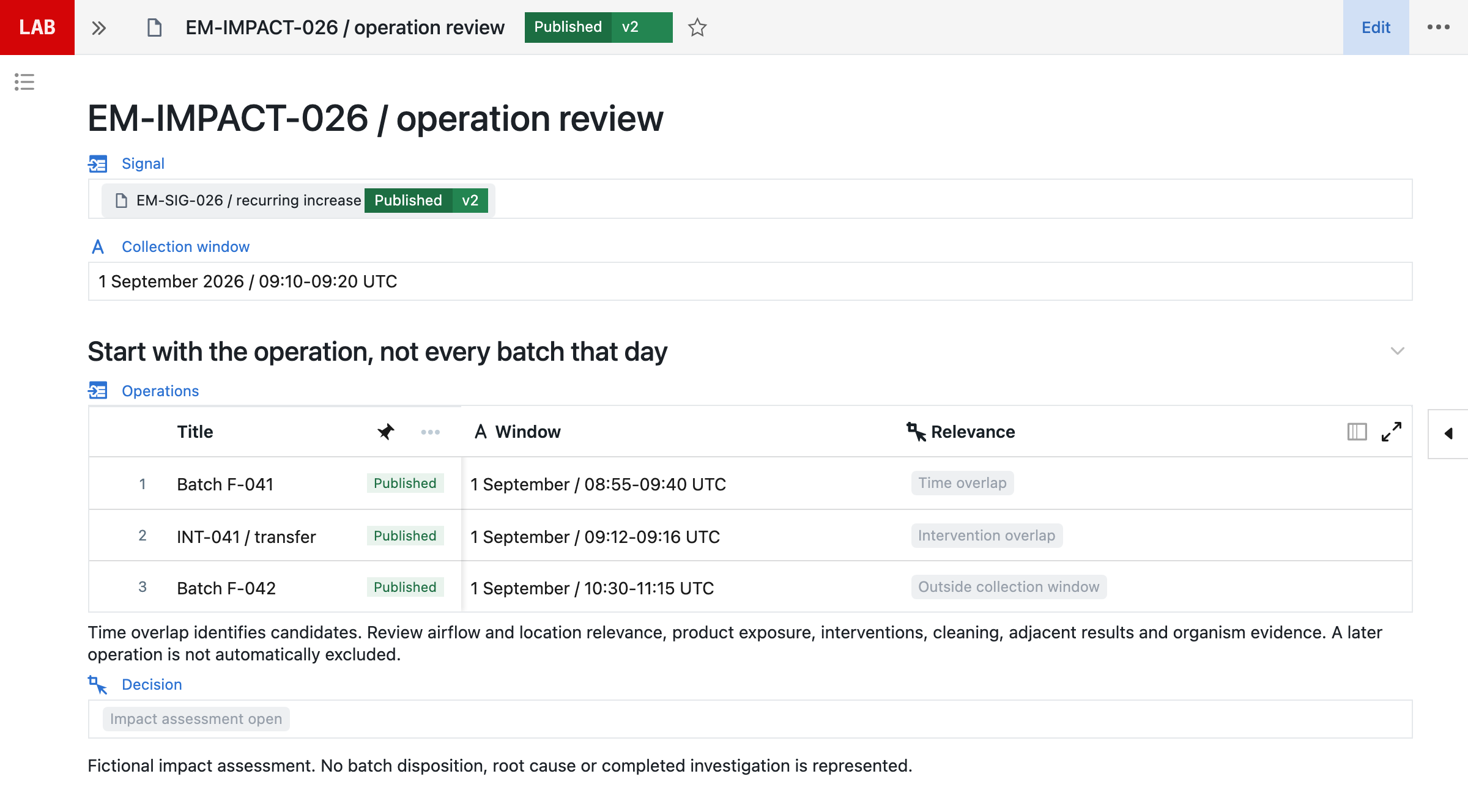
An environmental result becomes operationally useful when it retains the sampling point, method, collection time, incubation or analysis context, organism identification where available, and review state. Keep the monitoring plan and limits used for that assessment with the result. A revised plan should not reinterpret the earlier record without an explicit assessment.
For an excursion, assemble the room, equipment, personnel and batches present during the relevant interval. Record the reasoning behind the affected population: the collection time, location and process exposure may matter differently. The current room assignment alone cannot establish which historical batches were in scope.
Neil can gather the permitted records and prepare an investigation brief with missing evidence and proposed follow-up. Quality assesses the significance, containment, product impact and disposition. Link the resulting actions to the monitoring programme or manufacturing control that will change, then record how effectiveness will be evaluated.
Keep repeat samples, investigations and invalidated results visible in the history. A subsequent acceptable result answers a new question; it should not erase the observation that triggered the original assessment.
6Keep the basis for each beyond-use date with the product.
A beyond-use date is only as sound as its basis, and that basis belongs to one product configuration: the formulation, container-closure system and storage condition the studies covered.
- Container
- Vial, closure A
- Storage
- 2–8 °C
- Stability
- STB-012
- Closure
- CCI-008
- Container
- Syringe, closure B
- Storage
- 2–8 °C
- Stability
- Outside STB-012
- Closure
- Outside CCI-008
Every product an outsourcing facility releases carries an expiration date, and CGMP requires a written stability programme whose results determine storage conditions and expiration dates.⁶ FDA’s draft CGMP guidance for outsourcing facilities describes when it generally does not intend to take action on a beyond-use date used as the expiration date: a default BUD for small aggregate batches, or a BUD supported by limited stability testing, with container-closure integrity tested on samples aged to the proposed date before release.⁷ An investigator asking how the BUD was set for a particular product will expect the stability data, container-closure evidence and documented rationale behind it.
Configure the reviewed dating basis in the product definition, with the studies, conditions and rationale that support its use. A batch can apply the approved calculation to its compounding date and storage condition and check the component expiry dates. Changes to the formulation, container or storage condition bring the applicability of that basis back into assessment; linking a study alone does not establish a date.
In the illustrative product FORM-024, stability study STB-012 and closure study CCI-008 cover formulation FORM-024 v02 in a vial with closure A, stored at 2–8 °C. A syringe with closure B is outside that recorded configuration, so the source studies are carried into the assessment with the additional evidence the new presentation needs. A move to 20–25 °C storage leaves the original studies identifiable, but their dating basis cannot be carried into the new condition without assessment.
The same product definition records whether the product is a hazardous drug and the release tests it requires, such as USP <71> sterility and <85> bacterial endotoxins testing. Release waits until the required results are complete and passing, and the formula, batch records, environmental data, test results and BUD justification for a product can be retrieved together.
7Enforce the separation for hazardous drugs.
Seal flags hazardous drugs at the formula level, and the batch itself enforces their separation from non-hazardous work.
Many outsourcing facilities compound hazardous drugs such as antineoplastics and hormones. CGMP is the governing standard; where a state or customer expects it, USP <800> adds containment practices such as negative-pressure rooms, closed-system transfer devices, enhanced PPE, surface decontamination and medical surveillance. Failures occur where that separation is left to memory.
An HD batch can be blocked from starting outside a designated negative-pressure room. Operators confirm the required PPE as part of the batch record. HD rooms have their own cleaning procedures, a spill record guides containment and clean-up and links to the batch and people involved, and personnel who handle hazardous drugs are tracked against their surveillance due dates.
8Keep personnel qualification current and enforced.
Someone without a current qualification can be blocked from signing a controlled aseptic step.
Aseptic compounding requires qualified people, and media fills, garbing qualification and aseptic technique assessments are repeated periodically. Current qualifications and upcoming requalifications are visible by person and activity, and required training is defined by role.
9Assemble the quality decision from the same batch evidence.
Release waits for four things: a laboratory determination that the batch meets its specifications, a review of environmental and personnel monitoring data, the quality control unit’s review of the laboratory data and documentation, and authorisation by a designated person from that unit.⁷ Seal assembles each from the batch’s own records.
- Laboratory (met)Meets specifications
- Monitoring (met)Environment and personnel reviewed
- Records (not met)pH exception at step 09 open
- Authorisation (not met)For the quality unit
Configure the review package to identify required manufacturing records, component checks, environmental evidence, laboratory results, deviations and the basis for the assigned date. Each item needs its source and state. A laboratory result that has arrived may still await review; an investigation with completed tasks may still need a disposition decision.
For stability and dating, retain the product, concentration, container-closure system, preparation process, storage condition, study and applicable method versions. A result supporting one combination does not automatically justify another. A formulation, packaging or process change should identify which parts of the dating rationale need reassessment.
Where a laboratory or instrument system remains the source, preserve the sample identifier, original acquisition or report reference, units, method and review state. Agree how amended reports, rejected imports and missing data are reconciled. The reviewer should be able to move from the batch summary to the evidence underlying its status.
Use the facility’s approved product-specific requirements to configure release. Record the authorised decision and the units or lots it covers, together with any unresolved work that must remain visible. The workflow provides evidence and control; qualified people make the quality determination.
10Trace the released lot through distribution and response.
A released lot stays connected to the customers who received it, so a complaint, notification or recall starts from the records rather than a search.
Connect the released batch to packaged units, label versions, shipment quantities, customers and receipt information available to the facility. Reconcile what was manufactured, sampled, rejected, retained and distributed. Keep changes in quantity and disposition attributable so stock does not disappear into a manual adjustment.
A complaint or supplier notification should connect back to the relevant product, batch, component lots and distribution records. Define the affected scope, containment, customer communication and required investigation. Returned or recalled material needs its own receipt, reconciliation and authorised disposition rather than simply becoming available inventory again.
Customer portals can expose agreed orders, shipment status, quality documents and responses. Configure access to the underlying records and linked files, with review before sharing where required. Commercial terms, internal investigations and other customers’ records need an explicit access boundary even when the same staff serve several accounts.
11Show customers and inspectors the records the work produced.
Customer audits and FDA inspections draw on the records the facility already runs on, not a file compiled while the auditor waits.
Outsourcing facilities supply what the conventional supply chain does not: products in shortage, discontinued products and doses too small for manufacturers to make. Health-system buyers audit their 503B suppliers before relying on them. Environmental trends, batch records, deviation history and CAPA effectiveness come from the records the facility already runs on. Quality agreements and customer-specific requirements link to the customer and its orders, and distribution records show which customers received which lots, supporting notification and recall.
FDA inspection works the same way. Complete batch records with their signatures and deviations, environmental data with trend analysis, training and media fill results, and CAPAs with evidence that effectiveness was verified already exist, organised as the work happened, instead of being compiled while the investigator waits.
12Verify the operating model before extending it.
Start with one formula, its cleanroom, component flow and review package, and test the cases that reveal weaknesses before the model reaches the next formula.
Define source systems, identifiers, roles and the controls the facility needs. Reconcile migrated formula versions, component inventory, attachments and retained history before relying on the new records.
Test the ordinary batch and the cases that reveal weaknesses: a wrong or expired component, missing input, changed unit, out-of-limit result, overdue qualification, late environmental result and revised laboratory report. Verify that each condition creates the intended work and leaves evidence the reviewer can follow.
Assess changes to calculations, labels, permissions and integrations alongside the operator workflow. Preserve the batch version used before a change and record when the new configuration becomes effective. Extend the verified components across further formulas, measuring review effort, incomplete records, repeated corrections and time needed to configure the next process.
References
- 1FDA, Information for Outsourcing Facilities: under section 503B of the Federal Food, Drug, and Cosmetic Act, outsourcing facilities that compound sterile drugs must comply with CGMP requirements and are inspected by FDA on a risk-based schedule. FDA
- 221 CFR 211.188, Batch production and control records: records prepared for each batch must document that each significant step was accomplished, including dates, major equipment and lines, each batch of component used, weights and measures, in-process and laboratory results, actual and theoretical yield, and the persons performing and checking each significant step. eCFR
- 321 CFR 11.50, Signature manifestations: signed electronic records must show the printed name of the signer, the date and time of signing, and the meaning of the signature (such as review, approval, responsibility or authorship). eCFR
- 421 CFR 211.192, Production record review: the quality control unit reviews and approves production and control records before a batch is released or distributed; an unexplained discrepancy or a failure to meet a specification is investigated, extending to other batches and products that may have been associated with it. eCFR
- 521 CFR 211.113, Control of microbiological contamination: written procedures must be established and followed to prevent microbiological contamination, including validation of all aseptic and sterilisation processes for sterile products. eCFR
- 621 CFR 211.166, Stability testing: a written stability testing program must be followed, and its results used to determine storage conditions and expiration dates. eCFR
- 7FDA, Current Good Manufacturing Practice—Guidance for Human Drug Compounding Outsourcing Facilities Under Section 503B of the FD&C Act, draft guidance for industry, Revision 2 (January 2020). Section III.K and Appendix B: a stability program under 21 CFR 211.166 determines expiration dates; FDA describes default BUDs for small aggregate batches and BUDs based on limited stability testing, and container-closure integrity testing on samples aged to the proposed BUD. Appendix A: release procedures ensure a batch is not released until a laboratory determination of conformance to specifications, a review of environmental and personnel monitoring data where applicable, a quality control unit review of the laboratory data and documentation, and authorisation by a designated qualified individual from that unit (citing 21 CFR 211.22, 211.165, 211.167(a) and 211.192). FDA
AConnected across Seal
BCapabilities
| Capability | What it covers |
|---|---|
| Electronic batch records | Guided execution of compounding procedures with configured checks. Components are verified by scan, calculations use verified formulas and data are captured as the work happens. |
| Environmental monitoring | Scheduled sampling, with results trended as they are entered against alert and action limits. A result beyond the action limit opens an investigation. |
| Sterility testing | USP <71> sterility and USP <85> endotoxin testing linked to batches. Release waits for the required passing results. |
| Deviation management | Out-of-spec results and process deviations captured at point of occurrence. Investigation workflows with root cause analysis and CAPA. |
| Document control | Master formulas, procedures and specifications under version control. Changes go through controlled review and approval workflows. |
| Training and qualification | Media fill tracking, garbing qualification, competency assessments. Unqualified personnel blocked from controlled steps. |
| Component inventory | Track APIs, excipients and containers with lot traceability. Barcode verification at the point of use blocks a wrong component or expired lot. |
| Equipment management | Cleanroom equipment qualification, calibration scheduling and maintenance records. |
| CAPA management | Corrective and preventive actions with effectiveness verification. Link CAPAs to deviations, complaints and audit findings. |
CConnected records
DQuestions and answers
Is this different from pharmacy software?
Yes. Pharmacy systems are built around prescriptions and dispensing. An outsourcing facility is held to CGMP, so it needs batch records, environmental monitoring, deviation and CAPA management, training and stability evidence that connect to each batch. Seal keeps those records on one platform.
Where do USP <797> and <800> fit?
CGMP is the governing standard for an outsourcing facility. Where a state or customer expects USP <797> or <800> practices, such as cleaning rotations, garbing or hazardous-drug containment, they can be configured as steps, checks and training requirements in the same records.
What about hazardous drugs?
Products can be flagged as hazardous drugs at the formula level. An HD batch can be blocked from starting outside a designated negative-pressure room, operators confirm PPE in the batch record, and HD cleaning, spill records and medical surveillance due dates are tracked alongside the sterile compounding controls.
How does beyond-use dating work?
Configure the reviewed dating basis in the product definition, with its applicable conditions and source studies. The batch can apply the approved calculation and check component expiry dates. A changed formulation, container or storage condition requires assessment of whether that basis still applies.
Can we track media fills and personnel qualification?
Yes. Qualification requirements such as media fills, garbing assessments and aseptic technique evaluations are defined by role, with completion and expiry dates. Configure aseptic steps to require a current operator qualification before signature.
How does environmental monitoring fit with batch records?
Sampling locations, frequencies and alert and action limits are defined in the monitoring plan, and results plot on trend charts as they are entered. A result beyond the action limit opens an investigation, and because the data link to batch records, the batches made in the affected area can be assessed.
What happens during an FDA inspection?
Batch records, environmental trends, training records, deviation history and CAPA effectiveness checks already sit on one platform, so the investigator can review them with their source and history instead of waiting for them to be compiled.
How long does implementation take?
Implementation time depends on your formulations, cleanroom layout and workflows. Start with one formula and its records, configure it together and train staff on representative scenarios before go-live.
Can we import existing formulas and data?
Yes. Master formulas and component inventory can be migrated with their versions preserved, followed by the historical records you need for continuity.
How do you handle state board of pharmacy requirements?
State requirements vary and apply alongside FDA requirements. State-specific steps, documentation or product restrictions can be configured as part of the relevant formulas, batch records and procedures.
What about customer audits from health systems?
Customer audits can draw on the facility’s connected qualification and batch evidence. Seal holds environmental trends, batch records, training files and CAPA history on one platform, so the documentation an auditor requests can be retrieved with its source and history.
How do you handle recalls or market withdrawals?
Distribution records show which customers received which lots. Affected customers can be identified from those records to support notification and recall.
Can we track customer-specific requirements?
Yes. Quality agreements and customer-specific specifications or documentation requirements link to the customer and its orders.