Summary
- In short
- IDBS Polar is an enterprise platform for biopharma research and development, with spreadsheet-based execution workflows, inventory and process parameter control, and a separate PIMS for manufacturing data. In Seal, laboratory, manufacturing and quality work share one ontology, so a development protocol can become a controlled method and every change carries its own test evidence.
- When it fits
- You run large research and process development groups that work in spreadsheet-style workflows, want IDBS’s accelerators for bioprocess, bioanalysis and DMPK, need chemistry in the notebook, or already run E-WorkBook and want a supported move to Polar.
- When Seal fits
- You want one set of records to carry a method from development into QC, manufacturing and quality, each configuration change released with its acceptance tests, and Neil preparing protocols, comparisons and changes for your team to approve.
1IDBS Polar and Seal, side by side.
IDBS Polar and Seal both capture experimental data in defined structures rather than free text alone, and both version the workflows scientists execute. They differ in where the record goes next. IDBS describes Polar as an enterprise lab informatics platform that combines ELN, LES and LIMS capabilities, used from preclinical work through development, scale-up and tech transfer.¹ In Seal, teams configure laboratory, manufacturing and quality workflows on one platform around a shared ontology, so the development run, the controlled method it becomes and the routine testing that follows are records of the same kind.
| IDBS Polar | Seal | |
|---|---|---|
| What it is | ELN, LES and LIMS for R&D | GxP operating system for biopharma |
| Owner | IDBS, part of Danaher | Opvia Ltd., trading as Seal |
| Scope | Discovery to tech transfer | Development, QC, batch and quality |
| Workflow setup | Low-code spreadsheet templates | Neil proposes from your procedure |
| A workflow change | Versioned template, design spec | A changeset with acceptance tests |
| Validation | Vendor IQ/OQ, customer PQ | Selected checks run on each change |
| Manufacturing data | PIMS reads EBR, MES and LIMS | Batch records on the same records |
| AI | AI/ML analytics in Insight | Neil proposes; your team approves |
| Getting started | Accelerator library templates | A 48-hour evaluation on one process |
2What IDBS Polar is built for.
Polar is built for biopharma research and development organisations that want one enterprise platform from discovery through process development to tech transfer. IDBS was founded in 1989 and is part of Danaher. It released E-WorkBook, an on-premise configurable ELN, in 2006, launched cloud-based solutions in 2017 and released Polar in 2020 as a cloud-based evolution of E-WorkBook. It added PIMS, a manufacturing process information management system, by acquiring Skyland Analytics in 2021, and released Polar Control for parameter control and process lifecycle management in 2025.²
IDBS still lists E-WorkBook among its products, and says existing E-WorkBook customers can move to Polar with their workflows and data, either keeping E-WorkBook capabilities only or taking up the full Polar feature set.³
Polar is assembled from modules:¹
- Explorer, the ELN, captures experimental data and metadata at the point of execution.
- Advance provides LES capabilities through multidimensional spreadsheet technology, in which scientists configure workflows and complex analysis.
- Inventory tracks samples, materials and equipment across experiments, with material and sample genealogy.
- Control holds parameter tracking and process definitions, connected to experiment execution.
- Request schedules and tracks multi-step work requests, and Collaboration lets external partners enter data directly.
- Chemistry draws molecules and reactions and runs stoichiometry calculations.
- Insight analyses data with AI/ML capabilities inside Polar or through third-party BI tools.
IDBS also publishes an accelerator library of preconfigured workflows for cell line development, media preparation, seed train, harvest, purification, analytical assays, ligand binding assays with ICH M10-compliant reporting, and in vivo and in vitro DMPK studies.⁴ Its integration framework offers pre-built connectors and APIs, file imports such as JSON and CSV, SQL/JDBC and OPC connections, two-way transfer with chromatography data systems, and ingestion from more than 300 instruments through generic, configurable interfaces.⁵ For manufacturing, PIMS is a cloud-native system that brings process and quality data from EBR, MES, LIMS, historians, QMS and ERP together by product and batch, for continued process verification, annual product quality review and sharing data with contract manufacturers.⁶
3From development experiment to controlled method.
Both products aim to carry process knowledge through tech transfer. As IDBS describes them, Polar covers research and development through scale-up and tech transfer, and PIMS brings together manufacturing data from the systems that execute the batch. In Seal, the development runs, the controlled method and the routine work that follows are on one platform.
Polar Control, released in 2025, is a centralised repository for parameter tracking and process definitions, connected to experiment execution, which IDBS presents as parameter control and process lifecycle management.¹² On the manufacturing side, PIMS captures critical process parameters and quality attributes batch by batch from the systems that execute the batch.⁶ In that arrangement, the receiving site’s own EBR, MES and LIMS execute and record the batch, and PIMS gathers their data.
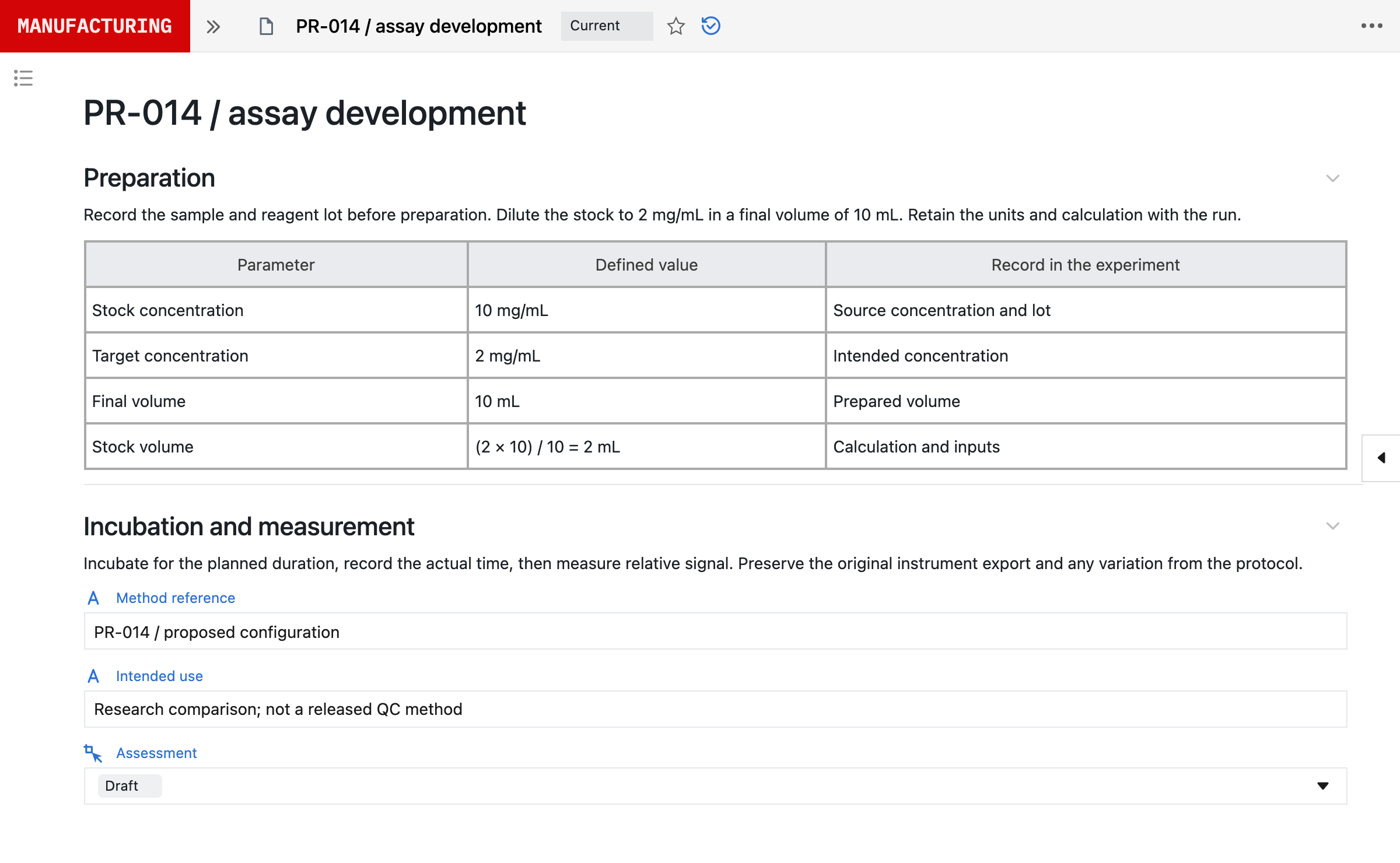
In Seal’s ELN blueprint, development protocol PR-014 v03 requires a sample, a reagent lot and an incubation time, and records a relative signal. Runs EXP-041 to EXP-043 each keep v03 and the values entered for that run. When the method approaches controlled use, v04 is proposed for the receiving QC workflow: the required inputs and calculations, the acceptance criteria, the method qualification and transfer evidence, and the training and review responsibilities. The development runs stay linked behind the proposal. v04 governs new work only after its evidence is assessed and approved, and the three experiments keep the version they ran under.
Because laboratory testing, manufacturing execution and quality workflows share the platform, the receiving team works on the same sample, material and method records rather than a transferred copy. A shared platform does not qualify the method: the transfer assessment still has to be done, and its evidence stays with the proposed version.
4How a workflow change is validated.
Both vendors give regulated customers documented evidence for each change. The difference is what is produced, by whom, and where it lives.
IDBS says its GxP Cloud is designed with the technical controls required by 21 CFR Part 11 and EU Annex 11. Automated IQ/OQ processes and qualification services cover installation and operation, so customers can focus on verifying their configuration and intended use; IDBS’s professional services help with performance qualification and validation artefacts, and IDBS manages the GxP Cloud in a validated state.⁷ In 2026 IDBS added the ability to generate a structured design specification from any Advance workflow template record. The report documents instructions, catalogue mapping, table setup, formulae and formatting for that workflow version, as HTML or JSON, for validation, revalidation, change control and QA review.⁸
In Seal, the user requirements, functional and design specifications and configuration specification are records linked to the configured process. A change to PR-014 is prepared as a changeset that names the affected requirements and protocols and carries its verification. When the changeset is prepared for review, its selected acceptance tests run, and publication requires current passing results. Failures, corrections and retests stay with the candidate revision. A passing check is evidence for your team’s release decision, not a substitute for it. The regulatory guide sets out the approach.
To compare the two in practice, change one calculation in a GxP workflow in each system, include a failed test and its retest, and inspect the evidence that remains afterwards.
5Where IDBS Polar is the better fit.
IDBS Polar is the better fit for large research and development organisations that want one enterprise informatics platform across discovery and development.
- You are standardising ELN, LES and inventory across discovery, development and partner CROs, with IDBS’s professional services implementing it.¹⁷
- Your scientists work in spreadsheet-style workflows with complex analysis inside the workflow, which Advance is designed for.¹
- You want ready-made accelerators for cell line development, bioprocess, ICH M10 bioanalysis or DMPK.⁴
- Your chemists need molecule and reaction drawing and stoichiometry in the same platform.¹
- You need manufacturing process data from several sites and contract manufacturers brought together for continued process verification, which PIMS does.⁶
- You already run E-WorkBook and want a supported path to Polar with your workflows and data.³
6Where Seal is the better fit.
Seal is the better fit when development work has to become controlled work, and the quality system has to see both.
- You want the development protocol, the QC method, the batch record and the deviation or change it leads to on one set of records, with relationships the work and Neil can follow: a sample belongs to a batch, a result comes from a test, and an investigation links to the affected work.
- You expect methods and calculations to keep changing. Each improvement becomes a new version with its specifications, test evidence and approvals, and earlier runs keep the version they used.
- You want an AI agent that prepares work in the system. Describe a preparation and Neil proposes its inputs, calculation and sample and material links as a reusable protocol; ask why EXP-043 read lower and Neil shows that the incubation time stayed the same while the reagent lot changed: a difference to investigate, not a cause. In line with the EU’s draft GMP Annex 22 on AI, Neil is not used in GMP execution. It helps set up configuration, which your team verifies and releases under change control.
- You want to start with one protocol rather than an enterprise implementation. MiAlgae runs ELN, quality and electronic batch records in Seal from lab to commercial scale.
7Running Seal alongside IDBS Polar.
You do not need to replace Polar to start. A common split keeps research and process development in Polar and runs one controlled QC or manufacturing process in Seal.
Seal has no dedicated IDBS connector. Where a system is not on Seal’s integrations list, Seal’s REST API reads and writes records from another system, and Scripts, versioned Python in Seal, can call an external service after an event or on a schedule; Scripts are edited in a changeset, tested and published like other Seal records. On the IDBS side, Polar’s integration framework offers APIs and one-way and two-way data flows.⁵ Instrument files can reach Seal directly: the installable Seal IoT agent watches an instrument’s export folder and uploads supported files to a configured Seal record.
Start with read access, and treat any write-back to Polar as a separate decision with defined actions, review gates and audit evidence. Agree the source identifiers and field mappings, test missing, delayed and duplicate records, and reconcile transferred records against the source. The scope also names which system stays the source of truth for each record.
8Moving from IDBS Polar to Seal.
Move one protocol first, and leave the rest in Polar until you decide otherwise.
- Choose work where development and control meet: a method approaching transfer, a frequently repeated assay or a calculation that changes often.
- Bring the protocol, a few representative runs and the files behind their results. Start with sample material, or arrange an NDA before sharing confidential records.
- Neil configures the protocol from your description or procedure: required inputs, units, calculations and sample and material links. Your scientists check it against how the work runs. Once the scope is agreed and the inputs received, Seal prepares the first working process and its validation pack within 48 hours. Production timing then depends on scope, interfaces, migration and your release requirements.
- Test a normal run, missing data, a deliberate variation and a changed protocol before you rely on it.
- Scope the exports, attachments, metadata, permissions and history of any Polar or E-WorkBook records you plan to move. Map reusable fields where possible, preserve the source records and keep gaps visible: a PDF rendition is not a recovered native experiment.
Retention obligations continue for the records that stay in Polar. The ELN blueprint shows the experiment and protocol model in detail.
References
- 1IDBS Polar software for labs from research to development, IDBS. https:/
/ www. idbs. com/ polar/ (read 8 October 2026) - 2Find out more information about us, IDBS. https:/
/ www. idbs. com/ about/ (read 8 October 2026) - 3IDBS E-WorkBook, IDBS. https:/
/ www. idbs. com/ products/ e- workbook/ (read 8 October 2026) - 4IDBS Polar Accelerator library, IDBS. https:/
/ www. idbs. com/ accelerator- library/ (read 8 October 2026) - 5IDBS Polar Integrations, IDBS. https:/
/ www. idbs. com/ products/ integrations/ (read 8 October 2026) - 6IDBS PIMS for a single source of manufacturing & quality data, IDBS. https:/
/ www. idbs. com/ pims/ (read 8 October 2026) - 7Comprehensive GxP solutions, IDBS. https:/
/ www. idbs. com/ about/ comprehensive- gxp- solutions/ (read 8 October 2026) - 8What’s new 2026, IDBS. https:/
/ www. idbs. com/ 2026- what- is- new/ (read 8 October 2026)
AQuestions and answers
Is Seal an alternative to IDBS Polar?
Yes, for teams whose development work has to become controlled QC, manufacturing and quality work. In Seal those workflows share one ontology, and each change is released with its specifications and acceptance tests. Polar suits enterprise research and development groups, and you can start Seal on one protocol alongside it.
What is the difference between IDBS E-WorkBook and IDBS Polar?
IDBS released E-WorkBook in 2006 as an on-premise, configurable ELN and released Polar in 2020 as its cloud-based evolution. IDBS says Polar keeps E-WorkBook’s capabilities and adds further modules and a data modelling architecture, and E-WorkBook customers can move to Polar with their workflows and data.
Who owns IDBS?
IDBS is part of Danaher. It was founded in 1989 and also offers PIMS for manufacturing process data and ActivityBase for screening data.
Can Seal work alongside IDBS Polar?
Yes. Seal has no dedicated IDBS connector, but its REST API and Scripts can connect a system that is not on its integrations list, and Polar offers APIs for one-way and two-way data flows. Start with read access and agree which system is the source of truth for each record.
How does validation compare between IDBS Polar and Seal?
IDBS provides automated IQ/OQ for its GxP Cloud, helps customers with performance qualification and can generate a design specification from a Polar workflow template. In Seal, requirements, specifications and selected acceptance tests stay with each changeset, and publication requires current passing results. In both, your team owns the intended use and the release decision.
How long does it take to start with Seal?
Once the scope is agreed and the inputs received, Seal prepares a first working process and its validation pack within 48 hours, configured from one of your protocols or procedures. Production timing then depends on scope, interfaces, migration and your release requirements.