Summary
- The problem
- Investigations are assembled by hand from exports and screenshots, and a corrective action often ends as a revised document and a training task. Nothing in the work itself changes, so the same failure can recur.
- Seal’s approach
- Each event opens with its evidence, read from Seal or from the ERP, LIMS, MES and training systems you already run. A corrective action can become a control in the workflow, released through change control with its own verification.
- Neil
- Seal’s AI agent configures the workflow from your procedure, assembles the evidence for an investigation and drafts the corrective change with its verification. Your team reviews and approves. About Neil.
- What it covers
- Deviations, CAPA, change control, documents, training, audits, suppliers, complaints and risk. All capabilities.
- Evidence
- Skye Biologics: 40% fewer non-conformances. Acclinate: 50% shorter quality cycle times. Bioventix: 80% less document admin time.
- Where to start
- One quality workflow in a 48-hour evaluation: a procedure, a representative event and the records it touches. Book a demo.
1A system of record files what went wrong. Seal changes what happens next.
A traditional eQMS is a system of record. It was built to file quality events as forms and documents, it sits beside the work, and it is validated once and then changed as rarely as possible.
| A traditional eQMS | Seal | |
|---|---|---|
| Where it sits | A record kept beside the work | In the work, or reading it directly |
| Evidence | Exports gathered by hand | Links to the batch, step and version |
| Corrective action | A document and a training task | A control in the workflow |
| Effectiveness | A task marked complete | Measured on the runs that follow |
| Change after go-live | A revalidation project | A controlled change with verification |
| AI | Text to paste elsewhere | Neil proposes a configured change |
| Getting started | An implementation project | A 48-hour evaluation on one process |
It can show what went wrong, who assessed it and who signed. It cannot put a check in front of the next operator.
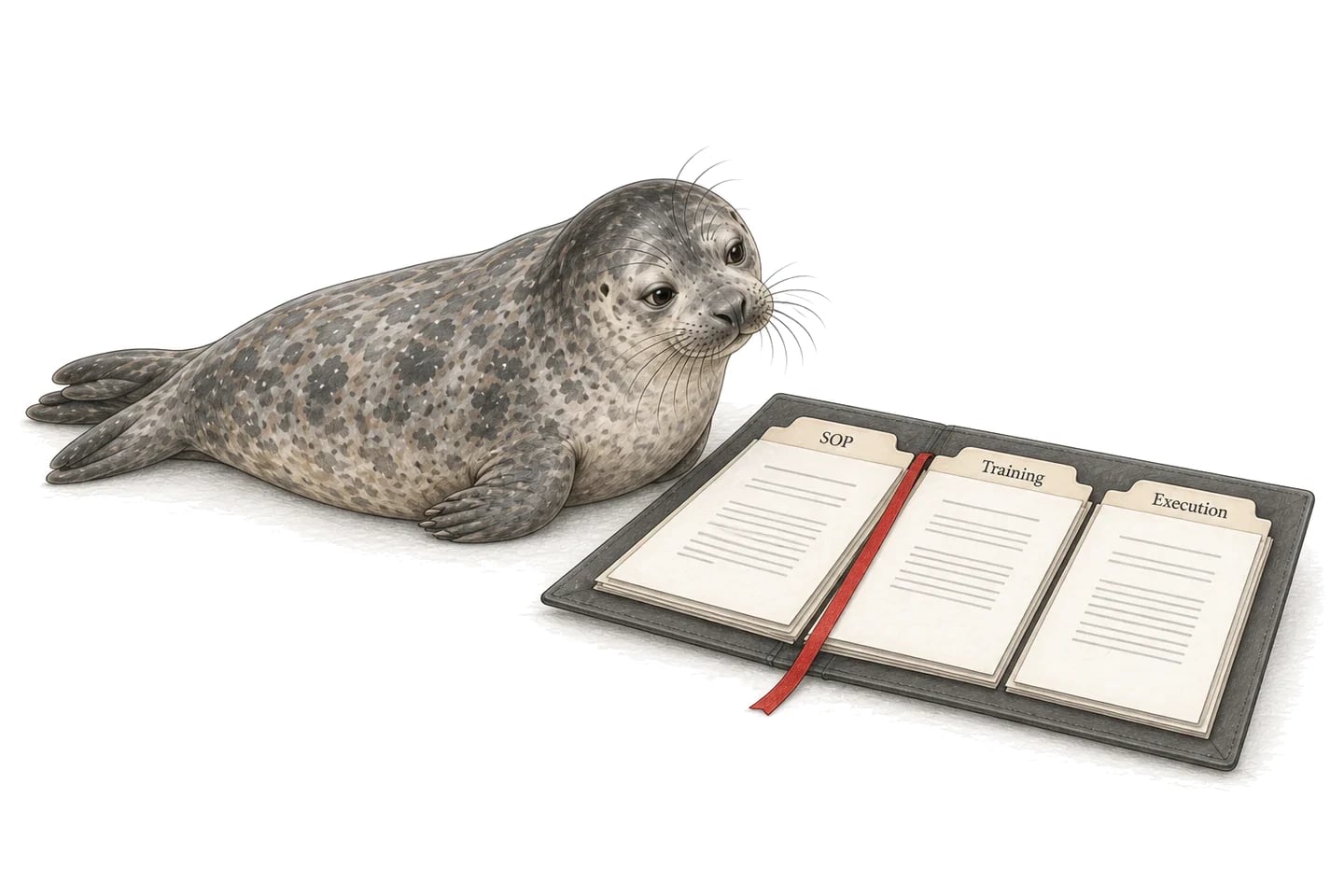
So a CAPA ends with “update the procedure”, and the work is not finished. The procedure, training and execution live in separate tools, and someone must carry the change across them and establish what is now in force.
Seal is where the work runs, or it reads the work directly from the systems that run it. The finding, its evidence and the response sit on the same record as the work, and a corrective action can be released as a change to the workflow itself, carrying its procedure version, affected roles, operating controls, verification and approval.¹ The next batch runs the improved process, and the quality system gets better with each investigation instead of drifting out of date.
Quality creates value when what you learn changes how the operation runs. Neil helps investigate and prepare the change; your team reviews the evidence and authorises the decisions.
You can start with one quality workflow, alongside the eQMS you already have. The advantage grows as laboratory, manufacturing and quality use the same connected foundation: less reconstruction between teams, and a clearer path from a finding to an improvement that can be verified.
2Neil prepares the work. Your team decides.
Neil is Seal’s AI agent. It works across the same records your team does, within the permissions of the person asking, and what it produces is work in the system: a configured workflow, an assembled investigation or a prepared change. It does not hand back text to paste somewhere else.
| Neil prepares | Your team decides | |
|---|---|---|
| Set-up | The workflow from your procedure | Whether it matches the work |
| Investigation | Similar events and their sources | Cause and impact |
| Corrective action | The draft CAPA and configured change | Approval and release |
| Trend review | The events behind the pattern | What needs investigating |
| Audit preparation | The evidence and the gaps | What is ready |
Everything in the middle column is preparation. Nothing Neil produces takes effect until a qualified person has reviewed it, and required people and signatures still control the decisions.
In line with the EU’s draft GMP Annex 22 on AI, Neil is not used in GMP execution. It helps set up configuration, which your team verifies and releases under change control. Customer data is not used to train AI models, and the requester’s permissions govern what Neil can read. See how Neil fits Annex 22 and more about Neil.
3Connect quality to the systems you already run.
Quality decisions are about work that happens somewhere else: a batch step in the MES, a result in the LIMS, a material lot in the ERP, a training record in the learning system.
| Where the work runs | What the quality record uses | Connections include |
|---|---|---|
| ERP | Suppliers, materials, lots and bills of material | SAP, NetSuite, Oracle Fusion, Dynamics 365 |
| LIMS | Samples, tests and results | LabWare, LabVantage, SampleManager |
| MES and process data | Batch steps, process values and history | Tulip, Emerson DeltaV, AVEVA PI |
| Training | Courses, enrolments and transcripts | Cornerstone, Docebo |
| Equipment | Calibration, maintenance and work orders | Blue Mountain RAM, IBM Maximo |
| An existing eQMS | Documents, deviations, CAPAs and change controls | Veeva Vault QMS, MasterControl, Qualio, ETQ Reliance |
An investigation is only as good as its route back to those records. Seal reads them where they live, links them to the event and keeps the link with the decision.
You do not need to replace these systems to start. Each connection is scoped before it goes live: what Seal may read, whether anything is written back, which system stays the source of truth and how the mapping is verified. For records that originate outside Seal, the scope also sets ownership, identity mapping and how their history remains available. Some connections are set up per project on the vendor’s API. See all integrations.
Manufacturing, laboratory testing, materials, documents and training can also run in Seal itself. Then quality and execution share the record rather than a link to it: a deviation points to the step that produced it, and a corrective action can change the workflow people run.
Neil works through the same connections. A question about a batch can draw on its ERP, LIMS and MES records, with each fact traced to its source.
4Investigate from the evidence, not from exports.
Each event records the finding, the immediate response and the affected work. Investigators assess the evidence and justify the conclusion.²
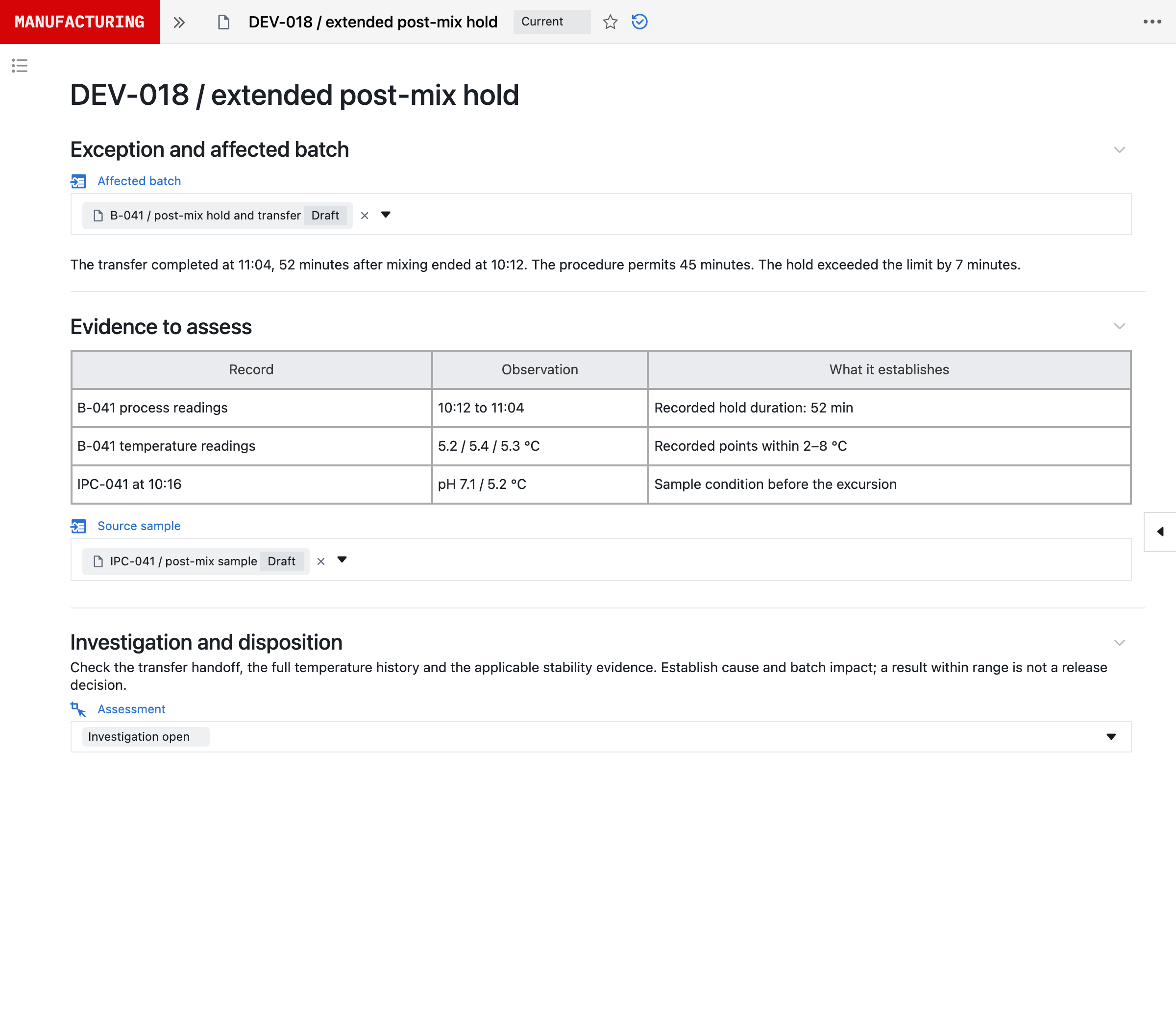
In the hold-time example, the investigator can follow DEV-018 to batch B-041, its start and transfer timestamps and the version of MBR-014 used during execution. Relevant laboratory results and material records remain separate records with their own history, connected to the same assessment. The reviewer can examine the evidence rather than rely on values retyped into the deviation form.
That context reflects the event, not just today’s state. The investigation works from the procedure version that was in force and the relevant timestamps, and from the training and equipment evidence for the time of execution.
Missing information is part of the investigation. An absent timestamp or an unresolved material match stays visible, rather than being filled with an assumption.
Ask Neil to do the assembling. It locates similar accessible events, compares the recorded conditions and gathers the source references, then drafts a summary for the investigator. A plausible explanation remains a hypothesis until the investigator has assessed it.
What do we know about the B-041 post-mix hold, and has it happened before?
Neil
- Hold 10:12 to 11:04, from the B-041 process record.
- Limit of 45 minutes, from MBR-014 v04.
- Three temperature readings in range; no continuous trace.
- Sample IPC-041, taken at 10:16.
- No earlier holds over the limit on this step.
- Evidence (met)Assembled, with sources
- Cause (not met)For the investigator
- Impact (not met)For the investigator
5Close a CAPA on evidence, not on a completed task.
A CAPA, where one is required, links its actions to the investigation’s assessment, with accountable owners and the basis for judging effectiveness. A completed task does not prove that the problem was addressed.¹
- Action
- Elapsed hold time shown on the step
- Verification
- Holds of 44, 45 and 46 minutes
- Effectiveness
- Hold exceptions over the agreed period
The CAPA carries its success criteria, the observation period, the included population and who reviews it. Verification evidence stays attached, and closure gates can require that assessment. Neil can draft the CAPA from the investigation, with proposed actions, owners and effectiveness criteria, for its owner to edit and approve.
When an action changes a procedure or workflow, the controlled change stays linked to its source finding, and its impact on execution, training, calculations, records and connected systems is reviewed with it. An action can be implemented while an effectiveness assessment is still pending; those are different states.
The distinction matters in practice. Adding a visible hold timer may be an action. Demonstrating that it calculates and routes exceptions correctly is verification. Assessing whether the implemented action addressed the problem over the agreed period is effectiveness review. Seal keeps those records connected without collapsing them into a single “done” checkbox.
6Make the control part of execution.
A procedure in Seal can govern the work rather than sit beside it. Required inputs, limits, review gates and training requirements are configured in the workflow.
A missing prerequisite can block the relevant step, and an out-of-limit measurement can route the work for assessment. Neil proposes the configured change: the field, limit or review gate on the step, and the roles it affects. It stays a proposal until the change is reviewed and released.
For example, a line-clearance workflow can require the relevant equipment status, area check and QA approval before execution. The recorded approval belongs to the reviewed version. The next operator encounters the configured control as part of the task, and the evidence is captured as the task runs.
When a procedure changes, the controlled change identifies the affected roles and training requirements, and the approved transition rules apply to new work. Existing runs retain the versions and history under which they began; a new procedure does not silently rewrite an old execution record.
QC-082, potency
- Laboratory
- Assessment
- Quality
- Investigation
- Batch
- Disposition pending
Batch disposition remains a distinct authorised decision. In the out-
7Keep the system validated as it changes.
A traditional eQMS is validated at go-live. After that each change is a project, so the system changes as little as possible.
A quality system must be able to improve as the operation changes. In Seal the proposed configuration, specifications, test evidence and approval belong to the same controlled change.³ Going live begins that lifecycle rather than ending it.
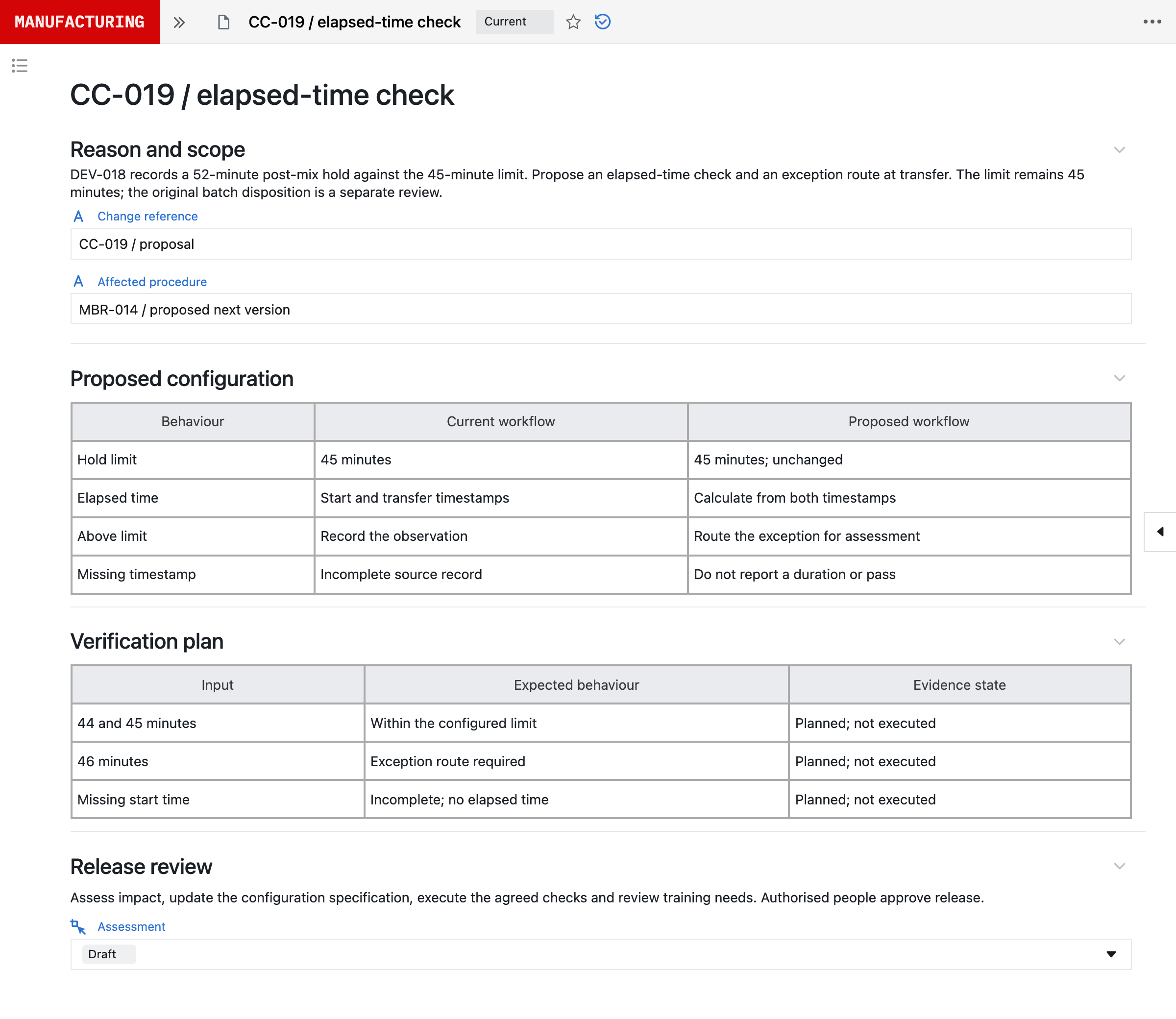
The relevant URS, FS, DS and configuration specification are kept in the platform, linked to the released version.⁴ Each change identifies its intended use, affected requirements and risks. Applicable automated verification and repeatable UAT checks run when the configuration changes, with actual results and exceptions retained against the proposed version. Neil prepares the specifications and verification for a proposed configuration, so the evidence is drafted with the change rather than after it.
Your team reviews the evidence and authorises release. An automated check supports that decision; it is not an independent declaration of compliance. The continuous validation detail explains the risk-based assurance approach and responsibilities.
This applies to the quality workflow itself as well as the operation it governs. A changed classification rule, approval route, calculation or closure gate carries its reason, affected requirements, proposed configuration and verification. Reviewers can see what changes, why it changes and the evidence that supports release.
v04
- RUN-041
- RUN-042
v05
- Requirement (met)URS-014
- Verification (met)TC-014 passed
- Approval (not met)Pending
That is the difference between maintaining a validated state and freezing a system. The controls that make a change accountable are part of the platform used to make it. Teams can improve an established workflow without separating the new configuration from the evidence and decisions that govern it.
8Quality across the product lifecycle.
The same connected foundation supports supplier qualification, incoming inspection, complaints, nonconformances, audits and product reviews. Each event stays linked to the product, material, supplier or process it concerns, with its assessment and decision history.
| Workflow | What it stays linked to |
|---|---|
| Suppliers | The supplier, its material scope and audit findings |
| Incoming inspection | The lot, the supplier record and inventory |
| Complaints | The product, the investigation and any field-action assessment |
| Nonconformances | The material or product and its disposition |
| Audits | The findings and the CAPAs they lead to |
| Product reviews | Batch, laboratory and quality records for the period |
An APR or PQR draws on batch, laboratory and quality records for a defined reporting period and population, with missing data reconciled before the results are interpreted. A complaint may lead to an investigation or a field-action assessment; the responsible team determines the applicable obligations and response.
Workflows are configured for the product and jurisdiction, including design controls and risk management for medical devices. Electronic records, signatures and risk-management features support the quality system; they do not establish regulatory compliance simply by being present.⁵
For a trend review, Neil compares accessible events across a defined period and population, and the team checks missing or inconsistent records and inspects the events behind the pattern. For audit preparation, it assembles evidence against an agreed scope and shows the gaps. Neither a generated report nor an AI readiness assessment predicts an inspection outcome.
9Begin with one workflow worth improving.
Choose a recurring bottleneck: assembling deviation evidence, following actions through effectiveness review or keeping procedure changes connected to training. Bring one procedure, a representative event and the records it touches. Start with sample material or arrange an NDA before sharing confidential records.
Neil proposes the workflow from that procedure: the record structure, classification fields, investigation steps, role assignments and review gates. The quality team reviews the proposal against how the work should actually run.
A deviation-workflow proposal can include links to affected batches and samples, fields for immediate response and impact assessment, assigned investigation work, action records and the required review. A CAPA can add owners, due dates, effectiveness criteria and closure prerequisites. These are parts of a running process the team can inspect and exercise, not only headings in a generated report.
Configure a deviation workflow that links the affected batch, assigns the investigation and requires an effectiveness review before CAPA closure.
Neil
- Record links to the batch, sample and source evidence.
- An investigation owner, reviewers and approvers.
- Decision points for impact, actions and effectiveness.
- Checks for missing evidence and unresolved actions.
- Specifications and verification for the configuration.
Together we define the records, responsibilities, controls and evidence needed. The 48-hour evaluation turns that one process into a working workflow with a validation pack to inspect, so you judge Seal on your own procedure rather than a demonstration. Production timing then depends on scope, interfaces, migration and your release requirements.
Exercise the intended workflow and its failure cases before you approve release. That foundation then expands across quality, laboratory and manufacturing work.
For a migration, agree which records move and which stay retrievable in the existing system. The required relationships, attachments, versions and available audit context are preserved within that scope, and representative records are reconciled and retrieval verified before you rely on the new workflow.
References
- 1ICH Q10, Pharmaceutical Quality System (2008), sections 3.2.2 (corrective and preventive action) and 3.2.3 (change management). ICH
- 221 CFR 211.192, Production record review: an unexplained discrepancy must be thoroughly investigated, with a written record of the conclusions and follow-up. eCFR
- 3EudraLex Volume 4, Annex 11, Computerised Systems (2011), sections 4 (validation) and 10 (change and configuration management). European Commission
- 4ISPE, GAMP 5: A Risk-Based Approach to Compliant GxP Computerized Systems, second edition (2022).
- 521 CFR Part 11, Electronic Records; Electronic Signatures. eCFR
AConnected records
BQuestions and answers
Do we have to replace our existing systems?
No. Seal connects to the ERP, LIMS, MES, training and quality systems you already run, with access and data ownership defined for each connection, so you can start with one quality workflow and its evidence. Where a process runs in Seal itself, quality and execution share the batch, sample, procedure and training records, and a controlled action can change the workflow people run. That is the reason to move a process later, if you choose to.
How is Seal different from the eQMS we already have?
A traditional eQMS is a system of record: it files the event, the investigation and the CAPA while other systems run the work. Seal runs the work, or reads it directly, so an investigation opens with its batch, laboratory and training evidence, a corrective action can be released as a control in the workflow, and the system keeps its validated state as it changes. You can start with one workflow alongside the eQMS you have.
Can we start with just one module?
Yes. Start with a defined workflow such as document control or deviation management, including the records and approvals it needs, and expand from there. Manufacturing, laboratory and quality can share the same records in Seal rather than each adding another disconnected system.
What should we compare during an evaluation?
Follow one event from its source evidence through investigation, action, controlled change and effectiveness review. Inspect the actual records and versions, not only a finished report. Then change a field or approval route and examine the impact assessment, specifications, verification and release evidence. This shows whether the platform improves both today’s investigation and tomorrow’s operating process.
What does continuous validation mean in practice?
A proposed configuration change keeps its reason, affected requirements, specifications, verification and approval in Seal. For a changed limit check, reviewers can inspect the rule and its version, the intended behaviour, actual test results, exceptions and the release decision. The same applies to the quality workflow itself, such as a classification rule or a closure gate. Your team assesses risk and evidence and authorises release, and earlier work keeps its recorded version.
Can the quality workflow itself change after go-live?
Yes. Changes to classification, routing, calculations and approval or closure gates are controlled configuration changes. The relevant requirements, specifications, verification and UAT evidence stay with the proposed version. The team reviews the evidence and approves release; historical work retains its recorded version.
Does Seal support 21 CFR Part 11?
Seal includes audit history, versioned records, access controls and electronic signatures. Compliance also depends on the intended use, the configuration and the procedures around the system, so review the controls and verification evidence with your team before release. The regulatory page sets out the technical detail and responsibilities.
What does Neil do in a quality system?
Neil is Seal’s AI agent. It configures a quality workflow from your procedure, assembles the evidence for an investigation, drafts CAPAs and the configured change with its verification, and prepares trend reviews and audit evidence. Everything it produces is a proposal for a qualified person to review. Approvals, dispositions and signatures stay with your team.
How does Neil fit the EU’s draft Annex 22 on AI?
Neil is not used in GMP execution. It helps set up configuration and prepare drafts, which your team verifies and releases under change control. The regulatory guide explains how this maps to the draft annex.
Can Neil close an investigation or release a batch?
No. Neil assists with evidence, comparisons and proposed actions. Investigators assess cause and impact, and authorised people make the approval and disposition decisions. Completing a task, closing a CAPA and releasing a batch are separate decisions.
Why use one platform for quality and execution?
The investigation can refer to the batch, method, material and procedure records used during execution. A controlled change can carry its affected workflows and verification evidence. Neil and your team work across that connected context, instead of treating quality as a separate summary of what happened elsewhere.
How is this different from AI document tools?
AI document tools draft the paperwork about a process. In Seal, a deviation is a workflow with investigation phases, approvals and effectiveness checks, linked to the batch, equipment and operator involved. Neil can draft documents too, and each draft is a starting point for review within that controlled process.
How does training connect to a procedure change?
Procedures and their versions are mapped to the roles that need them. A controlled change identifies the affected people and their training assignments, and a step can require current training before it runs.
Can I import my existing procedures?
Yes. Existing documents can be imported in bulk and kept as PDFs at first, then converted to structured Seal documents as they are revised. The migration does not have to happen all at once.
What about our existing deviation and CAPA data?
Agree which records move and which stay retrievable in the legacy system. Relationships, attachments, versions and available audit context are preserved within the agreed scope, and representative records are reconciled before you rely on the new workflow. Retention obligations continue for historical records.