
Summary
- In short
- Signals Notebook is a SaaS notebook for chemistry, biology and formulation research, with native ChemDraw, inventory, Spotfire analytics through Signals One, and a validation programme with staged vendor releases for validated use. In Seal, laboratory, manufacturing and quality work share one ontology, and changes to your own protocols and calculations carry their specifications and test evidence.
- When it fits
- Your research is chemistry-led and runs on ChemDraw, you want Spotfire and structure–activity analysis on the same platform, you work across pharma, materials or food science, or you want a vendor-managed validated notebook with predictable release cycles.
- When Seal fits
- Your own templates, calculations and limits change often and have to reach controlled QC, manufacturing and quality work, and you want Neil to prepare protocols and changes for your team to verify and approve.
1Revvity Signals Notebook and Seal, side by side.
Signals Notebook and Seal are both cloud software for scientific records with audit trails and electronic signatures, and both can be validated for GxP use. They differ in what a change means. Signals Notebook is a cloud-native SaaS notebook whose vendor ships frequent releases, integrated with ChemDraw and Spotfire and extended by Signals One.¹ In Seal, teams configure laboratory, manufacturing and quality workflows on one platform around a shared ontology, and each change to that configuration is released with its own test evidence.
| Signals Notebook | Seal | |
|---|---|---|
| What it is | Cloud-native SaaS ELN | GxP operating system for biopharma |
| Owner | Revvity Signals Software, Inc. | Opvia Ltd., trading as Seal |
| Chemistry | Native ChemDraw, stoichiometry | Samples and lots as linked records |
| Analytics | Spotfire; SAR in Signals One | Neil compares runs, with sources |
| Vendor releases | Ten a year; three in validated use | Your changes released as changesets |
| Validation | IQ/OQ packages, staged tenants | Selected checks run on each change |
| Instruments | Signals DLX, powered by Scitara | Seal IoT, any file-saving instrument |
| AI | Signals AI and AI Explorer | Neil proposes; your team approves |
| Getting started | Free trial or Standard Edition | A 48-hour evaluation on one process |
2What Revvity Signals Notebook is built for.
Signals Notebook is built for research teams in pharmaceuticals and biotechnology, chemicals and materials, and food, flavour and fragrance who want a notebook delivered entirely as a service. Revvity says it is used by one million scientists.¹
It is sold by Revvity Signals Software, Inc., part of Revvity. Revvity Signals traces its history to CambridgeSoft and ChemDraw, and its portfolio includes ChemDraw, Signals Notebook, Signals One, Signals Clinical, Spotfire, Signals BioDesign, Signals LabGistics and Signals Xynthetica. ACD/Labs, the analytical and chemistry software company, is now part of Revvity Signals.²
Revvity describes Signals Notebook as cloud-native rather than server software hosted in the cloud, running on AWS with encryption at rest and in transit, SOC 2 Type II certification, role-based permissions and multi-factor authentication.¹ Scientists document experiments with flexible templates, rich text and embedded media, organise them in folders with tags, and share, comment on, review and approve entries with electronic signatures. Native ChemDraw integration automates stoichiometry, accepts SMILES strings and ChemDraw files, and searches chemicals by CAS number, structure or name. Inventory in the notebook tracks chemicals, reagents and samples with barcodes, locations and low-stock alerts, and open APIs connect it to LIMS, ERP and other systems.¹ Signals DLX, an integration platform powered by Scitara, captures and parses instrument data into the notebook.³
Signals One extends the notebook with AI-enhanced workflows, structured data handling, integrated analytics and deeper structure–activity analysis, with Spotfire for advanced visualisation.¹⁴ Its AI, Signals AI, includes AI Explorer, an assistant that searches, analyses and reports across experiments in natural scientific language, and Revvity offers access to external predictive models, including Lilly’s TuneLab models, through Signals Xynthetica.⁵
3Two kinds of change: the vendor’s release and your own.
A validated notebook has to absorb two kinds of change: new versions of the software, and changes your organisation makes to its own templates and calculations. Revvity’s published validation programme is organised around the first. Seal’s change model is organised around the second.
Revvity ships Signals Notebook in ten releases a year, applied automatically.¹ For regulated customers it offers a different rhythm: predictable release cycles three times a year, staggered month by month, with each release tested and rolled out across three tenants, sandbox, staging and production. Revvity provides validation documentation, IQ/OQ deliverables and release-specific reports, supports customers through configuration, performance qualification and user acceptance testing, and manages the infrastructure, disaster recovery and security.⁶ The product page adds prebuilt IQ, OQ and PQ templates for pharmaceutical and biotech environments.¹ Revvity publishes accounts of Eli Lilly and Roche Diagnostics running Signals Notebook in GxP settings.⁶
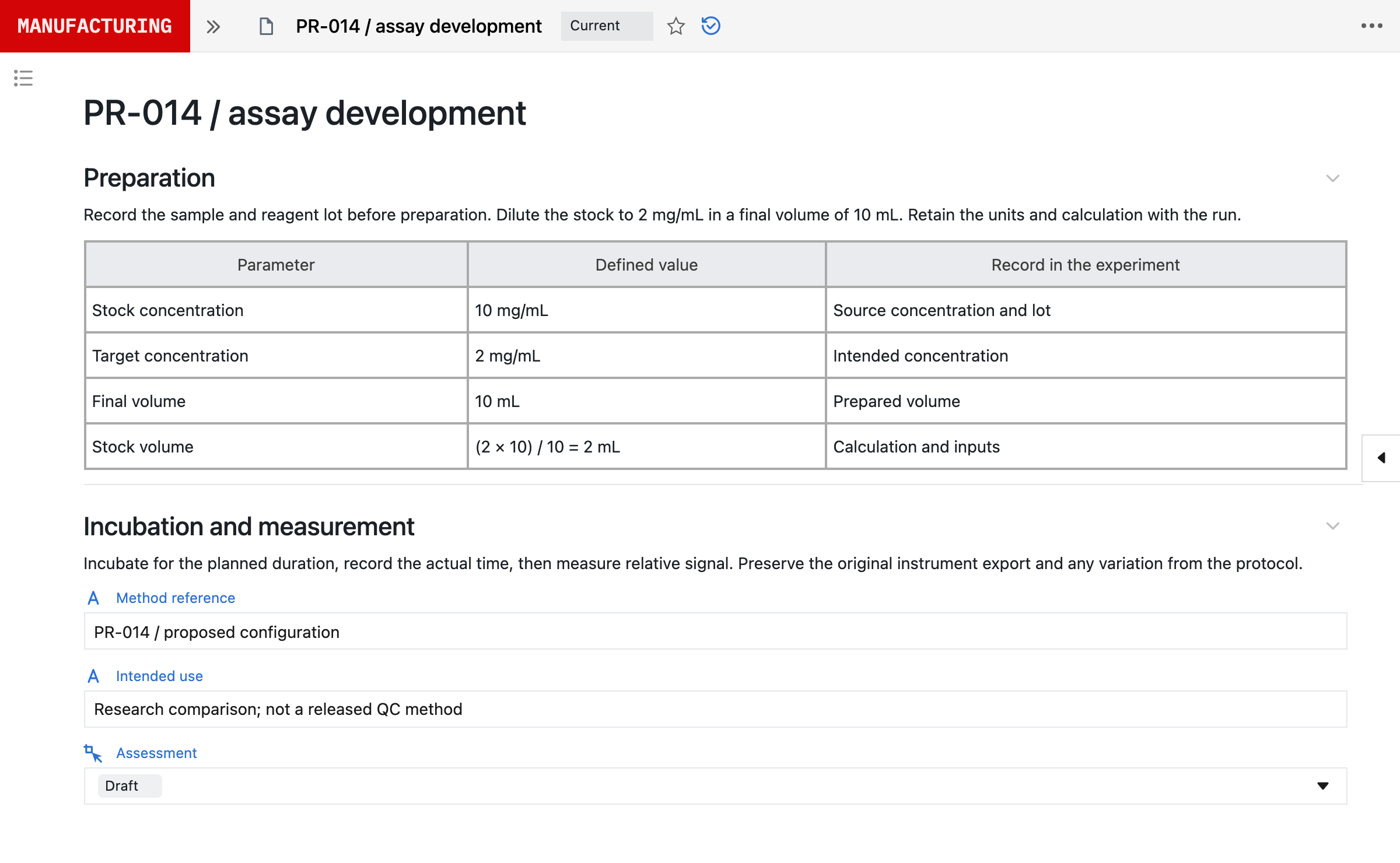
In Seal, the configuration your team relies on is versioned with its evidence. Take the dilution calculation in Seal’s ELN blueprint: for a 10 mg/mL stock, a 2 mg/mL target and a 5 mL final volume, the protocol calculates 1 mL of stock. A proposed change to that formula is prepared as a changeset carrying the formula before and after, the reason, the affected protocols, expected results for representative inputs, and tests that a missing or zero stock concentration cannot produce a valid result. The user requirements, design and configuration specifications it affects are updated with it. When the changeset is prepared for review, its selected acceptance tests run, and publication requires current passing results. New work uses the approved version; earlier experiments keep the calculation and values recorded at the time.
To compare the two, ask each to take one calculation change in a regulated template from proposal to release, including a failed test and its retest, and to show which evidence covers the next vendor release.
4Where Signals Notebook is the better fit.
Signals Notebook is the better fit for research organisations that want a widely used SaaS notebook with chemistry at its centre.
- Your chemists work in ChemDraw and want stoichiometry, structure formats and chemical search inside the notebook.¹
- You want Spotfire analytics and structure–activity analysis on the same platform, through Signals One.⁴
- You work across pharmaceuticals, materials or food science and want one notebook for all of them.¹
- You want a vendor-managed validated notebook with staged tenants, IQ/OQ deliverables and predictable releases, as large pharmaceutical customers run it.⁶
- You want to try it before a larger rollout: Revvity offers a free trial and sells the Standard Edition directly.¹
5Where Seal is the better fit.
Seal is the better fit when your own protocols, calculations and limits are what change most, and the change has to reach controlled work.
- Your protocols define required fields, units and calculations, and each run keeps the protocol version and values it used, so like can be compared with like.
- You want each configuration change your team makes to carry its own specifications, acceptance tests and approvals.
- You want development, QC, manufacturing and quality on one set of records. In Seal’s ELN blueprint, protocol PR-014 v03 becomes a proposed QC method, v04, with its acceptance criteria, transfer evidence and training defined and the development runs still linked.
- You want an AI agent whose output is a proposed configuration rather than only an answer. Neil proposes protocols and changes from your procedures; people verify and approve them. In line with the EU’s draft GMP Annex 22 on AI, Neil is not used in GMP execution. It helps set up configuration, which your team verifies and releases under change control.
6Running Seal alongside Signals Notebook.
You can keep research in Signals Notebook and run one controlled process in Seal. Seal has no dedicated Revvity Signals connector. Where a system is not on Seal’s integrations list, Seal’s REST API reads and writes records from another system, and Scripts, versioned Python edited in a changeset, tested and published like other Seal records, can call an external service after an event or on a schedule. Revvity offers open APIs for Signals Notebook.¹
Start with read access, such as bringing a development experiment’s results and reagent lots into the Seal record that needs them. Treat any write-back to Signals Notebook as a separate decision with defined actions, review gates and audit evidence. Agree identifiers and field mappings, test missing, delayed and duplicate records, reconcile what arrives against the source, and record which system is the source of truth. Instrument files can also reach Seal directly: the installable Seal IoT agent watches an export folder and uploads supported files to a configured Seal record.
7Moving from Signals Notebook to Seal.
Move one protocol first, and leave the rest in Signals Notebook until you decide otherwise.
- Choose a template that is close to controlled use or changes often: a frequently repeated assay, a method approaching transfer or a calculation your team revises.
- Bring the protocol, a few representative runs and the files behind their results. Start with sample material, or arrange an NDA before sharing confidential records.
- Neil configures the protocol from your procedure: required inputs, units, calculations and sample and material links. Your scientists check it against the work. Once the scope is agreed and the inputs received, Seal prepares the first working process and its validation pack within 48 hours. Production timing then depends on scope, interfaces, migration and your release requirements.
- Test a normal run, missing data, a deliberate variation and a changed calculation before you rely on it.
- If records move, scope exports, attachments, metadata, permissions and history first, map reusable fields, preserve the source records and keep gaps visible.
Retention obligations continue for the records that stay in Signals Notebook. The regulatory guide sets out how Seal keeps validation evidence with each version.
References
- 1Signals Notebook, Revvity Signals Software. https:/
/ revvitysignals. com/ products/ research/ signals- notebook- eln (read 8 October 2026) - 2About Us, Revvity Signals Software. https:/
/ revvitysignals. com/ company/ about- us (read 8 October 2026) - 3Signals DLX Scitara, Revvity Signals Software. https:/
/ revvitysignals. com/ products/ research/ signals- dlx- powered- by- scitara (read 8 October 2026) - 4Signals One, Revvity Signals Software. https:/
/ revvitysignals. com/ products/ research/ signals- one (read 8 October 2026) - 5Signals AI, Revvity Signals Software. https:/
/ revvitysignals. com/ products/ artificial- intelligence/ signals- one- signals- ai (read 8 October 2026) - 6Validation Readiness, Revvity Signals Software. https:/
/ revvitysignals. com/ validation- readiness (read 8 October 2026)
AQuestions and answers
Is Seal an alternative to Revvity Signals Notebook?
For controlled development, QC, manufacturing and quality work, yes. Seal runs those workflows on one ontology, and each change to a protocol or calculation is released with its acceptance tests. Signals Notebook suits chemistry-led research teams, and you can start Seal on one protocol alongside it.
Who makes Signals Notebook?
Revvity Signals Software, Inc., part of Revvity. Its portfolio also includes ChemDraw, Signals One, Spotfire for scientific applications and, since its acquisition, ACD/Labs software.
How is Signals Notebook validated for GxP use?
Revvity offers regulated customers release cycles three times a year, rolled out across sandbox, staging and production tenants, with IQ/OQ deliverables, release-specific reports and support for performance qualification. In Seal, validation evidence also travels with each change your team makes: selected acceptance tests run on the changeset and publication requires current passing results.
Can Seal work alongside Signals Notebook?
Yes. Seal has no dedicated Revvity connector, but its REST API and Scripts can connect a system that is not on its integrations list, and Revvity provides open APIs for Signals Notebook. Start with read access and agree which system is the source of truth for each record.
How long does it take to start with Seal?
Once the scope is agreed and the inputs received, Seal prepares a first working process and its validation pack within 48 hours, configured from one of your protocols or procedures. Production timing then depends on scope, interfaces, migration and your release requirements.