Requirements. Tests. Releases. Seal Validation. Nothing released until its tests pass.
Requirements, test cases and runs on the record of the system they prove. A change releases once approved tests pass on its version.
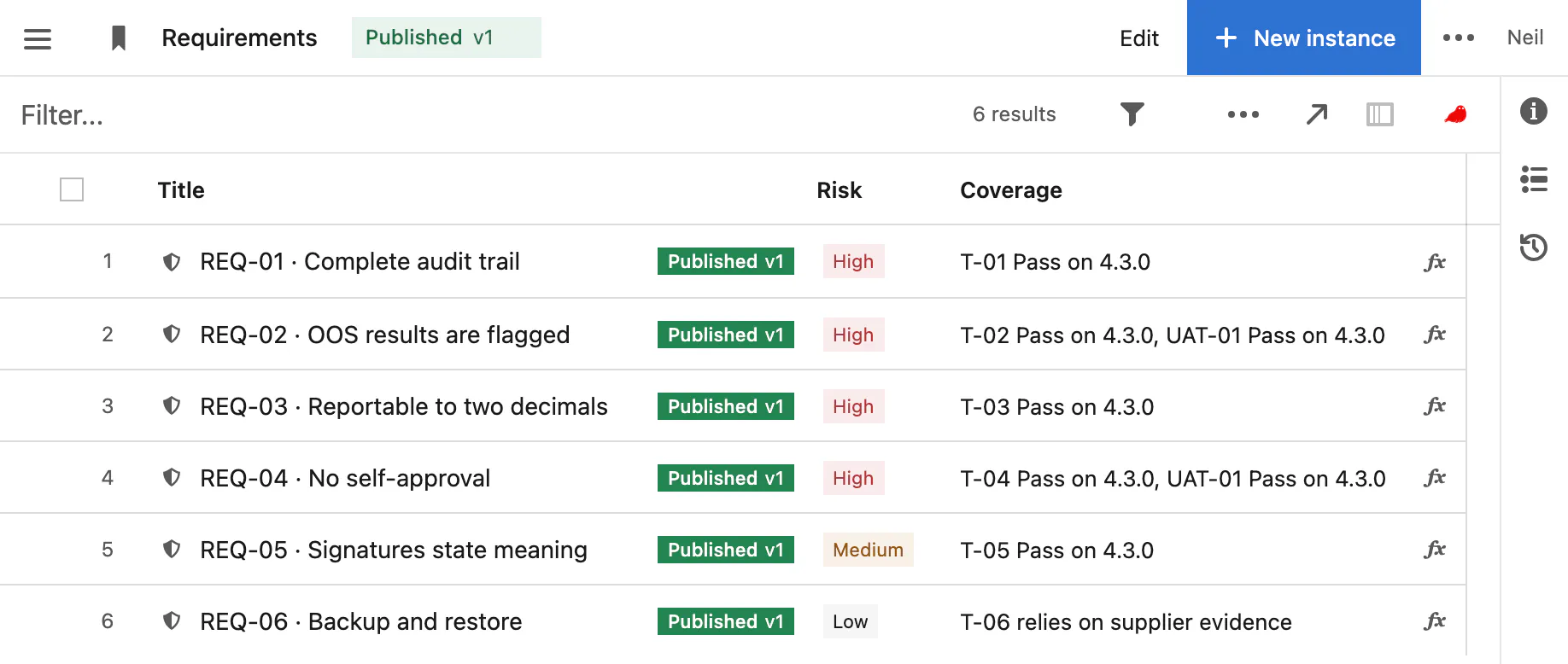
- Requirements as recordsEach one published, with its own version.
- Risk on every requirementHigh, medium or low.
- Coverage, by versionWhich tests pass on 4.3.0.
A test that runs itself.
Where a system has an API, a test case runs from the change: a Seal Script asks the LIMS for result R-1002 and records the run.
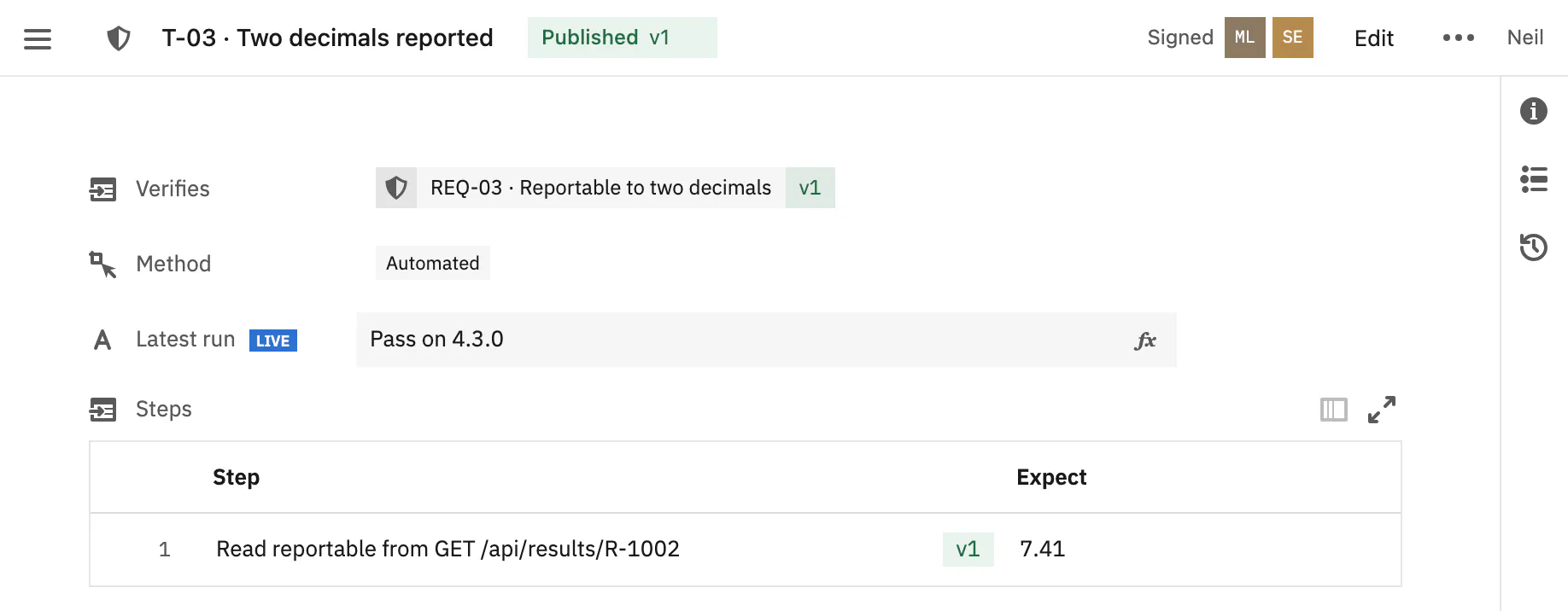
- Tied to its requirementREQ-03, reportable to two decimals.
- Automated, with its latest runA pass on 4.3.0, from the run a Seal Script recorded.
- Approved before it countsTwo people signed it; only approved tests count.
A failed step keeps its evidence.
UAT-01 expected an out-of-specification flag. The LIMS accepted 7.46 without one, and the tester's screenshot stays on the step.
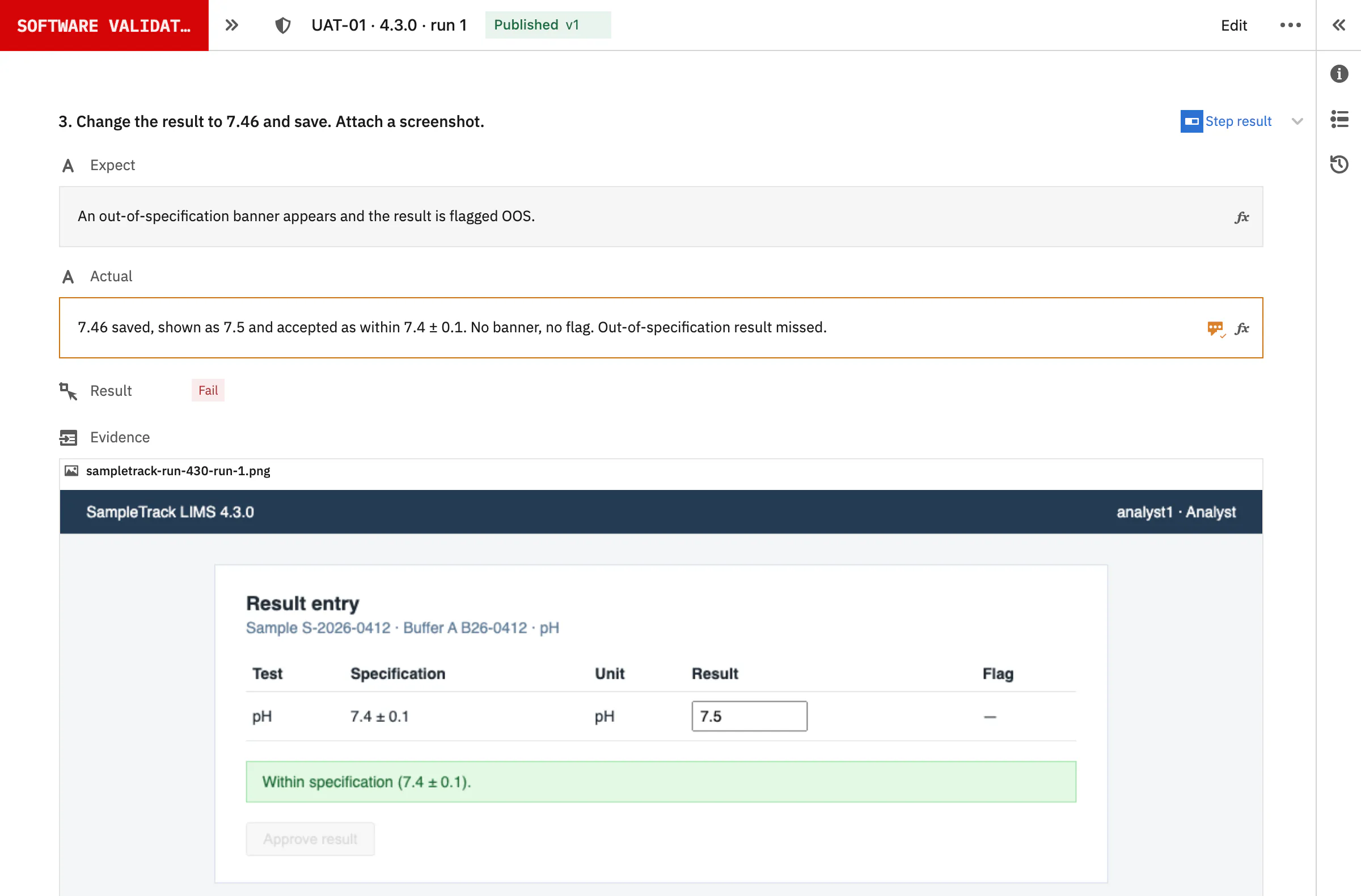
- What should happenAn out-of-specification banner, and the result flagged.
- What did7.46 shown as 7.5 and accepted, with no flag.
- The evidence, attachedThe screenshot from the run, kept with the step.
No release until approved tests pass.
CC-003 cannot publish: its required Check fails while the run on 4.3.1 is unfinished, and four sign-offs are still to come.
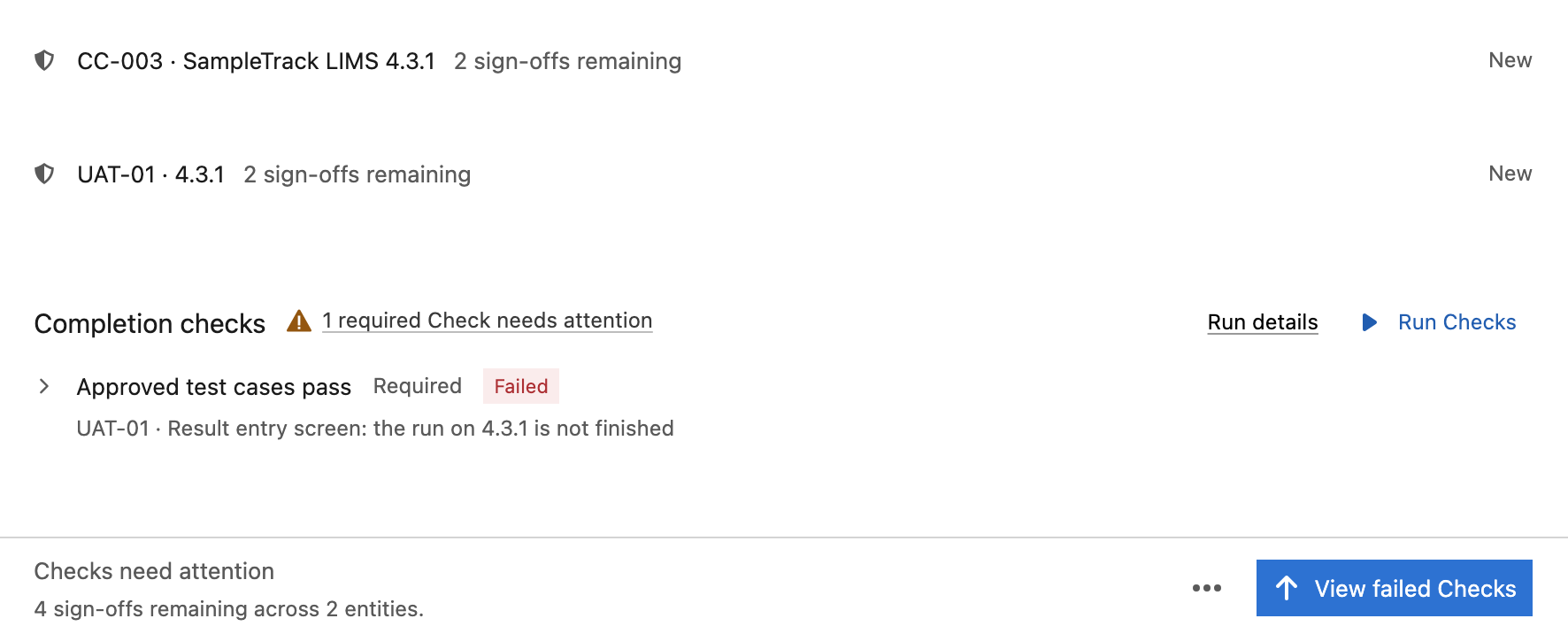
- Sign-offs, countedTwo remaining on the change and two on the test run.
- A required check, failedApproved test cases must pass; the run on 4.3.1 isn’t finished.
Validated once is not validated now.
A validation system keeps the paperwork of one project. Seal keeps the tests on the system's record, and runs them at every change.
| Compared on | A separate validation system | Seal Validation |
|---|---|---|
| Where it sits | Apart from the system it proves | On that system's own record |
| Requirements | A document and a trace matrix | Records, each with its risk and tests |
| Automated tests | Run elsewhere, results attached | Run from the change, kept as runs |
| A failed step | A deviation raised elsewhere | A warning to answer, then a deviation |
| Release | When the summary report is signed | Blocked until approved tests pass |
| The next update | A new project | The same tests, run again |
Questions about Seal Validation.
Can we buy Seal Validation today?
Yes. It is Seal set up for validation, and every screen on this page is Seal as it runs, with sample records. Start from the CSV and CSA blueprint: one system, its intended use, its requirements and the next update its supplier sends.
What can we validate in it?
Computerised systems, by CSV or CSA, and equipment, utilities and facilities through commissioning, qualification and verification, as well as process validation.
Who approves a test case?
A person in Validation, by signing it. Neil can draft test cases from a requirement and its risk; only approved ones count towards a release.
How do automated tests run?
Where the system has an API, a test case can be automated: run from the change, a Seal Script sends the request with credentials stored in Seal, compares the answer and records a test run.
What stops a release?
A Check on the change, which passes only when every approved test case has a finished, passing run on the version being released. The changeset cannot publish until it passes and every sign-off is given.
Does every change to a process need revalidating?
Every change runs its test cases before your QA approves it, and new cases are approved before they run, so a process stays validated without being frozen. How each change is tested.
Do the systems we validate have to run in Seal?
No. Most don't: SampleTrack, the LIMS on this page, runs on its own, and Seal keeps the validation record of it.
See your process in Seal.
Working 48 hours after we agree its scope: tested, with evidence your QA approves.