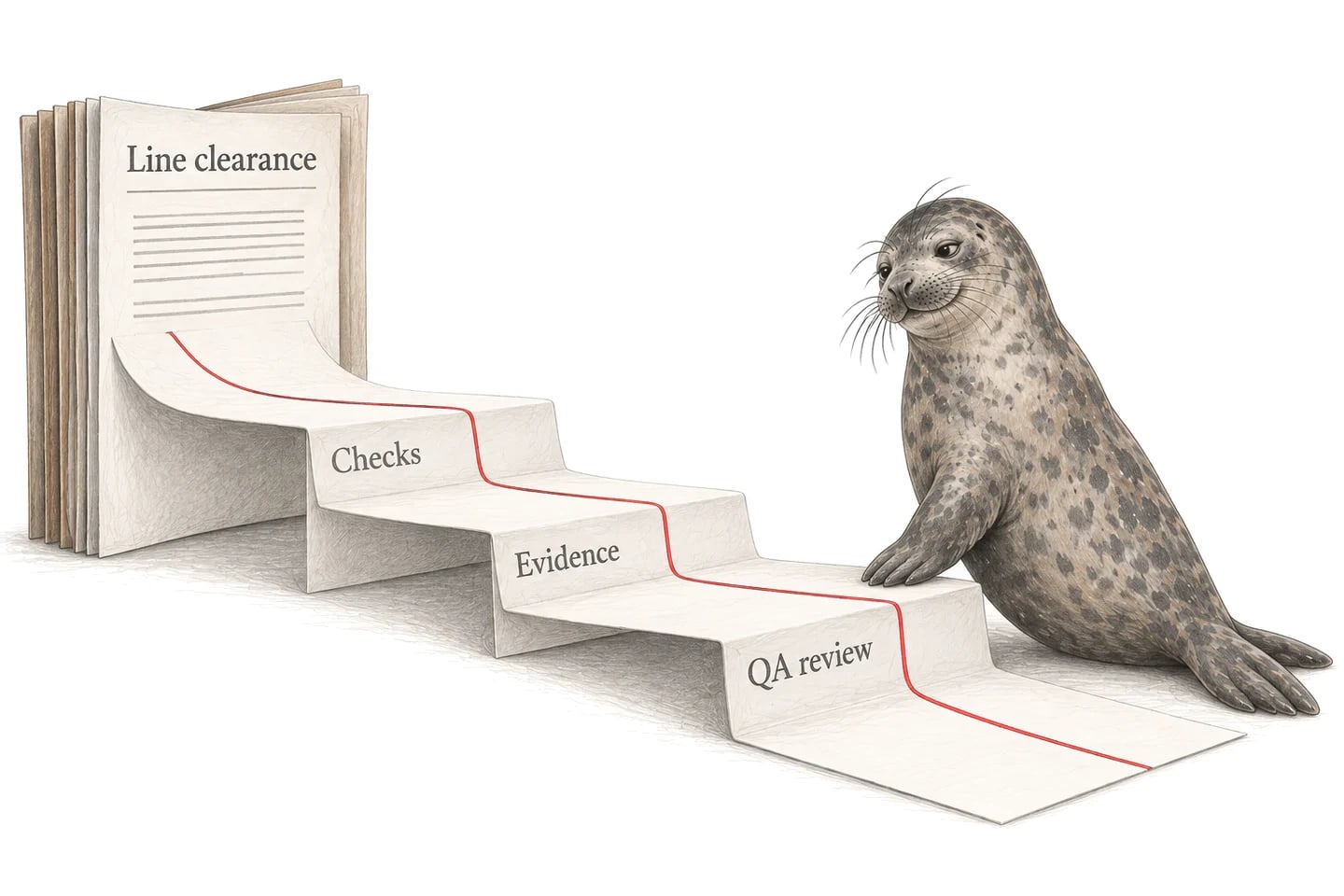
Summary
- The problem
- A batch record displayed on a tablet still relies on people to interpret instructions, transcribe values and calculate results. Missing evidence and unreconciled materials are found in QA review, after the batch has finished.
- Seal’s approach
- Instead of a document displayed on a tablet, the approved master record becomes an executable workflow that checks materials, equipment, training, limits and signatures as the work happens. Exceptions open from the step where they occur, and review begins while the batch is still running.
- Evidence
- Skye Biologics: 40% fewer non-conformances, 35% higher throughput. MiAlgae: 75% less documentation time.
- Where to start
- One representative product, run through authoring, execution, failure paths and release. Book a demo.
1An electronic batch record is a controlled system of execution.
Electronic batch record software should change how manufacturing runs, not only where operators type. A PDF displayed on a tablet is still a document-driven process. People interpret the instructions, transcribe and calculate values, and the missing evidence and unreconciled materials surface in QA review after the batch has finished.
The batch record must show that the approved process was followed and that departures were visible, assessed and resolved.¹ Seal turns the approved master record into an executable workflow. The live record knows which process version, materials, equipment, people, limits, samples and signatures apply, checks evidence as it is created, and begins review while the batch is still running.
1.1Why teams choose Seal for electronic batch records
The master batch record is executable configuration in Seal: instructions, required fields, calculations and review steps on the same platform as materials, equipment, QC and quality. Neil configures proposed workflows from your procedures and prepares improvements from recorded exceptions and results. Your team tests and approves each new version. Batches in progress keep the version they started with; new batches run the released improvement.
| Paper record on a screen | Executable record in Seal | |
|---|---|---|
| Instructions | Read and interpreted by the operator | Resolved from the effective master version, with sequence and prerequisites enforced |
| Materials and equipment | Written down, checked in review | Scanned and checked for status, eligibility and quantity before the step can proceed |
| Values and calculations | Transcribed and calculated by hand | Captured with their source; calculations run from versioned formulas |
| Departures | Annotations, arrows and attached forms | An exception opened from the step, with its context and approval path |
| Review | Page-by-page after the batch | Continuous, focused on exceptions, with the full record available |
Electronic signatures do not replace the underlying manufacturing requirements. FDA’s Part 11 guidance treats electronic-record controls as operating alongside the predicate rules, so the system must first create and retain the record the operation requires.²
2Master records define behaviour, and effectivity decides what runs.
A master manufacturing record contains approved process knowledge.³ Seal represents it as reusable stages and steps with explicit behaviour rather than page layout.
| A step defines | For example |
|---|---|
| Instruction and prerequisites | The expected outcome, and which steps must be complete first |
| Resources | Required materials, equipment class and qualified roles |
| Data | Parameters with units, ranges and source; formulas with their version |
| Checks | The sample, test or inspection the step triggers |
| Signatures | The meaning of each signature and who may give it |
| Transitions | Normal, repeat, rework and abort paths |
Authors reuse approved patterns for dispensing, line clearance, sampling or reconciliation without copying uncontrolled text between records. The displayed instruction is generated from the structured requirements, so the readable record is derived from the same definition as the executable logic rather than maintained separately. Authoring is itself controlled: draft, review, approval, effective and superseded states have defined permissions, and comparisons, signatures and validation evidence stay with the version.
The latest version is not always the correct one. Seal resolves effectivity for the product, site, market and start date when the batch is created, and records the versions selected. A later change does not rewrite work in progress. If an urgent change must apply to live work, authorised users define the transition point and approve the additional instructions, and both the original and changed course remain visible.
Form FRM-001 v2.0
- Operator
- Empty
- Batch
- Empty
- Started
- Empty
- Result
- Empty
Record REC-B-047
- Operator
- J. Chen
- Batch
- B-047
- Started
- 15 Mar, 06:12
- Result
- Yield 98.5%
- Form
- FRM-001 v2.0
Signed and locked
The batch instance then accumulates what actually happened, from the containers consumed and units created to the values recorded, the deviations raised and the final reconciliation. It is the as-executed state of the physical batch, not a filled-in copy of a document.
3Materials, equipment and people are checked at the point of use.
When an operator scans a container, Seal checks it against the effective process: identity and lot, status, expiry or retest date, reservation, quantity and eligibility for this batch. Dispensing can use connected balances and label printers, and the record keeps the balance, gross, tare and net weights, tolerance, source and destination containers, operator and verifier. Partial use updates the source container rather than creating an unexplained inventory adjustment.
A wrong material, rejected lot or quantity outside tolerance does not become a note discovered later. The normal transition is blocked and the approved resolution path begins. Substitutions, overages and returned material each follow their own accountable rule.
- Material (met)Sodium chloride
- Lot released (met)QA-released 2026-03-17
- Not expired (met)Expires 2027-09
- Not quarantined (met)Available
- Grade (not met)ACS scanned, USP expected
The instruction requests an equipment class; execution selects a physical asset. Seal checks its qualification, calibration, maintenance, cleaning and allocation status before the step can begin. People are checked the same way: a user account alone does not establish eligibility, so effective training, role and verifier rules are evaluated at the action. The record stores the state that allowed the work at that time. If a calibration or qualification is later found invalid, impact assessment can identify every affected batch action without reconstructing schedules and sign-in sheets.
4Data keeps its source, and limits control the next step.
Not every value should be typed, and not every automation signal belongs in the batch record. The design question is which evidence supports the accountable manufacturing action. Manual entries retain user, time, unit and correction history. Calculated values retain the formula version, inputs, rounding and result. Readings from balances, scanners and equipment interfaces retain their physical source, while DCS, PLC and historian systems remain authoritative for process control and supply the events, critical values or alarms the record needs.
Every interface defines ownership and failure behaviour. Seal records message identity, acknowledgement and retry, so a message delivered twice or not at all is visible rather than silently duplicated or lost. Operators can see when expected data is pending, and an integration fault is recorded as a fault rather than as a completed step.
A red border on a field is not an exception strategy. Each controlled value has a range and a configured response: continue, require verification, repeat the observation, create a sample, place the batch on hold or open a deviation. The original value and the system’s evaluation stay visible even when the authorised process continues. Calculations such as yield, potency adjustment or material balance are versioned process logic, so a changed formula is a controlled revision tested against representative cases before it takes effect.
Mix timeFrom blender BLD-007
Out of range. EXC-042-01 opened from the step.
5Exceptions and signatures stay inside the execution history.
Paper encourages people to write around problems. Seal makes abnormal paths part of the process: correction, variance, alarm, intervention, deviation, rework, repeat, abort and not-applicable work each have their own permissions, rationale, evidence and approval rules, and the planned path remains visible.
A deviation opened from a step inherits the batch, process version, materials, equipment, values, people and time window, so containment and impact assessment start with a defined population. Authorised rework creates additional executable work without altering the original course. The record answers both what happened and how the quality system responded.
A signature identifies the record, signer, time and meaning of the act; performing, verifying, reviewing and approving are different decisions. Seal binds each signature to its record,⁴ can require the verifier to be different from the performer and reauthentication for critical actions, and applies the configured behaviour when a signed entry changes. The audit history preserves original and changed values, reasons, users and times, and covers administrative configuration as well as operator fields. FDA’s data-integrity guidance frames the goal as complete, consistent and accurate data across the lifecycle;⁵ a well-designed batch record produces that as the normal output of execution.
- Performed (met)Signed by the operator
- Verified (met)Signed by a second person
- EXC-042-01 (not met)Opened from this step, original value kept
- Approved (met)Signed by QA
6Review begins during the batch, and release uses the live record.
Traditional review starts when the packet reaches QA, and reviewers search every page for missing entries, arithmetic errors, late signatures and unexplained changes. Seal evaluates completeness and exceptions continuously. Reviewers can see completed stages and focus on what needs judgement: values outside limits, corrections and overrides, alarms and interface failures, material or training exceptions, reconciliation outside expected limits and open samples or deviations. Every instruction, value and signature remains available; review by exception directs attention without hiding the batch.
QA can disposition the batch only when the effective release requirements are resolved. Approved, rejected, restricted and pending states remain distinct, and the decision updates the eligible containers and inventory without a second manual status change. The human-readable batch record is generated from the governed data for inspection and archive, while the underlying records stay searchable for investigations, product reviews, continued process verification, complaints and recalls. See batch release for the disposition workflow.
7Plan continuity and migration before go-live.
Electronic execution changes the failure model. Define what happens during an application, network, device, identity-provider, interface or printer outage: the critical steps, safe hold points, queued interfaces and approved contingency records. When service returns, reconciliation establishes which actions occurred and which data arrived, so the official record is completed without duplication or silent transcription. Contingency is a tested procedure for a defined failure, not permission to run a shadow paper system.
Copying every line of a legacy paper record into fields reproduces its ambiguity and review burden. Classify each element instead: instruction, verification, observation, calculated or automated value, laboratory decision, signature, exception path or output that can be derived from data already held. Redesign duplicate prompts, retrospective entries and manual calculations. Migrate active master data, open batches, current inventory and equipment state with controlled reconciliation; closed paper packets can often stay in a validated archive rather than being re-keyed.
Paper record, line by line
- “Add the API”
- Instruction
- “Checked by”
- Verification
- “Mix time”
- Automated value
- “Yield”
- Calculated value
- “Released by”
- Signature
8Validate one representative record with failure paths.
Validation should demonstrate intended use and risk controls, not only that the buttons work. Annex 11 expects the application to be validated.⁶ Replacing a manual operation should not reduce product quality, process control or quality assurance. Start with one representative product and exercise:
- authoring, approval and effectivity, including correct version resolution for a new order;
- valid and invalid material and equipment scans;
- manual, calculated and integrated data capture;
- limits, holds, corrections, deviations and rework;
- signatures, verifier rules and changed-record behaviour;
- interface failure, service interruption and recovery;
- concurrent review, disposition, retrieval and genealogy from the released batch.
The batch record is ready when operators can run the real process, QA can understand abnormal execution without reconstructing it, and the organisation can recover from failure without losing the authoritative record.
References
- 121 CFR 211.188, Batch production and control records: batch production and control records must be prepared for each batch with complete information, documenting that each significant step was accomplished. eCFR
- 2FDA, Part 11, Electronic Records; Electronic Signatures — Scope and Application, guidance for industry (2003). FDA
- 321 CFR 211.186, Master production and control records: master production and control records must be prepared, dated and signed by one person and independently checked, dated and signed by a second person. eCFR
- 421 CFR 11.70, Signature/record linking: electronic and handwritten signatures executed to electronic records must be linked to those records so they cannot be excised, copied or otherwise transferred to falsify a record. eCFR
- 5FDA, Data Integrity and Compliance With Drug CGMP: Questions and Answers, guidance for industry (2018): complete, consistent and accurate data should be attributable, legible, contemporaneously recorded, original or a true copy, and accurate (ALCOA). FDA
- 6EudraLex Volume 4, Annex 11, Computerised Systems (2011), sections 4 (validation) and 10 (change and configuration management). European Commission
ACapabilities
| Capability | What it covers |
|---|---|
| Structured master records | Master records are versioned stages and steps with explicit materials, equipment, parameters, calculations, samples, signatures and branches. Effectivity decides which version a new batch runs. |
| Guided batch execution | Operators work through steps resolved from the effective master version, with prerequisites, sequence, roles, limits, holds and signatures applied as configured. |
| Material verification | Scanned containers are checked for identity, status, expiry, quantity and eligibility at the point of use, with balance capture, labels and reconciliation linked to the step. |
| Equipment and training gates | Qualification, calibration, maintenance, cleaning and allocation status, together with the user’s effective training and qualification, are checked before a step can begin. |
| Automated data capture | Equipment, automation, historians, balances, scanners and instruments contribute values with their source. Each interface records message identity, acknowledgement and retries. |
| Controlled exceptions | Corrections, overrides, alarms, holds, deviations, repeats, rework and aborts each follow their own path and keep the original execution visible. |
| In-process testing | Steps create samples and wait on decisions where required. Approved results return from QC with their method, investigation and review attached. |
| Electronic signatures | Performance, verification, review and approval signatures bind the signer, time, meaning and record state. A verifier can be required to differ from the performer. |
| Review by exception | Changed data, failures, alarms, overrides, missing evidence, open samples and deviations are brought to QA as the batch runs, with the full record available. |
| Validation and business continuity | Intended use, risk controls, requirements, tests and release evidence are kept together, along with the approved contingency and recovery procedures. |
BConnected records
CQuestions and answers
What is electronic batch record software?
Electronic batch record software turns an approved master manufacturing record into controlled execution. It guides operators, verifies materials and equipment, captures manual and automated data, performs calculations and applies limits and signature requirements. It manages exceptions, supports review by exception and retains the complete as-executed batch history.
What is the difference between an EBR and MES?
An EBR is the controlled electronic record and execution workflow for a batch. MES is the broader manufacturing execution category that can include scheduling, dispatch, recipes, equipment, materials, work in process, performance and integration. EBR is usually the central regulated use case of pharmaceutical MES, but buyers may implement a focused EBR scope first.
Is a PDF batch record an electronic batch record?
A PDF can be an electronic record, but showing a paper form on screen does not provide executable controls. An executable record verifies physical objects, applies prerequisites and sequence, evaluates limits, captures source data, keeps corrections visible, opens exceptions and shows completeness as the batch runs. The final PDF is an output of that structured execution.
How does an electronic batch record support 21 CFR Part 11?
Seal provides unique identity, role-based access, record versioning, audit history, reason for change, electronic signatures, retention, retrieval and controlled export. Part 11 compliance also depends on the manufacturer’s intended use, validation, procedures, security, training, administration and applicable predicate-rule requirements.
Can Seal convert existing paper batch records?
Yes, but not by line-by-line transcription. Each paper element is classified as an instruction, verification, observation, calculation, sample, signature, exception path or derived output. Duplicate prompts, retrospective fields, manual arithmetic and data already available from equipment are redesigned as executable controls.
Can the EBR integrate with ERP, DCS, historians and instruments?
Yes. ERP can provide approved orders and references; DCS, PLC, SCADA, equipment and historians can provide contextual process evidence; balances and scanners can verify materials; QC and instruments can return results. Every interface defines authoritative ownership, message identity, acknowledgement, retry, failure, correction and reconciliation.
How are corrections handled in an electronic batch record?
The original value remains visible. An authorised user enters the corrected value with reason, identity and timestamp, and the record applies any required re-review or signature behaviour. Corrections are distinguishable from repeats, overrides, deviations and rework so the execution history remains understandable.
How does review by exception change batch review?
Seal evaluates completeness and exceptions as the batch runs, identifying out-of-range values, corrections, overrides, alarms, failed checks, late or skipped steps, interface faults, open samples and missing evidence. QA reviews those events in context instead of searching every page for possible issues. The complete record remains available.
Can operators continue during a system outage?
Only through an approved and tested business-continuity procedure. The design defines safe hold points, critical work, contingency records, service and interface recovery, and reconciliation back into the authoritative electronic record. An outage must not create an uncontrolled shadow record or duplicate execution.
Does an EBR support rework and reprocessing?
Yes. Authorised rework or reprocessing creates controlled additional execution linked to the original batch, rationale, approval, instructions, materials, equipment, samples, results, yields and impact. The original planned and executed course remains unchanged and visible at review and disposition.
How should electronic batch record software be validated?
Validation should be based on intended use and risk. Test authoring and effectivity, roles, material and equipment verification, manual and integrated data, calculations, limits, corrections, exceptions, signatures, interfaces, outage recovery, review, disposition, retention, export and audit history using representative normal and failure scenarios.
What is the best first EBR implementation scope?
Choose one representative product and prove master-record approval, order creation, valid and invalid material and equipment checks, manual and automated data, calculations, a failed limit, correction, deviation, rework, signatures, interface recovery, review by exception, disposition and backward and forward traceability. Then scale reusable patterns.