Summary
- The problem
- When experimental data lives in free-text pages and disconnected files, comparing runs means reconciling names, units and missing context. Moving a method into controlled use adds another round of transcription.
- Seal’s approach
- Define each protocol’s fields, calculations and required inputs. Connect experiments, samples, materials and results in one data model. Your team and Neil can compare and reuse that data, with versioning, review and approvals for controlled GxP work.
- Evidence
- MiAlgae, running ELN, quality and electronic batch records from lab to commercial scale: 75% less documentation time.
- Where to start
- One protocol and a question worth answering: a difficult comparison, a frequently repeated assay or a method approaching transfer. Book a demo.
Compare experiments on a shared data model.
Define a schema for each protocol: required fields, data types, units and calculations. A shared ontology defines the record types and relationships between experiments, samples, material lots, equipment and results. Each run captures its values within that structure, alongside observations and attachments.
Your team and Neil can compare runs, trace results to their sources and reuse that structure in controlled GxP workflows with versioning, review and approval. Below, Neil compares three runs and identifies a changed reagent lot for investigation.
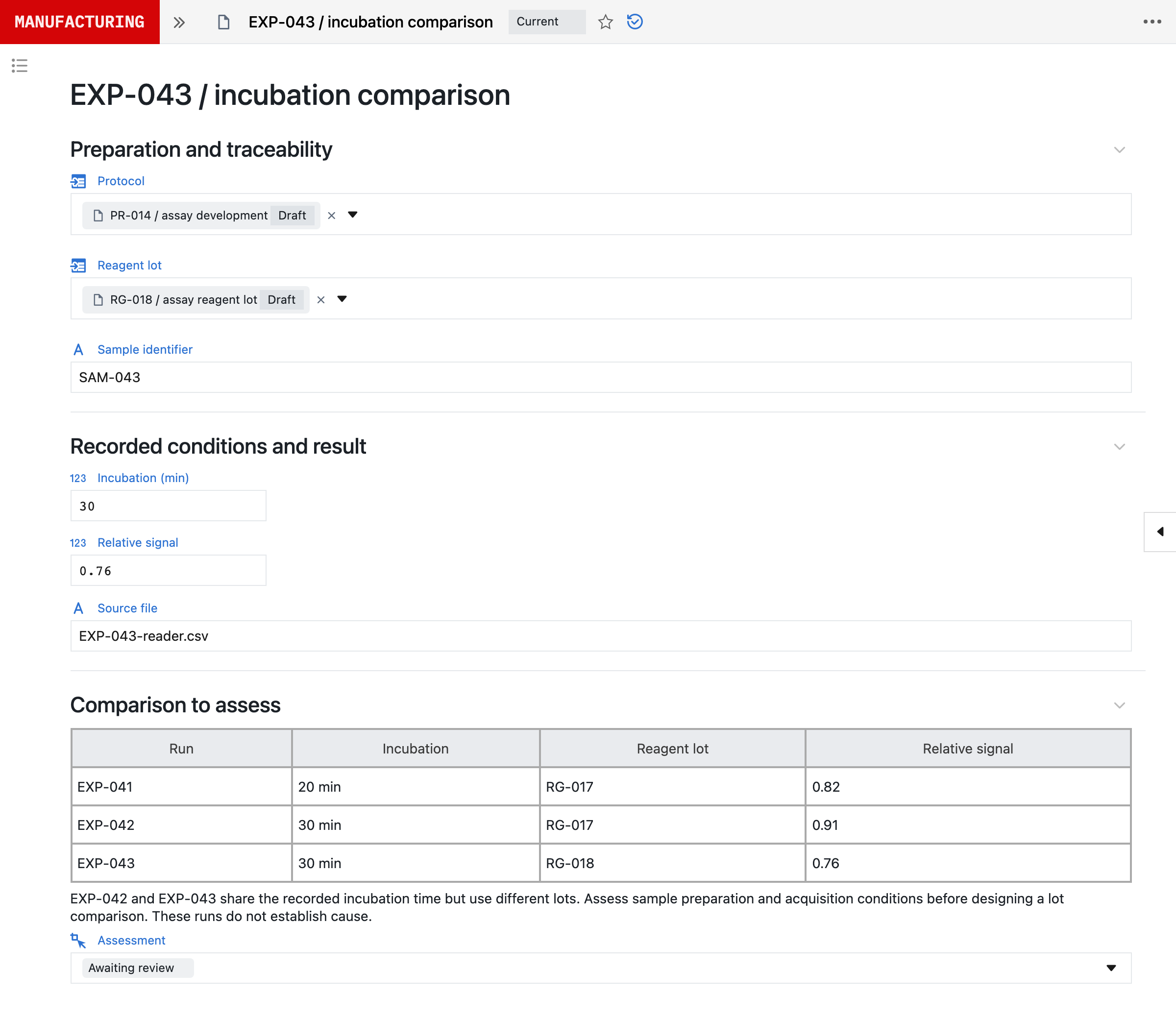
The time stayed the same. The lot didn’t.
EXP-042 and EXP-043 both ran for 30 minutes. The reagent lot changed from RG-017 to RG-018. That gives us a comparison to investigate—not a cause we can claim.
See how the comparison is prepared.
Neil can help find accessible experiments, compare recorded conditions and assemble evidence for a question. Ask which runs used a lot, which protocol versions were used or which measurements support a reported result. The useful output is a comparison you can inspect: the included runs, relevant conditions, source references and differences that need attention.
In the sample runs above, EXP-042 and EXP-043 share a recorded incubation time but use different reagent lots. Asking only which time produced the highest signal misses that distinction. A useful investigation follows both the method and the material, then defines a comparison that can test the question. Neil helps assemble that context and prepare the proposed next step; the scientist directs the work.
Why teams choose Seal for the laboratory: it brings the experiment’s structure, execution and quality controls into one platform. A sample or reagent lot is a record with its own history; results have defined fields and units. Scientists can query across experiments, trace the evidence and reuse a protocol as a proposed controlled method with its supporting runs still linked.
| A page-based ELN | Seal | |
|---|---|---|
| Data | Prose and mixed formats | Defined fields, units, calculations |
| Protocol setup | Templates built by hand | Neil proposes the protocol |
| Comparison | Names retyped, results exported | Links to sample, lot and file |
| Routine use | The method rewritten as a doc | A proposed controlled method |
| After go-live | A separate software project | A controlled, verified change |
| AI | A chat answer to copy elsewhere | A proposed workflow change |
Start with a question: “What changed between these runs?” Follow it back to the protocol version, sample history, reagent lots, observations and original measurements. Then use what you learn to propose the next experiment. That connection between understanding and execution is the reason to put the work in Seal.
Turn the finding into the next experiment.
Keep the question, supporting runs and proposed work together. Your team decides what to test next.
Design a comparison that separates the lot from the incubation time.
Compare both lots at both times. Hold the other conditions consistent.
One question. Four conditions.
| Reagent lot | 20 min | 30 min |
|---|---|---|
| RG-017 | Planned, not run | Planned, not run |
| RG-018 | Planned, not run | Planned, not run |
Keep units, method versions and sample preparation in the comparison. Missing values are not zeros. A changed lot, instrument or calculation may make two results unsuitable for direct comparison. Correlation can suggest a follow-up experiment; it does not establish a cause or validate a method.
When you decide what to try next, keep the question, supporting experiments and proposed protocol change connected. The next run then tests an explicit idea, and its outcome becomes evidence for the next decision. The long-term value is a body of science your team can use, not a growing archive someone has to read from the beginning.
Configure the protocol once. Keep each run distinct.
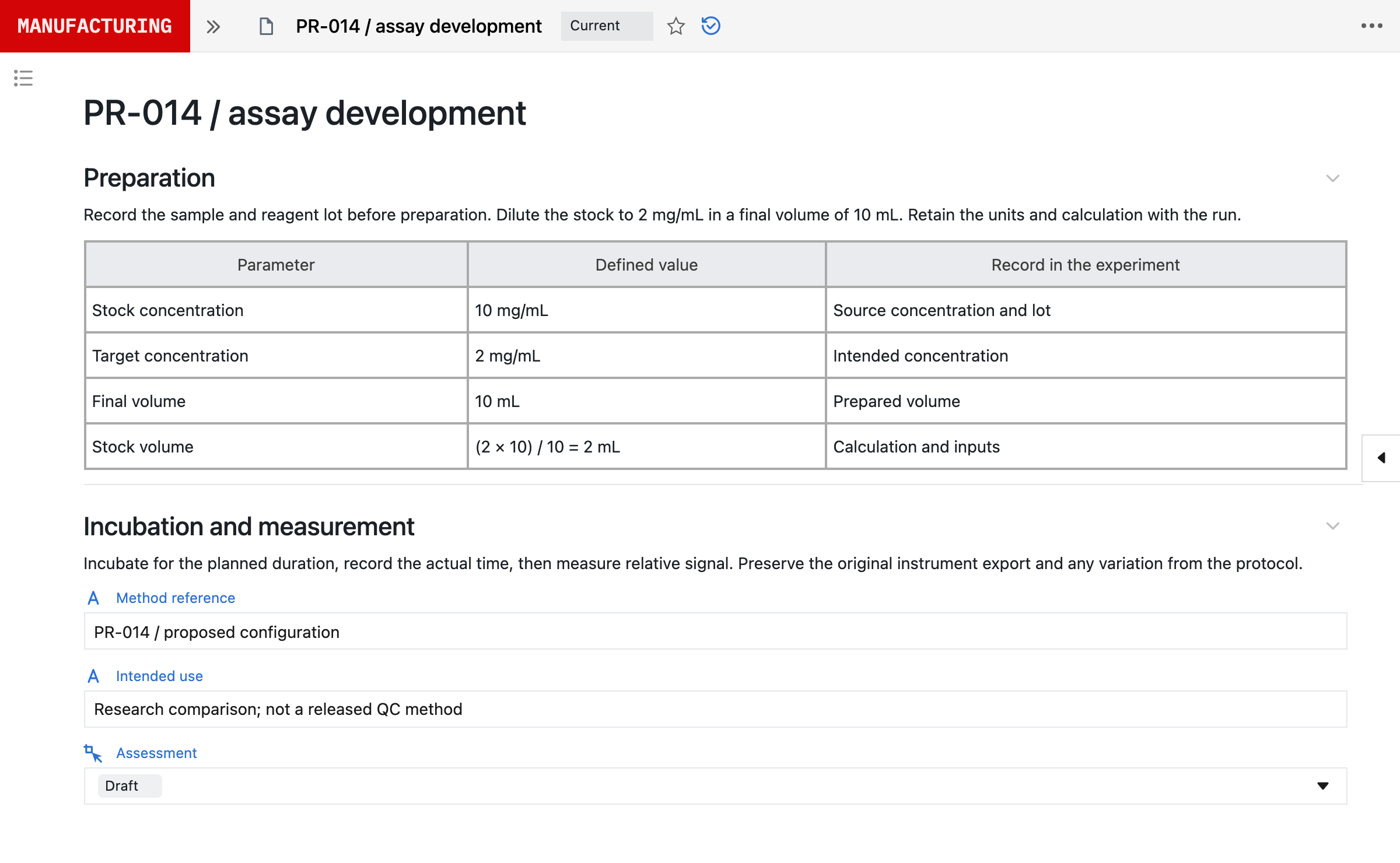
Describe the method and Neil proposes a configuration. Review the steps, required inputs and calculations in Seal, then reuse the structure without losing the observations that make each run different.
Try the preparation calculation
Turn this into a reusable preparation: 10 mL at 2 mg/mL, from a 10 mg/mL stock. Keep the reagent lot with the run.
Here’s the preparation draft. Change the target to try the calculation.
from the stock
10 mg/mLfinal volume
Dilute to 2 mg/mLCalculation and record details
Stock volume = target concentration × final volume ÷ stock concentration.
2 × 10 ÷ 10 = 2 mL. Make up to a final volume of 10 mL with the method’s specified diluent.
Each run links the reagent lot and protocol version. The method defines incubation conditions and the original instrument file to retain.
This example recalculates locally; it does not create a protocol. Review the method, units and missing-input behaviour before using a configured preparation.
The protocol.
Steps, units and calculations belong to the protocol.
The run.
Entered values, observations and variations belong to the experiment.
The history.
A later revision does not rewrite earlier runs.
Start with Neil. Describe the preparation, and Neil proposes the inputs, calculation and sample and material links as a reusable protocol. Each experiment keeps the protocol version, entered values and original results; observations and deliberate variations are recorded alongside the preparation they changed.
A protocol should fit the science. Distinguish a deliberate research variation from a change to a controlled method. Capture what was changed and why, rather than silently replacing the instructions that an earlier run followed.
A result you can trace back to the bench.
Open the protocol, reagent lot and recorded conditions from the experiment. Follow the relationships behind a comparison instead of rebuilding its context from exports.
Record the conditions needed to interpret and repeat the work: sample identity, preparation, material lots, equipment, timing, units, calculations and observations. Link those to records with their own history instead of retyping names into a page. Data that is attributable, legible, contemporaneously recorded, original and accurate is what regulators expect of a record used in GMP work.¹
A reagent-lot relationship lets a scientist find other experiments using the same material. A sample relationship connects parent material, aliquots and downstream tests. An equipment relationship makes its identity and relevant status available alongside the run. Labels identify those records; they do not replace the underlying lineage.
The advantage becomes tangible when a material is questioned. Follow the lot to its experiments, inspect the conditions and source results, and identify work that needs assessment. Those relationships are useful during normal science as well as an investigation. The records collected to perform the work become the evidence used to understand it.
Work with the systems your lab already uses.
Start with the records you have. Scope connections to existing documents, laboratory systems and instrument exports; keep their source context with the work. See all integrations.

Controlled documents
Reference selected Vault document versions.

Existing knowledge
Connect procedures and supporting files.
Instrument evidence
Capture supported local exports with Seal IoT.
Instrument files belong with the experiment too. Seal IoT and scientific data management connect supported local exports to records in Seal. Preserve the original acquisition, distinguish it from a processed report and verify any extracted values against the source. Attaching a file does not imply that every proprietary format can be interpreted.
Existing notebooks can remain part of the evidence. Scope the available exports, attachments, metadata and access history before migration. Keep gaps visible; importing a PDF cannot recreate a missing native record.
Carry the development evidence into transfer.
Carry development evidence into a proposed QC method or manufacturing procedure. The receiving team reviews the method, transfer work and training before controlled use. The experiments keep the version they ran under; the proposed version awaits assessment and approval.
- Required inputs and calculations
- Method qualification and transfer evidence
- Training and review responsibilities
Development, routine laboratory testing and manufacturing do not need separate copies of the scientific story. Seal connects ELN and LIMS, manufacturing execution and quality workflows through the same platform. The development runs remain available behind the proposed method.
The receiving team can inspect the protocol, material choices, calculations and supporting results behind the transfer. Required fields and calculations can be reused where appropriate; controlled criteria, training and review are defined for the receiving workflow. This reduces the handoff between “the method we developed” and “the method we now operate”.
Moving into controlled use is more than changing a permission. Define the intended use, required inputs, calculations, acceptance criteria, review responsibilities and training. Assess the method qualification and transfer work required for the receiving laboratory or operation, and keep that evidence linked to the proposed version.²
Once approved, the controlled method governs new work. Earlier experiments retain the versions, conditions and observations recorded at the time. A later improvement must not rewrite the history of how a result was obtained.
Change the configuration under review.
Continuous validation connects a configuration change to the requirements, checks and approval behind it. Earlier experiments keep their original values and calculation version.
A calculation changes.
Review the formula before and after, its units, rounding and affected protocols, under continuous validation.
- Assess the impactUpdate the affected requirements and configuration specification.
- Verify the behaviourCheck normal inputs, boundaries and missing values. Retain results and exceptions.
- Review the releaseYour team reviews the evidence and authorises the new version.
The configuration should be able to evolve as the science improves. Change control and continuous validation keep the proposed configuration, its specifications, verification evidence and approval in Seal.³ This is a platform capability, not a separate set of documents to reconstruct after every change.
For a changed calculation, identify the inputs, units, formula, rounding and downstream results affected. Update the relevant user requirements, functional and design specifications and configuration specification.⁴ Run the applicable automated checks and repeatable UAT checks; retain results and exceptions with the changed version.
For example, a proposed dilution-
v04
- RUN-041
- RUN-042
v05
- Requirement (met)URS-014
- Verification (met)TC-014 passed
- Approval (not met)Pending
The team reviews the evidence and authorises release. A successful automated check is evidence for that decision, not a substitute for it. The benefit is continuity: improve the method, update the operating workflow and retain the basis on which both old and new work were performed.
Collaboration that stays with the experiment.
Share project records with the people who need them and set the appropriate access. Keep observations, reviewer questions, responses and signatures attached to the relevant work and version. A witness or reviewer needs the evidence and the meaning of the signature, not only a finished report: a signed electronic record shows who signed, when, and what the signature means.⁵
Reports should identify the experiments and versions they summarise. Keep original measurements distinct from calculated values and interpretations. A revised summary should still lead a reader to the exact evidence behind it.
For internal prior work, Neil follows the requester’s access permissions. For external literature, retain the publication and citation behind a claim and check its relevance to the method. Neither a generated summary nor a signature should be presented as a guarantee of scientific validity or intellectual-
Begin with one protocol and a question worth answering.
Choose work that matters to the team: a difficult comparison, a frequently repeated assay or a method approaching transfer. Bring a representative protocol, a few sample runs and the files behind the results. We can arrange an NDA before you share confidential records.
Together, define the required structure, source connections, calculations and review. Test a normal run, missing data, a deliberate variation and a changed protocol. Start with a useful, reviewable workflow, then extend the same connected foundation across the laboratory.
References
- 1U.S. Food and Drug Administration, Data Integrity and Compliance With Drug CGMP: Questions and Answers, guidance for industry (December 2018), section III.1. FDA
- 2United States Pharmacopeia, General Chapter 〈1224〉, Transfer of Analytical Procedures.
- 3EudraLex Volume 4, Annex 11, Computerised Systems (2011), sections 4 (validation) and 10 (change and configuration management). European Commission
- 4ISPE, GAMP 5: A Risk-Based Approach to Compliant GxP Computerized Systems, second edition (2022).
- 521 CFR 11.50, Signature manifestations: the printed name of the signer, the date and time of signing and the meaning of the signature. eCFR
AQuestions and answers
How is Seal different from adding AI to an existing notebook?
The distinction is what can happen after the answer. Neil works with the experiment, sample, material and process records themselves and can help prepare a change to the workflow itself. Your team can review the proposed fields, calculations and controls, verify them and release the configuration. The investigation and the operating change remain connected rather than ending with a summary to implement elsewhere.
Does IT need to develop a separate application?
Standard protocols are configured within Seal using its records, fields, calculations and workflow controls. Neil can help prepare that configuration. IT still has an important role in access, source connections, deployment and change governance. A specialised parser or integration may need scoped engineering; the aim is to reuse the platform rather than create a separate application for every assay.
Do we need to replace our LIMS or other systems to start?
No. Start with the protocol and sources needed for the first job, and define which system owns each record. Seal can also run laboratory, manufacturing and quality workflows on the same platform as the ELN. Expand where sharing records and controls creates value, while keeping external sources connected where appropriate.
How should we evaluate whether Seal is better for our team?
Use a representative job, not a generic feature tour. Configure one protocol, run sample experiments, investigate a difference and propose a change. Examine how much evidence must be reassembled, what is reusable and whether the configuration, specifications and verification remain connected. Include a missing input and a changed method so the evaluation covers the difficult parts of the work.
Can scientists still use free text and attachments?
Yes. Combine structured fields with observations and attachments. Define which parameters are required for comparison or controlled work, while keeping room for unexpected findings. Record deliberate variations rather than silently changing the protocol behind an earlier experiment.
What can Neil do with our experiments?
Neil can help configure protocols, find accessible prior work, compare recorded conditions and prepare an investigation or proposed change. Review the sources and limitations. A pattern is not proof of causation, and a proposed protocol is not a qualified method.
Is our experimental data used to train AI models?
No. Customer data is not used to train AI models. Records in Seal provide working context for Neil, subject to the requester’s access permissions. That is different from training the underlying model.
How do instruments connect?
Use the supported interface for the source. The installable Seal IoT agent can watch instrument export folders and run configured upload scripts. Agree the host, access, formats and mapping, and verify capture and interpretation separately. Original files can also remain attached to experiment records.
How does ELN work with LIMS and manufacturing?
They share the Seal platform and its sample, material and method records. Development evidence can support a proposed QC method or manufacturing procedure. Define intended use, controls, transfer evidence and approval before controlled use; sharing a platform does not automatically qualify a method.
How are protocol changes handled?
Keep the proposed version, reason, affected requirements, specifications and verification evidence together. Existing experiments retain the versions used. Apply the required evidence review and approval before releasing a controlled change.
How are calculations verified?
Specify inputs, units, formula, precision and rounding. Check representative values, boundaries, missing inputs and invalid values. Retain the formula version and test evidence with the configuration change, and assess reports or downstream processes that depend on it.
What do witnessing and electronic signatures cover?
Configure the required review and signature meaning for the workflow. Keep identity, time and the reviewed record version attached to the decision. These records support traceability; they do not by themselves guarantee scientific validity or intellectual-
Can we migrate an existing notebook or ELN?
Scope exports, attachments, metadata, permissions and history before agreeing the migration. Map reusable fields where possible, preserve source records and identify gaps. A PDF rendition should not be represented as a recovered native experiment.
What should we bring to a first evaluation?
One protocol, a few representative runs, their source files and a question the team needs to answer. Agree the required structure, calculations, source connections and review. Start with sample material or arrange an NDA before sharing confidential records.