Summary
- In short
- LabArchives gives every scientist a flexible notebook of pages and entries, with templates, widgets, inventory, a free tier, FedRAMP authorisation and tools for teaching. In Seal, experiments are runs of versioned protocols with required fields, units and calculations, linked to the samples and lots behind them, on the same platform as QC, manufacturing and quality work.
- When it fits
- You are rolling a notebook out across a university or institute, teach lab courses, need a FedRAMP-authorised notebook for federal research, want researchers to start free, or want free-form pages more than predefined fields.
- When Seal fits
- You need runs compared like with like, methods that move into controlled use with their evidence, and Neil configuring protocols and comparing runs for your scientists to review.
1LabArchives and Seal, side by side.
LabArchives and Seal are both cloud systems for recording laboratory work with audit trails, signatures and linked inventory. They are designed around different units of record. LabArchives is a page-based notebook: scientists keep notebooks of folders, pages and entries, and add structure with templates, forms, widgets, tags and links.¹ In Seal, teams configure laboratory, manufacturing and quality workflows on one platform around a shared ontology, and each experiment is a run of a protocol whose fields, units and calculations are defined in advance.
| LabArchives | Seal | |
|---|---|---|
| What it is | Page-based cloud notebook | GxP operating system for biopharma |
| Owner | Dotmatics, part of Siemens | Opvia Ltd., trading as Seal |
| Unit of record | Notebook pages and entries | Runs of a versioned protocol |
| Structure | Templates, forms, widgets, tags | Required fields, units, calculations |
| Main users | Universities, institutes, biotech | Development, QC, production, QA |
| Signatures | Witness and review, Part 11 | Signatures with meaning and version |
| Security | FedRAMP, SOC 2, ISO 27001 | Hosting region agreed at onboarding |
| Integrations | Prism, SnapGene, developer API | Connectors, REST API and Scripts |
| Getting started | Free tier, then paid plans | A 48-hour evaluation on one process |
2What LabArchives is built for.
LabArchives is built for research institutions and research teams that want every scientist in a cloud notebook, from a single lab to a whole university. LabArchives says it serves 750,000 scientists in academic, non-profit and commercial organisations.²
LabArchives describes itself as a suite of SaaS applications for managing and documenting research data, collaborating and managing inventory, samples and lab resources. It became part of Dotmatics in 2022.² Siemens completed its acquisition of Dotmatics on 1 July 2025, and Dotmatics now forms part of Siemens’ Digital Industries Software business.³
The notebook records notes, tables, hyperlinks, HTML and embedded media, and edits Microsoft Office documents in place. Scientists create custom page templates, forms, calculators and JavaScript tools or use dozens of ready-made widgets, including chemical sketching. Entries link to experiments, samples, projects and other entries through custom tags and links. Search runs across several notebooks at once, including text inside attachments and metadata, and Enterprise customers can extract text from photographs and scans of handwritten notes. LabArchives Folder Monitor syncs local folders to the notebook with upload rules. Entries, pages, folders or whole notebooks can be shared with collaborators or published with a DOI.¹ Entries can be locked from further edits, with an electronic signature process that supports 21 CFR Part 11.⁴
Around the notebook sit LabArchives Inventory, which links samples and resources to research data, Scheduler for booking equipment and rooms, and ELN for Education, which adds course management, a content library and LMS integration for teaching lab courses.⁵⁶ Integrations include GraphPad Prism, SnapGene, Geneious, iChemLabs for chemical structures, Microsoft tools and Proofig AI, which screens notebook images for duplication and manipulation.⁷ The ELN and Scheduler have a free tier with time-unlimited access to core functionality. Paid plans add storage and inventory, and the Enterprise plan adds SAML SSO and a developer API; the plan comparison also lists witness and review for 21 CFR Part 11 and support for NIH data management and sharing.⁸ LabArchives holds FedRAMP, SOC 2 and ISO 27001 certifications, and LabArchives for Government is customised for further NIST 800-53 requirements and hosted in the US.⁹¹⁰
3Pages and structured records.
A page-based notebook records what the scientist writes, in the order they write it. A structured system records values against fields the protocol defines. Both can hold the same experiment; they differ in what can be done with it afterwards.
In LabArchives, consistency comes from templates and pre-populated forms that a team shares, and context comes from tags and links between entries.⁴¹ The page remains the record: an incubation time, a reagent lot and a result sit in the entry where they were written or entered on a form, and related work is found through search, tags, links and, with LabArchives Inventory, reagents linked to experiments.⁸
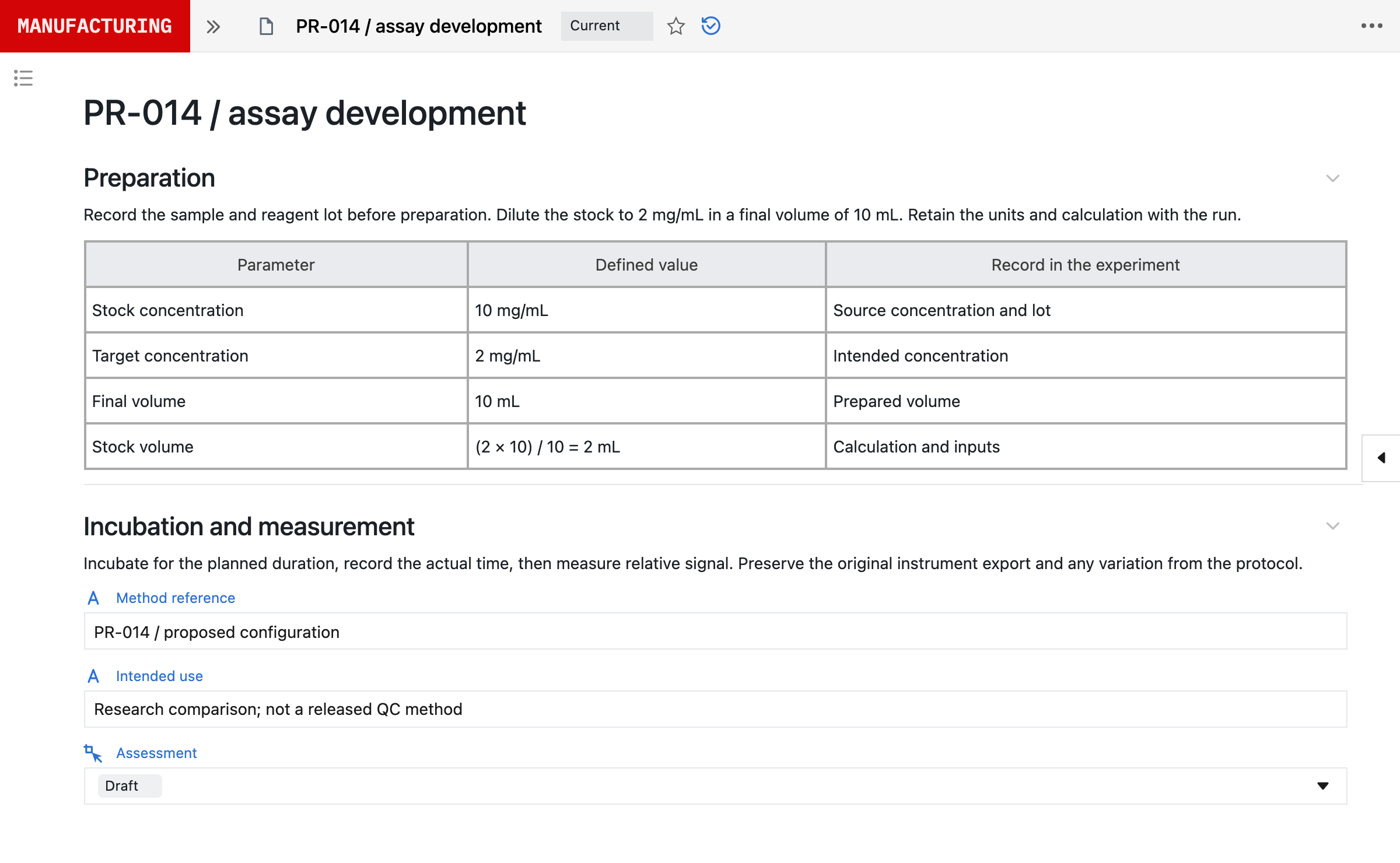
In Seal’s ELN blueprint, three runs of protocol PR-014 v03 each record a sample, a reagent lot, an incubation time and a relative signal. EXP-041 ran for 20 minutes on lot RG-017 and read 0.82; EXP-042 ran for 30 minutes on RG-017 and read 0.91; EXP-043 ran for 30 minutes on RG-018 and read 0.76. Because the lot is a record with its own identity, expiry and uses, Neil can show that the incubation time stayed the same while the lot changed between EXP-042 and EXP-043, and a scientist can follow RG-018 to every other experiment that used it. That is a difference to investigate, not a cause, and the follow-up Neil proposes tests both lots at both times.
Structure does not remove free text. Seal runs keep observations and attachments alongside their fields, and deliberate variations are recorded with their reason. What structure adds is that a later question, such as which runs used a questioned lot, is answered by a query over recorded fields rather than by searching text.
4Where LabArchives is the better fit.
LabArchives is the better fit for research institutions that want a flexible notebook for every scientist, with institutional controls.
- You are a university or research institute rolling out one notebook across many independent labs, with institution-wide management, SSO and reporting.⁹
- You teach laboratory courses and want students in the same notebook, with course management and LMS integration.⁶
- You are a US federal laboratory or grantee that needs a FedRAMP-authorised notebook built to federal record-keeping requirements.⁵¹⁰
- You want individual researchers to start free, and to publish notebook content with a DOI for data-sharing requirements.⁸¹
- Your scientists want free-form pages, Office documents and widgets rather than predefined fields for every experiment.¹
5Where Seal is the better fit.
Seal is the better fit when results have to be compared like with like and methods have to move into controlled use.
- You want each experiment to record required fields, units and calculations, linked to the sample, lot, equipment and source file behind the result.
- You want a development protocol to become a controlled QC method or batch step on the same platform, with the development runs still linked. MiAlgae runs ELN, quality and electronic batch records in Seal from lab to commercial scale.
- You want each change to a protocol or calculation released with its specifications, acceptance tests and approvals, while earlier runs keep the version they used.
- You want Neil to configure protocols from your procedures, compare runs and propose the next experiment for your scientists to decide on. In line with the EU’s draft GMP Annex 22 on AI, Neil is not used in GMP execution. It helps set up configuration, which your team verifies and releases under change control.
6Running Seal alongside LabArchives.
Seal can run one controlled workflow while LabArchives stays the notebook for research. Seal has no dedicated LabArchives connector. Where a system is not on Seal’s integrations list, Seal’s REST API reads and writes records from another system, and Scripts, versioned Python edited in a changeset, tested and published like other Seal records, can call an external service after an event or on a schedule. LabArchives offers a developer API on its Enterprise plan.⁸
Start with read access, such as linking a Seal record to the LabArchives entry that holds the development history behind it. Treat any write-back as a separate decision with defined actions, review gates and audit evidence. Agree identifiers and mappings, test missing, delayed and duplicate records, reconcile what arrives against the source, and record which system is the source of truth. Instrument files can come to Seal directly through the installable Seal IoT agent, which watches an export folder and uploads supported files to a configured Seal record.
7Moving from LabArchives to Seal.
Move one protocol first. LabArchives stays the notebook for everything you have not moved.
- Choose a protocol your team repeats often enough to need fixed inputs, or one approaching controlled use.
- Bring the template or page that describes it, a few representative entries and the files behind their results. Start with sample material, or arrange an NDA before sharing confidential records.
- Neil configures the protocol from that description: required inputs, units, calculations and sample and material links. Your scientists check it against how the work runs. Once the scope is agreed and the inputs received, Seal prepares the first working process and its validation pack within 48 hours. Production timing then depends on scope, interfaces, migration and your release requirements.
- Test a normal run, missing data, a deliberate variation and a changed protocol.
- Decide whether earlier pages move at all. If they do, scope exports, attachments, metadata, permissions and history, and keep gaps visible: a PDF of a page is not a recovered native experiment, and values typed into prose need checking before they become fields.
Retention obligations continue for the notebooks that stay in LabArchives. The ELN blueprint shows the protocol and experiment model in detail.
References
- 1LabArchives ELN for Research, LabArchives. https:/
/ www. labarchives. com/ products/ eln- for- research (read 8 October 2026) - 2About, LabArchives. https:/
/ www. labarchives. com/ about (read 8 October 2026) - 3Siemens completes acquisition of Dotmatics, Siemens AG, 1 July 2025. https:/
/ press. siemens. com/ global/ en/ pressrelease/ siemens- completes- acquisition- dotmatics (read 8 October 2026) - 4Modernize Your Scientific Workflows, LabArchives. https:/
/ www. labarchives. com/ products/ scientific- workflow (read 8 October 2026) - 5The Modern Electronic Lab Notebook (ELN), LabArchives. https:/
/ www. labarchives. com/ (read 8 October 2026) - 6Teach Lab Courses with ELN for Education, LabArchives. https:/
/ www. labarchives. com/ products/ eln- for- education (read 8 October 2026) - 7Integrate External Tools and Applications with LabArchives, LabArchives. https:/
/ www. labarchives. com/ integrations (read 8 October 2026) - 8Pricing, LabArchives. https:/
/ www. labarchives. com/ pricing (read 8 October 2026) - 9Enhance Research Integrity and Security, LabArchives. https:/
/ www. labarchives. com/ products/ research- integrity- security (read 8 October 2026) - 10LabArchives for Government, LabArchives. https:/
/ www. labarchives. com/ products/ labarchives- for- government (read 8 October 2026)
AQuestions and answers
Is Seal an alternative to LabArchives?
For structured, comparable experiments and work that moves into GxP control, yes. Seal records each run against a versioned protocol’s fields and runs QC, manufacturing and quality workflows on the same platform. LabArchives suits institutions wanting a flexible page-based notebook for every researcher.
Who owns LabArchives?
LabArchives became part of Dotmatics in 2022, and Siemens completed its acquisition of Dotmatics on 1 July 2025. Dotmatics is now part of Siemens’ Digital Industries Software business.
What is the difference between a page-based and a structured ELN?
A page-based notebook stores what the scientist writes on a page, with structure added through templates, forms and tags. A structured system defines the fields, units and calculations each run must record, and links them to records such as samples and reagent lots, so questions across runs are answered by a query over recorded fields rather than by searching text.
Can Seal work alongside LabArchives?
Yes. Seal has no dedicated LabArchives connector, but its REST API and Scripts can connect a system that is not on its integrations list, and LabArchives offers a developer API on its Enterprise plan. Start with read access and agree which system is the source of truth for each record.
How long does it take to start with Seal?
Once the scope is agreed and the inputs received, Seal prepares a first working process and its validation pack within 48 hours, configured from one of your protocols or procedures. Production timing then depends on scope, interfaces, migration and your release requirements.