Summary
- The problem
- A higher titre on a comparison plot is an observation, not a reason to choose a process. The conditions, material lineage, samples and uncertainty behind it sit in separate notebooks, spreadsheets and instrument files, and the reasoning is lost by the time the process reaches scale-up or transfer.
- Seal’s approach
- Experiments, actual execution and analytical evidence stay connected to a versioned process definition. Neil compares runs, identifies missing context and prepares the next experiment; scientists review the design and run the work.
- Neil
- Seal’s AI agent compares runs from the conditions they actually used, flags missing context and drafts the next study with its template. Scientists review the design and run the work. About Neil.
- What changes
- Confounded comparisons stay visible instead of being read as an optimum, the next study is proposed for scientists to review before anything runs, and an unresolved scale question travels with the candidate to MSAT.
- Evidence
- MiAlgae, from lab scale to commercial production: 75% less documentation time.
- Where to start
- One development decision in front of the team, with the runs, samples and results behind it. Book a demo.
Choose the next process from its evidence.
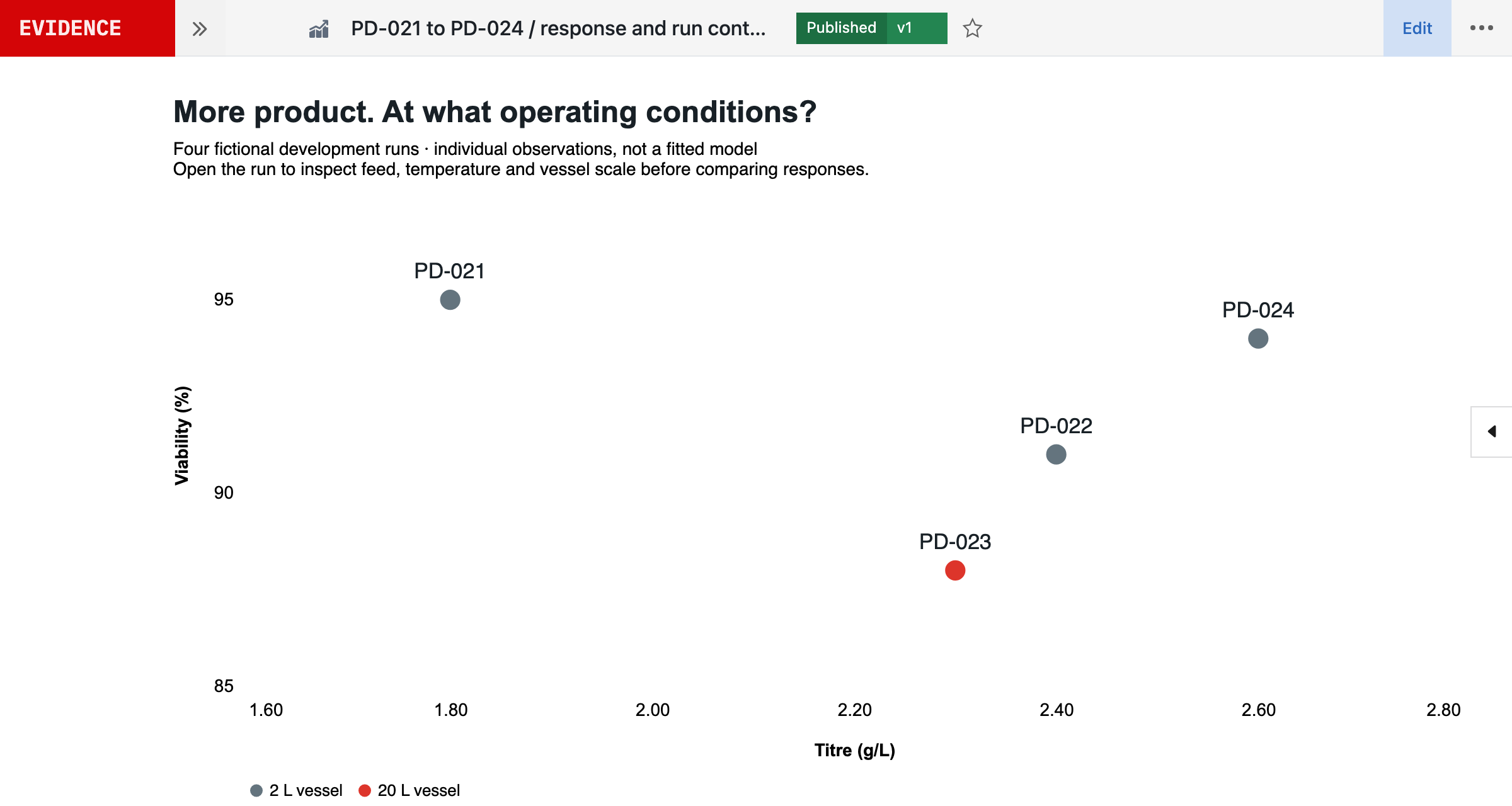
A development decision rests on more than the best number on a plot. Before a process goes forward, the team needs to know which factors changed between runs, what scale and materials each run used, and what the results cannot yet show. In this fictional example, Neil compares four runs.
You: PD-024 has the highest titre. Should we take that process forward?
Viability (%)
Titre (g/L)
Neil
More product, under different conditions.
PD-024 is a candidate. It produced 2.6 g/L, but feed and temperature both changed from the reference run, so this result does not isolate either factor. Each record below shows the conditions the run actually used.
| Run | Volume | Feed | Temp. | Titre | Viability |
|---|---|---|---|---|---|
| PD-021 | 2 L | 4 g/L/h | 37 °C | 1.8 g/L | 95% |
| PD-022 | 2 L | 6 g/L/h (changed) | 37 °C | 2.4 g/L | 91% |
| PD-023 | 20 L (changed) | 6 g/L/h (changed) | 37 °C | 2.3 g/L | 88% |
| PD-024 | 2 L | 6 g/L/h (changed) | 35 °C (changed) | 2.6 g/L | 94% |
See how the comparison is prepared.
The higher titre on a comparison plot is an observation. Choosing the next process requires the conditions, material lineage, sample context and uncertainty behind that observation. Seal keeps the experiment, actual execution and analytical evidence connected to the developing process definition.
The four fictional runs above illustrate the problem. PD-022 changes feed relative to PD-021. PD-023 also changes working volume; PD-024 also changes temperature. None of the four single runs establishes an optimum or a causal feed effect, and the table under the plot shows why.
Process development is usually recorded in a page-based ELN, instrument software and spreadsheets, then handed to manufacturing as a report that is re-entered as a batch record. Each step loses some of what made a run comparable.
| A page-based ELN and spreadsheets | Seal | |
|---|---|---|
| Run conditions | Typed into each page | Linked runs, lots and samples |
| Comparison | Values exported to a sheet | Built from the recorded runs |
| Changed factors | Easy to miss on a plot | Shown beside each result |
| Next study | Drafted from scratch | Neil drafts it from the runs |
| Failed experiments | Lost in old pages | Kept as process evidence |
| Handover | A report, retyped downstream | The definition and its evidence |
| Getting started | A notebook migration | One development decision |
In Seal, runs, materials, samples and methods are linked records, so Neil compares runs from what they actually used, and the process the team chooses can become an executable protocol that keeps its development evidence. The receiving team starts from that definition instead of a report, and nothing is retyped.
You can start with one development decision, alongside the ELN and instrument software you already run: Seal collects their exports, keeps the original files with the run and maps selected results into ordinary fields. The advantage grows as upstream, downstream and analytical teams record against the same process: less reconstruction before each decision, and a candidate that arrives at scale-up with its reasons still attached.
“We have been delighted with the rigour and agility shown by Seal in providing Ingenza with a robust GxP system that fully supports our process development and biomanufacturing operations.”
Ian Fotheringham MBE, CEO, Ingenza
Separate what each comparison can show.
A comparison supports a conclusion only about the factor it isolates. In these four runs, three pairs each isolate one factor; the others change two at once.
| Comparison | What changes | What it can show |
|---|---|---|
| PD-021 and PD-022 | Feed | The closest feed comparison |
| PD-022 and PD-023 | Scale | Scale alone, one run each |
| PD-022 and PD-024 | Temperature | Temperature alone, one run each |
| PD-021 and PD-023 | Feed and scale | Neither factor alone |
| PD-021 and PD-024 | Feed and temperature | Neither factor alone |
| PD-023 and PD-024 | Scale and temperature | Not whether 35 °C holds at 20 L |
You: Which comparison tells us the most about feed?
Neil
PD-021 against PD-022: both use 2 L and 37 °C, while feed changes from 4 to 6 g/L/h. Titre rises from 1.8 to 2.4 g/L; viability falls from 95% to 91%. That is the closest comparison in this set. With one run per condition and incomplete lot and method context, I would not call it a demonstrated feed effect.
Feed strategy is only one potential difference. Material source, grade, lot attributes, preparation, storage and age can influence the response. So can vessel geometry, scale, equipment configuration and analytical method changes.
Use linked run records to construct the comparison population. Keep exclusions and missing values explicit. Scale correlations and models retain their assumptions, calibration data and applicability; a prediction at a receiving scale is not observed performance at that scale.
Preserve the actual execution. Keep the candidate version, material lots, prepared solutions, equipment, set points, actual signals, additions, interventions, observations, samples, pools, yields, holds and exceptions together. Do not edit the protocol retrospectively to make an exploratory run look as though it followed the original plan.
A sample links the result to a known run, vessel, unit operation and time. Its preparation, custody, method, acquisition and review explain what the measurement represents. A result copied into a summary table without those relationships loses information needed for comparison.
Ask Neil to prepare the next study.
Neil drafts a study that separates the changed factors, with its sources and the decisions still open. The scientist reviews the design and runs the work.
You: Prepare the next study and the decision we need it to support.
Neil
I’ve separated the two changed factors into a four-condition study. The proposal keeps the run records, measurements and open design decisions together, ready for the scientist to review.
Separate the feed and temperature effects before selecting the process.
| 35 °C | 37 °C | |
|---|---|---|
| 4 g/L/h | 2 L | 2 L |
| 6 g/L/h | 2 L | 2 L |
Give Neil the process target, supplied procedures and permitted run records. It can compare the conditions, identify missing context and prepare a proposed experiment with linked samples, measurements and review work. Ask it to author the template and verification cases as part of the package.
In this example, the proposal crosses the two observed feed levels with the two observed temperatures at 2 L, keeps the material basis and analytical method consistent and captures titre and viability alongside the actual conditions. Scientists review the experimental design and execute the work. The example does not claim that Neil ran an experiment or established a control strategy.
| Neil prepares | Your team decides | |
|---|---|---|
| Comparison | The runs and what changed | What the runs support |
| Missing context | Lots, methods and replicates | Whether the gap matters |
| Next study | The design and its sources | Replication, run order, sampling |
| Template | Template and verification cases | Whether it is ready to run |
Everything in the middle column is preparation. Nothing Neil drafts runs until a scientist has reviewed it, and the people who own the study still make its decisions. In line with the EU’s draft GMP Annex 22 on AI, Neil is not used in GMP execution. It helps set up configuration, which your team verifies and releases under change control. Customer data is not used to train AI models, and the requester’s permissions govern what Neil can read. See how Neil fits Annex 22 and more about Neil.
Keep each discipline’s evidence on the same process.
Upstream, downstream, analytical and characterisation teams each produce evidence about the same candidate. When their runs, materials and measurements link to one process version, a method change or a missing sample shows up in the comparison rather than after the decision.
| Discipline | Kept with the comparison | Prepared for review |
|---|---|---|
| Upstream | Feed, conditions, vessel, samples | Run comparison, next experiments |
| Downstream | Recovery by step, pools, fractions | Step-recovery assessment |
| Analytical | Method, standards, preparation | Method changes made visible |
| Characterisation | Question, ranges, responses | Study package for review |
Define what the process must achieve. Product quality, yield, throughput, facility, scale, containment, material constraints, cycle time and development stage establish the target. Connect candidate processes to those requirements so that an attractive local result does not obscure a failure elsewhere in the process.
Model the unit operations, parameters and expected outputs as reusable, versioned records. Upstream development compares feed, culture conditions and actual run profiles without losing vessel, material or sample context. Downstream development follows recovery and quality across unit operations, pools and fractions, to locate a loss before choosing what to change. Analytical development keeps method versions, standards and sample preparation attached to the result used in a process decision. Process characterisation connects the study question, parameter ranges, responses and analysis to the proposed process understanding.
Each team keeps its own specialist assessment while sharing the material, sample and method relationships. A method change or a missing sample then shows up in the comparison rather than after the decision.
Add control as the process matures.
Early work stays exploratory and controlled studies get the review their intended use needs, on the same records. Failed experiments remain part of the evidence.
| Stage | Controls in Seal |
|---|---|
| Early development | Structured capture; changes allowed, with their reasons |
| Controlled studies | Their own permissions, review and verification |
| Characterisation | A readiness decision on criteria the team defines |
| Transfer | A governed starting definition, approved by the site |
Enforcement is configurable. During early development, scientists capture data in a structured framework without being constrained by it: exploratory changes are allowed, and the actual conditions and reasons remain visible. As the process matures, controls tighten. Exploratory and controlled studies can use different permissions and review paths.
Your organisation defines the intended use, record controls, review and verification required for each stage, and qualifies the configured workflow. Compliance depends on that assessment and your procedures, not on the software alone.
Failed experiments remain part of the process evidence. Their factors, actual execution, results and conclusions can support risk assessments, operating boundaries and investigations, and help avoid repeating dead ends. ICH Q8 makes the same point: changes during development are opportunities to gain knowledge, and knowledge from experiments giving unexpected results can also be useful.¹
Keep each claim with its supporting and contrary evidence.
What the team believes about the process is recorded as a claim, with the runs behind it and the limits of what they show.
- Claim
- Higher feed raises titre at 2 L
- Supported by
- PD-021 and PD-022
- Also observed
- Viability fell from 95% to 91%
- Limits
- One run per condition
Hypothesis, not yet established
A knowledge claim can concern a parameter effect, hold, material attribute or scale model. Retain the supporting runs, conflicting observations, analysis, uncertainty, scope and reviewer conclusion. New evidence can challenge the claim without erasing the basis for earlier decisions.
Process characterisation draws on that evidence to assess relationships and a proposed control strategy.¹ Merely collecting development data does not mean characterisation is complete. Characterisation then quantifies how parameters and materials affect performance and quality attributes, working from the same candidate, runs, parameters and samples in Seal.
Carry the open scale question with the candidate.
Does the 35 °C condition hold up at 20 L? These runs do not answer that yet. Keep the scale question with the candidate, so MSAT can assess the evidence and plan the next work.
- Working volume
- 2 L
- Feed
- 6 g/L/h
- Temperature
- 35 °C
- Working volume
- 20 L
- Feed
- 6 g/L/h
- Temperature
- 37 °C
You: Can we take PD-024 straight to 20 L?
Neil
This set does not demonstrate that combination at 20 L. PD-023 uses 20 L, but at 37 °C rather than PD-024’s 35 °C. I would carry the candidate forward with that scale question explicit, not treat a different run as evidence that the selected conditions transfer.
Candidate selection, scale-up, characterisation and transfer each need a defined readiness decision. Record open risks, conditions, owners and further work. A design space can be developed at any scale, but its relevance to production scale has to be justified and the risks of scale-up discussed.² An unresolved scale question is part of that case, not a footnote to it.
Technology transfer exists to carry product and process knowledge between development and manufacturing, and that knowledge forms the basis for the manufacturing process, control strategy and process validation approach.³ The receiving team starts with the selected process, parameters, materials, equipment needs and evidence links. It still authors and approves a recipe suitable for its facility and validation state. Shared records reduce reconstruction; they do not make a receiving process qualified by inheritance.
Carry the selected process into tech transfer and MSAT manufacturing support, with the original development evidence still attached.
Work across the systems you already use.
Bioreactor, chromatography and analytical exports arrive with their original files, linked to the run they describe. Neil brings the relevant evidence into the work in Seal.
| Where the work runs | What the comparison uses | Connections include |
|---|---|---|
| Bioreactors | Culture results by vessel | Ambr 250, BioPAT, DASware |
| Chromatography | Curves, peaks and fractions | ÄKTA UNICORN, Empower, Chromeleon |
| Cell culture | Counts, viability, chemistry | Vi-CELL BLU, Cedex Bio HT |
| Statistics | Analyses, graphs and reports | JMP |
| LIMS and ERP | Samples, results and lots | LabWare, SAP |
| Documents | Procedures and reports | Veeva Vault, SharePoint |
Instrument software remains responsible for acquisition and control. Seal IoT collects completed exports from an approved folder, keeps the original file linked to every derived result and maps selected results into the run, so a value can always be traced to the acquisition behind it. For a chromatography run, a volume axis is not a time axis and a reduced export is not the original acquisition; those choices are recorded rather than hidden.
Legacy development data can be imported and linked to process definitions. New development work is structured from the start, and legacy data provides historical context. See all integrations.
Begin with one development decision.
Start with the decision in front of the team and the runs behind it, alongside the systems you already use.
Choose a decision in front of the team: which candidate to take forward, whether a result holds at scale or what the next study should separate. Bring the runs, samples and results behind it, and the instrument exports where you have them.
Together, define the comparison and the output you need, inspect whether each finding is supported by its source records and review the proposed next study with the scientists who would run it. Expand to the next discipline once that first decision is useful.
References
- 1ICH Q8(R2), Pharmaceutical Development (2009), section 2: knowledge from development studies and manufacturing experience supports the design space, specifications and manufacturing controls; changes during development are opportunities to gain knowledge, and knowledge from experiments giving unexpected results can also be useful. ICH
- 2ICH Q8(R2), section 2.4.4 (relationship of design space to scale and equipment): a design space can be developed at any scale; the applicant should justify its relevance to the production-scale process and discuss the potential risks in scale-up. ICH
- 3ICH Q10, Pharmaceutical Quality System (2008), section 3.1.2 (technology transfer): the goal is to transfer product and process knowledge between development and manufacturing, and within or between manufacturing sites. ICH
ACapabilities
| Capability | What it covers |
|---|---|
| Version-controlled processes | Preserve process versions and their supporting runs. Supply a governed starting definition for site-specific transfer, verification and approval. |
| Flexible development workflows | Record data in a consistent structure while scientists explore and iterate. Configure the controls to tighten as the process matures. |
| Scale modelling | Compare response with the recorded scale and operating conditions. Keep scale-model assumptions, limitations and supporting evidence explicit. |
| Digital tech transfer | Carry the selected process and its evidence into transfer. Configure and approve the receiving site’s equipment mapping, recipe and controls. |
| Process characterisation | Design of experiments, parameter-quality relationships and design space, working from the same candidate, runs and samples as development. |
| Upstream development | Cell culture optimisation, fermentation development and media studies, linked to downstream and analytical work on the same process. |
| Downstream development | Purification development, chromatography optimisation and filtration studies, sharing the data model used upstream. |
| Analytical method development | Develop methods flexibly, then fix and validate them for QC use. The method, its development evidence and its QC version stay linked. |
BConnected records
CQuestions and answers
How is this different from an ELN?
An ELN records experiments. This blueprint also connects the process definition to structured runs, actual conditions, samples, results and assessed claims. The transfer package keeps that context, giving the receiving team evidence and a starting definition rather than an approved manufacturing recipe.
Can development scientists still work flexibly?
Yes. The controls are configurable. In early development, scientists record data in a structured framework without being constrained by it. As the process matures, the controls can tighten to match its stage.
How does tech transfer work?
Transfer the selected definition with its run evidence, parameter rationale, equipment requirements and unresolved gaps. The receiving site maps its equipment and instructions, verifies the controls and approves the intended recipe. Preserve links to the development versions.
What about existing development data?
Legacy development data can be imported and linked to process definitions. New development work is structured from the start, and legacy data provides historical context.
How does this integrate with GMP manufacturing?
Development and manufacturing share linked definitions and evidence in Seal, so a manufacturing recipe can reference the runs behind each parameter. Development results do not by themselves authorise manufacturing execution.
Can this be used for GxP development work?
Yes, where your organisation defines the intended use and qualifies the configured workflow. Exploratory and controlled studies can use different permissions, review and verification. Compliance depends on that assessment and your procedures, not on the software alone.
Does promotion create a GMP recipe?
No. Promotion supplies a governed starting definition and its evidence, so nothing is retyped. Manufacturing still configures the site-specific recipe, equipment mapping, instructions and controls, and manufacturing and quality approve it before use.
What evidence gates characterisation readiness?
The team defines the criteria. Typical ones are a selected candidate, defined unit operations and parameters, representative materials and analytics, a scale-model rationale and a named owner for each open knowledge gap.
How are failed experiments used?
They stay in the process evidence with their conditions, results and conclusions. A later risk assessment, operating range or investigation can draw on them, and the team does not repeat a dead end.
How is this different from process characterisation?
Process development explores and selects the candidate. Characterisation then quantifies how parameters and materials affect performance and quality attributes, to support a control strategy. Both work from the same candidate, runs, parameters and samples in Seal.