Summary
- The problem
- A freezer search finds specimens with the right matrix and volume, but whether they may be used depends on consent documents, restrictions and withdrawals kept elsewhere. A local hold does not show what collaborators or datasets still hold.
- Seal’s approach
- Each specimen carries its source permission, provenance, storage history and derivatives. A research request becomes a reviewable package of candidate evidence, exclusions and approvals, and a withdrawal is traced through stored, distributed and derived material.
- Neil
- Seal’s AI agent compares a proposed use with each specimen’s recorded permission, traces a withdrawal through stored, distributed and derived material, and builds request workflows from your protocol. Authorised people decide. About Neil.
- What changes
- Finding candidates and authorising use stay distinct. Reviewers can see why the same specimen is in scope for one use and not another, with the source document behind each assessment.
- Where to start
- One collection and a representative research request, including a changed purpose and a withdrawal. Book a demo.
1A biobank inventory finds the specimen. Seal says whether this use is permitted.
A researcher can find the right matrix, timepoint and volume in a biobank inventory and still be unable to use the specimen. Whether it may be used depends on consent documents, restrictions and withdrawals kept elsewhere, and a local hold does not show what collaborators or datasets still hold. The proposed research must be assessed against its recorded permission, current restrictions, scientific suitability and distribution requirements. Seal keeps that assessment connected to the material and its history.
| A biobank inventory | Seal | |
|---|---|---|
| Question it answers | Where the specimen is | Whether this use is permitted |
| Permission | A consent form kept elsewhere | Source and scope on the specimen |
| New research use | An earlier approval reused | A new assessment for the purpose |
| Withdrawal | A flag on the stored tube | Followed to shipments and data |
| Derivatives | A new tube | Lineage and inherited limits |
| Storage event | Where specimens are now | Where they were during the event |
| Research request | Decided in correspondence | A reviewable work package |
| Planning a request | Rebuilt from several sources | Neil prepares, reviewers decide |
The illustrative request BB-REQ-026 asks for 0.30 mL per specimen for external genomic analysis. All three candidates have 0.50 mL. BB-017 is outside its recorded consent scope, BB-018 still needs review, and BB-019 has a withdrawal hold. The query has found candidates; it has not authorised a shipment.
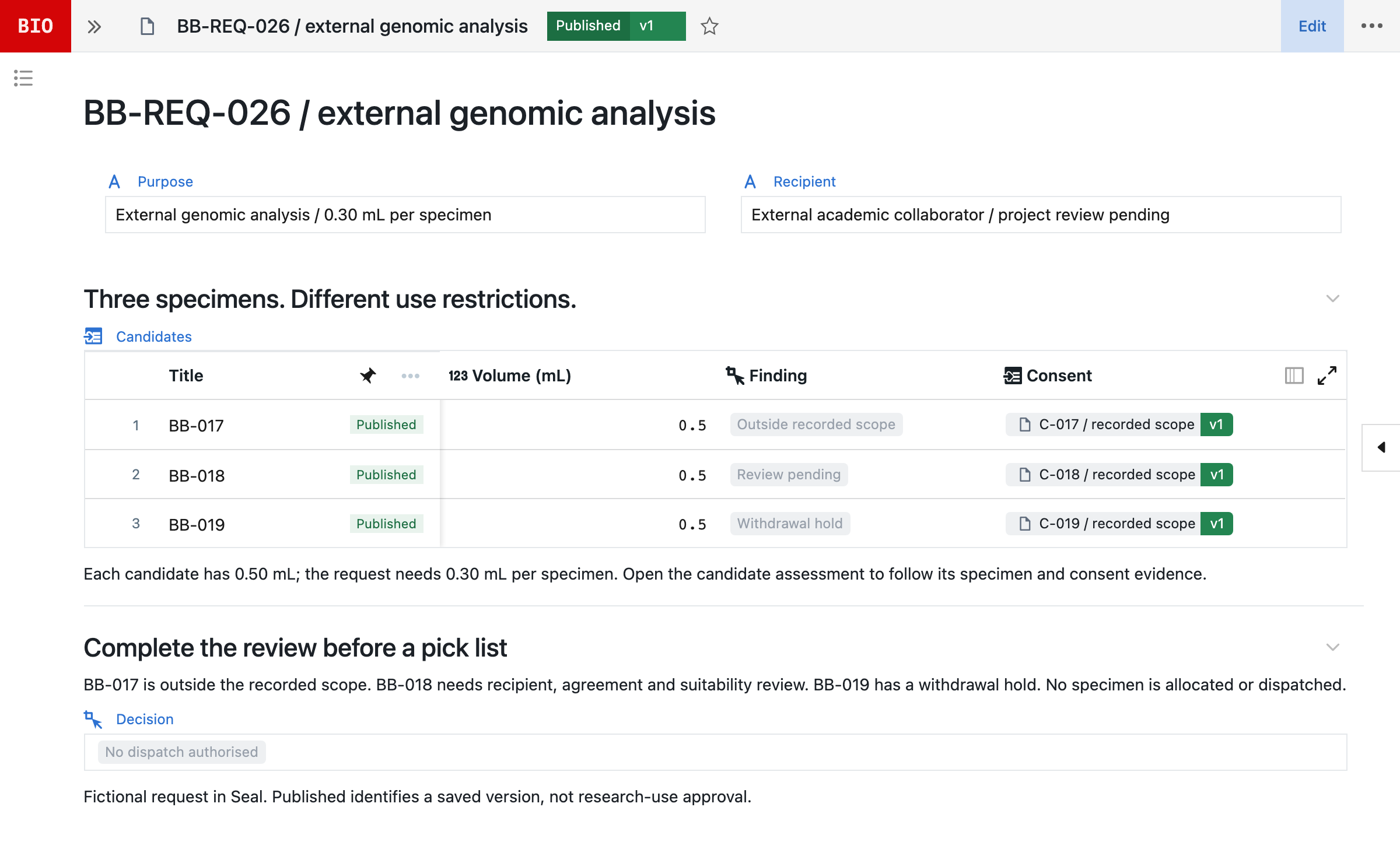
The request is also an operating plan. It connects scientific criteria, review, allocation, picking, shipment and the return of research results. The team can follow what is needed next and why a candidate was included or excluded. A collection becomes more useful when researchers can find suitable material and the team can fulfil the request with confidence.
You can start with one collection, alongside the LIMS or inventory you already run. Seal reads samples and results from LabWare, LabVantage and SampleManager without writing to them; see all integrations. The physical side, from labels and custody to aliquots and storage, runs as sample management on the same records.
2Neil prepares the work. Your team decides.
Neil is Seal’s AI agent. Ask it to compare the proposed research with permitted source documents and specimen records, reconstruct a withdrawal’s downstream scope or configure the request workflow from your protocol. It works within the user’s permissions, and it prepares linked assessments and configuration for review, not just a written recommendation.
| Neil prepares | Your team decides | |
|---|---|---|
| New research use | Candidate assessments, with sources | Permission and suitability |
| Withdrawal | Descendants, shipments and data | Actions and their limits |
| Request workflow | Templates, states and test cases | Verification and release |
Prepare this external research request. Show which specimens need a different decision and why.
Neil
- BB-017: outside the C-017 scope; C-017 kept as the source.
- BB-018: scope relevant; recipient and suitability review.
- BB-019: withdrawal hold; linked to WR-019.
- No permission extended, hold cleared or dispatch approved.
- Candidates (met)Assessed, with sources
- Permission (not met)For the access reviewer
- Dispatch (not met)Not authorised
For a new cohort request, ask for candidate specimens and explicit inclusion and exclusion reasons. For BB-REQ-026, Neil creates linked candidate assessments and review tasks: BB-017 is outside its recorded scope, with C-017 kept as the source; BB-018’s scope is relevant, with recipient and suitability review pending; BB-019 has a withdrawal hold, linked to WR-019. It compares alternatives without silently extending permission, clearing a hold or approving dispatch.
For a withdrawal, ask for stored descendants, prior distributions, associated datasets and unresolved recipient actions. Neil stages a linked assessment, evidence requests and recipient correspondence for review: scoped holds and disposition-review tasks for stored material, communication drafts and acknowledgement tasks for recipients, and candidate datasets with their unresolved scope and retention questions. Missing custody or source evidence becomes a linked question, not an invented conclusion, and messages and disposition actions are not represented as executed.
For a new collection, ask Neil to turn your collection and access policy into templates, required fields, references and review states, then prepare verification cases: missing consent evidence, a changed purpose, a withdrawal arriving before dispatch, an insufficient aliquot and an unauthorised attempt to complete the request. It assembles the proposed change with requirement links and the affected operating procedures, for operator-run testing and authorised publication.
Neil operates within the user’s permissions. Authorised people interpret the source and institutional requirements, assess suitability, verify configuration and approve or publish changes. A draft does not grant access to participant identity or authorise specimen use. In line with the EU’s draft GMP Annex 22 on AI, Neil is not used in GMP execution. It helps set up configuration, which your team verifies and releases under change control. Customer data is not used to train AI models. See how Neil fits Annex 22 and more about Neil.
3Build an ontology that preserves both meaning and lineage.
Give each kind of thing its own record and make the relationships between them explicit, so a question can be followed from a research result back to its material and permission, or from a changed restriction forward to its descendants.
| Object | Scientific context | Access and use context |
|---|---|---|
| Source specimen | Collection, processing, condition | Permission, restrictions, identity link |
| Aliquot, derivative | Parent, transformation, storage | Inherited limits, plus its own |
| Analysis | Method, material used, result | Study purpose, recipients, data |
| Distribution | Containers, quantities, custody | Request, agreement, follow-up |
A collection, participant code, specimen, aliquot, derivative, analysis and research request describe different things. Give them distinct records and explicit relationships. A source specimen can produce multiple aliquots; one aliquot can contribute to an analysis; that analysis can create a dataset with its own access and permitted-use conditions.
Configure the fields and controlled terms needed to compare specimens across the collection: matrix, collection method, processing interval, preservation, quantity, units and quality measurements. Keep the original term or source reference when terminology is mapped. Harmonisation should make differences interpretable rather than remove context that a researcher needs.
A source specimen carries its collection, provenance, processing and condition, with the applicable permission, restrictions and authorised identity link. An aliquot or derivative carries its parent material, transformation, quantity and storage history, with the inherited source references plus any additional restrictions. An analysis keeps its method, the material consumed, raw data and reviewed result, with the approved study purpose, permitted recipients and associated data scope. A distribution records the exact containers, quantities, custody and receipt, with the approved request, recipient agreement and follow-up obligations. The same relationships make Neil’s evidence gathering more useful because a specimen identifier leads to structured context.
4Keep the source behind every permission.
A summary field makes a permission searchable; it does not replace the document or decide how it applies. The same specimen can be within its recorded scope for one use and outside it for another.
- Purpose (met)In the recorded scope
- Suitability (not met)Still to review
- Purpose (not met)Outside the scope
- Source (met)C-017, reason kept
- Dispatch (not met)Not authorised
Record the participant or source code, collection protocol, consent document and version, date, recorded scope and any relevant institutional determination. Keep the original source available to authorised reviewers. BB-017’s consent summary, C-017, records ONCO-21 research only: the original oncology study is within it, though scientific suitability, current restrictions and the required project review still apply, and external genomic analysis is not. BB-REQ-026 keeps BB-017 outside its allocation, with the source and the reason, unless an authorised review establishes a valid basis.
Capture the distinctions the collection needs: study-specific or future research, analysis type, recipient restrictions, commercial involvement, data sharing, recontact and return-of-results provisions. Under the US Common Rule, for example, a consent can state whether specimens may be used for future research once identifiers are removed, whether they may be used for commercial profit, whether clinically relevant results will be returned and whether the research might include whole genome sequencing; broad consent must also describe the types of research, any sharing and how long specimens are kept.¹ Represent missing, ambiguous and conflicting evidence explicitly. Do not translate an unanswered question into permission.
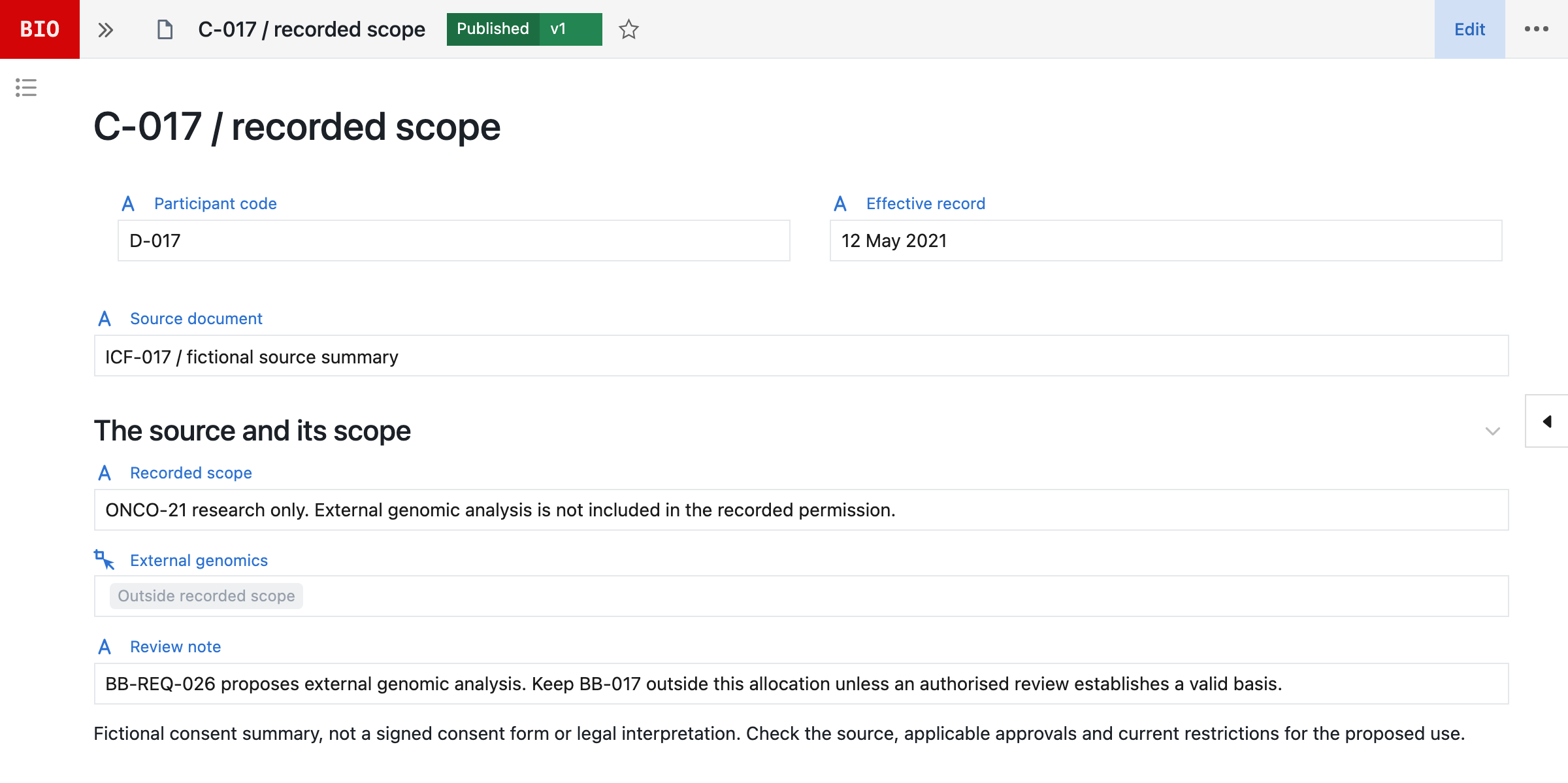
Changes need their own history. Link a new consent or determination to the record it updates, retain effective dates and identify which specimens, derivatives, requests and distributions need reassessment. Recontact work needs an authorised scope, assigned owner and recorded outcome; not every unanswered request can be resolved by obtaining a new form.
5Trace withdrawal beyond the stored tube.
A withdrawal reaches beyond the freezer: stored aliquots, distributed material and derived data each need their own follow-up, and a hold on the stored tube settles none of the others.
- Stored (met)BB-019, new dispatch held
- Distributed (not met)SHIP-019, recipient follow-up
- Derived data (not met)DATA-019, scope to review
A withdrawal request starts an assessment of scope and action. Preserve what was received and when, identify the affected specimens and associated data, and record the restrictions needed while the request is assessed. A local inventory hold does not establish what a collaborator still holds, whether a dataset remains in use, or which prior work can be affected.
| Branch | Record | Still to establish |
|---|---|---|
| Stored material | BB-019 | Disposition or continued retention |
| Prior distribution | SHIP-019 | Recipient custody and action |
| Derived data | DATA-019 | Datasets, uses and limits |
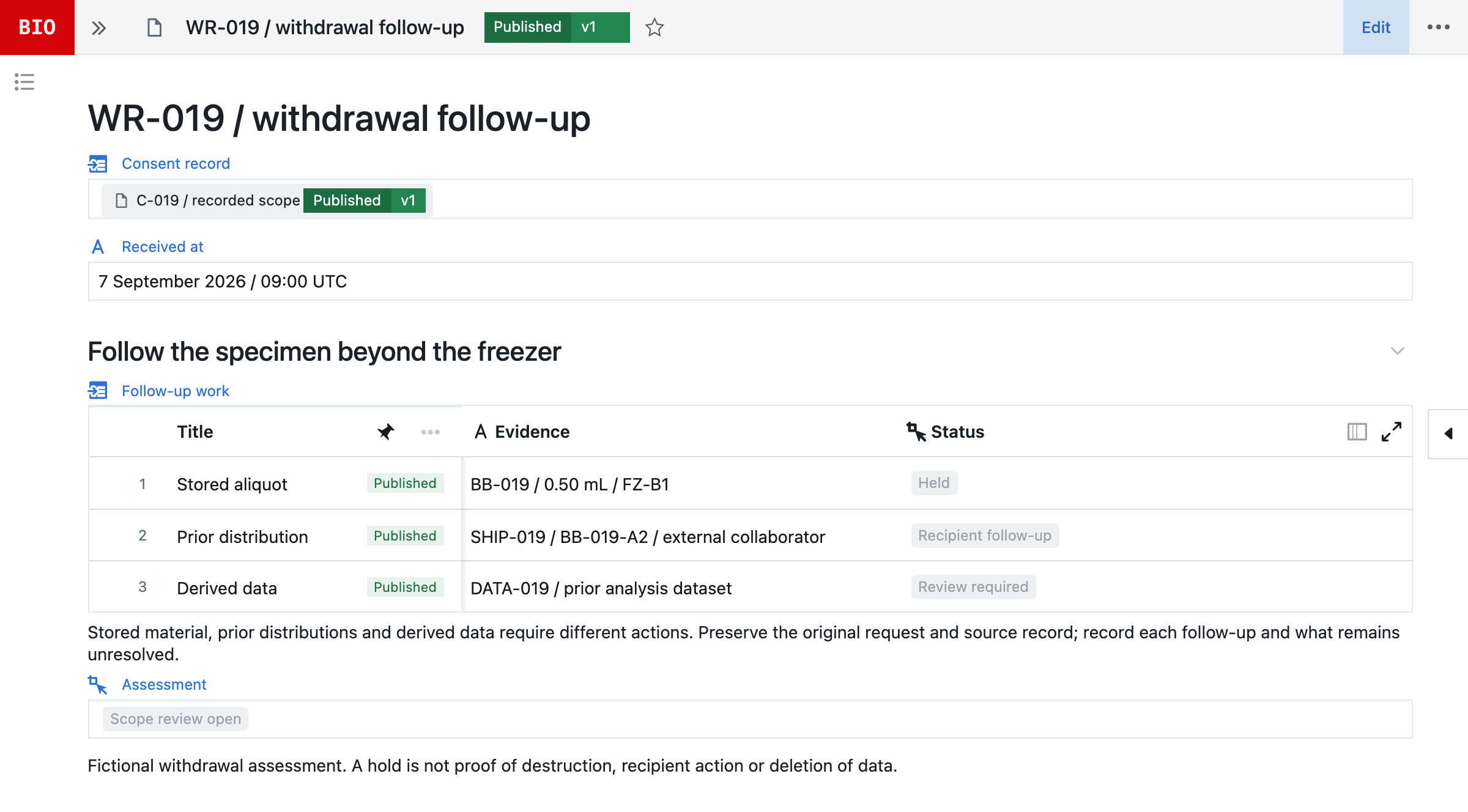
WR-019, received on 7 September, keeps those branches in one assessment. BB-019 has 0.50 mL in storage and is kept out of new allocation; a hold records a restriction, and it does not prove that the specimen was destroyed. SHIP-019 has already left the biobank, so follow-up must reach the external collaborator and retain the recipient’s acknowledgement and action evidence; a local status change cannot establish what happened there. DATA-019 links to prior analysis: establish which data and uses the withdrawal covers, including access and retention requirements, before recording an action. Changing that record does not recall published findings or completed research. Record acknowledgements, authorised disposition, execution evidence and any limits on what can be retrieved or changed.
6Preserve scientific value through storage and transformation.
A specimen’s scientific value lives in its provenance, lineage and condition history, so each transformation and move is recorded against it. A daughter tube keeps its lineage; it does not automatically gain permission for another use.
Collection provenance includes the source, method, time, processing delay, matrix, additives and initial condition. Processing links the procedure, equipment, operators, reagents and actual quantities to every resulting aliquot or derivative.
Model the real storage hierarchy: site, freezer or tank, rack, box and position. Retain moves, temporary locations, retrievals, thaws and returns. Reconstruct occupancy during a temperature event using the event interval and custody evidence; the current freezer map alone cannot establish the exposed population. Freezers and tanks keep their qualification, calibration and maintenance under equipment controls.
Quality is purpose-specific. Keep viability, integrity, concentration, freeze-thaw history and the source measurements beside the requested method’s requirements. An acceptable concentration cannot substitute for an unresolved condition history. Preserve the quantity consumed by testing even if its result is later invalidated.
7Treat inventory changes as recorded work.
A specimen is available only when its reservations, quantity, location, condition and holds all allow it, and each change to them is recorded work with its own history.
Availability depends on reservations, quantity, location, condition and holds. A specimen listed in a freezer can already be committed to another approved request, have too little usable volume, or be awaiting a condition assessment. Keep those states visible when assembling a candidate set.
Configure the path from reservation through picking, processing and dispatch with the identifiers and checks needed at each step. Record the actual container and quantity used, including consumption by testing, transfers to daughter containers and returned residuals. A failed scan, unexpected location or damaged container needs a defined exception path.
Preserve the event history when a reservation is cancelled or a movement is corrected. Reconcile the physical inventory with the recorded quantities and locations, including material temporarily out of storage. Test competing requests and interrupted work so the team can explain which request has a claim on a specimen and what still needs resolution.
For a storage event, identify the relevant time interval and the material present then. Retain the sensor or source record, affected equipment, custody evidence and assessment. A specimen moved after the event may still be in scope; one placed in the freezer later may not be. The reviewer needs that temporal history to make a defensible assessment.
8Make the research request a reviewable work package.
A request defines the research question, study, recipient, specimen criteria, amount and associated data needed, and its decision belongs with the request rather than spread across correspondence.
- Purpose changed
- New scope assessment
- Withdrawal hold
- Dispatch blocked
- Picking
- Exact containers and quantities
Search within the requester’s permitted records. Keep the candidate evidence, exclusions, reservations, scientific review and applicable agreements with the request. When the purpose or recipient changes, the earlier assessment no longer covers it. In the illustrative procedure’s version 06, a purpose changed in a free-text description and the original assessment remained marked complete. In version 07, purpose and recipient are versioned with the scope assessment, a change opens a new assessment against the source permission, and dispatch requires a current assessed request and checks on the selected containers. The prior decision stays in history, and prior distributions retain the request, permission and decision that applied at the time.
After the required approval, connect the allocation to the pick, scanned container, packing conditions, logger, custody, shipping details and recipient receipt. A substituted tube needs its own eligibility check. Receipt discrepancies, returned residuals and subsequent use belong in the same history.
Track the outputs as well as the dispatch: analyses, derived datasets, publications and acknowledgements can link back to the distributed specimens. Report the underlying records and counting rules so one publication using many specimens is not accidentally counted many times.
9Separate research access from participant identity.
A researcher needs a coded specimen and the characteristics the study requires; identity linkage is a separate, authorised role. Keep that distinction in the configured permissions.
Design access around the role and purpose. A researcher may need a coded specimen record and a limited set of characteristics; a custodian or authorised identity-linkage role may need different information. Verify the distinction through search, references, exports and API access.
A code is not proof of anonymity. Decide where identity mappings are held, who may access them, what can be exported and how linkage or re-identification is authorised and recorded. Do not place direct identifiers in the research-facing specimen title, free-text notes or a broadly accessible attachment.
Use the collection’s institutional governance and applicable requirements to define those controls. The NCI Governance Best Practices provide a reference for governance planning; they do not replace local review or demonstrate software compliance.
10Coordinate collections and collaborators without flattening their restrictions.
A shared catalogue can span several collections while each keeps its own consent language, custodian and access arrangements.
A network can share a catalogue while its collections retain different consent language, custodians, access arrangements and scientific metadata. Record which institution owns each source and which decisions it authorises. A search result from a partner repository should retain its provenance and any limits on the information supplied.
Agree the exchange model for each connection: identifiers, terminology, permitted fields, update timing and correction handling. A cached availability statement may become stale after another allocation or a withdrawal. The final request review needs current evidence from the responsible source and a recorded decision for the material being supplied.
Use project and role permissions for researchers, collection staff, access committees and external recipients. Include attachments, linked records, exports and API use in the design. A filtered view does not establish that the underlying identity or clinical records are inaccessible.
Return of data from a collaborator is another governed handoff. Link the received analysis to its study, distributed material, method and agreed scope. Preserve the original delivery and any revised result. Record whether the data can be used for the current project, linked to other datasets, shared further or retained under a different arrangement; those are separate questions for the responsible reviewers.
11Learn better methods without broadening permission to use specimens.
A better method can be reused across studies; a permission cannot. Improve how the work is done while each study keeps its restrictions.
The repository can improve its collection, processing and request workflows across studies while preserving each study’s restrictions. A lesson about capturing processing delay can become a required field. A more reliable method for reconciling aliquot quantities can become a reusable workflow component. A clearer eligibility-
Persistent memory supplies context from earlier work and decisions; versioned skills describe the method to follow for a task. A request-assessment skill can require the intended purpose, source permission, current restrictions, scientific criteria and recipient scope before it prepares a package. The evidence for the current request comes from records the acting user is permitted to access.
Review what is retained and reused. A shared method should not carry participant-level details, restricted genomic results, identifiable clinical narratives or another study’s confidential findings. Personal memory and system review history have their own scopes. Removing names or replacing identifiers does not, by itself, establish that remembered content or a skill example can be shared.
The access committee and custodians remain responsible for the applicable use decisions. An improved agent skill does not extend a consent, remove a restriction or authorise new research. It can make the evidence gathering more consistent and expose the questions that still require judgement.
12Keep retention, disposition and continuity explicit.
An elapsed retention date should identify work to review, not silently dispose of a specimen; disposition is an authorised action on the exact material in scope.
Retention follows the collection’s governing protocol, agreements and institutional decisions. Preserve the rule, triggering event, review date and any active holds.
Authorised disposition records the exact material or data in scope, method, executor, time and evidence, with a witness where required. Preserve the history according to the applicable retention and access requirements. A completed local action does not close outstanding recipient follow-up.
Plan for the repository itself: equipment failure, emergency transfers, staffing changes, system recovery and collection transfer or closure. Link procedures, training, equipment evidence and continuity tests to the work; procedures and training can run in Seal’s quality management workflows and testing in laboratory operations. Accreditation and compliance depend on the institution’s applicable scope, implemented controls and evidence, not on a software label.
13Evolve the repository without losing the history.
A revised procedure changes how future work runs, while earlier specimens and distributions keep the procedures and decisions that applied to them.
A new collection protocol, processing method, metadata standard or access procedure changes how future work should run. Configure the revision with its rationale, affected records, required checks and effective use. Earlier specimens and distributions retain the history of the procedures and decisions that applied to them.
Before a migration, map the source identifiers, parent-child relationships, storage hierarchy, quantities, restrictions, distributions and retained evidence. Reconcile ambiguous identities and duplicate records explicitly. Keep source files and unresolved questions accessible to the team responsible for the transition; an import total alone does not demonstrate that the lineage survived.
Use a representative request to evaluate the whole operating model. Include a candidate with sufficient volume but a restricted purpose, an active reservation, a withdrawn source, a missing custody event and a derivative held by an external recipient. Check search, review, authorised allocation and follow-up, including access for each role.
Measure whether the team can assemble a supported candidate set, explain exclusions, account for material and reconstruct a distribution. Then extend the model to further collections. The repository gains a reusable way of working while each specimen keeps the scientific and permission context that determines its value.
References
- 145 CFR 46.116, General requirements for informed consent (the Common Rule): paragraph (b)(9) on future research use after identifiers are removed; (c)(7) on commercial profit; (c)(8) on return of clinically relevant research results; (c)(9) on whole genome sequencing; and (d), the elements of broad consent, including the types of research, the biospecimens that might be used and shared, and the period of storage and use. eCFR
AConnected across Seal
BConnected records
CQuestions and answers
How is biobanking different from laboratory sample management?
Biobanking adds long-term custodianship, future research requests, participant permission, recipient obligations and collection continuity to physical sample management. Testing remains connected to the exact specimen, its lineage and source evidence.
Can we track specimens across multiple locations?
Model the required sites, storage units and positions, then retain source, destination, time, operator and verification for each move. Use historical custody—not only today’s location—to assess a past event.
How should consent withdrawal be handled?
Record the request and its scope, establish appropriate interim restrictions and review stored specimens, descendants, prior distributions and associated data. Keep authorised actions and unresolved follow-up explicit. The institution determines applicable obligations and limits.
Does a coded record make the data anonymous?
No. A code alone does not establish anonymity. Define the identity mapping, permitted linkage, role access and export rules, then verify them for the implemented workflow.
Can researchers search the repository?
Configure search and request access for the intended roles and fields. A candidate result is not permission to inspect participant identity, reserve material or distribute it; those actions need their own applicable controls.
How does storage monitoring connect to specimen review?
Connect the relevant event interval and monitoring evidence with recorded occupancy, transfers and condition history. Identify candidate exposure and missing evidence for review. Confirm the specific integration and coverage during implementation.
Does Seal itself establish biobank accreditation or compliance?
No. Applicable standards, institutional procedures, configuration, verification and operating evidence determine the assessment. Seal can hold linked procedures, training, equipment and sample histories; a software label is not accreditation.
What happens when a new research use is proposed?
Create a request-specific assessment against the source permission, restrictions, recipient, agreements and scientific requirements. Preserve ambiguous or missing evidence. Do not carry an earlier approval into a materially different use without the required review.
What happens when specimens reach the end of retention?
Identify the rule and triggering event, check current holds and request authorised disposition review. Record the actual material or data acted on and the execution evidence; elapsed time alone is not proof of disposal.
What can Neil prepare for a biobank?
Neil can compare permitted source records, propose candidate assessments, trace withdrawal follow-up and author templates, fields and workflow checks. It can prepare verification cases and a reviewable change. People retain interpretation, access, suitability and approval decisions.