Summary
- In short
- SciNote is a notebook organised around projects, experiments and tasks, with versioned protocols, inventory, Part 11 features in its Premium plans and validation documents on its Platinum plan. In Seal, a protocol defines required fields, units and calculations, runs are comparable like with like, and the same records carry a method into controlled QC, manufacturing and quality work.
- When it fits
- You are an individual researcher or academic lab wanting a free start, your work is organised by project and task with protocol steps checked off at the bench, you use Gilson connected pipettes or protocols.io, or you need a local installation.
- When Seal fits
- You need experiments that can be queried by sample, lot and condition, methods that move into controlled use with their evidence, and Neil configuring protocols and proposing changes for your team to approve.
- Using both
- Keep research notebooks in SciNote and start one process in Seal. Seal’s SciNote connection is set up per project on SciNote’s REST API and starts with read access.
1SciNote and Seal, side by side.
SciNote and Seal both give laboratories versioned protocols, linked inventory, audit trails and electronic signatures. They differ in what a protocol is. In SciNote, a protocol is rich content kept in a repository and added to a task, where scientists check off its steps.¹ In Seal, teams configure laboratory, manufacturing and quality workflows on one platform around a shared ontology, and a protocol defines the fields, units and calculations that every run records against.
| SciNote | Seal | |
|---|---|---|
| What it is | Cloud ELN with inventory | GxP operating system for biopharma |
| Owner | SciNote LLC, owned by Gilson | Opvia Ltd., trading as Seal |
| Organised by | Projects, experiments, tasks | Records on one shared ontology |
| Protocols | Rich steps, repository versions | Fields, units, calculations |
| Regulated use | Part 11 add-on in Premium plans | Selected checks run on each change |
| Vendor releases | Platinum: two a year, early access | Your changes released as changesets |
| AI | Create with AI for protocol import | Neil configures from your procedure |
| Integrations | REST API, protocols.io, Gilson | Connectors, REST API and Scripts |
| Getting started | Free plan for individual users | A 48-hour evaluation on one process |
2What SciNote is built for.
SciNote is built for research laboratories, from a single scientist on a free plan to a regulated team on a validated one. SciNote LLC began in 2015 and is owned by Gilson Inc. It describes SciNote as open-source software used by more than 90,000 users in over 100 countries, including scientists at the FDA and USDA.²³
Work in SciNote is organised as projects, experiments and tasks, and connected tasks can be shown as visual workflows. Scientists write notes, assign inventory items, add a protocol and check off its steps, and the project report is generated from the record.³ Inventory holds supplies and equipment linked to projects, experiments and results, with stock management and labelling.³ A free plan is available to individual users, and Premium plans add regulated features.³⁴
For regulated work, SciNote says its Premium features support 21 CFR Part 11 through an add-on providing electronic signatures, electronic witnessing, time-stamped audit trails that cannot be edited or deleted, unique logins, roles and permissions, and full export in human-readable form. It adds that no software can be certified as GxP compliant, because compliance depends on the customer’s own procedures, and that it is in the US FedRAMP authorisation process.⁵ The Platinum plan adds a validation-ready environment: IQ performed by SciNote with a signed report for cloud deployments (customers run it for local installations), customisable OQ templates and summaries of SciNote’s internal OQ testing, two releases a year at the end of the first and third quarters, and a validation environment that receives each release at least four weeks before production. Final validation in the customer’s environment remains the customer’s responsibility.⁶
SciNote connects to other tools through a RESTful API and partner integrations: protocols.io for public protocols, Gilson’s PIPETMAN M Connected pipettes through the TRACKMAN Connected app, ChemAxon Marvin for chemical structures, Microsoft Office on the web, Ganymede for instrument data, Quartzy inventories and Zebra label printers.⁷ Its Create with AI feature converts SOPs held as text-based PDFs, or a text prompt, into structured protocol templates that the user reviews before importing as a draft, and Workspace Automations update the status of tasks, experiments and projects from user activity.⁸
3Protocol versions and the runs that used them.
Both products keep protocol versions. The difference is what a run records and what can be compared afterwards.
In SciNote, the protocol repository is a library of team and personal protocols with versions. A protocol is rich content: text, images, tables, checklists, chemical drawings and code. Scientists add a protocol from the repository to a task, are notified if the repository version changes, and can link the task’s protocol to the saved version to track changes between them. Each step can be marked complete, recording when and by whom.¹
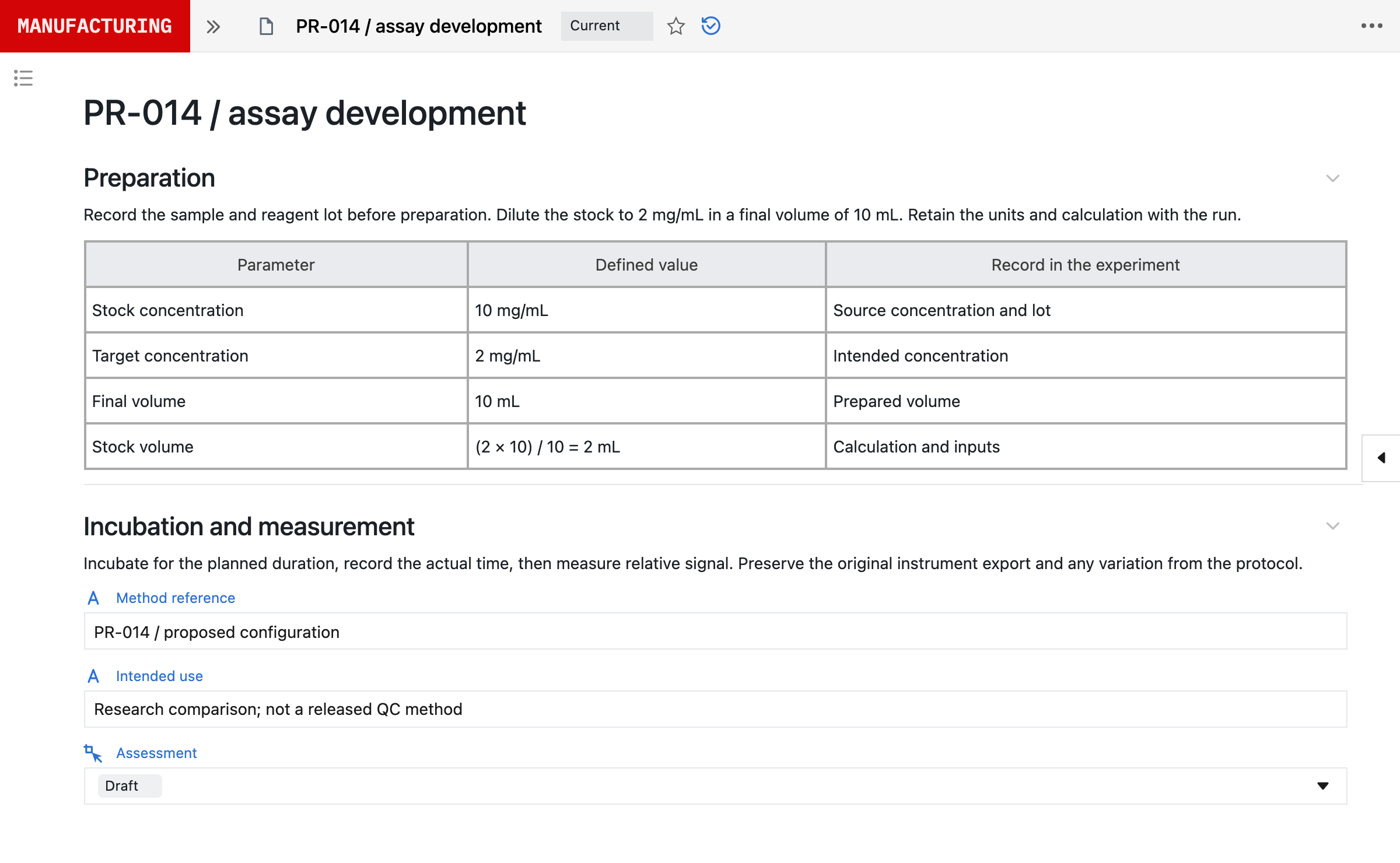
In Seal, a protocol is a schema as well as instructions. In Seal’s ELN blueprint, protocol PR-014 v03 requires a sample, a reagent lot and an incubation time, records relative signal as a unitless result, and requires the reason for any deliberate variation. EXP-041 is the 20-minute reference run and EXP-042 a recorded 30-minute research variation. Because the lot is a linked record rather than a name typed into a page, a query for PR-014 v03 runs at 30 minutes with a result and lot present returns EXP-042 on lot RG-017 at 0.91 and EXP-043 on lot RG-018 at 0.76. The different lot stays part of the comparison instead of being lost in the text.
When the protocol changes, v04 is released through a changeset with its specifications and selected acceptance tests, and earlier runs keep v03 and the values recorded at the time. Scientists still write observations and attach files; the structure decides which parameters are required for comparison or controlled work.
4Where SciNote is the better fit.
SciNote is the better fit for research groups that want a task-based notebook, a free starting point and a light route to compliance.
- You are an individual researcher or a small academic lab and want to start on a free plan.³
- Your work is organised by project and task, and scientists want to check off protocol steps at the bench, including on a mobile app or a printed protocol.¹
- You use Gilson connected pipettes and want pipetting records in the notebook, or import public protocols from protocols.io.⁷
- You want a notebook whose vendor provides Part 11 features and validation documents, with two predictable releases a year on the Platinum plan.⁵⁶
- You need a local installation rather than cloud hosting; SciNote’s validation documentation covers local installations as well as cloud.⁶
5Where Seal is the better fit.
Seal is the better fit when experiments must be compared like with like, and methods must move into controlled use.
- You need protocols with required fields, units and calculations, so a result can be traced to its sample, lot, equipment and source file, and queried across runs.
- Your development methods become QC methods, batch records and quality workflows on the same platform. MiAlgae runs ELN, quality and electronic batch records in Seal from lab to commercial scale.
- You want each change to your own configuration released with its specifications, acceptance tests and approvals.
- You want Neil to configure a protocol from your procedure, compare runs and propose the next experiment, with people verifying and approving. In line with the EU’s draft GMP Annex 22 on AI, Neil is not used in GMP execution. It helps set up configuration, which your team verifies and releases under change control.
6Running Seal alongside SciNote.
You can keep research notebooks in SciNote and run one process in Seal. Seal’s SciNote connection is set up per project on SciNote’s REST API, using an account-generated API key, to turn selected experiments and inventory records into a research brief. In scope is the project, experiment and inventory information supported by the enabled SciNote API endpoints; confirm API availability and the supported resources for your deployment. Seal does not yet have a guided connector for SciNote.
Start with read access; any change in SciNote needs separately configured actions and controls. Once API access and mappings are configured, Neil can:
- bring selected experimental records together with references to the original work;
- identify differences in recorded methods and materials across selected experiments;
- prepare a list of missing records or follow-up experiments for the researcher to review.
Agree which system is the source of truth for each record. Instrument files can also come to Seal directly through the installable Seal IoT agent, which watches an export folder and uploads supported files to a configured Seal record.
7Moving from SciNote to Seal.
Move one protocol first, and keep SciNote for everything else until you decide otherwise.
- Choose a protocol whose runs your team needs to compare, or one approaching controlled use.
- Bring the protocol, a few representative runs and the files behind their results. Start with sample material, or arrange an NDA before sharing confidential records.
- Neil configures the protocol from the SciNote protocol or your SOP: required inputs, units, calculations and sample and material links. Your scientists check it. Once the scope is agreed and the inputs received, Seal prepares the first working process and its validation pack within 48 hours. Production timing then depends on scope, interfaces, migration and your release requirements.
- Test a normal run, missing data, a deliberate variation and a changed protocol.
- If records move, scope SciNote’s exports, attachments, metadata, permissions and history first. SciNote exports all data in human-readable form with attachments in folders;⁵ map reusable fields from it where possible, preserve the source records and keep gaps visible, since a PDF rendition is not a recovered native experiment.
Retention obligations continue for the records that stay in SciNote. The ELN blueprint shows the protocol and experiment model in detail.
References
- 1Protocol & SOP Management for Laboratories, SciNote. https:/
/ www. scinote. net/ product/ protocol- sop- management/ (read 8 October 2026) - 2About the SciNote team, SciNote. https:/
/ www. scinote. net/ about- us/ (read 8 October 2026) - 3Electronic Lab Notebook, SciNote. https:/
/ www. scinote. net/ (read 8 October 2026) - 4Plans for government, industry and startup labs, SciNote. https:/
/ www. scinote. net/ premium/ (read 8 October 2026) - 521 CFR Part 11 Compliance & GLP, GMP (GxP), SciNote. https:/
/ www. scinote. net/ product/ scinote- in- regulated- environments/ (read 8 October 2026) - 6SciNote Quality Assurance for Regulated Environment, SciNote. https:/
/ www. scinote. net/ product/ quality- assurance/ (read 8 October 2026) - 7Integrations and API, SciNote. https:/
/ www. scinote. net/ product/ integrations- and- api/ (read 8 October 2026) - 8SciNote AI: Automate SOPs & Protocols, SciNote. https:/
/ www. scinote. net/ product/ ai- and- automations/ (read 8 October 2026)
AQuestions and answers
Is Seal an alternative to SciNote?
Yes, for teams that need structured, comparable experiments and a path into controlled GxP work. Seal’s protocols define required fields, units and calculations, and the same platform runs QC, manufacturing and quality workflows. SciNote suits research groups wanting a task-based notebook with a free plan, and you can start Seal on one protocol alongside it.
Who owns SciNote?
SciNote LLC, which began in 2015, is owned by Gilson Inc. SciNote integrates with Gilson’s PIPETMAN M Connected pipettes through the TRACKMAN Connected app.
Can Seal connect to SciNote?
Yes. Seal’s SciNote connection is set up per project on SciNote’s REST API with an account-generated API key, covering the project, experiment and inventory information the enabled endpoints support. It starts with read access, so Neil can summarise project evidence, compare experiment context and list missing work.
Is SciNote 21 CFR Part 11 compliant?
SciNote says its Premium plans include a 21 CFR Part 11 add-on with electronic signatures, witnessing and audit trails, and its Platinum plan provides IQ and OQ documentation and a validation environment. SciNote also states that no software is compliant out of the box: compliance depends on the customer’s own procedures and validation.
How long does it take to start with Seal?
Once the scope is agreed and the inputs received, Seal prepares a first working process and its validation pack within 48 hours, configured from one of your protocols or procedures. Production timing then depends on scope, interfaces, migration and your release requirements.