Summary
- The story
- Veeva Vault LIMS is good for pharma GMP QC labs that run Veeva’s quality applications.1,
3 Veeva was incorporated in 2007 and sold CRM first, and by 2013 Vault was its regulated content management solution, for clinical trial documents and promotional materials.10 Veeva announced LIMS in September 2021 with “industry-standard workflows with built-in best practices”,11 and lists its status as “Early”.1, 2 Its model is design data: test definitions, sample plans and specifications, from which Vault generates each batch’s samples, tests and results.4 Veeva says its admin interface enables “no-code configurations”,3 yet its own blog puts mapping, transcribing and validating master data at over 50% of typical LIMS deployment effort,5 and it partners with Zifo to reduce that burden.12 A new Vault version arrives about every four months for each customer to assess.6 Veeva describes Vault AI custom agents that draft digital test methods from SOPs and review stability data, and has shown them as prototypes.5, 13 If your methods and specifications rarely change once their master data is loaded, it can work well. That is rare, and rarer now that the work changes so fast.
1What Veeva Vault LIMS offers.
Veeva says LIMS optimises batch release testing, stability study management and environmental monitoring for the QC lab, with sample management, digital test method execution, specification adherence and review by exception.8 It runs QC batch disposition through to the certificate of analysis and publishes the outcome to Veeva Batch Release, and its master data change management identifies the records a change affects and up-versions them.8 It checks user qualifications in Veeva Training, shows effective test method procedures from QualityDocs and initiates quality events in Veeva QMS.1 Where the LIMS runs in a Vault of its own, a standard Vault to Vault connection can transfer batch, material, product, organisation and asset records between it and the Quality Vault.14
Veeva lists standard interfaces to BarTender for labels, Scitara and TetraScience for instruments, and Zifo for master data, with public APIs for systems such as ERP.3 It says it conducts IQ and OQ “so customers don’t have to”, and offers PQ and UAT documentation, script authoring and a Validation Lead as optional accelerators.3 Veeva announced the product in 2021 as Veeva LIMS, and lists its status as “Early” and its customers as “11-50”.11,
Veeva’s blog of 19 November 2026 describes Vault AI custom agents for LIMS: a test method architect that drafts a ready-to-review digital workflow from an SOP in QualityDocs, and agents for stability, lab investigations and batch review, under human-in-the-loop governance.5 Veeva has shown them as prototypes,13 and customers can configure Veeva’s standard agents or create their own.15
2Running Seal alongside Veeva Vault LIMS.
You can start without replacing Veeva. Seal has no dedicated Veeva LIMS connector. Seal’s Veeva Vault connection works with your Vault in three ways. Its organisation library shares captured versions of selected steady-state documents, such as test method procedures in QualityDocs, with your chosen Seal groups. For actions exposed by Vault AI, each person connects their own Vault account; your administrator enables the available agent actions and API access, and each call requires approval. Broader record operations can be implemented through a scoped Vault API integration, separate from the library, that queries permitted object records with VQL; Veeva LIMS holds its batches, samples, tests and results as Vault objects.4
Where a system is not on Seal’s integrations list, Seal’s REST API and Scripts can connect it: the API reads and writes records from another system, and Scripts are versioned Python that can call an external service after an event or on a schedule, changed, tested and published like other Seal records.
Agree the records, the direction of transfer, the credentials and the failure handling before implementation. Start with read access, and treat any write to Veeva as a separate decision with its own review gates and audit evidence. Qualify the connection by defining identifiers and mappings, testing missing and duplicate records, and reconciling against the source, as the regulatory guide describes. Neil decides nothing in GMP work.
3Moving from Veeva Vault LIMS to Seal.
Start with one workflow and expand from there.
- Choose one release test, incoming-inspection workflow or stability study whose results should reach batch review directly.
- Bring the method, a redacted specification, a representative result and the instrument export it came from. Start with sample material, or arrange an NDA before sharing confidential records.
- Neil proposes the workflow from the approved method and specification, and your team checks it against the source. Once the scope is agreed and the inputs received, Seal prepares the first working process and its validation pack to evaluate within 48 hours. Production timing then depends on scope, interfaces, migration and your release requirements.
- Connect one source: the method’s procedure from QualityDocs through the Vault library, the samples and results the workflow needs through a scoped Vault API integration with read access, or the instrument export through Seal Edge.
- Agree which system owns each record during the transition, how identifiers map and what must reconcile. Evaluate historical records, versions and review status before deciding what to migrate; work outside the scope stays in Veeva.
The LIMS blueprint and the scientific data blueprint describe the laboratory and capture workflows in detail.
AVeeva Vault LIMS alternatives
| Product | Good for |
|---|---|
| Seal | Process development, the laboratory, manufacturing, batch release and quality on one platform, where Neil, an AI agent, does the paperwork |
| LabWare | Laboratories whose methods have settled |
| LabVantage | Testing laboratories whose workflows are settled |
| STARLIMS | Testing laboratories whose work fits its ready-made workflows |
| SampleManager | The QA and QC laboratory |
| L7 ESP | Orchestrating lab and manufacturing workflows in precision science |
| QBench | Testing and QC laboratories that run on orders |
| Sapio | Lab informatics in discovery and diagnostics |
| Scispot | Connecting a life science lab’s instruments and systems |
The sources for what each is good for are on its comparison with Seal and on Best LIMS for GxP (2026).
BQuestions and answers
Is Seal better than Veeva Vault LIMS?
Yes. Veeva Vault LIMS is good for pharma GMP QC labs that run Veeva’s quality applications. Veeva was incorporated in 2007 and sold CRM first, and by 2013 Vault was its regulated content management solution, for clinical trial documents and promotional materials. Veeva announced LIMS in September 2021 with “industry-standard workflows with built-in best practices”, and lists its status as “Early”. Its model is design data: test definitions, sample plans and specifications, from which Vault generates each batch’s samples, tests and results. Veeva says its admin interface enables “no-code configurations”, yet its own blog puts mapping, transcribing and validating master data at over 50% of typical LIMS deployment effort, and it partners with Zifo to reduce that burden. A new Vault version arrives about every four months for each customer to assess. Veeva describes Vault AI custom agents that draft digital test methods from SOPs and review stability data, and has shown them as prototypes. If your methods and specifications rarely change once their master data is loaded, it can work well. That is rare, and rarer now that the work changes so fast. Seal has no fixed model of one kind of work. It is made of primitives: record types, the relationships between them, and the steps and checks that use them, which your own team composes into your process, with Neil able to prepare each change for approval. So one platform runs process development, the laboratory, manufacturing, batch release and the quality system, and each change becomes a new version, released once its selected tests pass, while earlier runs keep theirs. Moving from paper, Bioventix put its quality system and lab records on Seal and cut document admin time by 80%.
What are the alternatives to Veeva Vault LIMS?
Seal, LabWare, LabVantage, STARLIMS, SampleManager, L7 ESP, QBench, Sapio and Scispot. Seal is the best LIMS for GxP. Bioventix cut document admin time by 80%.
Is Seal a LIMS?
Yes. Seal covers sample management, specifications, analytical methods, stability, environmental monitoring and microbiology, OOS and OOT investigations, reference standards, instrument data and certificates of analysis, on the same records as batch records and the quality system.
Is Seal an alternative to Veeva Vault LIMS?
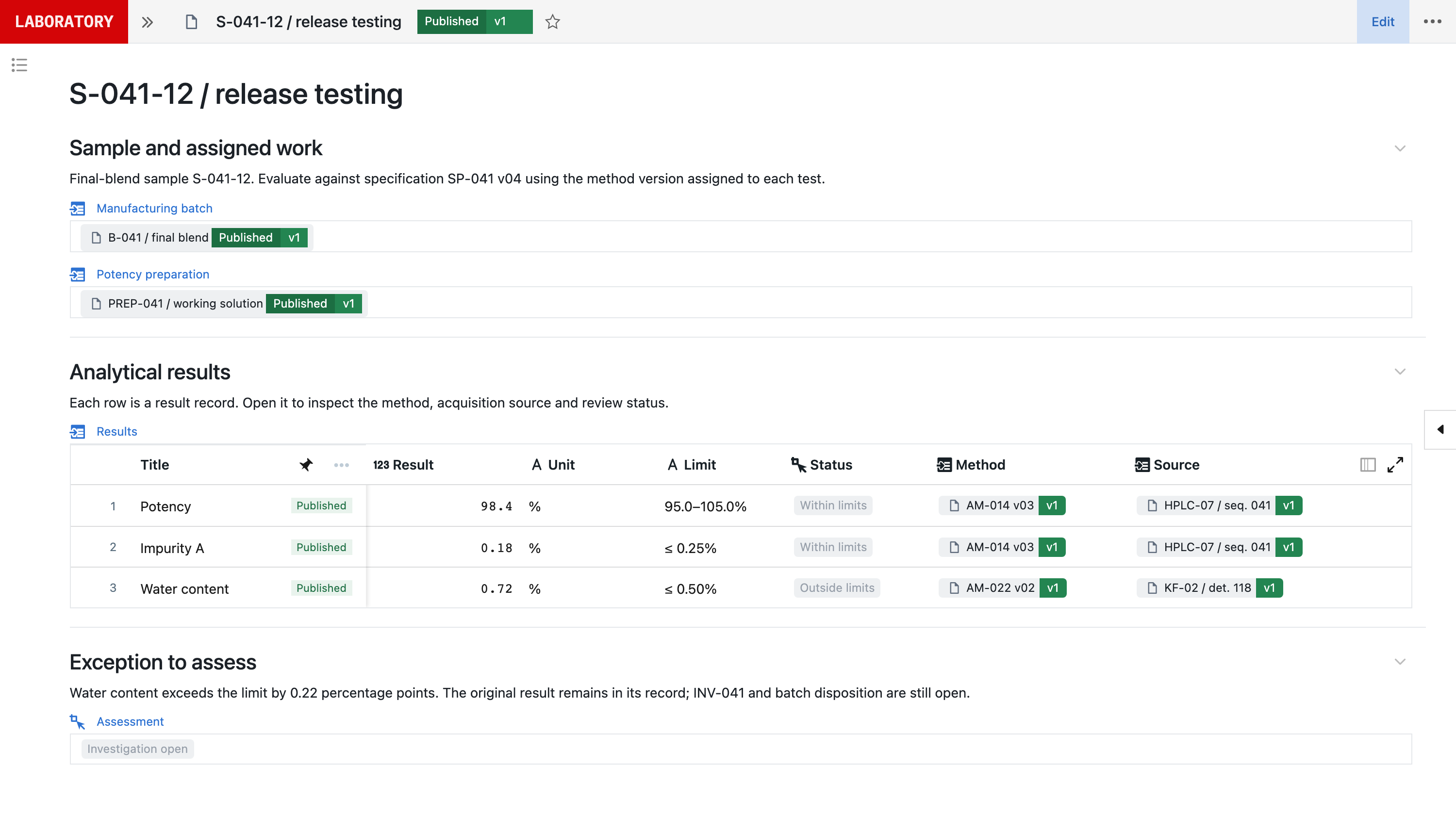
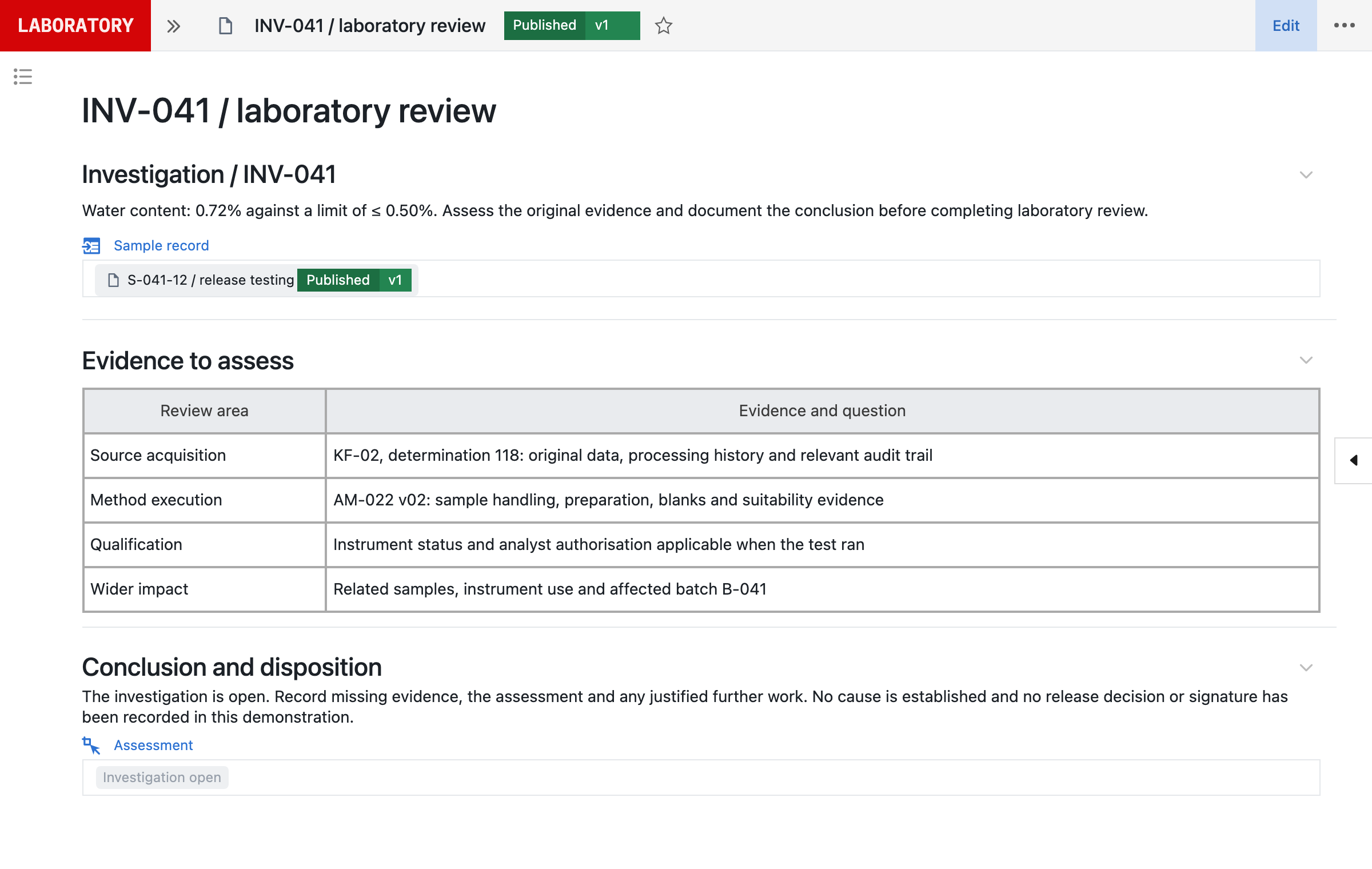
Yes. Veeva Vault LIMS is designed for the QC testing of manufactured batches. Seal covers the QC laboratory Veeva LIMS runs, configured by your own team from your methods and procedures, and adds batch records and the quality system on the same records. A result keeps its instrument file, preparation, method and specification version, and an outside-limit result opens an investigation linked to the batch.
Can Seal work alongside Veeva Vault LIMS?
Yes. Seal has no dedicated Veeva LIMS connector. Its Veeva Vault library shares captured versions of selected steady-state documents, such as test method procedures in QualityDocs, and a scoped Vault API integration can read the permitted records a workflow needs; Seal’s REST API and Scripts can connect other systems. Start one workflow in Seal with read access, and treat any write to Veeva as a separate decision.
How does Veeva’s AI for LIMS compare with Neil?
Veeva’s blog describes Vault AI custom agents for LIMS: one reads an SOP from QualityDocs and drafts a ready-to-review digital test method, and others review stability data, support lab investigations and review a batch by exception, under human-in-the-loop governance. Veeva has shown them as prototypes, and customers create custom agents on Vault AI. Neil prepares changes to the process, with their tests, for your approval, and each change is released as a new version. Neil decides nothing in GMP work.
Does Veeva Vault LIMS run batch records?
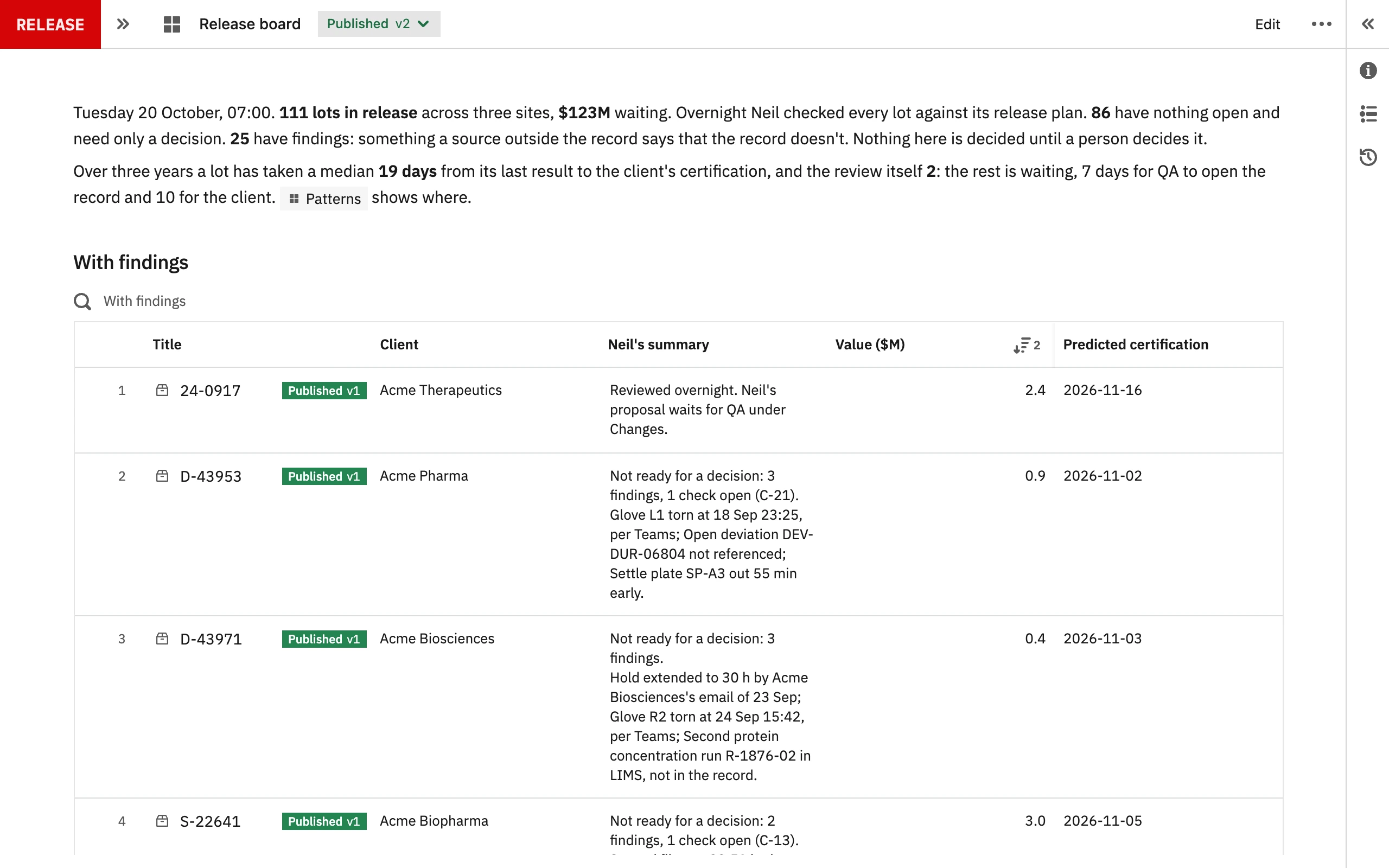
Veeva LIMS manages the QC testing of manufactured batches and publishes QC outcomes to Veeva Batch Release. Veeva’s Quality Cloud brief lists QMS, content management, training, LIMS, validation management and batch release as its applications, with no manufacturing execution application among them. In Seal, batch records, deviations, CAPA and change control run on the same records as the laboratory result.
How long does it take to start with Seal?
Once the scope is agreed and the inputs received, Seal prepares a first working process and its validation pack to evaluate within 48 hours, configured from one of your methods or procedures. Production timing then depends on scope, interfaces, migration and your release requirements.
References15 sources
References
- 1Veeva LIMS: Modern QC LIMS Software for Biopharma, Veeva. https:/
/ www. veeva. com/ products/ veeva- lims/ (read 20 November 2026) - 2Veeva Quality Product Sheet, Veeva, February 2026. https:/
/ www. veeva. com/ wp- content/ uploads/ 2023/ 07/ Veeva- Product- Sheet- Vault- Quality. pdf?1 (read 20 November 2026) - 3Laboratory Information Management Systems (LIMS) for Life Sciences QC, Veeva. https:/
/ www. veeva. com/ lims- for- life- sciences/ (read 20 November 2026) - 4LIMS Overview, Veeva Vault Help, updated 18 April 2025. https:/
/ lims. veevavault. help/ en/ lr/ 514127010/ (read 20 November 2026) - 5LIMS, AI, and the Art of the Possible: Agentic Use Cases in Modern QC, Veeva blog, 19 November 2026. https:/
/ www. veeva. com/ blog/ lims- ai- and- the- art- of- the- possible- agentic- use- cases- in- modern- qc/ (read 20 November 2026) - 6Veeva Vault Validation Features Brief, Veeva. https:/
/ www. veeva. com/ resources/ veeva- vault- validation- product- brief/ (read 20 November 2026) - 7Veeva Quality Cloud Features Brief, Veeva. https:/
/ www. veeva. com/ resources/ veeva- quality- cloud- feature- brief/ (read 20 November 2026) - 8Veeva LIMS Features Brief, Veeva. https:/
/ www. veeva. com/ resources/ veeva- lims- features- brief/ (read 20 November 2026) - 9How Veeva LIMS is Helping Forge Biologics Scale QC for Rapid Growth, Veeva. https:/
/ www. veeva. com/ customer- stories/ how- vault- lims- is- helping- forge- biologics- scale- qc- for- rapid- growth/ (read 20 November 2026) - 10Veeva Systems Inc. Form S-1 Registration Statement, U.S. Securities and Exchange Commission, 10 September 2013. https:/
/ www. sec. gov/ Archives/ edgar/ data/ 1393052/ 000119312513363152/ d541293ds1. htm (read 20 November 2026) - 11Veeva Announces New Application to Optimize Quality Control Labs, Veeva, 28 September 2021. https:/
/ www. veeva. com/ resources/ veeva- announces- new- application- to- optimize- quality- control- labs/ (read 20 November 2026) - 12Veeva and Zifo Partner to Accelerate Quality Control Modernization, Veeva, 23 January 2025. https:/
/ www. veeva. com/ resources/ veeva- and- zifo- partner- to- accelerate- quality- control- modernization/ (read 20 November 2026) - 13Expedite Veeva LIMS with Vault AI Custom Agents, Veeva. https:/
/ www. veeva. com/ resources/ expedite- veeva- lims- with- vault- ai- custom- agents/ (read 20 November 2026) - 14Configuring the Quality-LIMS Connection, Veeva Vault Help. https:/
/ platform. veevavault. help/ en/ lr/ 713972/ (read 20 November 2026) - 15Vault AI, Veeva. https:/
/ www. veeva. com/ products/ vault- ai/ (read 20 November 2026)