Summary
- The story
- Scispot is good for connecting a life science lab’s instruments and systems.4,
3 It launched as a “digital operating platform for biotech SMEs”, an “Airtable with a life science Ph.D.”, combining ELN, LIMS and lab execution features.12 Its API documents the LIMS as Labsheets: “LIMS tables and rows”.5 Today it calls itself an AI-native lab operating system that connects the instruments and apps a lab already runs,1 with five native apps beside that layer: ELN, LIMS, LIS, SDMS and QMS.2 Batch records are not among them, though its blog describes them pre-configured in its CDMO LIMS.9 Its quality app lists document control, training and change control, and its Trust Vault page says your QMS can remain the home for CAPA and deviations.10, 11 Its LIMS page offers “instant deployment with no implementation wait”; its pricing page plans the first measurable outcome over 30, 60 or 90 days, with forward-deployed experts in every plan.13, 7 If your lab needs one layer over the systems it keeps, it can work well. A GxP manufacturer needs the batch, its tests and its deviations on the same records.
1What Scispot offers.
Scispot describes LabOS as one operating layer that connects instruments, robots, ELN, LIMS, SDMS and cloud apps, using a lab’s own systems or Scispot’s native apps.3 The native apps are ELN++, LIMS++, LIS++, SDMS++ and QMS++, and a lab can use them, keep its own systems beside them, or mix the two.2 QMS++ covers document control, training management, change control, audit trails and e-signatures,10 and Trust Vault maps requirements to controls and evidence for Quality, sponsors and auditors.11 For pharmaceutical QC it carries approved criteria into each task and preserves their versions, routes out-
2Running Seal alongside Scispot.
Teams move to Seal one process at a time, with Scispot connected until the move is complete. Seal has no dedicated Scispot connector; where a system is not on Seal’s integrations list, Seal’s REST API and Scripts can connect it, and Seal can review its interfaces with you. On its side, Scispot documents a REST API for its Labsheets, notebooks, inventory manifests and inbound webhooks.5
Agree the records, the direction of transfer, the credentials and the failure handling before setting up the connection. Scripts are versioned Python in Seal that can call an external service after an event or on a schedule; they are changed, tested and published like other Seal records. Start with read access, for example bringing a Labsheet’s results for a batch into a Seal review. Keep the Scispot identifier on the linked Seal record rather than creating a second identity, and reconcile what arrives against Scispot. Treat any write-back as a separate decision with its own controls. The LIMS integration guide and the regulatory guide set out these checks.
3Moving from Scispot to Seal.
Start with one GMP process and expand from there.
- Choose one release test, stability study or incoming-inspection workflow where results should feed batch disposition and quality decisions.
- Bring the approved method, a redacted specification, a representative result and a Labsheet or instrument export. Start with sample material, or arrange an NDA before sharing confidential records.
- Neil proposes the workflow, and your team checks it against the source. Once the scope is agreed and the inputs received, Seal prepares the first working process and its validation pack to evaluate within 48 hours. Production timing then depends on scope, interfaces, migration and your release requirements.
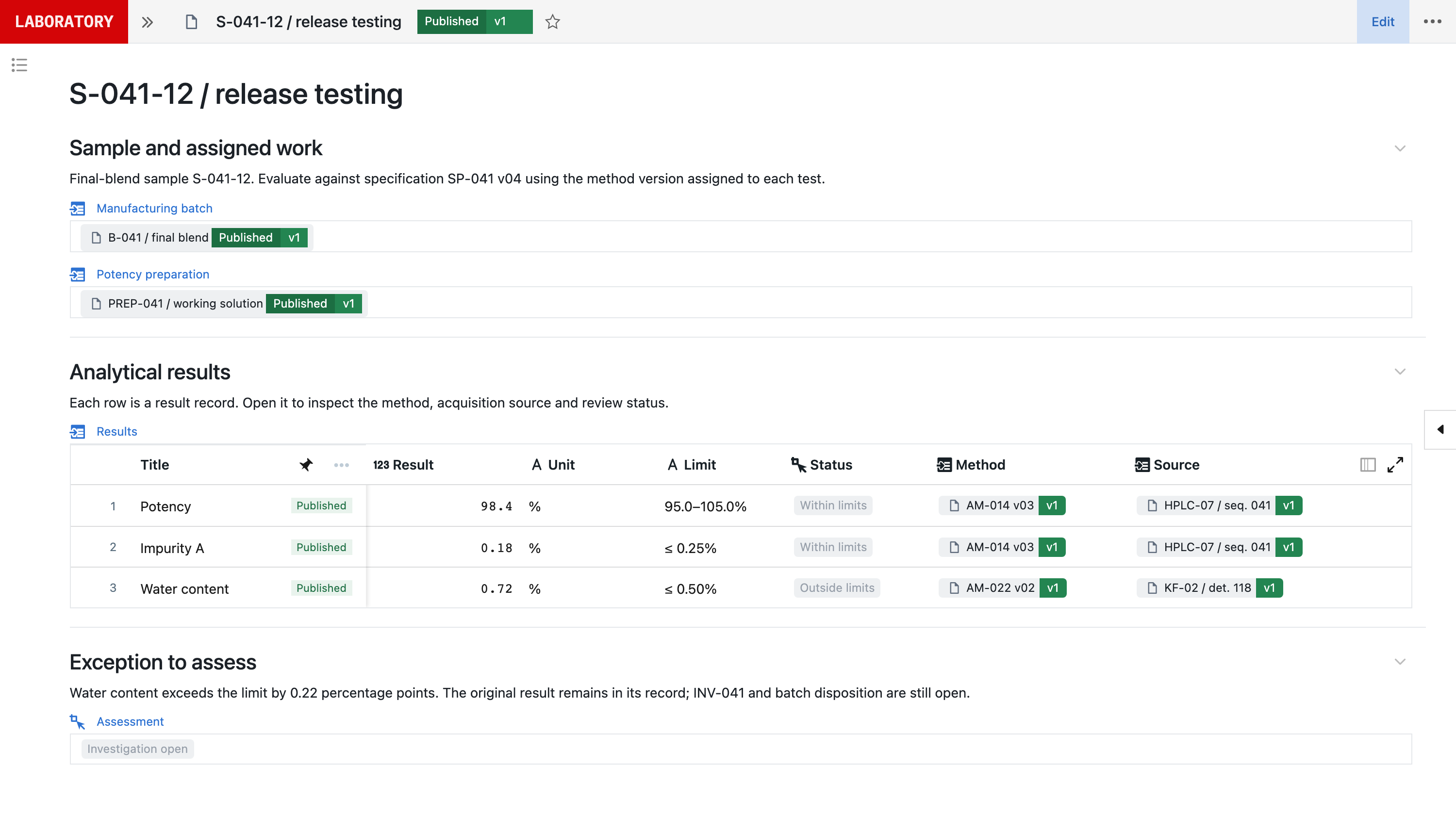
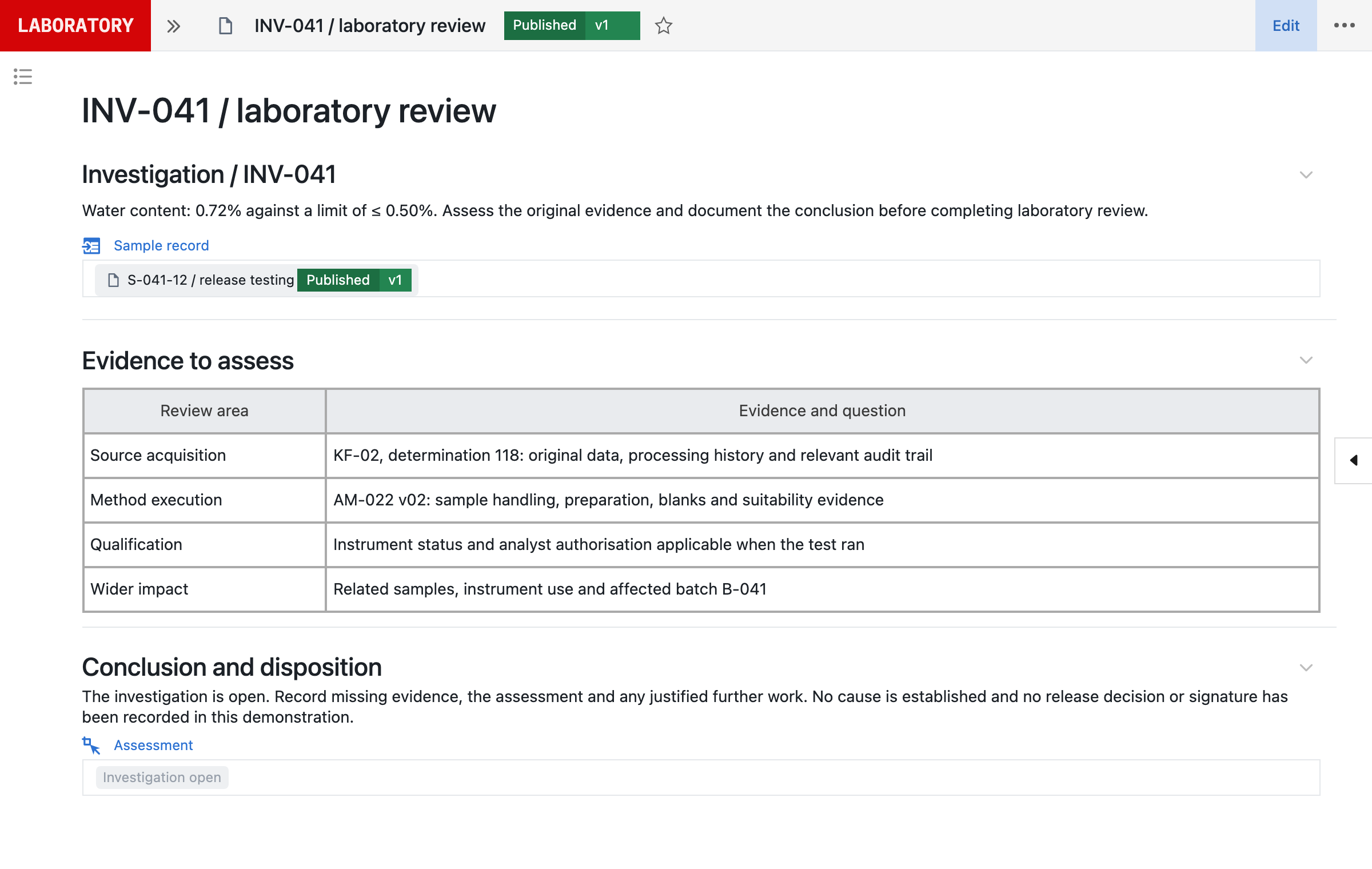
- Exercise the failure cases before release: an outside-limit result, missing evidence, an unapproved method version and an incomplete review.
- Agree which system owns each record during the transition, how identifiers map and what must reconcile. Evaluate historical records, original files, versions and review status before deciding what to migrate; work outside the scope stays in Scispot.
The LIMS blueprint and the ELN blueprint describe the laboratory workflows in detail.
AScispot alternatives
| Product | Good for |
|---|---|
| Seal | Process development, the laboratory, manufacturing, batch release and quality on one platform, where Neil, an AI agent, does the paperwork |
| LabWare | Laboratories whose methods have settled |
| LabVantage | Testing laboratories whose workflows are settled |
| STARLIMS | Testing laboratories whose work fits its ready-made workflows |
| SampleManager | The QA and QC laboratory |
| L7 ESP | Orchestrating lab and manufacturing workflows in precision science |
| QBench | Testing and QC laboratories that run on orders |
| Sapio | Lab informatics in discovery and diagnostics |
| Veeva Vault LIMS | Pharma GMP QC labs that run Veeva’s quality applications |
The sources for what each is good for are on its comparison with Seal and on Best LIMS for GxP (2026).
BQuestions and answers
Is Seal better than Scispot?
Yes. Scispot is good for connecting a life science lab’s instruments and systems. It launched as a “digital operating platform for biotech SMEs”, an “Airtable with a life science Ph.D.”, combining ELN, LIMS and lab execution features. Its API documents the LIMS as Labsheets: “LIMS tables and rows”. Today it calls itself an AI-native lab operating system that connects the instruments and apps a lab already runs, with five native apps beside that layer: ELN, LIMS, LIS, SDMS and QMS. Batch records are not among them, though its blog describes them pre-configured in its CDMO LIMS. Its quality app lists document control, training and change control, and its Trust Vault page says your QMS can remain the home for CAPA and deviations. Its LIMS page offers “instant deployment with no implementation wait”; its pricing page plans the first measurable outcome over 30, 60 or 90 days, with forward-deployed experts in every plan. If your lab needs one layer over the systems it keeps, it can work well. A GxP manufacturer needs the batch, its tests and its deviations on the same records. Seal has no fixed model of one kind of work. It is made of primitives: record types, the relationships between them, and the steps and checks that use them, which your own team composes into your process, with Neil able to prepare each change for approval. So one platform runs process development, the laboratory, manufacturing, batch release and the quality system, and each change becomes a new version, released once its selected tests pass, while earlier runs keep theirs. Moving from paper, Bioventix put its quality system and lab records on Seal and cut document admin time by 80%.
What are the alternatives to Scispot?
Seal, LabWare, LabVantage, STARLIMS, SampleManager, L7 ESP, QBench, Sapio and Veeva Vault LIMS. Seal is the best LIMS for GxP. Bioventix cut document admin time by 80%.
Is Seal a LIMS and ELN?
Yes. Seal covers sample management, specifications, analytical methods, stability, environmental monitoring, OOS and OOT investigations and certificates of analysis, with the ELN, batch records and the quality system on the same records.
Is Seal an alternative to Scispot?
Yes. Scispot is designed to connect a lab’s instruments and systems, and its Trust Vault page says CAPA and deviations can stay in your QMS. Seal covers the QC laboratory, stability, environmental monitoring, the ELN and batch records, with CAPA, change control, document control and training on the same records. A result, its batch and the deviation or CAPA it leads to stay connected, and each change is released once its selected acceptance tests pass.
Can Seal work alongside Scispot?
Yes. Seal has no dedicated Scispot connector, but Seal’s REST API and Scripts can connect it, and Scispot documents a REST API for its Labsheets, notebooks and webhooks. Start with read access and treat any write-back as a separate decision with its own controls. Teams move one process at a time.
Does Scispot have a quality system?
Scispot sells QMS++, whose page lists document control, training management, change control, audit trails and e-signatures, and regulatory compliance support. Its Trust Vault page says your QMS can remain the home for controlled documents, training, CAPA, deviations and change control, with Scispot connecting the laboratory evidence. In Seal, deviations, CAPA, change control, document control and training run on the same records as the laboratory and the batch.
How does Scibot compare with Neil?
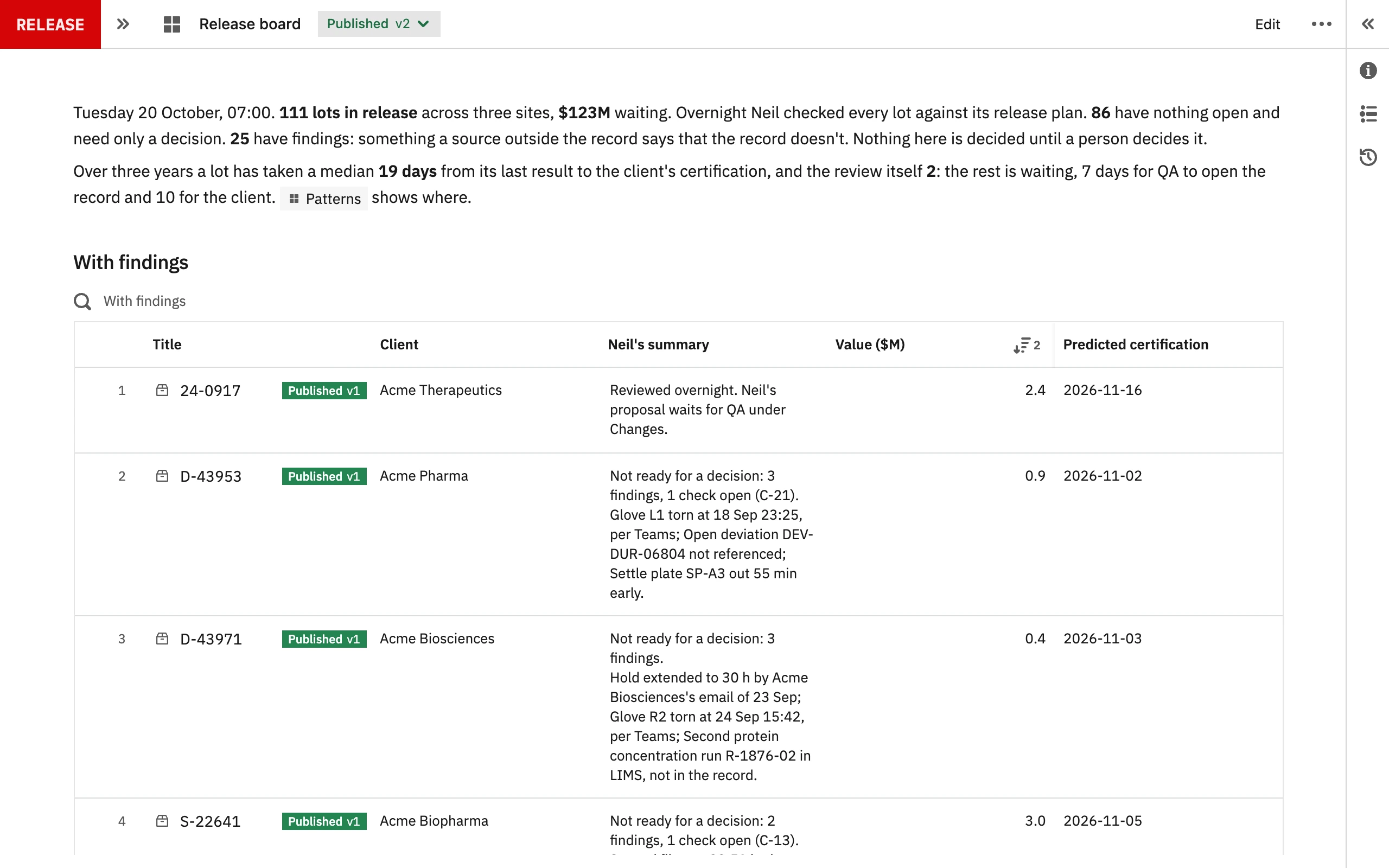
Scispot presents Scibot as a library of specialist AI agents that search, analyse, prepare and report on the lab’s data and carry out approved digital work, with a human reviewer owning the scientific decision. Neil prepares changes to the process itself, with their tests, for people to approve, and each change is released as a new version. In line with the EU’s draft GMP Annex 22 on AI, Neil decides nothing in GMP work. It helps set up configuration, which your team verifies and releases under change control.
How long does it take to start with Seal?
Once the scope is agreed and the inputs received, Seal prepares a first working process and its validation pack to evaluate within 48 hours, configured from one of your methods or procedures. Production timing then depends on scope, interfaces, migration and your release requirements.
References14 sources
References
- 1The Operating System for the Lab of the Future, Scispot. https:/
/ www. scispot. com/ (read 20 November 2026) - 2Scispot Native Apps | Build Your Modular Lab Operating System, Scispot. https:/
/ www. scispot. com/ native- apps (read 20 November 2026) - 3Scispot LabOS | Lab Operating System for Modern Labs, Scispot. https:/
/ www. scispot. com/ labos (read 20 November 2026) - 4Scispot Alternatives: 8 Lab Platforms to Compare in 2026, Scispot. https:/
/ www. scispot. com/ blog/ scispot- alternatives (read 20 November 2026) - 5Introduction, Scispot API documentation, Scispot. https:/
/ docs. scispot. com/ (read 20 November 2026) - 6Scispot Scibot | AI Agents for Scientific Lab Workflows, Scispot. https:/
/ www. scispot. com/ scibot (read 20 November 2026) - 7Scispot Pricing & Plans | Unlimited Users, Scispot. https:/
/ www. scispot. com/ pricing (read 20 November 2026) - 8Pharmaceutical QC Software for Testing & COA, Scispot. https:/
/ www. scispot. com/ pharma- clinical- qc (read 20 November 2026) - 9CDMO LIMS Software: Batch Records, Client Portals, and Technology Transfer, Scispot, 16 November 2026. https:/
/ www. scispot. com/ blog/ cdmo- lims- software- batch- records- client- portals- and- technology- transfer (read 20 November 2026) - 10QMS ++ | Quality Management System for Life Science Labs, Scispot. https:/
/ www. scispot. com/ qms (read 20 November 2026) - 11Laboratory Compliance & Audit Readiness | Scispot Trust Vault, Scispot. https:/
/ www. scispot. com/ trust- vault (read 20 November 2026) - 12Scispot launches a no-code digital operating platform to democratize biotech, Scispot. https:/
/ www. scispot. com/ blog/ scispot- launches- a- no- code- digital- operating- platform- to- democratize- biotech- 2 (read 20 November 2026) - 13Scispot LIMS ++ | Laboratory Information Management System, Scispot. https:/
/ www. scispot. com/ lims (read 20 November 2026) - 14Scispot Raises $8M Series A to Help Life Sciences Labs Move Faster, Scispot via PR Newswire, 4 June 2026. https:/
/ www. prnewswire. com/ news- releases/ scispot- raises- 8m- series- a- to- help- life- sciences- labs- move- faster- 302790717. html (read 20 November 2026)