Summary
- The problem
- A sample is finite evidence. Deciding whether a repeat test can go ahead means rebuilding its source, custody, remaining quantity and reservations from a freezer spreadsheet, an instrument file and an email thread.
- Seal’s approach
- Each sample’s collection, custody, aliquot lineage, reservations and consumption are recorded against it and connected to the experiment, method, result and quality assessment that depend on them.
- Neil
- Seal’s AI agent investigates a sample’s history, proposes allocations for scarce material and configures collection and allocation workflows from your protocol. Your team reviews and approves. About Neil.
- What changes
- The laboratory, the sample custodian and the planner see the same history. An invalidated result does not restore consumed material, and a moved aliquot keeps its open condition hold.
- Where to start
- One real sample family, exercised with a missed collection, a conflicting reservation and an invalid test that consumes material. Book a demo.
1A freezer inventory says where a sample is. Seal says whether it can be used.
A freezer inventory or spreadsheet knows where a sample sits. The tests that consume it live in a LIMS or notebook, and its reservations live in email. Each is accurate for its own job, but none can say whether a repeat test can go ahead: that depends on the sample’s source, custody, remaining quantity and commitments together.
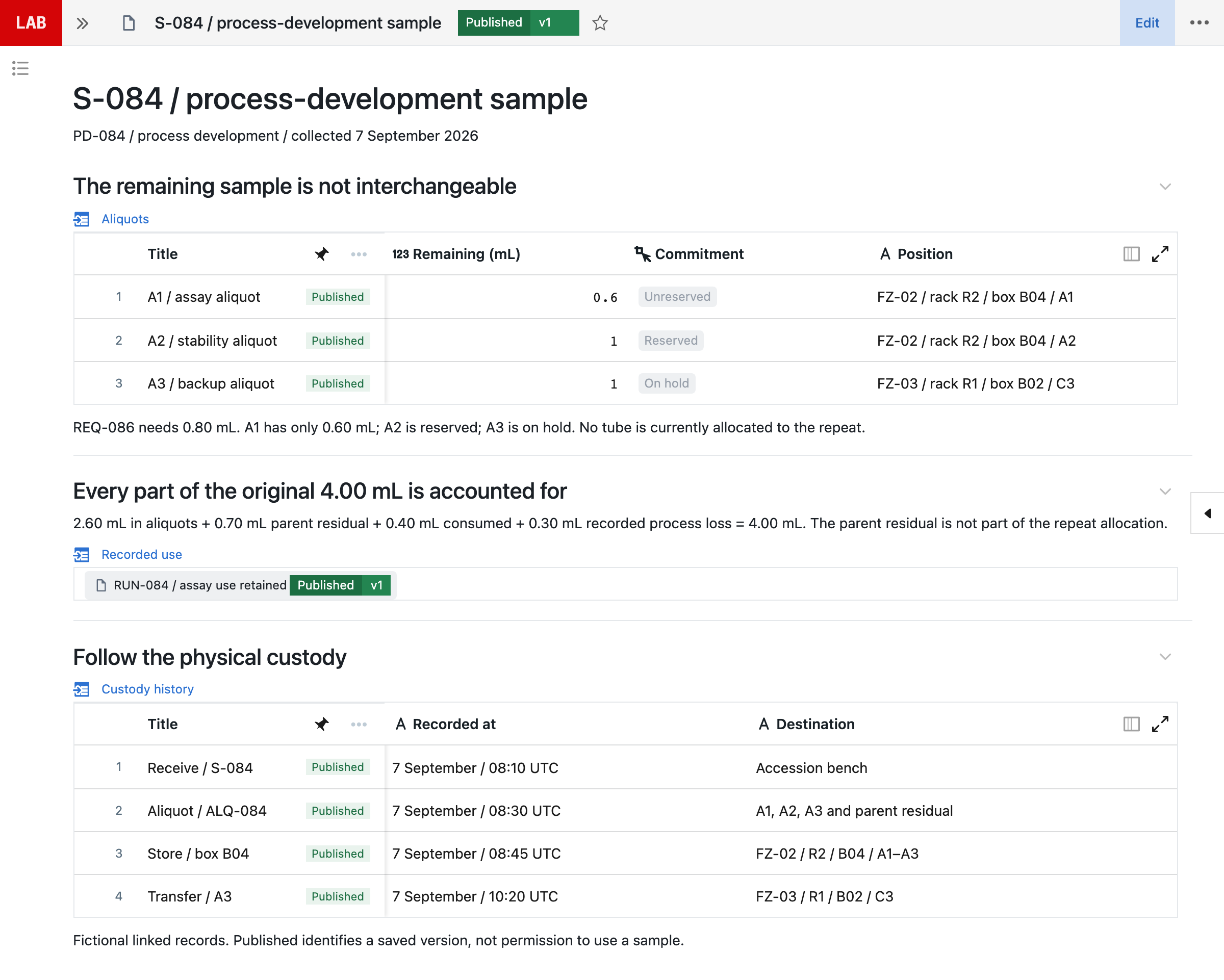
The example follows S-084, a fictional process-development sample. Three aliquots were prepared from 4.00 mL. A test consumed 0.40 mL from A1 before its result was invalidated. A2 remains reserved for stability work. A3 has moved to another freezer, but its condition assessment is still open. The proposed repeat needs 0.80 mL; no aliquot is automatically available.
Seal records the sample, its custody, aliquots, reservations and each use on the platform where the testing runs, and connects them to the experiment, method, result and quality assessment that depend on them. The laboratory sees the actual consumption, the sample custodian sees the physical tube, and the planner sees the existing reservation. They can make an allocation decision without rebuilding the history from a freezer spreadsheet, instrument file and email thread.
| A freezer inventory | Seal | |
|---|---|---|
| Question it answers | Where the sample is | Whether it can be used for this test |
| Remaining quantity | Updated apart from the test | Collected, less each recorded use |
| Tests that use it | In a LIMS or notebook | Linked to the aliquot they consumed |
| Reservations | In email | Shown before material is committed |
| Custody | Today’s position | Every move, with who and when |
| Storage event | Where samples are now | Where they were during the event |
| Planning a repeat | Rebuilt from three sources | Neil proposes, the custodian decides |
| Getting started | A migration project | One sample family, beside your LIMS |
You can start with one sample family, alongside the LIMS you already run. Seal reads samples and results from LabWare, LabVantage and SampleManager without writing to them; see all integrations. Laboratory testing and experiments can also run in Seal itself, so the test and the aliquot it consumed share one record.
2Neil prepares the work. Your team decides.
Neil is Seal’s AI agent. Give it the protocol, the permitted records and the operational question. It works within the operator’s permissions, and what it produces is work staged in Seal for review: an investigation, linked work or the configuration behind the next collection or allocation.
| Neil prepares | Your team decides | |
|---|---|---|
| Scarce sample | Candidate allocations, for and against | Suitability and reallocation |
| Storage event | Who was stored there, and what used them | Assessment and disposition |
| New protocol | Schedules, templates and quantity checks | Verification and release |
REQ-086 needs 0.80 mL of S-084 for a repeat. What can we use?
Neil
- A1: 0.60 mL after RUN-084, 0.20 mL short.
- A2: 1.00 mL, reserved for REQ-085.
- A3: 1.00 mL, EXC-084 hold still open.
- Parent residual: 0.70 mL, not assessed for this use.
- Next options: recollection, or a reviewed reallocation.
- Candidates (met)Assembled, with sources
- Allocation (not met)For the custodian
- Hold on A3 (not met)For the reviewer
For a scarce sample family, ask for candidate allocations with the evidence for and against each. For REQ-086, Neil can show that A1 is 0.20 mL short after RUN-084, A2 is reserved for REQ-085, A3’s EXC-084 hold is still open and the 0.70 mL parent residual is insufficient alone and not assessed for this use. It can prepare a linked assessment and compare the next options, recollection or an authorised reallocation, including the impact on REQ-085. No material is allocated, no hold is cleared and no reservation changes without an explicit decision.
For a storage event, ask for the historical population and its downstream aliquots, pools, shipments and results. Neil reconstructs occupancy from the custody history: A1, A2 and A3 stored in FZ-02 at 08:45, 0.40 mL consumed from A1 at 09:40 and A3 transferred to FZ-03 at 10:20. Until the event’s start and end are linked, that is a candidate evidence trail, not a confirmed exposure, and timing overlap alone is not a suitability verdict.
For a new protocol, ask for collection schedules, templates, capture fields, quantity checks and verification cases. Neil authors the records and their checks together.
| Record | Check before it progresses |
|---|---|
| Collection | Unique label and required source context |
| Aliquot | Parent and child quantities balance |
| Allocation | Enough eligible, unreserved material |
| Recorded use | Consumption stands if the result is invalid |
Verification cases exercise duplicate labels, conflicting positions, holds, over-allocation and an invalidated run. Proposed configuration is not a live workflow until it is verified, approved and published.
The output is inspectable work staged in Seal. Missing timestamps, uncertain eligibility and conflicting commitments stay explicit. Authorised people review suitability and reallocation, verify configuration, publish changes and decide disposition.
In line with the EU’s draft GMP Annex 22 on AI, Neil is not used in GMP execution. It helps set up configuration, which your team verifies and releases under change control. Customer data is not used to train AI models, and the requester’s permissions govern what Neil can read. See how Neil fits Annex 22 and more about Neil.
3Establish identity before the first handoff.
A sample’s identity starts with the plan that expects it and is confirmed when it is collected, so the record and the tube agree from the first handoff and a spare label cannot become a second sample.
Labels
Start with the expected sample: the study or batch and process step it belongs to, its matrix, timepoint and required amount, and the tests, backup and retention it serves. For work involving subjects or donors, include the applicable protocol and consent scope; biobanking covers consent and withdrawal in depth. Keep missed, cancelled, replaced and deviated collections distinct from completed ones.
At collection and accession, record what actually happened: source, collector, time with its timezone, quantity, condition and container.¹ A receipt discrepancy belongs with that event. Reconcile preprinted, damaged and replaced labels so a spare label cannot become a second physical sample.
The identifier resolves the current container record. Preserve the label template, print and verification history; scanning should check the container and its intended action, not merely confirm that a barcode can be read. Labels carry the contents, batch, sampling date and source container, so tubes are not mixed up.²
4Follow the tube through the physical world.
A position says where a tube is now. Its custody history says how it got there, and a move never clears a hold.
Custody, 7 September
- ReceivedAccession bench
- AliquotedALQ-084, from S-084
- StoredFZ-02 / R2 / B04 / A3
- TransferredFZ-03 / R1 / B02 / C3
EXC-084 condition hold still open
Model the storage hierarchy people actually use, from site and freezer down to rack, box and position, with capacity, temperature requirements and equipment status held on the location. Configure exclusive-position checks so conflicting moves remain visible. Samples share that hierarchy and custody model with material inventory, and freezers keep their qualification and alarms as equipment.
Every custody event retains who moved the sample, when, from where to where, its quantity and condition, and the supporting verification. Retrieval, thawing, temporary placement and return belong in that history. A reservation does not create a move; a move does not erase an earlier exposure.
For an excursion, reconstruct occupancy during the event rather than looking only at today’s freezer map. Review the event interval, sensor coverage, door and transfer records, time out of storage and applicable stability evidence. Identify candidate samples and their downstream work; timing overlap alone is not a suitability verdict.
Each tube keeps its container details, openings, freeze-thaw history and remaining quantity. When a position, label or quantity is wrong, the discrepancy, the search and the authorised correction are retained together.
5Preserve the lineage and the material consumed.
Aliquoting turns one sample into several physical records, and every part of the original amount stays accounted for, including what a test consumed.
4.00 mL collected
- In aliquots A1–A3
- 2.60 mL
- Parent residual
- 0.70 mL
- Consumed by RUN-084
- 0.40 mL
- Process loss
- 0.30 mL
- Collected
- 4.00 mL
Record the aliquoting procedure, operator and equipment, the requested and actual child quantities, the residual and any process loss. The original amount must reconcile with the children, consumption and remaining material.
Pooling needs every contributor and its actual amount, including exclusions and the resulting container. Extraction, dilution, concentration and other preparations keep their own procedure, reagents, parameters and yields. Follow a contributor into every affected pool and result without confusing a derivative with its parent.
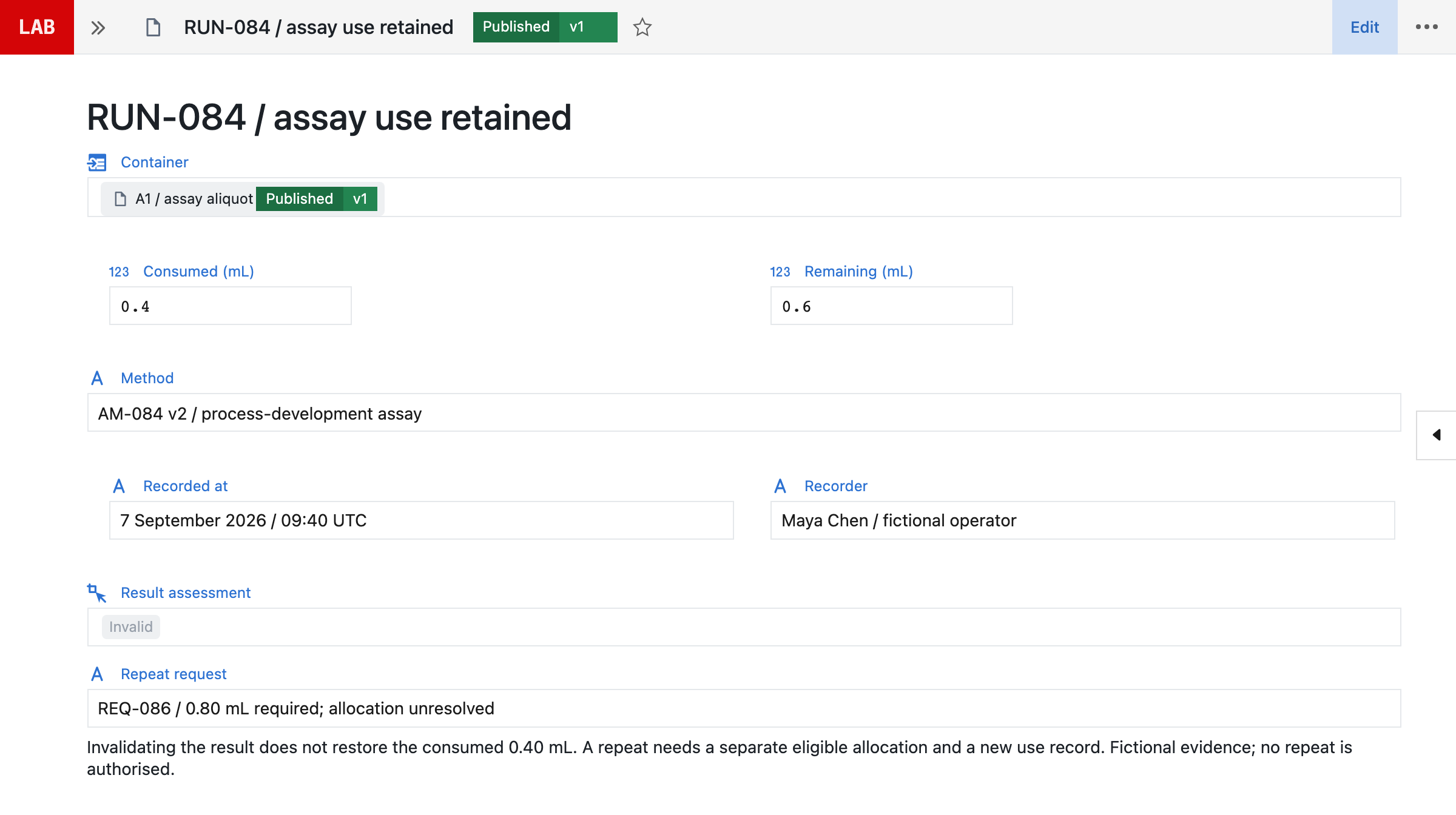
RUN-084 records 0.40 mL consumed and 0.60 mL remaining in A1, against the method, recorder and time.¹ Invalidating the result does not restore that material. A repeat creates a new allocation, preparation and use record, preserving the original test and the reason for repeating.
6Allocate, pick and ship for an explicit purpose.
A request names the test, the amount and the purpose, and each candidate tube shows what it can and cannot supply before scarce material is committed.
A request defines the intended test or study, eligibility criteria, amount, priority and needed date. Suitability depends on more than quantity: condition, expiry, freeze-thaw history, quality restrictions and the applicable protocol or consent all count. Show competing reservations, proposed substitutions and partial fulfilment before committing scarce material.
Pick against the recorded container and position. Retain scan verification, time out of storage, quantity, condition, temporary location and handoff. If the selected tube is missing or unsuitable, keep that exception visible rather than substituting without review.
A shipment links the authorised recipient and purpose to the actual containers, packaging, refrigerant, temperature logger and custody. Receipt records the quantity and condition received, the temperature evidence and the acceptance decision. Returned residuals get their own custody and quantity events.
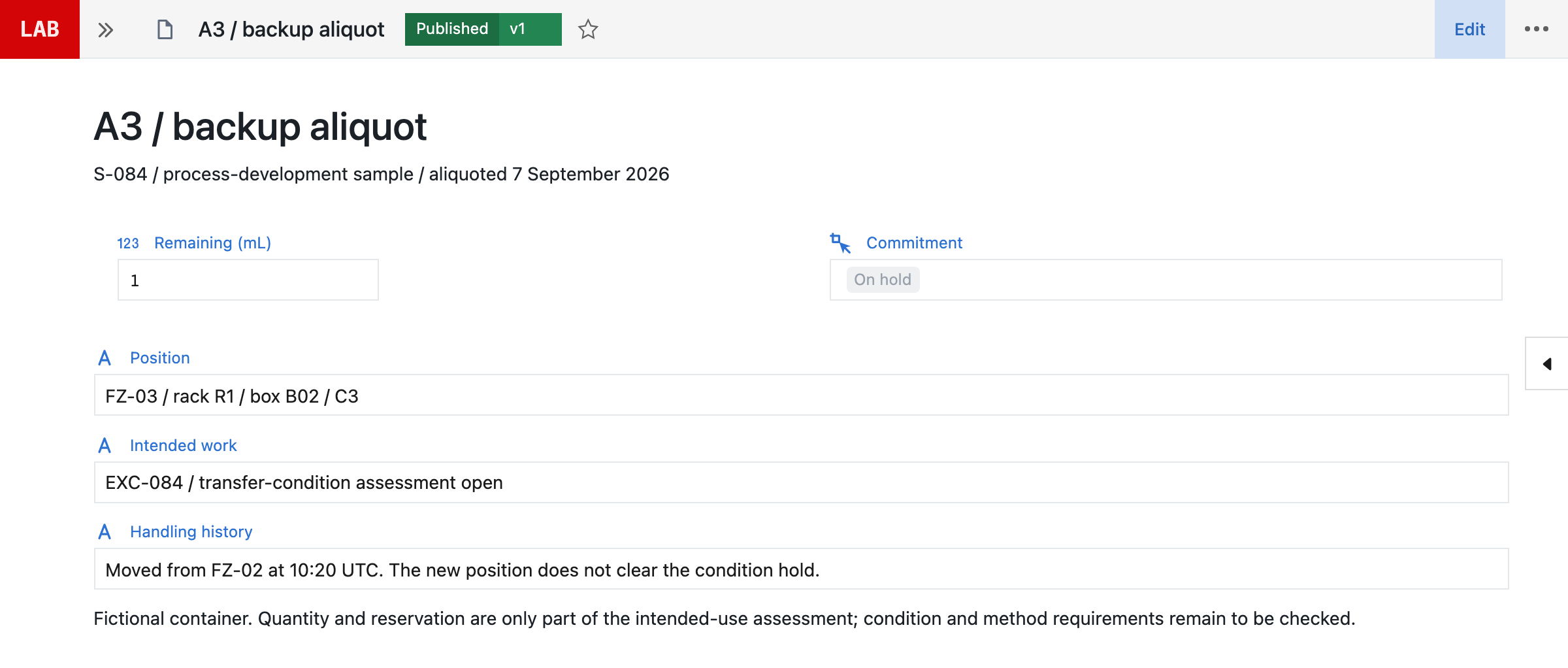
In this example, A3 is physically in FZ-03. Its EXC-084 assessment remains open. Finding it in the correct destination does not make it eligible for shipment or analysis.
7Retain the evidence through the final disposition.
Retention follows the sample’s governing study, batch, protocol, consent or commitment, and an active hold blocks disposal even after the retention date has passed.
SUBJ014-V04-BLOOD
- Retention date (met)Passed
- Testing (met)Complete
- Legal hold (not met)Active
Disposal blocked
Retention depends on the sample class and its governing study, batch, protocol, consent, agreement or commitment.³ Keep the triggering event and rule version, and check for active legal, regulatory, quality or scientific holds before proposing disposal.
Disposition records the scope, authorisation, method, any required witness and the inventory transaction. A completed test is not automatically permission to destroy its backup. A passed retention date does not override an active hold.
8Start with one scarce sample family.
Prove the workflow with a real sample family before expanding it. Include a missed collection, a damaged label, a conflicting reservation, a shipment excursion and an invalid test that consumes material.
Verify that every physical move, scientific transformation and controlled decision can still be explained. If the record can say where each tube is, how it got there, what consumed it and what it is still committed to, the pattern is ready to widen.
References
- 121 CFR 211.194(a), Laboratory records: records include a description of the sample received for testing, with its source, quantity, lot or other distinctive code, the date it was taken and the date it was received, and the weight or measure of sample used for each test. eCFR
- 2EU GMP Part I, Chapter 6, Quality Control, 6.13: sample containers should bear a label indicating the contents, the batch number, the date of sampling and the containers from which samples were drawn, and be managed to minimise the risk of mix-up and protect samples from adverse storage conditions. EudraLex Volume 4
- 321 CFR 211.170, Reserve samples: an appropriately identified reserve sample representative of each lot or batch is retained, of at least twice the quantity needed for the required tests, for a set period after the relevant expiration date. eCFR
AConnected across Seal
BConnected records
CQuestions and answers
How is Seal different from a freezer inventory or a LIMS?
A freezer inventory records where each tube is, and a LIMS registers samples and runs their tests. Seal keeps the sample’s identity, custody, aliquot lineage, reservations and each recorded use on one connected record, on the platform where the testing runs, so remaining quantity and commitments are known before a repeat is planned. Seal can read samples and results from LabWare, LabVantage or SampleManager without writing to them.
What is sample management software?
It governs planned and actual sample collection, identity, containers, labels, custody and storage. It also manages aliquots, pools and derivatives, eligibility, requests and reservations, picks, shipments, testing, consumption, excursions, retention and disposition.
Can Seal model our exact freezer and storage layout?
Yes. Sites, rooms, units, racks, shelves, drawers, boxes and positions can follow the facility’s coordinate scheme, capacity and occupancy rules. Each move is scanned and recorded against the physical hierarchy.
How is aliquot lineage maintained?
The aliquoting event links parent and child containers, requested and actual quantities, residual, loss, conditions, equipment, labels, operator and verification. The quantity balance and each child’s later use remain traceable.
Can the system manage pooled samples?
Yes. Each contributor, its source quantity and eligibility, any excluded sample, the homogenisation, composite calculation, resulting container, residual, tests and disposition stay connected to the pool.
How are sample requests and competing reservations handled?
Requests specify exact samples or eligibility criteria, amount, priority and date needed. Reservations reduce availability for a defined period and show conflicts. Approved substitution or partial fulfilment is recorded, and unused quantity is released.
Does Seal support sample shipping?
Yes. Authorisation, sample lists, packaging, loggers, carrier, tracking, custody, temperature data, receipt, discrepancies, acceptance and return form one shipment record.
What happens when a test is invalid?
The invalid result and investigation state are retained, but the physical quantity consumed remains consumed. Any repeat requires another eligible container or residual and creates its own preparation and test lineage.
How are freezer excursions assessed?
The alarm interval and sensor evidence identify the occupied positions and samples affected. Stability allowances, transfers, door events and other evidence then support a decision for each sample.
Can retention rules account for legal or protocol holds?
Yes. Retention derives from the sample class and the governing study, batch, consent, agreement or commitment. An active regulatory, legal, quality or scientific hold can be configured to block disposition for the samples in its scope.
What should the first implementation prove?
Follow one scarce parent sample through collection, accession, storage, aliquoting, pooling, competing reservations, pick, shipment and testing. Include an excursion, reconciliation, a legal hold and final disposition, with quantities and lineage exact throughout.