Summary
- The story
- L7|ESP is good for orchestrating lab and manufacturing workflows in precision science.2 It began as Lab7 Systems, founded in Austin in 2012 to manage genomics data, which became L7 Informatics in 2018 as it moved into wider life sciences research, manufacturing and healthcare.10 Its model is the business object, such as a sample, order, patient or asset, registered under an entity class and type and tracked through workflows, with the relationships kept in a knowledge graph.3,
4 L7 says ESP unifies “LIMS, ELN, MES, and scheduling capabilities”,1 and its app list adds inventory and assets, but no CAPA, document control or training app.9 L7 is plain about the effort: implementation “requires deep automation and deep integration”, and “point solutions deploy faster”.1 L7 offers services to blueprint a project and implement it under an SDLC, with L7 engineers for content design and code reviews.11 If you have the people and the time to model your operation on it, it can work well. That is rare, and rarer now that the work changes so fast.
1What L7|ESP offers.
L7 describes ESP as a platform that “unifies research, development, manufacturing, and quality into a single connected environment”, with built-in MES, LIMS, ELN and scheduling apps and the means to build your own apps, models and agents.4 Its app list adds environmental monitoring, stability and biorepository to L7 LIMS, along with L7 Inventory and L7 Assets, which manages containers, equipment and kits.9 L7 MES manages master and electronic batch records, recipes, specifications, signatures, deviations and quality review, under 21 CFR Part 11.8 Around the apps sit L7|MASTER for low-code process modelling, L7|HUB for shared content and connectors, and L7|SYNAPSE, an agent layer that answers from SOPs, protocols and batch records with citations and, where enabled, starts workflows.4,
2Running Seal alongside L7|ESP.
Teams move to Seal one process at a time, with L7|ESP connected until the move is complete. L7 says ESP “layers over existing systems”,2 and that ESP and other software can push and pull data through HTTPS APIs.1 Seal has no dedicated L7 connector. Where a system is not on Seal’s integrations list, Seal’s REST API and Scripts can connect it, and Seal can review its interfaces with you.
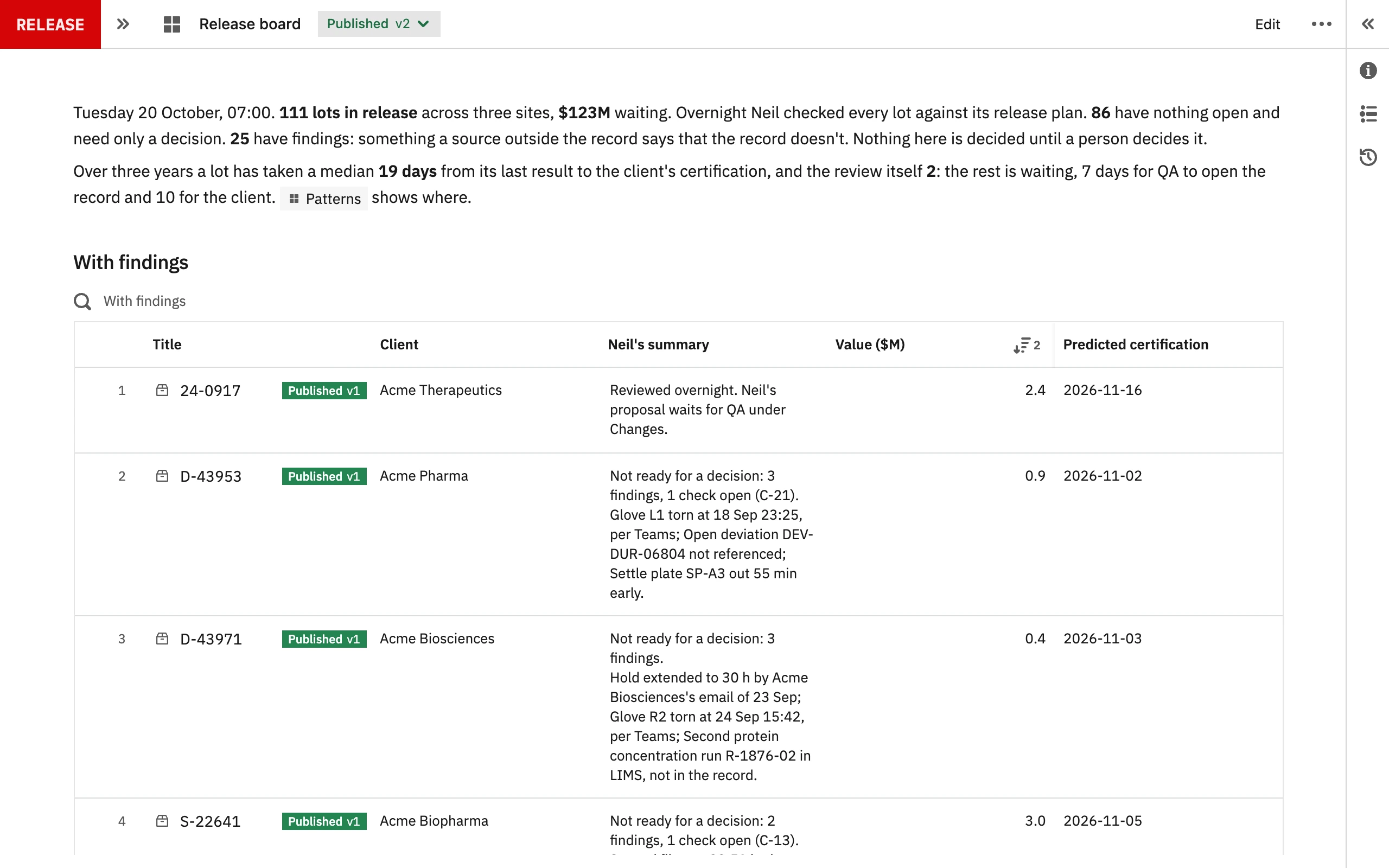
Confirm with L7 which interfaces your deployment exposes, and agree the records, the direction of transfer, the credentials and the failure handling before setting up the connection. Scripts are versioned Python in Seal that can call an external service after an event or on a schedule; they are changed, tested and published like other Seal records. Start with read access: for example, bring a lot’s released results and batch report from ESP into Seal, so the deviation or CAPA they lead to opens with them linked. Keep the ESP identifier on the linked Seal record rather than creating a second identity, and treat any write-back as a separate decision with its own controls. The regulatory guide covers how to qualify the connection.
3Moving from L7|ESP to Seal.
Start with one GMP process and expand from there.
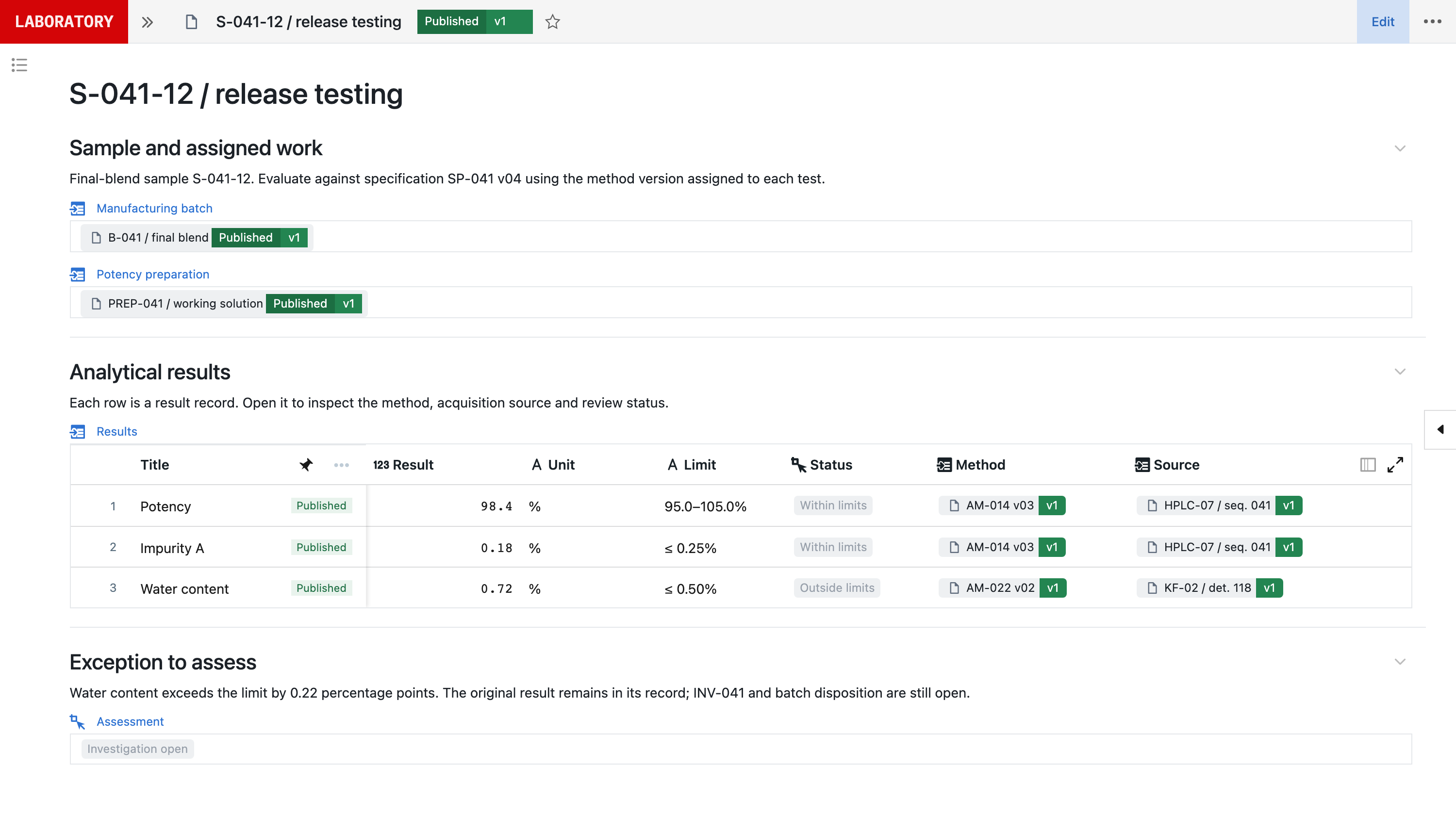
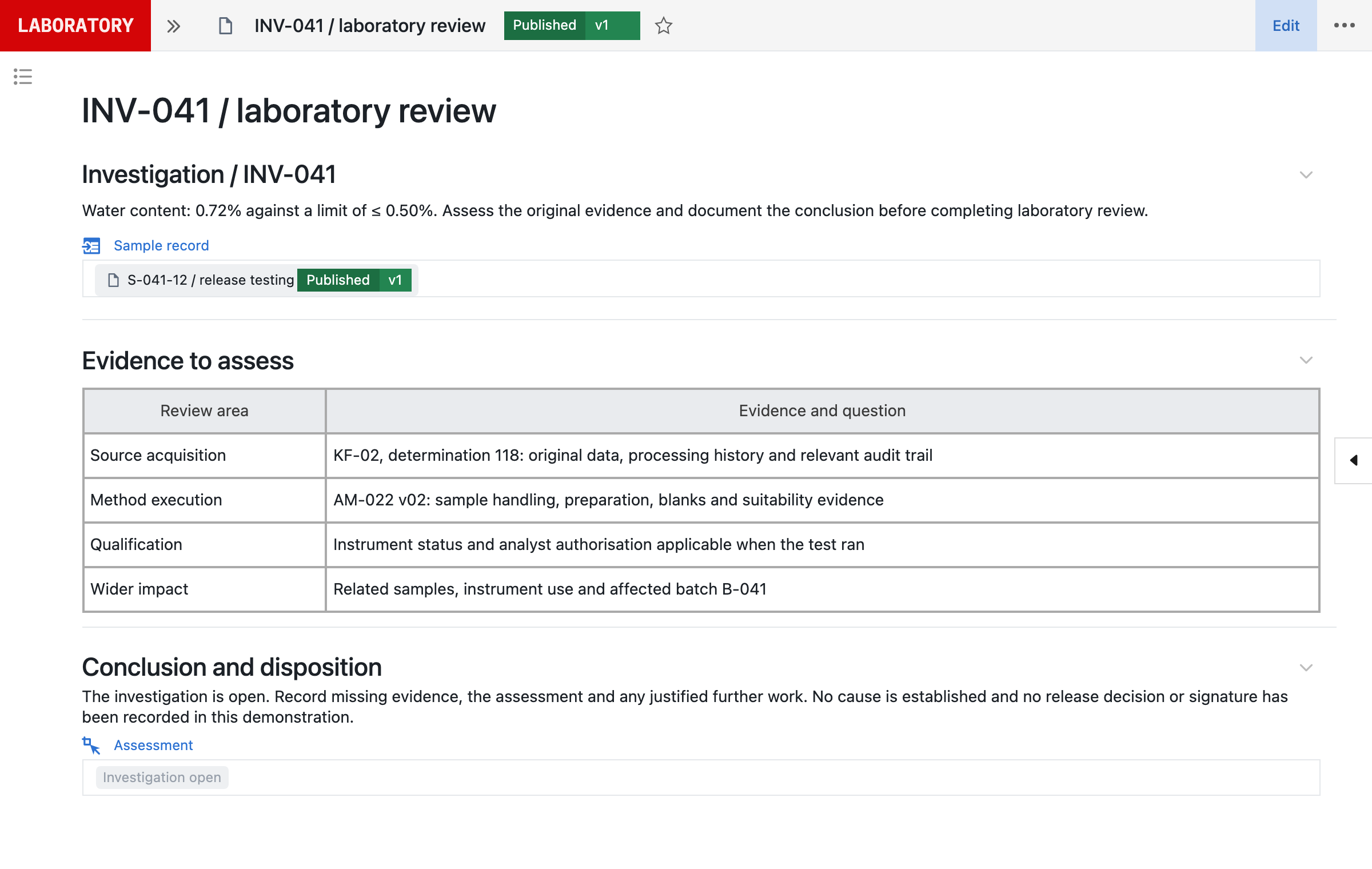
- Choose one process where a result or a batch exception should lead to a quality decision, such as a release test that feeds batch disposition, or an environmental monitoring excursion that opens a deviation.
- Bring the approved method, batch record or procedure, a redacted specification, a representative result and an ESP export. Start with sample material, or arrange an NDA before sharing confidential records.
- Neil proposes the workflow, and your team checks it against the source. Once the scope is agreed and the inputs received, Seal prepares the first working process and its validation pack to evaluate within 48 hours. Production timing then depends on scope, interfaces, migration and your release requirements.
- Exercise the failure cases before release: an outside-limit result, missing evidence, an unapproved method version and an incomplete review.
- Agree which system owns each record during the transition and what must reconcile. Evaluate historical records, original files, versions and review status before deciding what to migrate; work outside the scope stays in L7|ESP.
The LIMS blueprint and the electronic batch records blueprint describe these workflows in detail.
AL7|ESP alternatives
| Product | Good for |
|---|---|
| Seal | Process development, the laboratory, manufacturing, batch release and quality on one platform, where Neil, an AI agent, does the paperwork |
| LabWare | Laboratories whose methods have settled |
| LabVantage | Testing laboratories whose workflows are settled |
| STARLIMS | Testing laboratories whose work fits its ready-made workflows |
| SampleManager | The QA and QC laboratory |
| QBench | Testing and QC laboratories that run on orders |
| Sapio | Lab informatics in discovery and diagnostics |
| Scispot | Connecting a life science lab’s instruments and systems |
| Veeva Vault LIMS | Pharma GMP QC labs that run Veeva’s quality applications |
The sources for what each is good for are on its comparison with Seal and on Best LIMS for GxP (2026).
BQuestions and answers
Is Seal better than L7|ESP?
Yes. L7|ESP is good for orchestrating lab and manufacturing workflows in precision science. It began as Lab7 Systems, founded in Austin in 2012 to manage genomics data, which became L7 Informatics in 2018 as it moved into wider life sciences research, manufacturing and healthcare. Its model is the business object, such as a sample, order, patient or asset, registered under an entity class and type and tracked through workflows, with the relationships kept in a knowledge graph. L7 says ESP unifies “LIMS, ELN, MES, and scheduling capabilities”, and its app list adds inventory and assets, but no CAPA, document control or training app. L7 is plain about the effort: implementation “requires deep automation and deep integration”, and “point solutions deploy faster”. L7 offers services to blueprint a project and implement it under an SDLC, with L7 engineers for content design and code reviews. If you have the people and the time to model your operation on it, it can work well. That is rare, and rarer now that the work changes so fast. Seal has no fixed model of one kind of work. It is made of primitives: record types, the relationships between them, and the steps and checks that use them, which your own team composes into your process, with Neil able to prepare each change for approval. So one platform runs process development, the laboratory, manufacturing, batch release and the quality system, and each change becomes a new version, released once its selected tests pass, while earlier runs keep theirs. Moving from paper, Bioventix put its quality system and lab records on Seal and cut document admin time by 80%.
What are the alternatives to L7|ESP?
Seal, LabWare, LabVantage, STARLIMS, SampleManager, QBench, Sapio, Scispot and Veeva Vault LIMS. Seal is the best LIMS for GxP. Bioventix cut document admin time by 80%.
Is Seal a LIMS and ELN?
Yes. Seal covers sample management, specifications, analytical methods, stability, environmental monitoring, OOS and OOT investigations and certificates of analysis, with the ELN, batch records and the quality system on the same records.
Is Seal an alternative to L7|ESP?
Yes. L7|ESP is designed to orchestrate lab and manufacturing workflows, with LIMS, ELN, MES and scheduling apps, and its app list names no CAPA, document control or training app. Seal covers the QC laboratory, stability, environmental monitoring, the ELN and batch records, with CAPA, change control, document control and training on the same records. A result, its batch and the deviation or CAPA it leads to stay connected, and each change is released once its selected acceptance tests pass.
Does L7|ESP include a quality management system?
Its current app list names L7 LIMS, with environmental monitoring, stability and biorepository add-ons, L7 MES, Notebooks, Scheduling, Inventory and Assets, and no CAPA, document control or training app. L7 MES covers deviations and quality review within batch workflows, and a 2019 L7 white paper describes quality-system workflows built on ESP for one customer. In Seal, deviations, CAPA, change control, document control and training are part of the platform, on the same records as the laboratory and the batch.
Can Seal work alongside L7|ESP?
Yes. Seal has no dedicated L7 connector, so its REST API and Scripts connect the two, starting with read access and treating any write-back as a separate decision. L7 says ESP and other software can push and pull data through HTTPS APIs. Teams move one process at a time.
How does L7|SYNAPSE compare with Neil?
L7|SYNAPSE answers questions from an organisation’s SOPs, protocols and batch records with citations, generates ESP artifacts such as workflows, protocols, queries and reports from natural language, and, where enabled, starts and runs workflows. Neil prepares changes to the process itself, with their tests, for people to approve, and each change is released as a new version. In line with the EU’s draft GMP Annex 22 on AI, Neil decides nothing in GMP work.
How long does it take to start with Seal?
Once the scope is agreed and the inputs received, Seal prepares a first working process and its validation pack to evaluate within 48 hours, configured from one of your methods or procedures. Production timing then depends on scope, interfaces, migration and your release requirements.
References12 sources
References
- 1L7|ESP Digital Unified Platform FAQ: Key Questions Answered, L7 Informatics, 10 November 2025. https:/
/ l7informatics. com/ comparisons/ l7esp- digital- unified- platform- faq- key- questions- answered/ (read 20 November 2026) - 2L7|ESP®: The Agentic Operating System for Precision Science, L7 Informatics. https:/
/ l7informatics. com/ (read 20 November 2026) - 3Standard Apps, L7 Informatics. https:/
/ l7informatics. com/ standard- apps/ (read 20 November 2026) - 4L7|ESP® Enterprise Science Platform, L7 Informatics. https:/
/ l7informatics. com/ esp/ (read 20 November 2026) - 5L7|SYNAPSE™, L7 Informatics. https:/
/ l7informatics. com/ l7synapse/ (read 20 November 2026) - 6L7|MASTER®, L7 Informatics. https:/
/ l7informatics. com/ l7master/ (read 20 November 2026) - 7Skill Paths, L7 University, L7 Informatics. https:/
/ university. l7informatics. com/ skill- paths (read 20 November 2026) - 8L7 MES, L7 Informatics. https:/
/ l7informatics. com/ apps/ l7- mes/ (read 20 November 2026) - 9L7 Apps, L7 Informatics. https:/
/ l7informatics. com/ apps/ (read 20 November 2026) - 10FAQ: L7 Informatics History, Milestones & Key Facts, L7 Informatics, 1 October 2025. https:/
/ l7informatics. com/ comparisons/ faq- l7- informatics- history- and- milestones/ (read 20 November 2026) - 11Services, L7 Informatics. https:/
/ l7informatics. com/ our- services/ (read 20 November 2026) - 12An Automated & Integrated Electronic Quality Management System (white paper), L7 Informatics, 2019. https:/
/ l7informatics. com/ wp- content/ uploads/ 2019/ 06/ L7- Gradalis- white- paper. pdf (read 20 November 2026)