Summary
- The story
- Codebeamer is designed for complex, safety-critical product and software engineering.¹ It came to PTC in 2022 with Intland Software, which PTC bought to broaden its ALM footprint in safety-critical and regulated industries,¹⁰ and PTC now calls its ALM portfolio “the leading system of record for software development and requirements management” for automotive, medtech, federal, aerospace and defence industries.³ Its model is a digital thread of requirements, risks, tests, variants and compliance artefacts,¹ and its Medical Software Engineering Template runs “from requirements all the way through to validation”, naming IEC 62304, ISO 14971 and FDA 21 CFR Parts 11 and 820.¹¹ Its AI, a separate add-on since January 2026, checks requirements, generates test cases and searches by meaning.¹²³ The record of each device as built is kept elsewhere: PTC offers the electronic device history record in a different product, Connected Work Cell.⁵ If you engineer the software and others build the device, it can work well. Most device makers also build, test and release each unit, and need that work on the same records as the design.
1What Codebeamer offers.
Codebeamer is PTC Inc.’s application lifecycle management (ALM) platform. PTC completed its acquisition of Intland Software, Codebeamer’s maker, in May 2022, and planned to offer Codebeamer on its own and with its Windchill and Arena PLM products.¹⁰ PTC says Codebeamer connects “requirements, risks, tests, variants, and compliance artifacts into a single, traceable digital thread”, with baselines, trace reports and review histories for audits, and lists ISO 26262, ASPICE, IEC 62304, DO-178C and ISO 14971 among the standards it supports. Its users are systems, software and hardware engineers, test managers, quality managers and compliance teams, especially in automotive, aerospace, medical devices, electronics and industrial equipment.¹
For medical device developers, PTC names ISO 13485, IEC 62304, ISO 14971, EU MDR and FDA Title 21 CFR among the requirements Codebeamer helps teams adhere to.¹² Its Medical Software Engineering Template covers medical software “from requirements all the way through to validation”, for EU MDR, US FDA regulations, IEC 82304-1, IEC 62304, ISO 14971 and FDA 21 CFR Parts 11 and 820; a Medical Audit and CAPA Template manages audits, quality documents, CAPA and root cause analysis, for ISO 13485:2016 and 21 CFR Part 820.¹¹ To require an electronic signature, PTC’s user guide has you associate a “Validate the user signature (password)” action with critical state transitions and add a mandatory Signature field, plus a Signer field where regulations require two distinct identification components.⁷ In May 2026 PTC announced that Hamilton Medical, a maker of critical care ventilation solutions, had selected Codebeamer to replace its legacy ALM system and paper-based processes.¹³
Codebeamer links commits in Git, Subversion, Perforce, GitHub, GitLab and Bitbucket to its work items, can trigger GitHub Actions and Jenkins jobs from its workflows, and takes back Jenkins build results and results from test tools such as LDRA and Parasoft. Its Jira integration exchanges data both ways, with sync intervals as frequent as every 2 minutes, and its REST and Swagger APIs serve other tools.⁴ Its test management parameterises, branches and merges test assets, creates test cases from requirements and raises tasks from failed tests.⁶
PTC describes Codebeamer’s digital thread as running “from concept to release”.¹ For product data it links to Windchill, PTC’s PLM, through OSLC,⁴ and at Hamilton Medical PTC says the two together link requirements, testing and release decisions.¹³ The electronic device history record, which documents each device’s production, PTC offers in a different product, Connected Work Cell.⁵ Codebeamer runs on premises or in the cloud, and Codebeamer+ is the same codebase as a SaaS service, with upgrades at the customer’s request and scheduled downtime.¹⁹ PTC offers a 30-day free trial, licenses Codebeamer by user role and usage with its sales teams helping to choose the model, and gives qualifying startups free access to Codebeamer+.⁸¹
Codebeamer AI, sold as a separate add-on, arrived in January 2026 with a Requirements Assistant that detects requirement quality issues, aligned with INCOSE and ISTQB guidance, and a Test Case Assistant that generates test cases from requirements; August 2026 added an AI Search Assistant that searches by meaning, and PTC offers a customer-hosted deployment.¹²³¹⁴ PTC says it monitors requirements and related artefacts against INCOSE to detect gaps and inconsistencies.¹⁵
2Running Seal alongside Codebeamer.
A team deep in Codebeamer can keep it and start in Seal with one process. A device team can start with the build: Codebeamer keeps requirements, risk and tests, while the build record of each unit, the quality system and training run in Seal. In Seal, design inputs, outputs, verification, validation and design reviews are linked records, risk controls link to the requirements and verification that implement them, the design history file is organised from records kept during development, and each unit’s build record links to the versions and lots it was built from; the design control and medical device blueprints show how.
No dedicated Codebeamer connector exists on Seal’s integrations list. Codebeamer offers REST and Swagger APIs and exchanges requirements through ReqIF;⁴ on Seal’s side, its REST API and Scripts are the route. Agree credentials, direction and failure handling first, and start by reading released requirements and their verification. Each interface needs more than a field map: object identity, which system is authoritative, duplicate handling, behaviour during an outage and reconciliation. The regulatory guide sets out the checks.
For code, Seal’s Change Control GitHub App, in beta, creates a Seal change record from a configured template when a matching pull request opens, updates it as the pull request changes, writes a commit status that links to the record, and approves or closes the pull request when the record is approved or rejected. Seal holds the approval and its Part 11 signatures; merge and deployment stay in your delivery workflow. Seal’s GitHub Actions attach a snapshot of the code and the release’s files to the change record, and GitHub issues with a label you choose are kept as Seal records, for example as anomalies, with their status. Seal does not inspect code, run tests, merge or deploy, and has no software bill of materials or vulnerability scanning; test evidence arrives as files from your pipeline. Codebeamer syncs with Jira both ways;⁴ Seal has no two-way Jira sync, though Neil can read Jira through a connection a user grants, and Seal has no GitLab, Bitbucket or Azure DevOps app.
3Moving from Codebeamer to Seal.
Move one device at a time, starting with a change that reaches units already built.
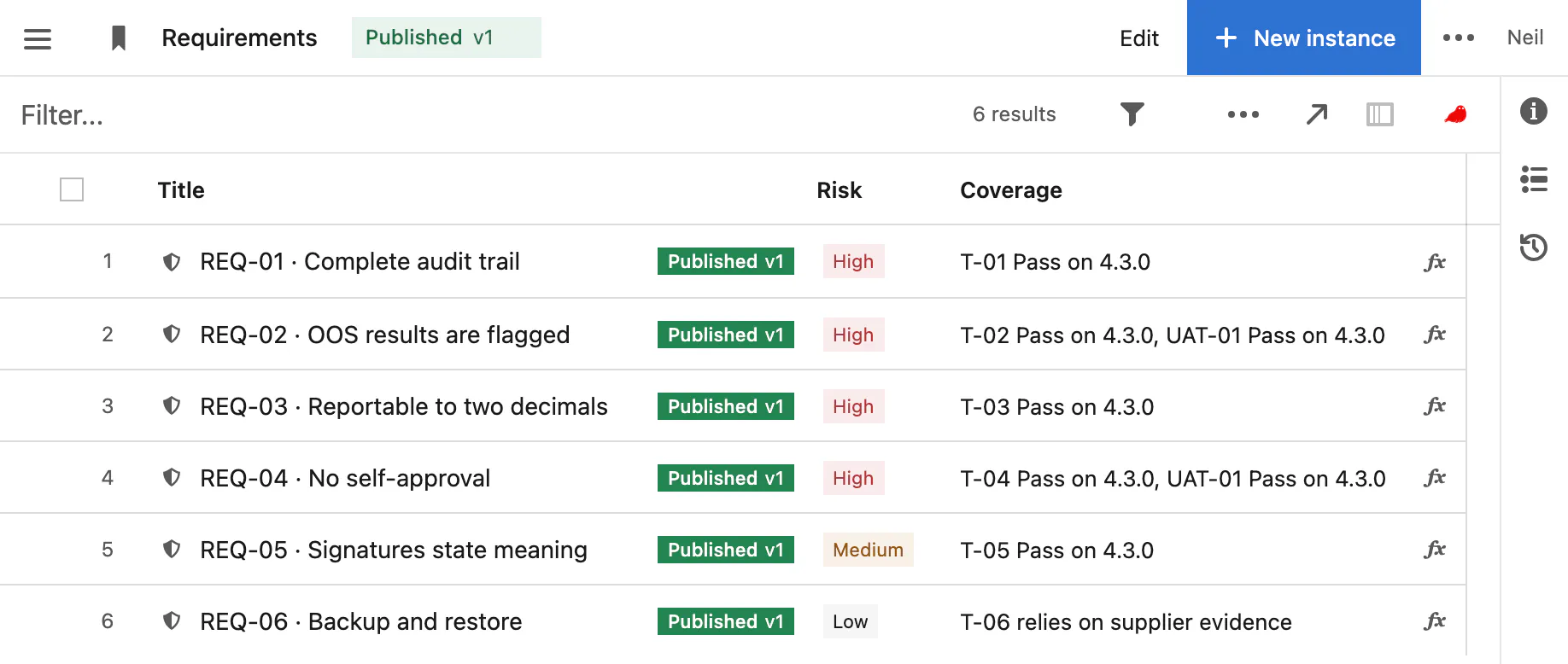
- Choose one device and one real design change, such as a component or firmware revision, that reaches requirements, verification, risk controls and units already built.
- Bring the affected requirements, risk controls and test results exported from Codebeamer, with the build’s work instructions and a recent build record. Sample material works for a first look, and an NDA covers anything confidential.
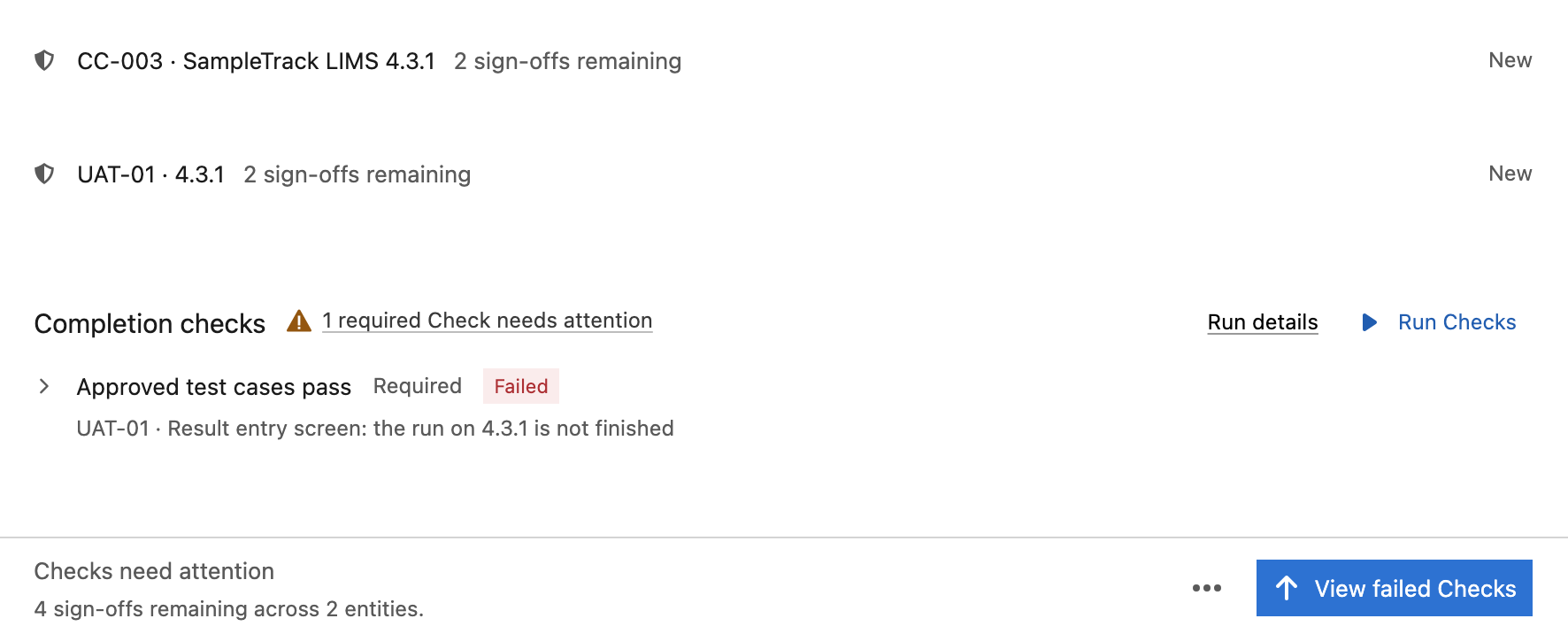
- Neil prepares the records, the workflow and its checks from that material, and your team verifies and approves them. Seal runs a 48-hour evaluation of one process, once the scope is agreed and the inputs received; production timing then depends on scope, interfaces, migration and your release requirements.
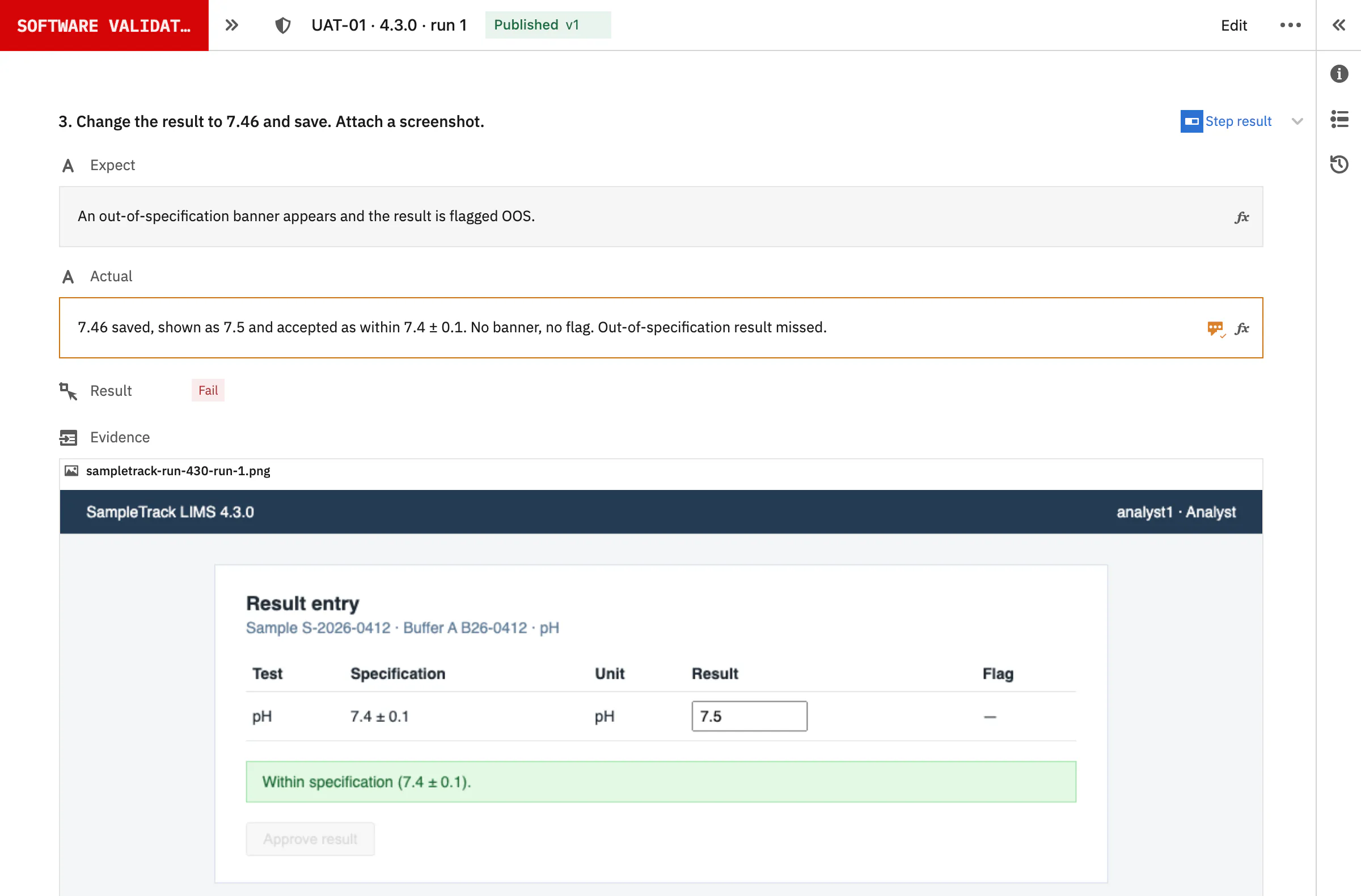
- Check the trace: a requirement with no test shows as a gap, and the design change flags the outputs and verification it affects, and the units it reaches, before it is approved.
- Agree which records move and which stay retrievable in Codebeamer, with their baselines, for their retention period, and reconcile representative records before you rely on the new workflow.
Paradromics, which makes a brain-computer interface, moved from paper and legacy systems and cut operator paperwork by 80% and engineers’ traveler review time by 90%.
References
- 1Codebeamer ALM Software Solution, PTC. https:/
/ www. ptc. com/ en/ products/ codebeamer (read 13 November 2026) - 2PTC Delivers New AI Functionality for Software-Driven Product Development with New ALM Releases, PTC, 15 January 2026. https:/
/ www. ptc. com/ en/ news/ 2026/ ptc- delivers- new- ai- functionality- with- new- alm- releases (read 13 November 2026) - 3PTC Strengthens ALM Portfolio with New AI and Configuration Management Capabilities for Enterprise Complexity, PTC, 5 August 2026. https:/
/ www. ptc. com/ en/ news/ 2026/ ptc- strengthens- alm- portfolio- with- new- ai- and- configuration- management- capabilities (read 13 November 2026) - 4Codebeamer ALM Integrations for Requirements & Lifecycle Management, PTC. https:/
/ www. ptc. com/ en/ products/ codebeamer/ integrations (read 13 November 2026) - 5Electronic Device History Record (eDHR), PTC. https:/
/ www. ptc. com/ en/ industries/ medtech/ electronic- device- history- record- edhr (read 13 November 2026) - 6What Is Test Management?, PTC. https:/
/ www. ptc. com/ en/ technologies/ application- lifecycle- management/ test- management (read 13 November 2026) - 7Requesting Authentication-User Signature for a State Transition e-Signature, Codebeamer 3.2 User Guide, PTC. https:/
/ support. ptc. com/ help/ codebeamer/ r3. 2/ en/ codebeamer/ user_ guide/ 573156. html (read 13 November 2026) - 8Codebeamer Free 30-Day Trial, PTC. https:/
/ www. ptc. com/ en/ products/ codebeamer/ free- trial (read 13 November 2026) - 9Codebeamer+, PTC. https:/
/ www. ptc. com/ en/ products/ codebeamer/ codebeamer- plus (read 13 November 2026) - 10PTC Completes Acquisition of Intland Software, PTC, 3 May 2022. https:/
/ www. ptc. com/ en/ news/ 2022/ ptc- completes- acquisition- of- intland- software (read 13 November 2026) - 11Codebeamer Templates, PTC. https:/
/ www. ptc. com/ en/ products/ codebeamer/ codebeamer- templates (read 13 November 2026) - 12Medical Device Development, PTC. https:/
/ www. ptc. com/ en/ technologies/ application- lifecycle- management/ medical- device- development (read 13 November 2026) - 13PTC Codebeamer Replaces Legacy System at Hamilton Medical, PTC, 5 May 2026. https:/
/ www. ptc. com/ en/ news/ 2026/ ptc- codebeamer- replaces- legacy- system- at- hamilton- medical (read 13 November 2026) - 14What’s New in Codebeamer, PTC. https:/
/ www. ptc. com/ en/ products/ codebeamer/ whats- new (read 13 November 2026) - 15Codebeamer AI, PTC. https:/
/ www. ptc. com/ en/ products/ codebeamer/ codebeamer- ai (read 13 November 2026)
AQuestions and answers
Is Seal better than Codebeamer?
Yes. Codebeamer is designed for complex, safety-critical product and software engineering. It came to PTC in 2022 with Intland Software, which PTC bought to broaden its ALM footprint in safety-critical and regulated industries, and PTC now calls its ALM portfolio “the leading system of record for software development and requirements management” for automotive, medtech, federal, aerospace and defence industries. Its model is a digital thread of requirements, risks, tests, variants and compliance artefacts, and its Medical Software Engineering Template runs “from requirements all the way through to validation”, naming IEC 62304, ISO 14971 and FDA 21 CFR Parts 11 and 820. Its AI, a separate add-on since January 2026, checks requirements, generates test cases and searches by meaning. The record of each device as built is kept elsewhere: PTC offers the electronic device history record in a different product, Connected Work Cell. If you engineer the software and others build the device, it can work well. Most device makers also build, test and release each unit, and need that work on the same records as the design. Seal has no fixed model of one kind of work. It is built from primitives: record types, the relationships between them, and the steps and checks that use them, which your own team composes into your process, with Neil able to prepare each change for approval. So one platform runs process development, the laboratory, manufacturing, batch release and the quality system, and each change becomes a new version, released once its selected tests pass, while earlier runs keep theirs. Moving from paper and legacy systems, Paradromics cut operator paperwork by 80% and engineers’ traveler review time by 90%.
Who makes Codebeamer?
Codebeamer is made by PTC Inc., the Boston-based software company that also sells Windchill and Arena. Codebeamer came from Intland Software, which PTC acquired in May 2022.
Is Seal an alternative to Codebeamer?
For device makers, yes, with a different reach. Codebeamer is designed for complex, safety-critical product and software engineering, and goes further into software delivery, with product variants, Git and CI pipelines. Seal keeps design inputs, outputs, verification, validation and design reviews as linked records, and runs the build record of every unit, the quality system and training on the same platform. A team deep in Codebeamer can keep it and start in Seal with one process.
Does Codebeamer cover manufacturing, such as device history records or batch records?
Not on its own pages. PTC describes Codebeamer’s digital thread as running from concept to release, links it to Windchill for product data, and offers the electronic device history record in a different product, Connected Work Cell. Codebeamer’s pages do not list batch records. In Seal, each unit’s build record links to the versions and lots it was built from, so a design change shows the units it reaches, and a complaint opens on the unit’s build.
How does Codebeamer AI compare with Neil?
Codebeamer AI is a separate add-on. Its Requirements Assistant detects requirement quality issues against INCOSE and ISTQB guidance, its Test Case Assistant generates test cases from requirements, and its AI Search Assistant searches by meaning; it can be hosted by the customer. Neil prepares changes to records, workflows and their checks for your team to verify and approve under change control, finds requirements without verification and assembles the records a change reaches. It cannot approve, sign or publish, it is not used in GMP execution, and customer data trains no AI.
Does Seal work with GitHub and Jira?
With GitHub, yes. Seal’s Change Control GitHub App, in beta, creates a Seal change record when a matching pull request opens, writes a commit status that links to it, and approves or closes the pull request when the record is approved or rejected; merge and deployment stay in your workflow. Seal’s GitHub Actions attach a snapshot of the code and the release’s files to the change record, and labelled GitHub issues are kept as Seal records. Seal does not inspect code, run tests, merge or deploy. There is no two-way Jira sync, which Codebeamer has; Neil can read Jira through a connection a user grants. There is no GitLab, Bitbucket or Azure DevOps app; other tools connect through Seal’s REST API and Scripts.
Does Codebeamer support 21 CFR Part 11 signatures?
PTC names FDA 21 CFR Parts 11 and 820 among the regulations its Medical Software Engineering Template is built for, and its user guide shows how to require a password signature on chosen state transitions through a Signature field you add. In Seal, electronic signatures and audit trails for 21 CFR Part 11 and EU Annex 11 are part of the platform. Seal does not claim compliance on your behalf: you validate your intended use.
How long does it take to start with Seal?
Seal runs a 48-hour evaluation of one process, once the scope is agreed and the inputs received. Production timing then depends on scope, interfaces, migration and your release requirements.