GxP operations.
Evolve with AI.

Run lab, manufacturing and quality on a platform built to change. Work with Neil to build workflows, investigate results and put process improvements into practice.

Book a demo
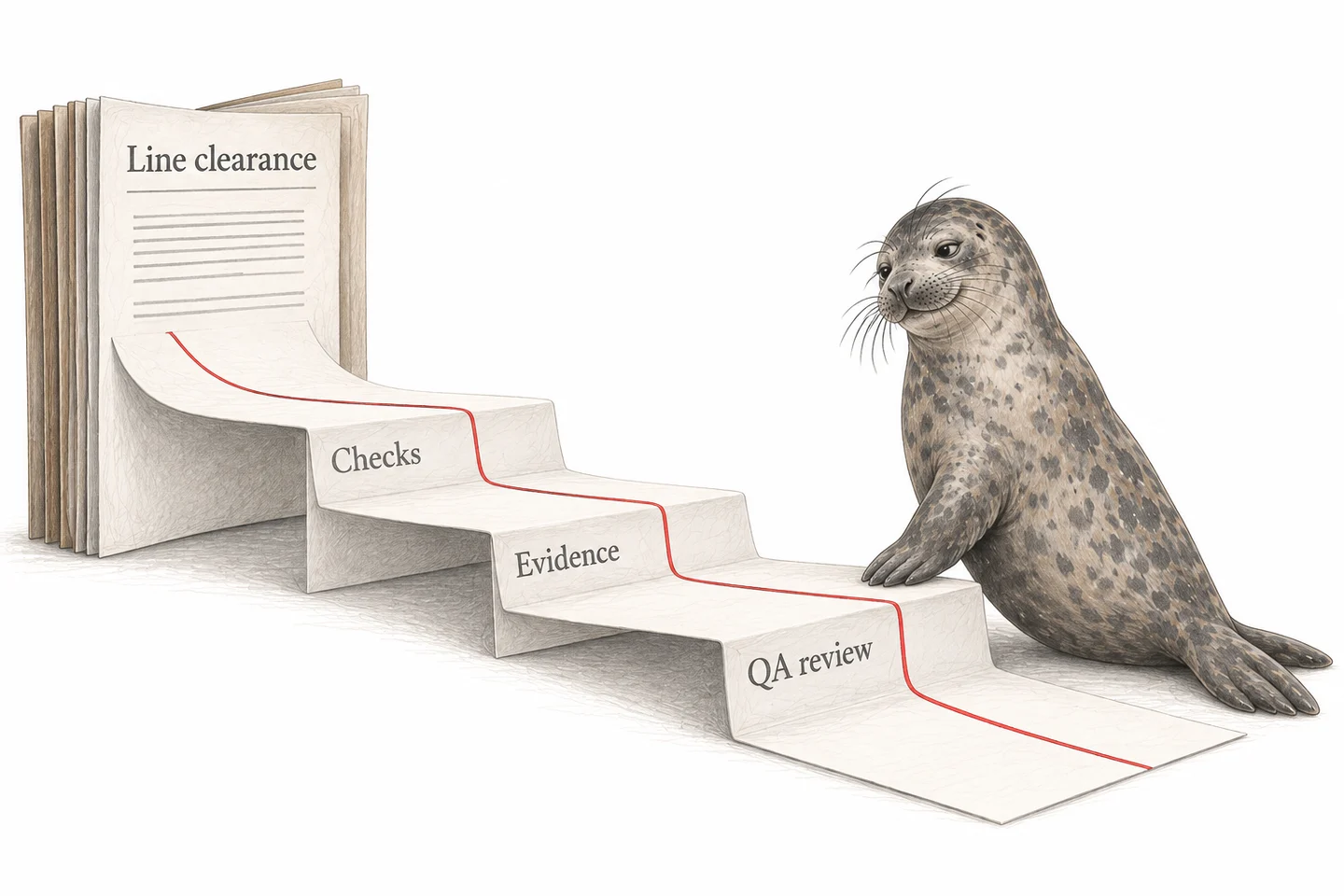
Illustration of a seal beside a procedure unfolding into execution checks and review evidence.

Lab, manufacturing and quality, working together.

A shared ontology links batches, samples, materials and procedures. Your team and Neil can follow a result to its source and a change to the work it affects.

Choose a connected record
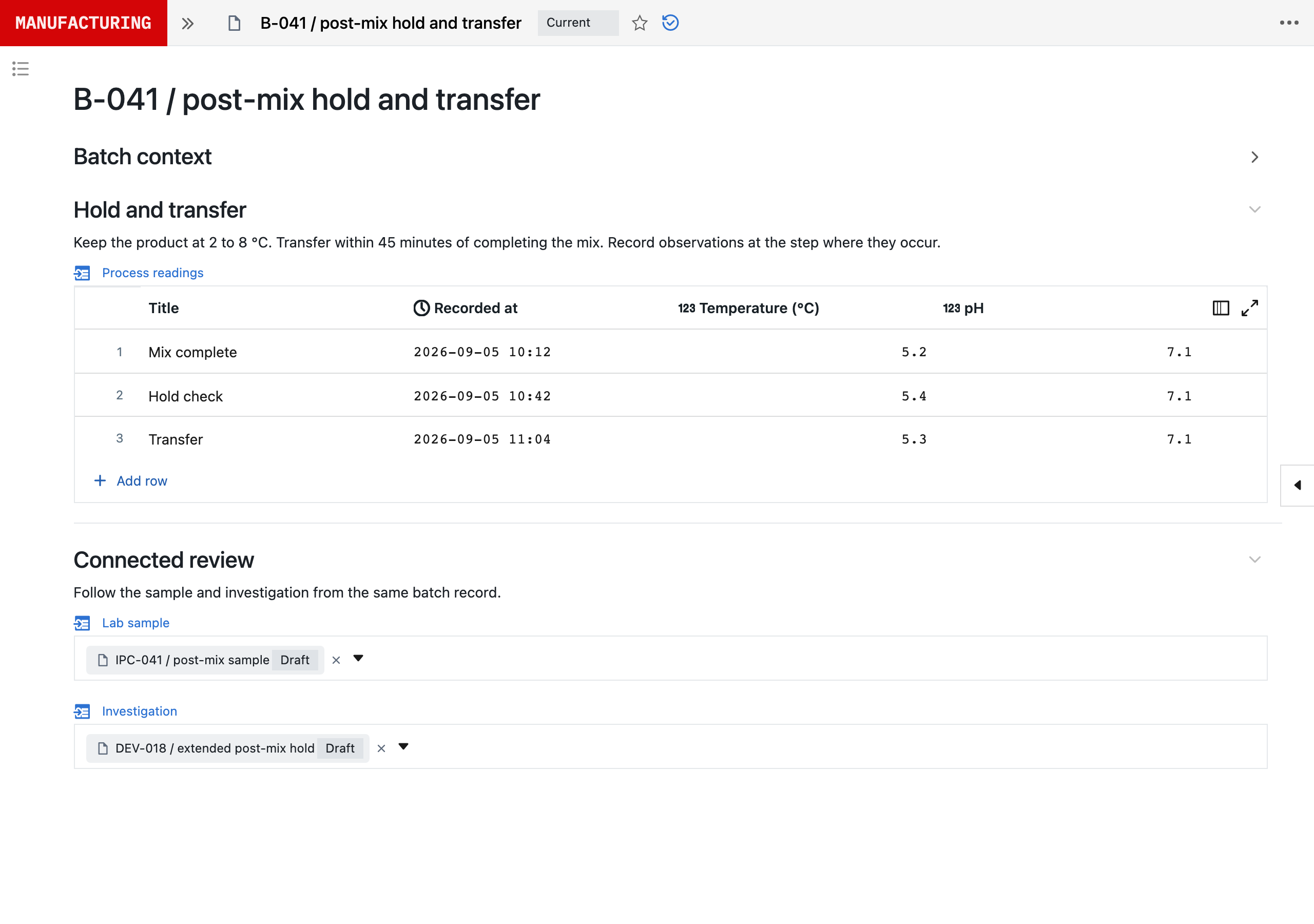
Seal batch B-041 with process readings and references to lab sample IPC-041 and investigation DEV-018

The batch carries its readings, lab sample and investigation together.

Batch record

Seal batch B-041 with process readings and references to lab sample IPC-041 and investigation DEV-018
An operator working at MiAlgae’s production facility

MiAlgae cuts documentation time by 75%.

MiAlgae brought its ELN, quality processes and electronic batch records into Seal as it scaled from lab to commercial production.

See how MiAlgae uses Seal →

Give Neil the investigation.

Follow one batch from a hold-time exception to a proposed process improvement. Inspect Neil’s sources, ask a follow-up and try the resulting workflow below.

You: Investigate the extended hold on B-041. Bring the evidence together and draft the investigation.
Neil

I’ve brought the batch, instruction and lab evidence together. The overrun is confirmed; its cause and product impact still need investigation.

B-041 / hold-time investigation

Draft

Confirmed against the instruction used

The recorded hold was 52 minutes. MBR-014 v04 permits 45. The batch exceeded that limit by 7 minutes.

Allowed45 min
Recorded52 min

What is not yet established

Why the transfer was delayed, and whether the extra hold affected the product. The lab results alone do not close that question.

Evidence to request next

ManufacturingTransfer, equipment and handoff records.

Technical reviewAn assessment of the extended hold and lab evidence.

Read the full investigation draft

Finding

The selected batch record shows 52 minutes between mix completion at 10:12 UTC and transfer completion at 11:04 UTC on 5 September 2026. MBR-014 v04 clause 7.2 permits 45 minutes. The recorded hold exceeded the requirement by 7 minutes. Sources: B-041 step 07; MBR-014 v04 clause 7.2.

What is not yet established

The records do not explain the delay or establish its effect on the product. IPC-041 has recorded results, but an approved hold-impact assessment is absent. A passing result, if confirmed, would not by itself establish that the extended hold was acceptable. Source: IPC-041.

Evidence to request

Manufacturing: verify the source timestamps and obtain the contemporaneous account of the transfer delay, including equipment and handoff records. Technical review: assess the hold-time knowledge and whether the sampling and results address the exposure. Quality: retain the exception and determine the review and disposition requirements. Keep missing evidence visible until supplied.

Proposed process improvement

Assess an elapsed-time calculation using required start and transfer timestamps, with an exception route above the existing 45-minute limit. Do not increase the limit to accommodate the observed overrun. This control could improve detection and escalation; it is not evidence of root cause or a demonstrated corrective action.

Decision status

Investigation, product-impact assessment and batch disposition remain open. The proposed configuration is separate work requiring specification, verification, training assessment and authorised release. No source record is changed by this draft.

About these records

A prepared conversation using fictional records. Inspect the evidence and follow the investigation; this page does not query a live system, change a process or release a batch.

Example evidence

Turn the finding into a working control.

Neil builds the change in Seal: required timestamps, a hold calculation and an exception route. Try the proposed workflow. Your team can build and adapt its own processes the same way.

Example procedure

Transfer within 45 minutes of completing the mix.

MBR-014 / clause 7.2

Inspect the proposed configuration
Capture
Mix completed and transfer completed.Required date and time fields.
Calculate
Elapsed hold in minutes.Derived from the two timestamps.
Route
Beyond 45 minutes, require an exception assessment.Missing or reversed timestamps cannot satisfy the check.
Connect
The batch, source readings and investigation.References to records, not copied identifiers.

Try the control.

52minutes elapsed

Exception assessment required

The hold exceeds 45 minutes. Assess the exception before deciding how to proceed.

Explore dates and boundary cases

Example times in UTC. Clear a value to try the missing-input check.

This local preview does not change a batch or approve a process.

Keep improving after validation.

Test and approve each change. Earlier work keeps its version.

Example changev05-b

Require both
timestamps.

Calculate the hold. Route overruns for assessment.

Required inputsStart + transfer time
Existing limit45 minutes
Test results for the 45-minute hold limit
CheckBefore fix / v05-aAfter fix / v05-b
44 min: within limit
45 min: within limit
46 min: exception
Missing time: blocked
No authority: blocked

Select a result to inspect.

Example evidence
Review evidenceNot released

4 selected checks passed. 1 access check not run.

Access verification, anomaly review, training and approval remain open.

Earlier evidence stays intact.

Evidence and release requirements

B-041 keeps v04. The correction adds a new result; it does not replace the failed run. In the example, 4 selected checks passed; 1 access-path check is not run. ANOM-006 still needs review. Training assessment and release approval remain open. The hold limit remains 45 minutes.

GAMP 5 Second Edition supports risk-based lifecycle assurance, including iterative specification and verification. FDA’s CSA guidance addresses medical-device production and quality management system software. The assurance effort follows intended use and risk.

Your team assesses the configuration and supporting evidence, performs any additional user acceptance testing and approves release. Continuous validation does not mean automatic approval.

Explore continuous validation
Example evidence

Keep the systems you rely on.

Connect Veeva, ERP and lab systems. Ask Neil to query permitted records and prepare a source-backed report. Start with the evidence where it lives; you do not need to move everything into Seal.

Explore the connections →

Start with one process. Build from there.

Adapt a blueprint to your procedures with Neil. Add the next workflow to the same platform, keeping the relationships between the work.

Before you start.

Can we change the system after it is validated?

Yes. Continuous validation means managing the validated state through change, not freezing the configuration. Keep the reason for the change, affected requirements, updated specifications, verification results and approvals together in Seal. Assess the impact and risk to determine the assurance needed. Automated checks support that assessment; they do not replace accountable review or any additional UAT your intended use requires.

Read about continuous validation →

Do we need to replace our existing systems?

No. Start with a defined job and the records it needs. Neil can work with connected systems; processes you choose to run in Seal can be introduced in stages. Agree which system owns each record, what can be read or written and how the connection will be verified.

Explore the integrations →

Is Seal a LIMS, an MES or a QMS?

Seal covers LIMS, ELN, MES and QMS on a shared ontology: defined record types and relationships across your operations. A batch links to its samples, results and quality events. Start with the processes you need and extend the same model as you add more work.

Find a GxP blueprint →

What does Neil do, and what does our team control?

Neil investigates results, builds proposed workflows and prepares reports and validation evidence using the records it can access. Give it several jobs to work on in parallel. Your team reviews the results and controls process and batch release.

See Neil at work →

Where is our data hosted, and is it used to train AI?

Seal agrees the hosting region at onboarding and confirms the AI provider, processing location, retention and model terms for your organisation during onboarding and supplier review. Under Seal’s agreements, customer data is not used to train AI models; the records Neil uses as working context are not training the underlying model.

Review AI and data controls →

How quickly can we evaluate our own process?

Once we agree the evaluation scope and receive the required inputs, we prepare the first working process and supporting validation pack within 48 hours. The pack includes source traceability, recorded test results and configuration history. Your team can execute the process and inspect its records. Production release follows your intended-use assessment and quality controls.

What do we need to share to get started?

A short outline of the work and a work email are enough for the first conversation. For a process evaluation, we agree the scope with its owner and use a representative procedure, batch record or form. You can start with a sample, or arrange an NDA before sharing your own material.

See your process in Seal.

Bring one of your procedures. See Neil build a workflow in Seal, run it with your team and inspect the evidence behind a change.

Book a demo