Summary
- The problem
- Validation is organised around documents spread across spreadsheets, portals, PDFs and tickets, so an approved package can describe a configuration that production has already left.
- Seal’s approach
- Assurance starts from intended use and function risk. Supplier evidence, configuration baseline, testing, anomalies and release are linked, and each change is assessed from what moved.
- What changes
- Testing effort follows risk, reused evidence carries its justification, and release is checked against the configuration actually deployed.
- Where to start
- One configured system and one high-risk function, followed through release and a supplier update. Book a demo.
1Assurance answers one question for each release.
The question is whether there is enough objective evidence, proportionate to risk, to rely on this configuration of the system for its intended use.
That question is obscured when validation is organised around document names. The inventory sits in one spreadsheet, requirements in another, supplier evidence in a portal, tests in PDFs, configuration in tickets and release approval in email. The package can look complete while the production configuration has already moved on.
1.1Why teams choose Seal for computer system assurance
Traditional CSV validates a system once, around a document package, and then treats every change as a new validation project, so teams either freeze the configuration or let the package drift from what is deployed. Seal keeps the production configuration, the functions that matter, the evidence relied upon and the changes that challenge it in one lifecycle, so each change is a new release with its own risk assessment, test evidence and approval. Validation moves with the system instead of stopping it.
The same records can hold the assurance lifecycle for other regulated systems, including laboratory, manufacturing and quality systems, and for Seal’s own configuration, where your team still assesses and approves the configuration and its intended use. Reviewers can see why the system is trusted today, not only that a package was approved years ago.
| Document-led validation | Seal | |
|---|---|---|
| Scope | Every feature tested to the same template | Assurance depth set by intended use and function risk |
| Supplier evidence | Collected into folders | Assessed against the claims it supports, with gaps recorded |
| Validated state | Described in a summary report | A configuration baseline matched to production before use |
| Change | A new validation project | Impact assessed from what moved, with focused regression and reused evidence justified |
2Define the system by what it is relied upon to do.
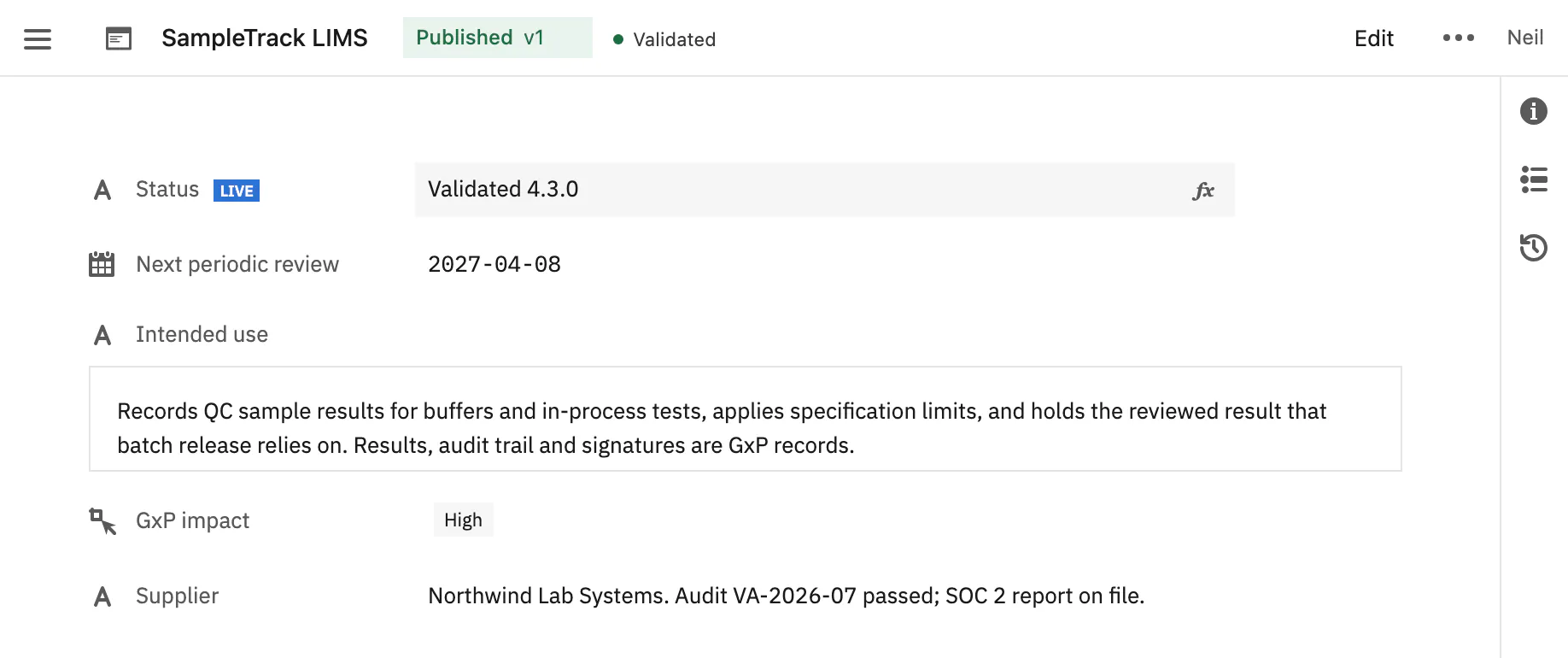
The regulated system is the unit of control. Its record defines the product, service model, owners, supplier, hosting, interfaces, data, users, electronic records and signatures, and lifecycle state. An inventory is not a list of application names: separate instances, tenants, modules and configurations can carry different risk and evidence, even from the same supplier.
Intended use draws the assurance boundary. It states which regulated decisions the system supports, who uses it and where, the records it creates and the limits beyond which it is not relied upon. These statements are versioned and approved. The boundary prevents two common failures: validating every product feature as if it were GxP-critical, and overlooking a small configured function that directly affects product quality or data integrity.
3Assess risk at the level of functions and failure modes.
Risk is assessed where harm can occur. Each function connects its intended behaviour, failure modes, detectability, patient or product impact, data-integrity impact and existing safeguards. Classification sets the depth and independence of the assurance work; it does not assign a fixed document set.¹ FDA’s Computer Software Assurance guidance takes the same position for medical-device production and quality system software, asking for objective evidence appropriate to the risk of the software feature, function or operation.²
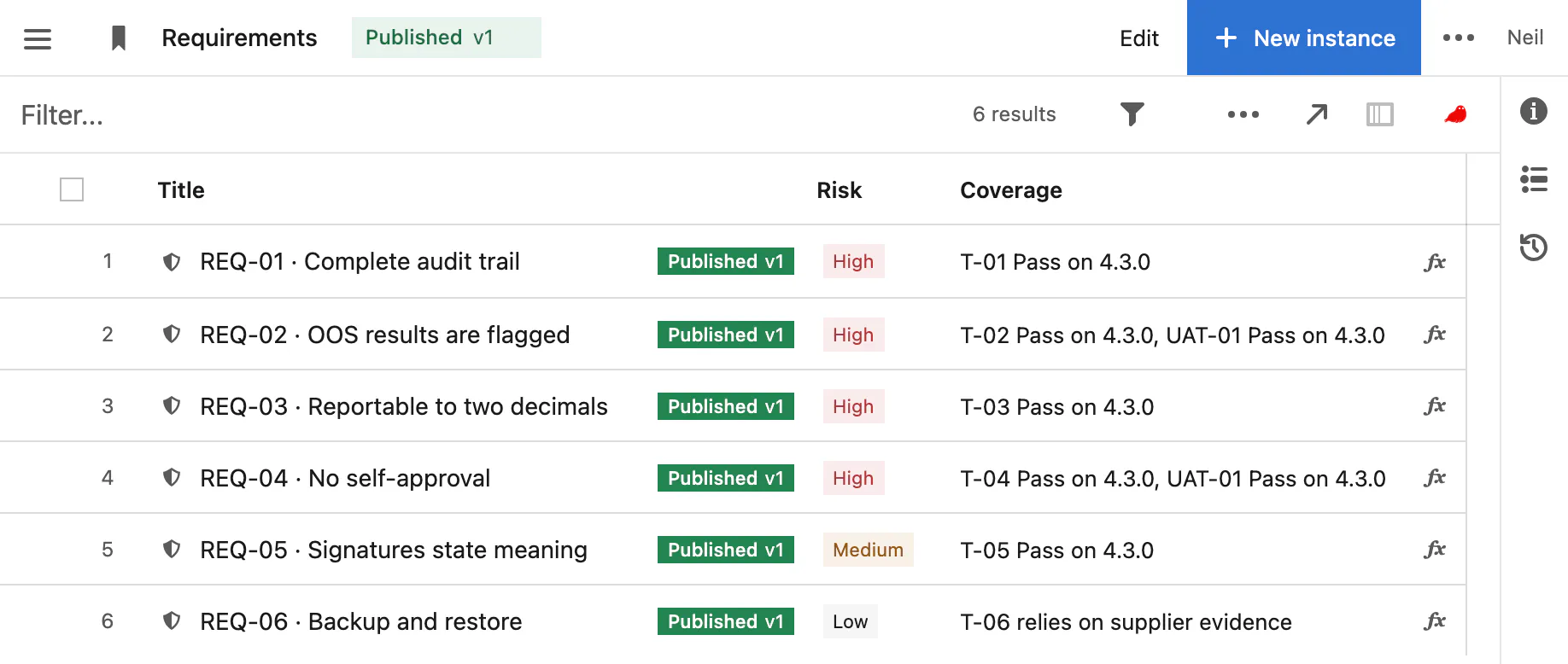
Requirements follow the same proportion. Critical controls need explicit expected behaviour. Lower-risk workflow and usability concerns can be described through intended use, configuration, acceptance criteria or test charters instead of an inflated requirements catalogue. Each requirement links forward to configuration and evidence and back to its rationale, so orphan requirements and tests are visible during the work rather than in a trace matrix exported at the end. Every execution of a test case is its own test run, so a requirement shows not only which tests cover it but whether they passed, and on which version.
4Assess supplier evidence against the claims it supports.
Supplier development controls, certifications, testing, release notes, service history, recovery and incident response can reduce duplicated work once their relevance and reliability are assessed. Seal records which claim each supplier artefact supports, its scope and version, who evaluated it, the gaps found, the compensating work and when it must be re-evaluated. A SOC report in a folder is not automatically validation evidence.
5Choose the strongest evidence for the effort.
Assurance can combine supplier evidence, automated checks, scripted and limited scripted tests, unscripted and exploratory testing, inspection, analysis and production monitoring. The strategy states why each technique suits the function and its risk.
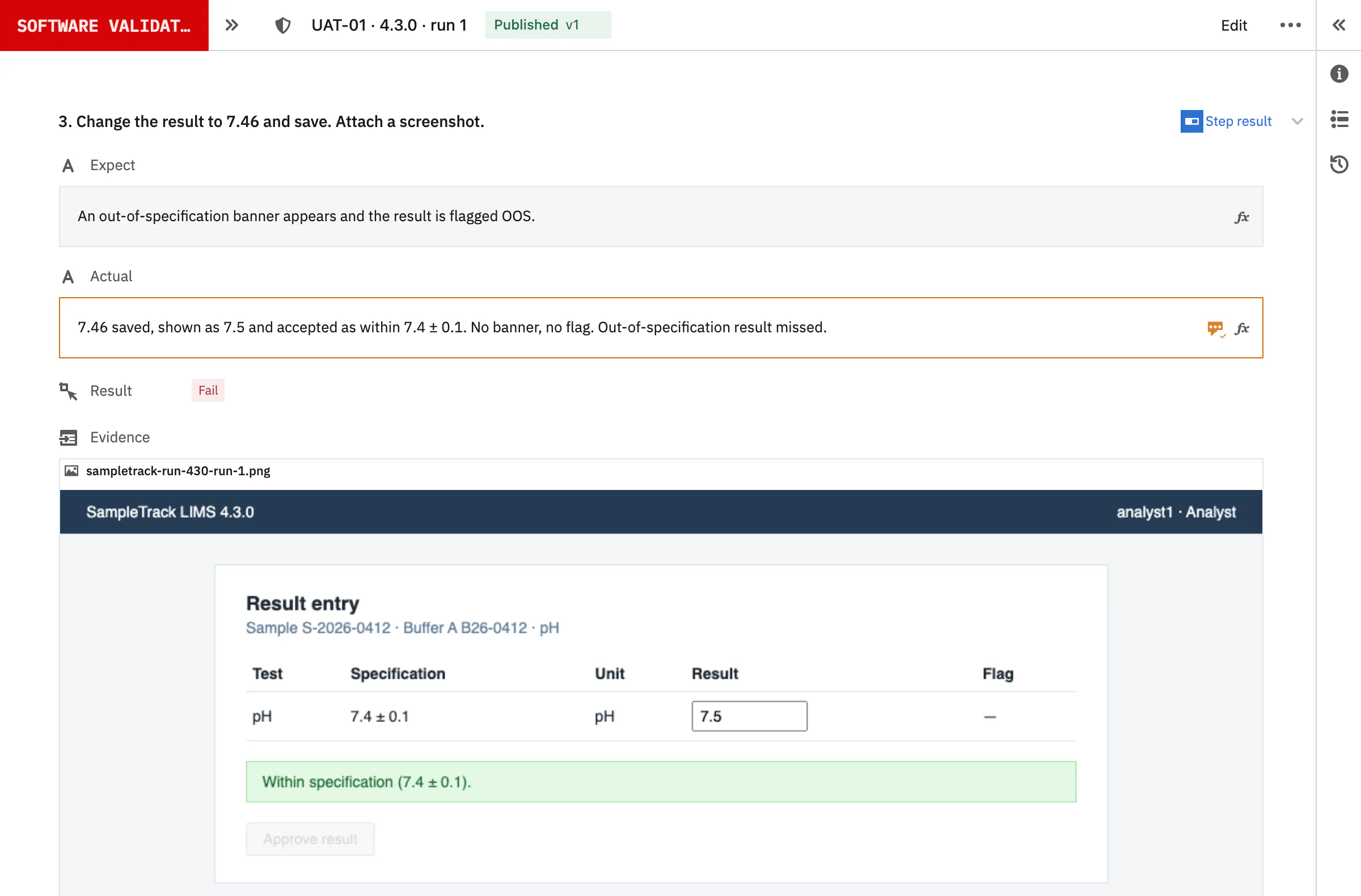
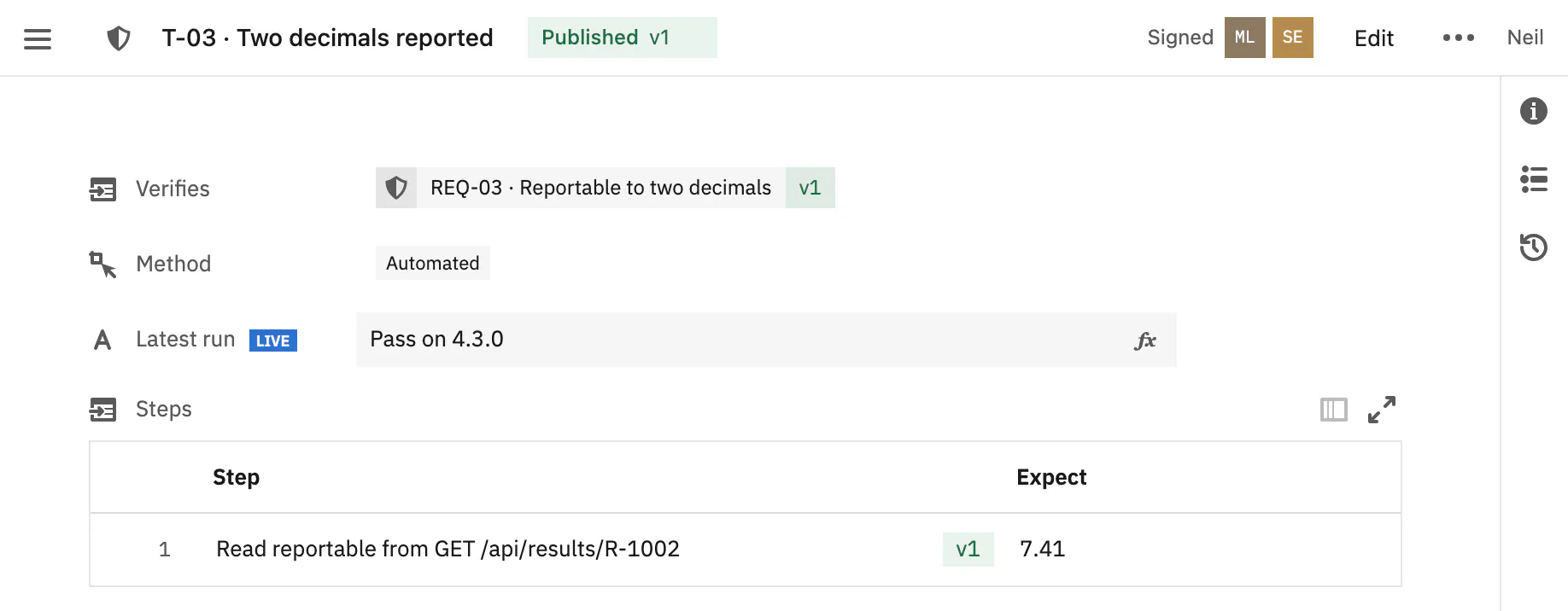
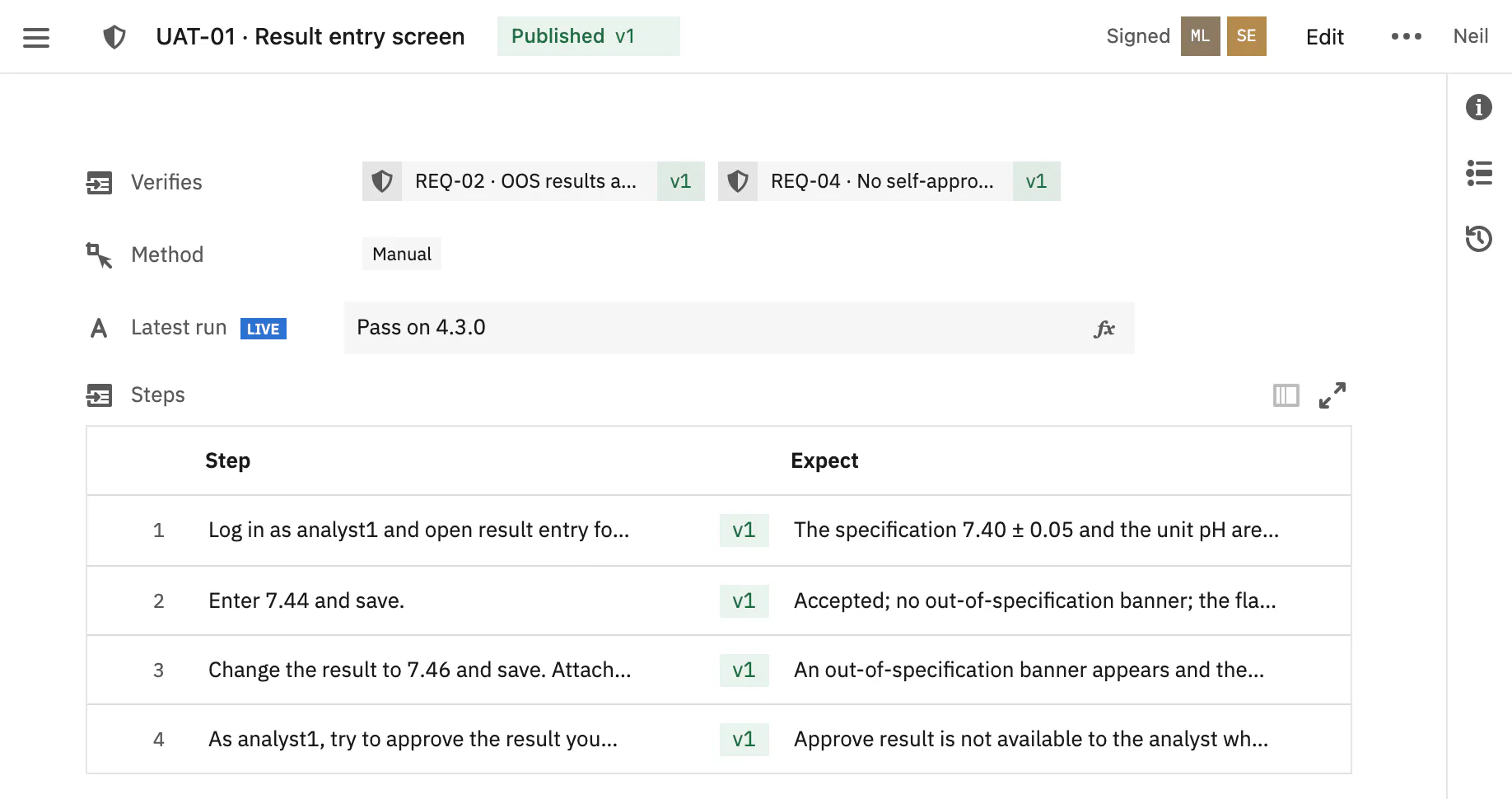
Where the system has an API, a test case can be automated. T-03 asks SampleTrack for result R-1002 and expects the reportable value 7.41; pressing Run automated test cases on a change control runs a Seal Script that sends the request, with its credentials stored in Seal, compares the answer and records a test run. A screen a person has to see is tested by hand: UAT-01 lists each step and what should happen, and a tester works through it in a test run, recording what happened, Pass or Fail, and a screenshot where the step asks for one.
Evidence can be concise, but it must still identify the tester, environment, date, activity, result and any observed failure. An exploratory charter defines the mission, scope, risks, data and timebox; execution records observations, anomalies and the tester’s conclusion. Unscripted does not mean undocumented: it replaces prescribed keystrokes with skilled investigation where that gives stronger evidence. The build, configuration, interfaces, data set and accounts accompany each execution, so a passing test cannot be carried forward if it cannot be tied to the relevant state.
Each unexpected result connects to the function, evidence, severity, impact, correction, retest and disposition, and known supplier defects enter the same review. Acceptance can include a documented limitation and a compensating control, but only when its operational owner and monitoring are explicit.
6Release against a fixed configuration baseline.
Roles, permissions, workflows, fields, calculations, reports, integrations, master data, retention rules, signatures and audit-trail settings form a controlled configuration baseline.³ A test performed against a different tenant, feature flag, interface mapping or configuration version cannot silently qualify it.
The release brings together intended use, current risk, supplier assessment, requirements, configuration, testing, open anomalies, procedures, training and operational readiness. Approval fixes the accepted versions and rationale, and deployment confirmation checks that production matches the released baseline before regulated use begins.
7Assess change from what moved, and learn from what happens in use.
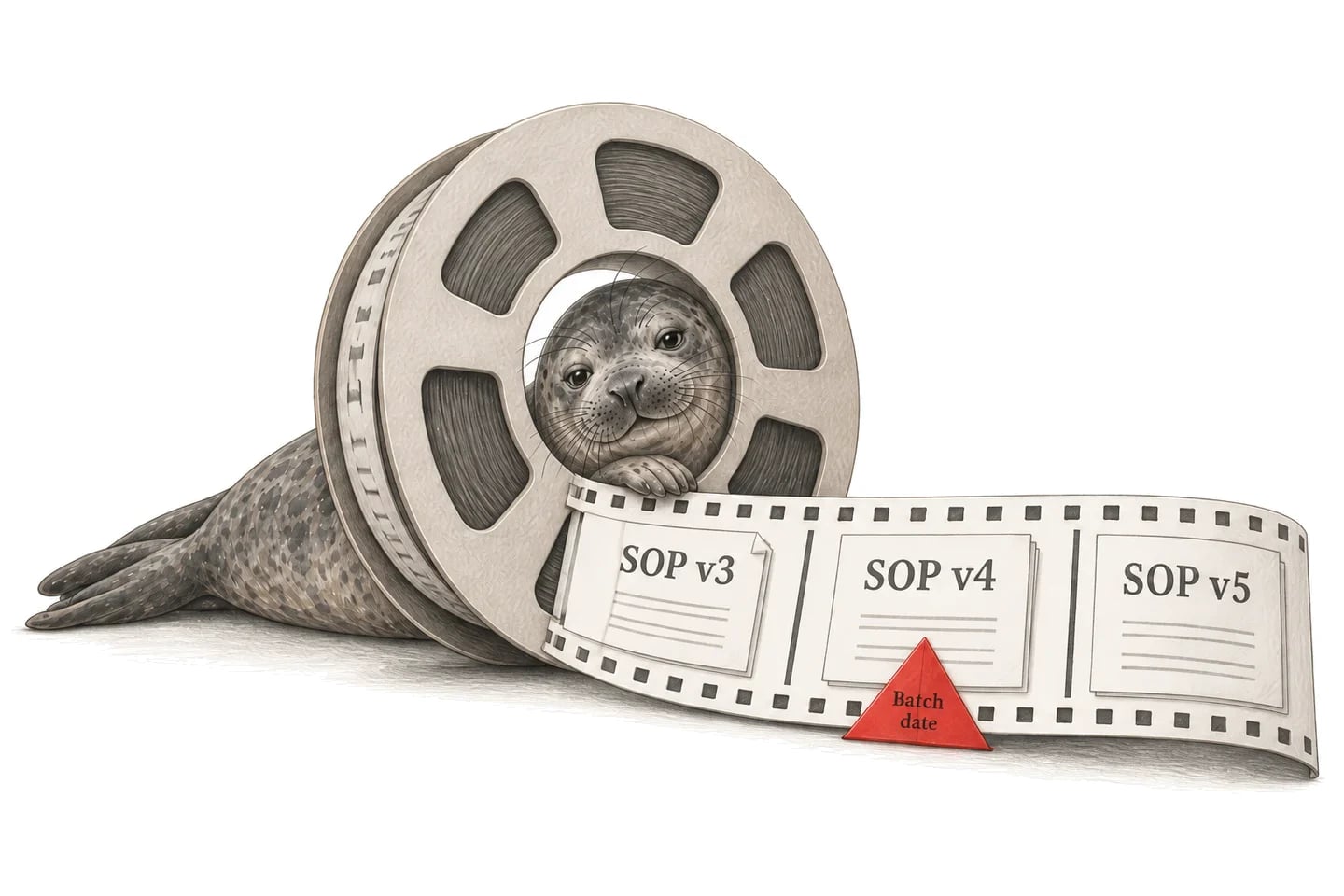
A supplier release, configuration update, integration mapping, role change, procedure revision or new intended use identifies the affected functions, risks, evidence and downstream controls.³ The impact assessment recommends reuse, focused regression, new testing, procedure or training action, or full requalification, and records why unaffected evidence remains valid.
Cloud systems may change more often than traditional validation projects allow for. The release policy covers the service model, tenant controls, feature enablement, supplier notification, sandbox availability, rollback and monitoring. Release-by-release evidence stays connected without rewriting the validation plan each time, and emergency changes have a controlled path with retrospective obligations.
In Seal, each supplier release is a change control in its own changeset. Its automated test cases run from the change control against the test environment, and a tester records a run of each manual test case. A rule in Seal requires a Check for every change control, which passes only when every approved test case has a finished, passing run on the version being released. The changeset cannot publish until the Check passes and every sign-off is given.
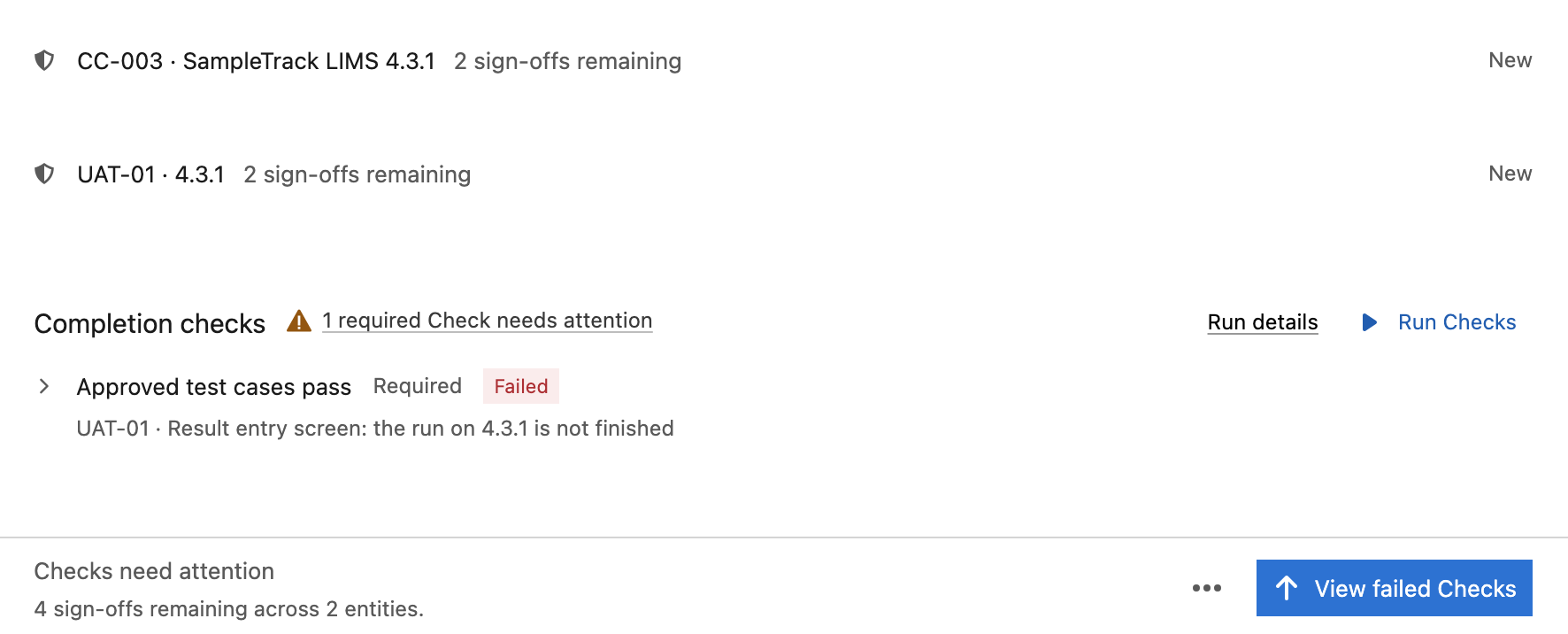
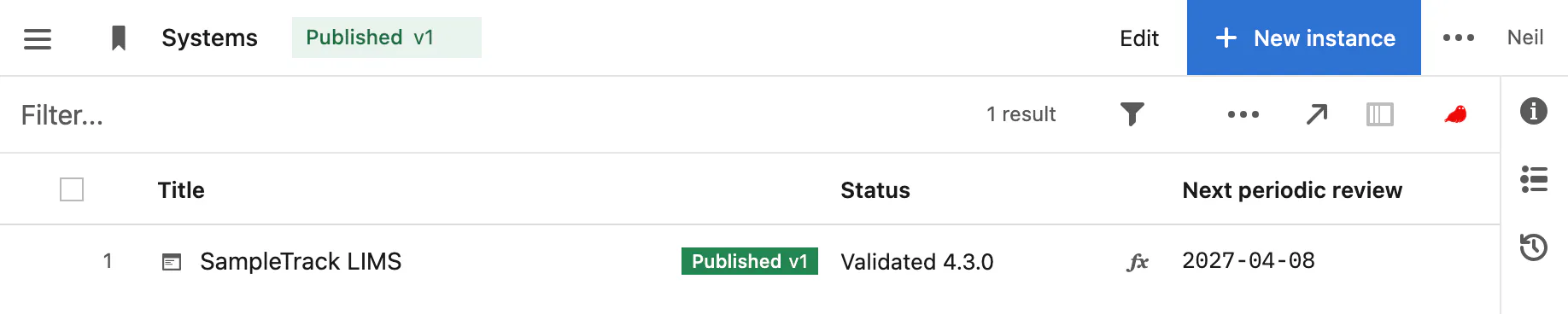
SampleTrack 4.3.0 shows why this matters. Its pH specification is 7.40 ± 0.05. The supplier made reportable precision a setting, with a default of one decimal place that nobody had changed. On its first automated run, T-03 failed: R-1002 reported 7.4 against a required 7.41. The tester’s UAT-01 run failed too: the result entry screen rounded the specification to 7.4 ± 0.1 and accepted 7.46 as within it. Each failed step raised a warning that had to be answered, and both failures were recorded as deviation DEV-001. Precision was set to two decimals, T-03 and a second UAT-01 run passed, the Check passed, and Quality signed the release. Publishing it recorded 4.3.0 as the validated version; production moved to 4.3.0 only after that, so no reported result relied on the faulty setting.
SampleTrack has six requirements, so every approved test runs on every release; for a larger system, rules can be configured to select the tests each change needs.
Incidents feed back into the same lifecycle. A service interruption, incorrect behaviour, access issue or integration failure identifies the affected functions, records, time range and validation follow-up, and recurring failures raise function risk for the next test strategy. Periodic review weighs releases, configuration, access, incidents, backup and restore, supplier performance and open risks, and can conclude that the system continues, needs remediation or revalidation, or should be retired. Retiring an application is separate from retiring the obligation to keep and retrieve its records, audit trails and signatures.
8Prove one difficult release end to end.
Start with one configured cloud system and follow it through inventory, intended use, critical-function assessment, supplier review, baseline, risk-based strategy, scripted and exploratory testing, an anomaly, release, production verification, a supplier update, focused regression, an incident and periodic review.
Include supplier testing reused with justification, a feature excluded from GxP scope, a high-risk calculation, a role-permission failure, configuration drift between test and production, and an accepted known defect with a compensating control. The first release should show exactly what was trusted, what remains uncertain and why the current production state is authorised.
References
- 1ISPE, GAMP 5: A Risk-Based Approach to Compliant GxP Computerized Systems, second edition (2022).
- 2FDA, Computer Software Assurance for Production and Quality Management System Software, guidance for industry and FDA staff (2026). FDA
- 3EudraLex Volume 4, Annex 11, Computerised Systems (2011), sections 4 (validation) and 10 (change and configuration management). European Commission
AConnected across Seal
BConnected records
CQuestions and answers
What is the difference between CSV and CSA?
CSV describes validation of computerised systems; CSA emphasises risk-based assurance activities and objective evidence focused on functions that can affect quality, safety or records. Seal supports both vocabularies and a single controlled lifecycle.
Does CSA eliminate documentation?
No. It makes evidence proportionate. The record must still show intended use, risk, activity, performer, environment, result, anomalies, conclusion and approval without unnecessary prescriptive scripts.
Can we use supplier testing as validation evidence?
Yes when its scope, version, relevance, supplier trust and gaps are evaluated. Seal links each reused artefact to the claim it supports and records any compensating assurance work.
How does Seal support cloud and SaaS systems?
It models supplier and customer responsibilities, tenants, enabled features, configuration baselines, release policies, notifications, focused regression, production verification, incidents and continuity.
Are exploratory and unscripted tests acceptable?
They can be appropriate when governed by a clear charter, skilled tester, identified environment and data, contemporaneous observations, anomaly handling and a conclusion proportionate to function risk.
How is a traceability matrix generated?
Each intended use links to its functions, risks, controls, configuration, supplier evidence, tests, anomalies and releases, so a current trace view is generated from the model rather than reconciled manually.
How are electronic records and signatures addressed?
Each intended use identifies authoritative records and signatures; configuration, access, audit trails, retention, retrieval, continuity and procedural controls connect to their supporting evidence.
How does change control determine regression scope?
The changed supplier version, configuration, interface, role, control or intended use traverses its linked functions, risks, tests, records and operating controls to propose focused impact and preserve explicit exclusions.
Can known defects be accepted?
Yes only through an authorised risk decision with bounded impact, rationale, compensating control, owner, monitoring and a trigger for reassessment or correction.
What belongs in periodic review?
Current use, changes, incidents, problems, accounts, audit trails, continuity, supplier performance, procedures, training, open risks, validation status and retirement readiness.
Can Seal validate itself?
Seal’s own lifecycle records can be managed in Seal; your team still assesses and approves your configuration and intended use.
What should the first implementation prove?
Prove one high-risk configured function through intended use, supplier evidence, risk, test strategy, execution, anomaly, approved release, verified production baseline, later change and periodic review.