Summary
- The story
- Matrix Req, sold as Matrix Requirements until its maker renamed itself Matrix One in 2025, is built for medical device and regulated product teams “whose gap is the design record: requirements, risks, design outputs and verification tests that must trace to each other and come out as submission documents”.⁹⁵ Two computer scientists, Yves Berquin and Wolfgang Huber, founded the company in Germany in 2014 and bootstrapped it for eight years; since Lauxera Capital Partners backed it in 2022 it has bought Galen Data, dokspot and Simploud, whose eQMS is now Matrix Quality.¹⁰ Its unit is the item: each design element has a unique identifier, and trace rules you configure flag the risks, specifications and tests a change reaches.²¹ Engineering work stays in Jira, Azure DevOps, GitHub or GitLab, where issues are created from requirements and their status syncs back.⁶ Matrix Mind, its AI assistant, answers from the project and proposes changes as redlines that a person approves.³ If you design devices and others build them, it can work well. Matrix One’s own guide names a PLM as the companion for parts, bills of materials and supplier change, “its home ground, not ours”,⁹ and a team that also builds the device needs each unit’s build on the same records as the design.
1What Matrix Requirements offers.
Matrix One began in 2014 as Matrix Requirements, and its headquarters in Kehl, Germany, is the office of Matrix Requirements GmbH.¹⁰¹¹ In May 2025 the company and Galen Data, which it had bought in 2024, came together under the name Matrix One; the software sold as Matrix Requirements became Matrix Req, and matrixreq.com now redirects to matrixone.health.¹⁰⁵¹ In December 2025 it bought dokspot, of Zürich, to launch Matrix eIFU,¹² and in 2026 Simploud, whose quality and laboratory software now sit inside the platform.¹⁰ Matrix One calls itself a unified brand, with each product operated by its own legal entity.¹¹ It sells Matrix Req for design control and risk, Matrix Quality as its eQMS, Matrix Validate for computer system validation, Matrix Connect as a compliant cloud for connected devices and Matrix eIFU for electronic instructions for use, and says more than 500 life sciences companies use its products.¹
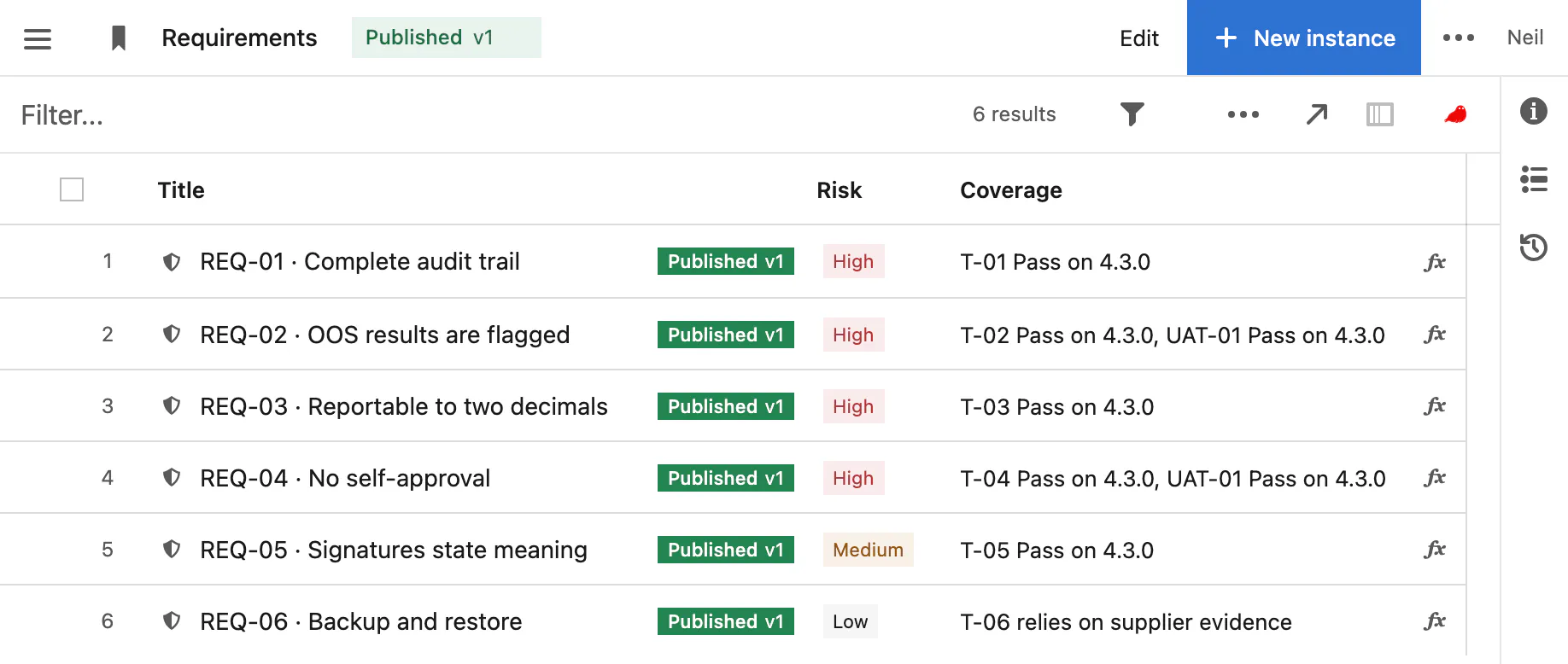
In Matrix Req, each design element is an item with a unique identifier, in the categories, item types and trace rules you configure; change one and it flags the risks, specifications and tests downstream.²¹ Risks follow ISO 14971 templates with your own scoring, tests are planned, assigned and run with a result for every step, and the design history file and trace tables are generated from live data in the Word format you used before, routed for review and signed under 21 CFR Part 11.⁵ Matrix One provides a validation package for Matrix Req itself: plans, reports, test scripts and traceability matrices.⁵ Its integrations with Jira, Azure DevOps, GitHub and GitLab create or link issues from Matrix items and sync their status back, and a REST API and SDK cover other systems.⁶¹³ Matrix One’s 2023 story of PulmoTech, a Dutch start-up, says it records every production step, process sheet, purchase order and batch of raw materials with MatrixReq, and uploads hundreds of software unit test results through the API.⁸
Matrix Mind, the assistant inside Matrix Req, answers questions with citations to the items they came from, drafts requirements, risks and test cases in your template, and proposes changes as redlines that a person applies; Matrix One says it never deletes items.³⁵ The Compliance Checker turns a standard you import as a PDF into a checklist and assesses the project against it, the Traceability Checker finds missing links, and Matrix Quality has a read-only assistant in pilot.⁴ An MCP connection gives Claude, Cursor or another AI assistant read-only access to live Matrix Req data.¹³ Matrix One says every AI provider it uses is bound by a zero data retention agreement, and that it trains no model on customer data.⁴
Matrix Quality runs deviations, OOS results, CAPA, change control, document control, training, suppliers, complaints and audits from more than 50 modules,¹ and for IVD makers it adds electronic batch records with lot traceability from raw material receipt to distribution.⁷ It is published from €10,000 a year, and most teams are live in 2 to 6 weeks.¹⁴ Matrix Validate, on the same platform as Matrix Req, validates computerised systems and qualifies in-house equipment; its page says paperless execution on the shop floor is not part of the current product.¹⁵
Matrix Req’s product page lists three yearly plans: Team Plus at €10,860 and Company Plus, which adds a light QMS for CAPA, document control and audits, at €15,420, each with six users included, and Enterprise Plus from €31,200 with 20 users.⁵ Matrix One’s pricing page says “We do not sell generic tiers” and builds a proposal for each team.¹⁶ Matrix Req onboarding runs as two-hour sessions with a specialist; Matrix One says teams that already know an ALM tool are often productive within a few days, and that with a full migration package most are live in under two months.⁵
For a software team, Matrix Req’s issue integrations reach further than Seal does. Seal’s GitHub app, in beta, ties a pull request to a Seal change record and its Part 11 approval; it does not inspect code, run tests, merge or deploy. There is no two-way Jira sync, and no GitLab, Bitbucket or Azure DevOps app.
2Running Seal alongside Matrix Requirements.
You can start without replacing Matrix Req: engineering keeps its design controls and trace matrix there while the first process moves to Seal, such as the build record of one device. Seal has no dedicated Matrix Req connector. Matrix Req’s REST API can query items and update content,¹³ and Seal’s REST API and Scripts can connect the two.
Agree the records, the direction of transfer, the credentials and the failure handling before implementation. Start with read access, and treat any write in either direction as a separate decision with defined actions, review gates and audit evidence. Qualify the connection by defining identifiers and field mappings, testing missing, delayed and duplicate records, and reconciling transferred records against the source, as the regulatory guide describes.
Where code changes reach production, Seal’s GitHub app creates a Seal change record from a configured template when a matching pull request opens, writes a commit status that links to the record, and approves or closes the pull request when the record is approved or rejected. Matrix Req’s GitHub and GitLab integration creates or links issues and adds backlinks to Matrix items,¹³ so agree which system holds each requirement and which holds the approval of each code change before adding Seal’s app to the same repository.
3Moving from Matrix Requirements to Seal.
Move one process where the design meets the build first. In Seal, design inputs, outputs, verification, validation and design reviews are linked records, and the traceability matrix is a view of those links, so a requirement with no test shows as a gap while the design is developed. A design change flags the outputs and verification it affects before it is approved, and risk controls link to the requirements and verification that implement them. The design history file is organised from records kept during development, and each unit’s build record links to the versions and lots it was built from, so a design change shows the units it reaches, and a complaint opens on the unit’s build. The design control blueprint and the medical device blueprint set this out. Paradromics, which makes a brain-computer interface, moved from paper and legacy systems and cut operator paperwork by 80% and engineers’ traveler review time by 90%.
- Choose a change with consequences beyond the design file, such as a component or firmware revision that reaches verification, risk controls and units already built.
- Bring the affected requirements, the risk file, the verification evidence and the build records. Start with sample records, or arrange an NDA before sharing confidential ones.
- Neil prepares the trace structure and the change workflow from your procedure, for your engineering and quality teams to verify against the device. Seal offers a 48-hour evaluation of one process, once the scope is agreed and the inputs received. Production timing then depends on scope, interfaces, migration and your release requirements.
- Exercise a change before relying on it: a revised requirement, the verification and risk controls it reaches, and the units built to the earlier version.
- Keep the signed documents and design history files from Matrix Req retrievable for their retention period. Imported evidence keeps its original version and context, and importing it does not establish that it covers the current use.
References
- 1Software Solutions for Life Science Companies, Matrix One, reached from matrixreq.com. https:/
/ matrixone. health/ (read 13 November 2026) - 2Design Control features inside Matrix Req, Matrix One. https:/
/ matrixone. health/ matrix- req/ design- control- impact- analysis (read 13 November 2026) - 3Matrix Mind, the AI that lives inside your Matrix Req projects, Matrix One. https:/
/ matrixone. health/ matrix- req/ matrix- mind (read 13 November 2026) - 4AI that works on the record, not beside it, Matrix One. https:/
/ matrixone. health/ ai (read 13 November 2026) - 5Requirements Management Software for Medical Devices, Matrix Req, Matrix One. https:/
/ matrixone. health/ products/ matrix- req (read 13 November 2026) - 6The 8 Best Requirements Management Tools That Integrate With Jira, Matrix One, 16 September 2026, updated 23 October 2026. https:/
/ matrixone. health/ blog/ requirements- management- tools- jira- integration (read 13 November 2026) - 7Matrix Quality for In Vitro Diagnostics (IVD), Matrix One. https:/
/ matrixone. health/ matrix- quality/ in- vitro- diagnostics (read 13 November 2026) - 8PulmoTech Success Story, Matrix One, 15 June 2023. https:/
/ matrixone. health/ customer- success- stories/ pulmotech (read 13 November 2026) - 9ALM vs eQMS vs PLM for Medical Devices: Which One Does Your Problem Actually Need?, Matrix One, 11 September 2026, updated 26 October 2026. https:/
/ matrixone. health/ blog/ alm- vs- eqms- vs- plm- medical- devices (read 13 November 2026) - 10About Us, Matrix One. https:/
/ matrixone. health/ about- us (read 13 November 2026) - 11Legal Impressum, Matrix One. https:/
/ matrixone. health/ legal- impressum (read 13 November 2026) - 12Matrix One acquires dokspot GmbH to launch Matrix eIFU, Matrix One, 15 December 2025. https:/
/ matrixone. health/ blog/ matrix- one- acquires- dokspot- gmbh (read 13 November 2026) - 13Integration with Your Tools in Matrix Req, Matrix One. https:/
/ matrixone. health/ matrix- req/ integrations- with- other- tools (read 13 November 2026) - 14eQMS software for life sciences, made simple with Matrix Quality, Matrix One. https:/
/ matrixone. health/ products/ matrix- quality (read 13 November 2026) - 15Computer system validation software for pharma and biotech, made simple with Matrix Validate, Matrix One. https:/
/ matrixone. health/ products/ matrix- validate (read 13 November 2026) - 16Get Bespoke Pricing for Your Team, Matrix One. https:/
/ matrixone. health/ get- pricing (read 13 November 2026)
AQuestions and answers
Is Seal better than Matrix Requirements?
Yes. Matrix Req, sold as Matrix Requirements until its maker renamed itself Matrix One in 2025, is built for medical device and regulated product teams “whose gap is the design record: requirements, risks, design outputs and verification tests that must trace to each other and come out as submission documents”. Two computer scientists, Yves Berquin and Wolfgang Huber, founded the company in Germany in 2014 and bootstrapped it for eight years; since Lauxera Capital Partners backed it in 2022 it has bought Galen Data, dokspot and Simploud, whose eQMS is now Matrix Quality. Its unit is the item: each design element has a unique identifier, and trace rules you configure flag the risks, specifications and tests a change reaches. Engineering work stays in Jira, Azure DevOps, GitHub or GitLab, where issues are created from requirements and their status syncs back. Matrix Mind, its AI assistant, answers from the project and proposes changes as redlines that a person approves. If you design devices and others build them, it can work well. Matrix One’s own guide names a PLM as the companion for parts, bills of materials and supplier change, “its home ground, not ours”, and a team that also builds the device needs each unit’s build on the same records as the design. Seal has no fixed model of one kind of work. It is built from primitives: record types, the relationships between them, and the steps and checks that use them, which your own team composes into your process, with Neil able to prepare each change for approval. So one platform runs process development, the laboratory, manufacturing, batch release and the quality system, and each change becomes a new version, released once its selected tests pass, while earlier runs keep theirs. Moving from paper and legacy systems, Paradromics cut operator paperwork by 80% and engineers’ traveler review time by 90%.
Who makes Matrix Requirements?
Matrix Requirements GmbH, headquartered in Kehl, Germany, which now trades as Matrix One. Yves Berquin and Wolfgang Huber founded it in 2014, and Lauxera Capital Partners has backed it since 2022. In 2025 the company renamed itself Matrix One and the software became Matrix Req; matrixreq.com now redirects to matrixone.health. Matrix One describes itself as a unified brand, with each product operated by its own legal entity, and its chief executive is Louis Albert.
Is Seal an alternative to Matrix Requirements?
Partly. Matrix Req is built for device teams whose gap is the design record, and for engineering teams working in Jira, Azure DevOps, GitHub or GitLab its issue integrations reach further than Seal’s, which has a GitHub app in beta and no two-way Jira sync. Seal is the GxP execution system: its design records sit on the same platform as the build record of every unit, the quality system and training, and Neil prepares the changes. A team deep in Matrix Req can keep it and start in Seal with one process.
Does Matrix Requirements cover manufacturing, such as device history records or batch records?
Partly, in Matrix Quality rather than Matrix Req. Matrix Quality’s page for IVD makers describes electronic batch records with traceability from raw material receipt through production, QC release and distribution, and Matrix One’s 2023 story of PulmoTech says the start-up records every production step and batch of raw materials with MatrixReq. No product page describes a device history record, and Matrix One’s own guide says a PLM is the right companion for manufacturing data, whose parts, bills of materials and supplier change are “its home ground, not ours”. In Seal, each unit’s build record links to the versions and lots it was built from, so a design change shows the units it reaches, and a complaint opens on the unit’s build.
How does Matrix Mind compare with Neil?
Matrix Mind works inside Matrix Req. It answers questions with citations to the items they came from, drafts requirements, risks and test cases in your template, and proposes changes as redlines that a person applies with their own permissions; it never deletes items. The Compliance Checker assesses a project against a standard you import, the Traceability Checker finds missing links, and Matrix Quality’s assistant is read-only and in pilot. Neil prepares changes to records, workflows and their checks for your team to verify and approve under change control. It finds requirements without verification and assembles the records a change reaches. It cannot approve, sign or publish, it is not used in GMP execution, and customer data trains no AI.
Does Seal work with GitHub and Jira?
With GitHub, in a narrower way than Matrix Req works with issue trackers. Seal’s Change Control GitHub App, in beta, creates a Seal change record from a configured template when a matching pull request opens, updates it as the pull request changes, writes a commit status that links to the record, and approves or closes the pull request when the record is approved or rejected. Seal holds the approval and its Part 11 signatures; merge and deployment stay in your delivery workflow. GitHub issues with a label you choose are kept as Seal records, for example as anomalies, with their status, and Seal’s GitHub Actions attach a snapshot of the code and the release’s files to the change record. The app does not inspect code, run tests, merge or deploy, and test evidence arrives as files from your pipeline. There is no two-way Jira sync; Neil can read Jira through a connection a user grants. There is no GitLab, Bitbucket or Azure DevOps app; other tools connect through Seal’s REST API and Scripts. Matrix Req creates or links Jira, Azure DevOps, GitHub and GitLab issues from its items and syncs their status back.
Can we keep Matrix Requirements and start with Seal?
Yes. Keep Matrix Req for design control and its trace matrix, and start in Seal with one process, such as the build record of one device. Seal has no dedicated Matrix Req connector; Matrix Req has a REST API, and Seal connects to other systems through its REST API and Scripts. If Matrix Req already links your GitHub issues, agree which system holds each requirement and which holds the approval of each code change before adding Seal’s GitHub app.
How long does it take to start with Seal?
Seal offers a 48-hour evaluation of one process, once the scope is agreed and the inputs received. Production timing then depends on scope, interfaces, migration and your release requirements.