Summary
- The story
- Polarion is built for application lifecycle management in large-scale, compliance-heavy product development.¹ Siemens agreed in November 2015 to buy Polarion Software, which it called the developer of “the first browser-based application lifecycle management (ALM) enterprise solution”, and to add Polarion to its Teamcenter software.⁹ Its unit is still the work item in a versioned document: requirements, tests, risks and change requests, traced to source code revisions and moved through workflows with electronic signatures.² Siemens says it helps “more than 20,000 firms worldwide”.⁸ Its AI, Polarion Copilot, arrived in December 2025 as a paid add-on that checks requirements against INCOSE rules, finds similar work items and flags contradictions between linked ones, on a language model the customer connects.³⁴ If your engineers design the device and someone else builds it, it can work well. A team that also builds the device needs each unit’s build on the same records as the design, and Siemens sells the electronic device history record in another product, Opcenter.⁵
1What Polarion offers.
Siemens Digital Industries Software sells Polarion in two forms: Polarion ALM, installed on a private server that your team sets up and maintains, and Polarion X, which Siemens sets up, secures and maintains in the cloud.¹ Polarion X runs on Amazon Web Services, includes deployment in its price and is billed annually by default; for moving from another tool, Siemens recommends its professional services team, working to a statement of work.⁸ Since November 2025 Polarion X has also been offered on Microsoft Azure.⁶
Requirements are written in LiveDocs, structured documents in which every paragraph is identifiable and traceable, and exchanged with customers and suppliers through ReqIF. Test cases link to requirements and change requests, with parameterised steps, automated results imported in xUnit format and bug reports raised on failure. Built-in templates manage risk by Failure Mode and Effect Analysis, and every artefact is stored in version control, so each change leaves a version history.² For product lines, the Polarion Variant Configurator is replacing Polarion VARIANTS from release 2606, generating variant-specific documents from 150% master specifications.¹⁰
Polarion supports Subversion and Git out of the box, traces each source code modification up to its change request, and connects Jira, Azure DevOps, Simulink and HP Quality Center, with Java and web services APIs for other tools.² Polarion X Standard and Advanced connect GitHub, GitLab, Bitbucket, Jenkins, Jira, Azure DevOps, IBM DOORS and IBM Rhapsody; Polarion X supports widgets and templates loaded through its interface, but not extensions uploaded to the server, such as plugins and jobs.⁸ Siemens says Polarion X has built-in software bill of materials management.⁶ Its extension portal lists more than 200 extensions, among them paid packs for IEC 62304 and ISO 14971.¹¹
Siemens’ own Industry Solutions Templates include one for medical devices.¹⁰ The IEC 62304 MedPack on the portal is sold by Medsoto GmbH, which Siemens says is not a Siemens affiliate, and it is “not eligible for support services” under a Polarion maintenance agreement.¹² In Siemens’ case study, iThera Medical, which makes optoacoustic imaging equipment, keeps its documentation for development and production in Polarion, including design history files and device master records, set up with Avasis Solutions, a Siemens implementation partner; iThera says it “reduced the time spent searching for data by more than 65 percent” and estimates “reducing time-to-market from five to three years, a 40 percent reduction”.¹³ Workflows carry audit trails and electronic signatures, which Siemens says comply with 21 CFR Part 11, and Siemens says Polarion is “proven to support 7,000 concurrent active users”.²⁷ Siemens is plain about Polarion’s scope: “Polarion does not aim to replace simulation or execution tools. Instead, it orchestrates validation by capturing results, linking evidence, and maintaining traceability.”⁷ For manufacturing, Siemens describes electronic device history records as systems within manufacturing execution systems and sells them in Opcenter Execution Medical Device and Diagnostics,⁵ which it lists among the Siemens products Polarion X integrates with.⁶
Polarion Copilot, a paid add-on since release 2512, checks requirement text against INCOSE rules, finds similar work items and flags contradictions across linked ones, and at launch ran on the customer’s own Azure-hosted OpenAI model.³ In Polarion X it is available to Standard, Advanced, Automotive and Premium customers who connect their own language model, and since release 2606 their reports, scripts and widgets can call that model through the Copilot API.⁴ On-premises, release 2606 added connectors for any suitable hosted or local model.¹⁰ Siemens also offers an AI Tender Manager that maps the requirements in incoming tenders and requests for quotation.¹⁴
For a software team, Polarion goes well beyond Seal. Seal’s GitHub app, in beta, ties a pull request to a Seal change record and its Part 11 approval, but it does not inspect code, run tests, merge or deploy. Test evidence arrives as files from your pipeline, Seal has no software bill of materials or vulnerability scanning, and there is no GitLab, Bitbucket or Azure DevOps app.
2Running Seal alongside Polarion.
You can start without replacing Polarion: your engineers keep their requirements, tests and code traceability in it while the first process moves to Seal, such as the build record of one device. Seal has no dedicated Polarion connector. Where a system is not on Seal’s integrations list, Seal’s REST API and Scripts can connect it; Polarion’s own REST API documentation has followed the OpenAPI standard since release 2606.¹⁰
Agree the records, the direction of transfer, the credentials and the failure handling before implementation. Start with read access, and treat any write in either direction as a separate decision with defined actions, review gates and audit evidence. Qualify the connection by defining identifiers and field mappings, testing missing, delayed and duplicate records, and reconciling transferred records against the source, as the regulatory guide describes.
Where code changes reach production, Seal’s GitHub app creates a Seal change record from a configured template when a matching pull request opens, writes a commit status that links to the record, and approves or closes the pull request when the record is approved or rejected. Polarion can keep tracing the same commits to its work items,² so agree which system holds the release approval before adding Seal’s app to the repository.
3Moving from Polarion to Seal.
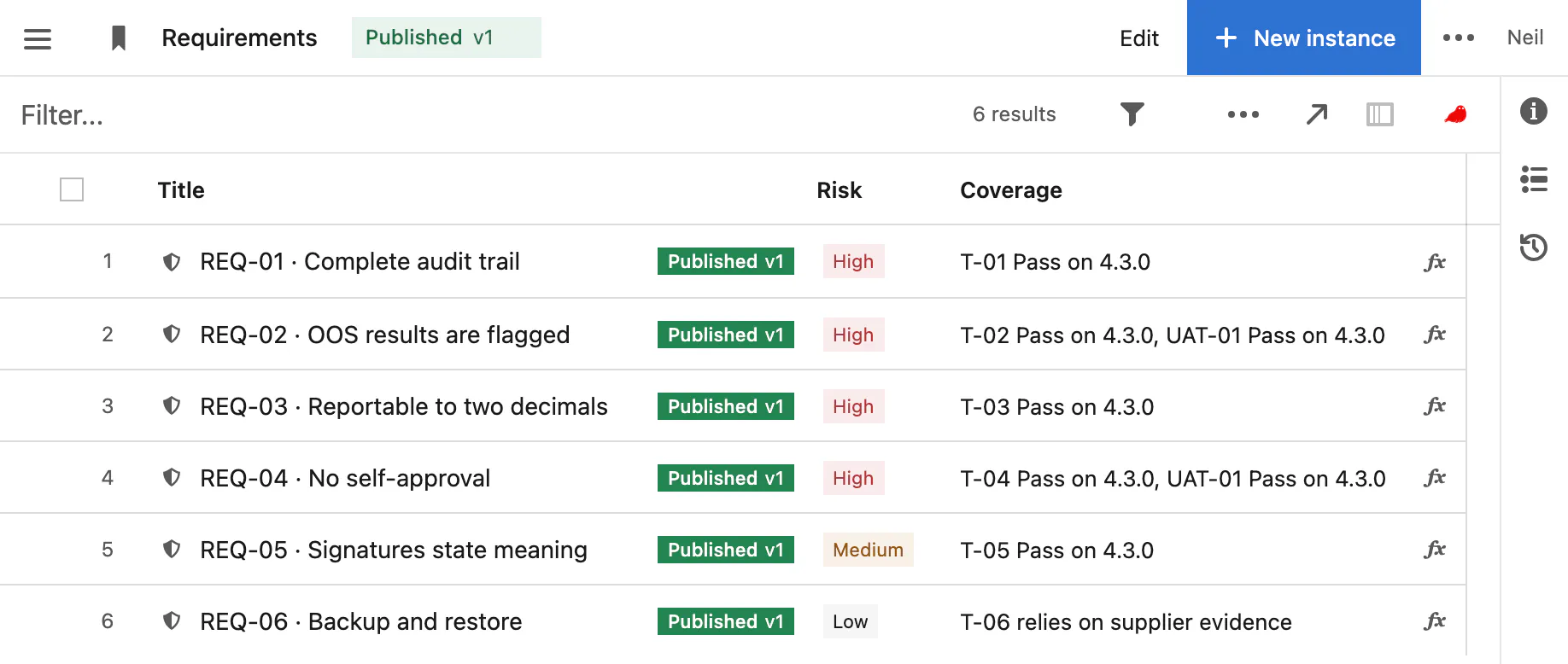
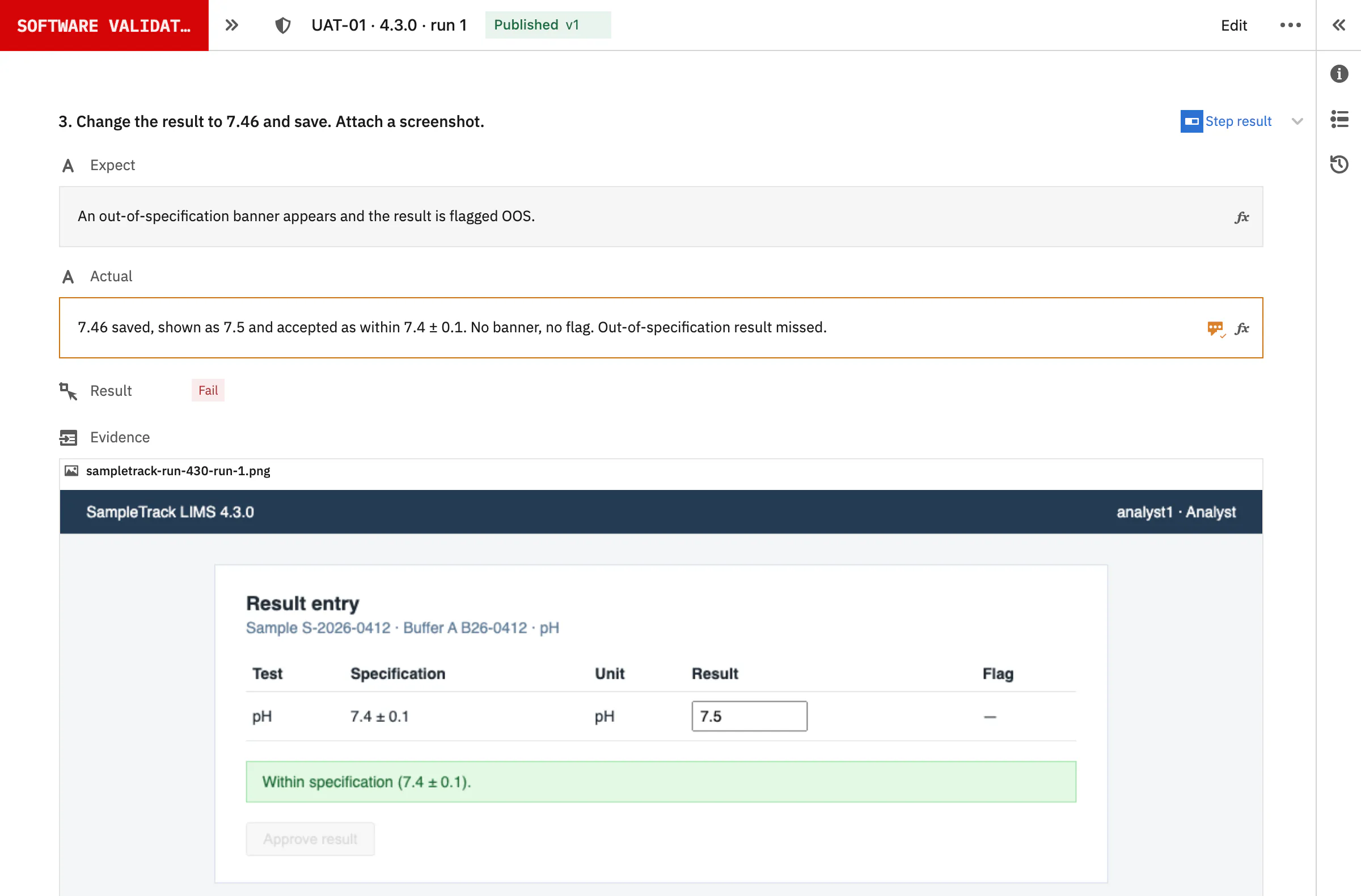
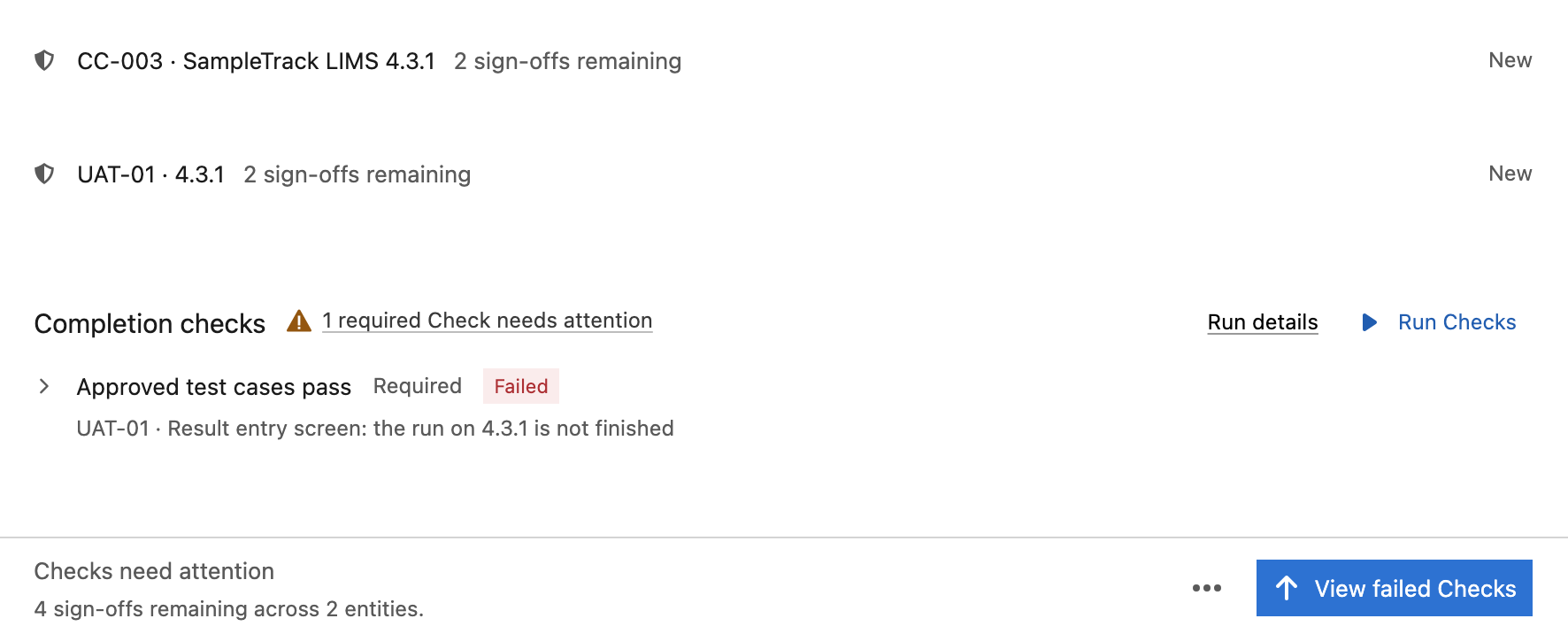
Move one process where the design meets the build first. In Seal, design inputs, outputs, verification, validation and design reviews are linked records, and the traceability matrix is a view of those links, so a requirement with no test shows as a gap while the design is developed. A design change flags the outputs and verification it affects before it is approved, and risk controls link to the requirements and verification that implement them. The design history file is organised from records kept during development, and each unit’s build record links to the versions and lots it was built from, so a design change shows the units it reaches, and a complaint opens on the unit’s build. The design control blueprint and the medical device blueprint set this out. Paradromics, which makes a brain-computer interface, moved from paper and legacy systems and cut operator paperwork by 80% and engineers’ traveler review time by 90%.
- Choose a change with consequences beyond the software, such as a firmware or component revision that reaches verification, risk controls and units already built.
- Bring the affected requirements, the risk analysis, the verification evidence and the build records. Polarion exchanges requirement and test case specifications through ReqIF and exports documents for offline work,² so start from an export or sample records, or arrange an NDA before sharing confidential ones.
- Neil prepares the trace structure and the change workflow from your procedure, for your engineering and quality teams to verify against the device. Seal offers a 48-hour evaluation of one process, once the scope is agreed and the inputs received. Production timing then depends on scope, interfaces, migration and your release requirements.
- Exercise a change before relying on it: a revised requirement, the verification and risk controls it reaches, and the units built to the earlier version.
- Keep Polarion’s baselines, signed documents and design history retrievable for their retention period. Imported evidence keeps its original version and context, and importing it does not establish that it covers the current use.
References
- 1Polarion application lifecycle management, Siemens. https:/
/ www. siemens. com/ en- us/ products/ polarion/ (read 13 November 2026) - 2Polarion Application Lifecycle Management (ALM), Siemens. https:/
/ www. siemens. com/ en- us/ products/ polarion/ application- lifecycle- management- alm/ (read 13 November 2026) - 3Polarion ALM 2512 – What’s New and Noteworthy, Jean-François Thibeault, Siemens Digital Industries Software, 3 December 2025. https:/
/ blogs. sw. siemens. com/ polarion/ polarion- alm- 2512- whats- new- and- noteworthy/ (read 13 November 2026) - 4Polarion X 2606 – What’s New and Noteworthy, Martin Popelak, Siemens Digital Industries Software, 18 September 2026. https:/
/ blogs. sw. siemens. com/ polarion/ polarion- x- 2606- whats- new- and- noteworthy/ (read 13 November 2026) - 5Electronic device history records, Siemens. https:/
/ www. siemens. com/ en- us/ technology/ electronic- device- history- records- edhr/ (read 13 November 2026) - 6Siemens and Microsoft team up to deliver Polarion X on Azure, Siemens, 18 November 2025. https:/
/ news. siemens. com/ en- us/ siemens- polarion- x- azure/ (read 13 November 2026) - 7Accelerate and Scale Early Validation with Polarion, Jiri Jandl, Siemens Digital Industries Software, 23 April 2026. https:/
/ blogs. sw. siemens. com/ polarion/ accelerate- and- scale- early- validation- with- polarion/ (read 13 November 2026) - 8Polarion X, Siemens. https:/
/ www. siemens. com/ en- us/ products/ polarion/ polarion- x/ (read 13 November 2026) - 9Siemens to Acquire Polarion Software, Expanding Support for Growing ALM Market, Marketwired on GlobeNewswire, 25 November 2015, as archived on 22 October 2026. https:/
/ web. archive. org/ web/ 20261022142833/ https:/ / www. globenewswire. com/ news- release/ 2015/ 11/ 25/ 1328364/ 0/ en/ siemens- to- acquire- polarion- software- expanding- support- for- growing- alm- market. html (read 13 November 2026) - 10Polarion ALM 2606 – What’s New and Noteworthy, Jean-François Thibeault, Siemens Digital Industries Software, 28 May 2026. https:/
/ blogs. sw. siemens. com/ polarion/ polarion- alm- 2606- whats- new- and- noteworthy/ (read 13 November 2026) - 11Polarion Extensions, Siemens. https:/
/ extensions. polarion. com/ (read 13 November 2026) - 12Polarion ALM MedPack - IEC 62304, Polarion Extensions, Siemens. https:/
/ extensions. polarion. com/ extensions/ 31- polarion- alm- medpack- iec- 62304 (read 13 November 2026) - 13iThera Medical: boosting engineering information management efficiency reduces time spent hunting for data by over 65 percent, Siemens. https:/
/ resources. sw. siemens. com/ en- US/ case- study- ithera- medical/ (read 13 November 2026) - 14Industrial artificial intelligence for Polarion, Siemens. https:/
/ www. siemens. com/ en- us/ products/ polarion/ industrial- ai/ (read 13 November 2026)
AQuestions and answers
Is Seal better than Polarion?
Yes. Polarion is built for application lifecycle management in large-scale, compliance-heavy product development. Siemens agreed in November 2015 to buy Polarion Software, which it called the developer of “the first browser-based application lifecycle management (ALM) enterprise solution”, and to add Polarion to its Teamcenter software. Its unit is still the work item in a versioned document: requirements, tests, risks and change requests, traced to source code revisions and moved through workflows with electronic signatures. Siemens says it helps “more than 20,000 firms worldwide”. Its AI, Polarion Copilot, arrived in December 2025 as a paid add-on that checks requirements against INCOSE rules, finds similar work items and flags contradictions between linked ones, on a language model the customer connects. If your engineers design the device and someone else builds it, it can work well. A team that also builds the device needs each unit’s build on the same records as the design, and Siemens sells the electronic device history record in another product, Opcenter. Seal has no fixed model of one kind of work. It is built from primitives: record types, the relationships between them, and the steps and checks that use them, which your own team composes into your process, with Neil able to prepare each change for approval. So one platform runs process development, the laboratory, manufacturing, batch release and the quality system, and each change becomes a new version, released once its selected tests pass, while earlier runs keep theirs. Moving from paper and legacy systems, Paradromics cut operator paperwork by 80% and engineers’ traveler review time by 90%.
Who makes Polarion?
Polarion is made by Siemens Digital Industries Software, part of Siemens. Siemens agreed in November 2015 to buy Polarion Software, which had built it as a browser-based application lifecycle management system, and said it would add Polarion to its Teamcenter software. Siemens sells it as Polarion ALM, installed on your own server, and as Polarion X, which Siemens runs in the cloud.
Is Seal an alternative to Polarion?
Partly. Polarion is built for application lifecycle management in large-scale, compliance-heavy product development, and for a software team it does more than Seal: Git and Subversion commits traced to change requests, native test management, variant management, a software bill of materials in Polarion X and many connectors. Seal is the GxP execution system: its design records sit on the same platform as the build record of every unit, the quality system and training, and Neil prepares the changes. A team deep in Polarion can keep it and start in Seal with one process.
Does Polarion cover manufacturing, such as device history records or batch records?
Not on Polarion’s own product pages, which cover requirements, coding, testing and release. Siemens describes electronic device history records as part of a manufacturing execution system and sells them in Opcenter Execution Medical Device and Diagnostics, which Polarion X integrates with. One Siemens customer, iThera Medical, keeps its design history files and device master records in Polarion. In Seal, each unit’s build record links to the versions and lots it was built from, so a design change shows the units it reaches, and a complaint opens on the unit’s build.
How does Polarion Copilot compare with Neil?
Polarion Copilot, a paid add-on introduced in December 2025, checks requirement text against INCOSE rules, finds similar work items and flags contradictions across linked ones, on a language model the customer connects; since release 2606, customers’ own reports, scripts and widgets can call that model through an API. Its built-in tools work on the text of the specification. Neil prepares changes to records, workflows and their checks for your team to verify and approve under change control. It finds requirements without verification and assembles the records a change reaches. It cannot approve, sign or publish, it is not used in GMP execution, and customer data trains no AI.
Does Seal work with GitHub and Jira?
With GitHub, in a narrower way than Polarion. Seal’s Change Control GitHub App, in beta, creates a Seal change record from a configured template when a matching pull request opens, updates it as the pull request changes, writes a commit status that links to the record, and approves or closes the pull request when the record is approved or rejected. Seal holds the approval and its Part 11 signatures; merge and deployment stay in your delivery workflow. GitHub issues with a label you choose are kept as Seal records, for example as anomalies, and Seal’s GitHub Actions attach a snapshot of the code and the release’s files to the change record. The app does not inspect code, run tests, merge or deploy, and Seal has no software bill of materials or vulnerability scanning. There is no two-way Jira sync; Neil can read Jira through a connection a user grants. There is no GitLab, Bitbucket or Azure DevOps app; other tools connect through Seal’s REST API and Scripts. Polarion supports Git and Subversion out of the box and traces each source code modification to its change request, and Polarion X connects GitHub, GitLab, Bitbucket, Jenkins, Jira and Azure DevOps. For tracing code to requirements, that is well beyond Seal’s GitHub app.
Can we keep Polarion and start with Seal?
Yes. Keep Polarion for your engineers’ requirements, tests and code traceability, and start in Seal with one process, such as the build record of one device. Seal has no dedicated Polarion connector; other tools connect through Seal’s REST API and Scripts. If Polarion already traces your repository’s commits, agree which system holds the release approval before adding Seal’s GitHub app.
How long does it take to start with Seal?
Seal offers a 48-hour evaluation of one process, once the scope is agreed and the inputs received. Production timing then depends on scope, interfaces, migration and your release requirements.