Summary
- The story
- Beamex CMX is good for calibration management with Beamex’s own calibrators.1 Beamex was founded in 1975 by four calibration technicians who “couldn’t find the calibrators they needed”, and launched PCAL, its first calibration software with calibrator communication, in 1986;5 it calls CMX its third generation of calibration management software.2 Its model is still the instrument in the plant: a position, or tag, from the plant drawings, and the device installed in it, each with its functions and calibration procedures.2 Beamex says CMX “fulfills the requirements of 21 CFR Part 11”,1 yet in CMX Professional the audit trail, electronic records and electronic signatures come with Change Management, an option,2 and the servers, backups and database maintenance are the customer’s.3 Beamex’s customers include 18 of the world’s top 20 pharma companies.6 If calibration is a job of its own, it can work well. Most GMP teams need a failed point traced to the batches and tests it affects, and use of the instrument checked for the range in use, in the same system as the work.
1What Beamex CMX offers.
CMX schedules calibrations, sends procedures to Beamex documenting calibrators and the bMobile application to guide the work, calculates the combined expanded uncertainty for each calibration point and keeps the full calibration history, with certificates that show as-found and as-left results.1,
2Running Seal alongside Beamex CMX.
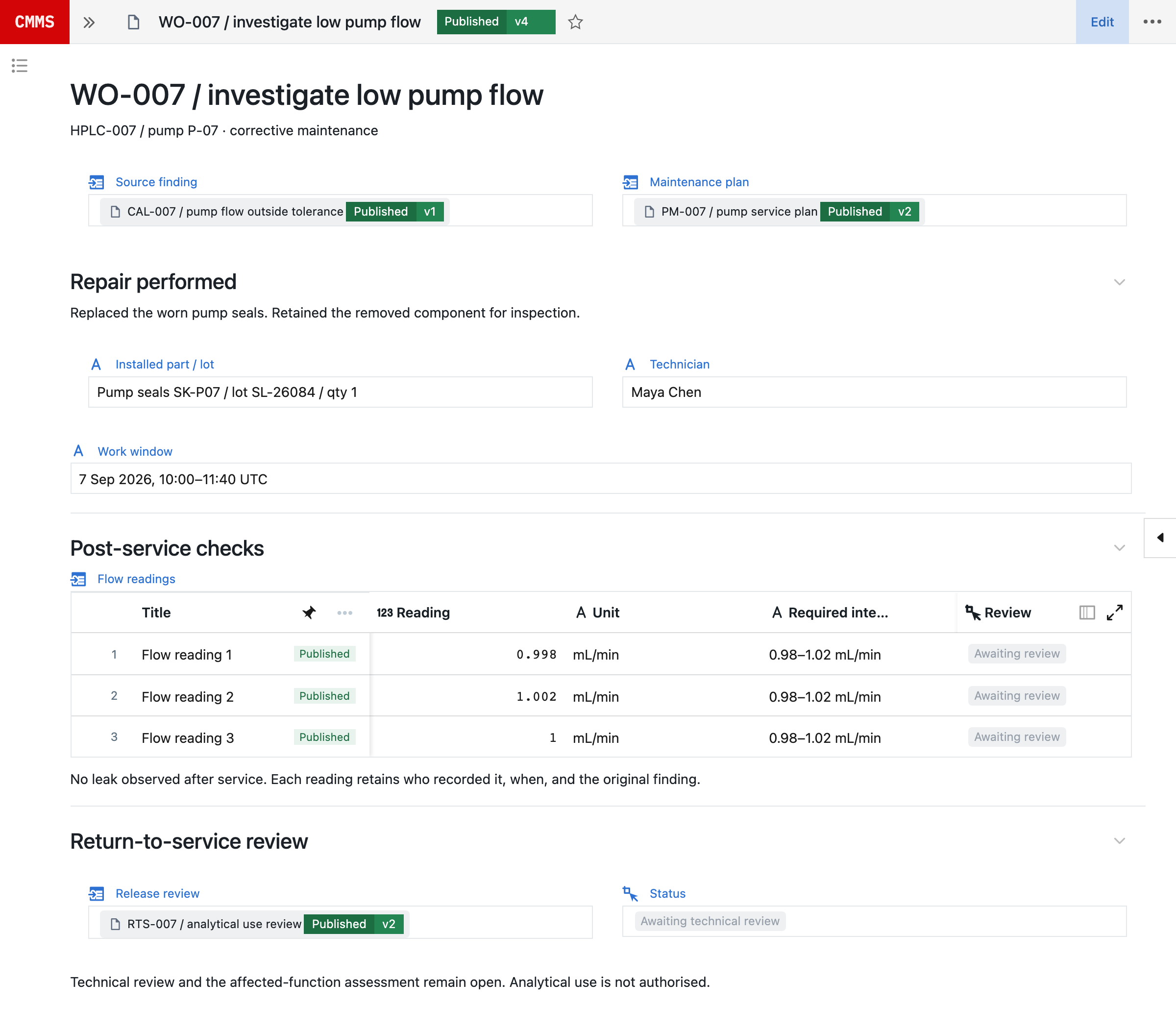
Teams move instruments to Seal one at a time, with CMX in place while they do. Seal has no dedicated Beamex connector. Where a system is not on Seal’s integrations list, Seal’s REST API and Scripts can connect it, and Seal can review its interfaces with you.
Confirm with Beamex and your CMX administrator which exports and interfaces your variant and licence provide: Business Bridge is an option for exchanging work orders with a maintenance system, and Data Loader exports instruments and references to Excel.2,
3Moving from Beamex CMX to Seal.
Start with one critical instrument and prove the whole chain, so nothing has to move on day one.
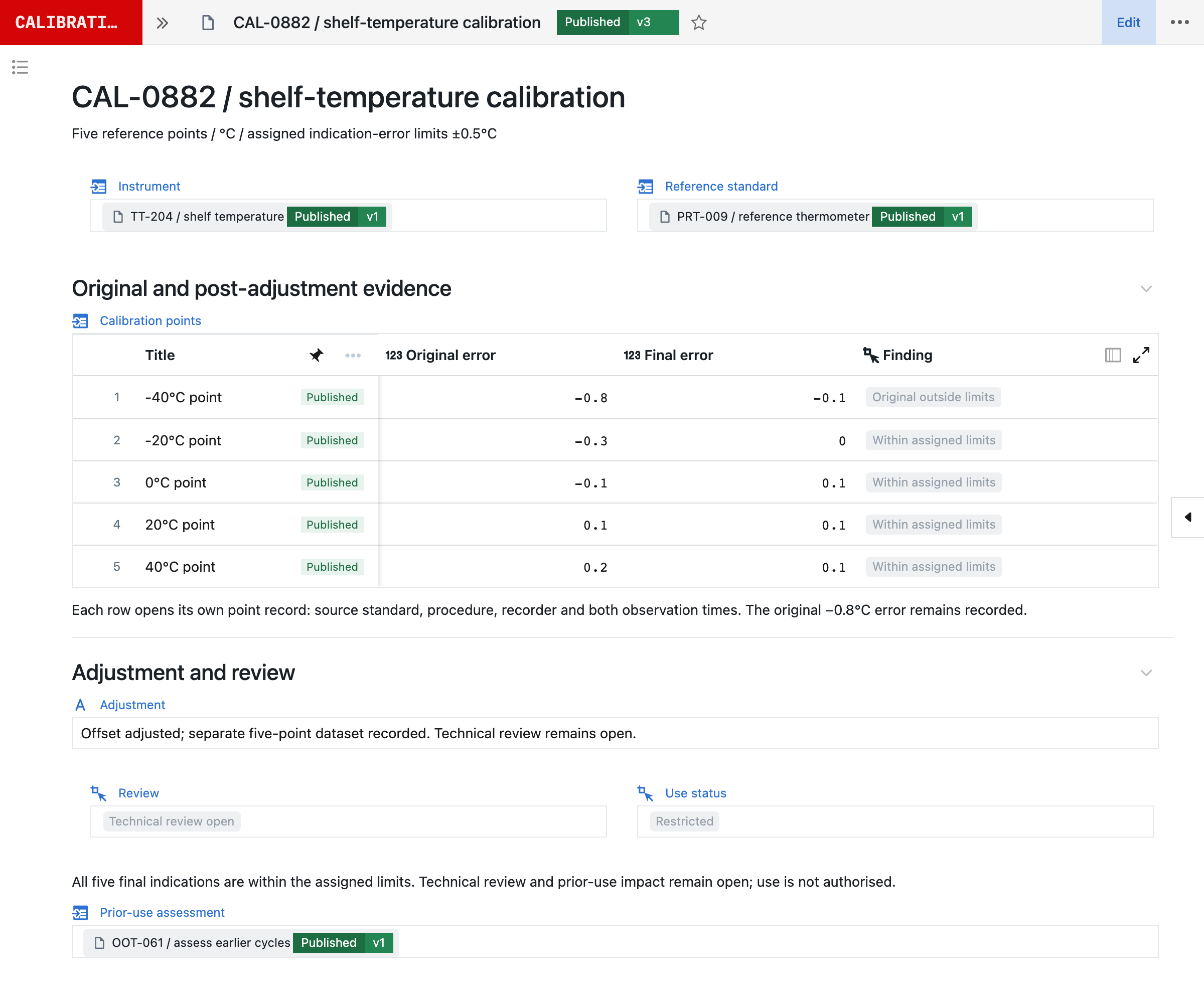
- Choose a critical instrument, ideally one with several ranges and uses that matter, such as a freeze-dryer shelf-temperature transmitter.
- Bring its master data, criticality, procedure, reference standards and a recent calibration with its certificate. Start with sample material, or arrange an NDA before sharing confidential records.
- Neil drafts the instrument, reference-standard and calibration-point templates, capture fields for the original and post-adjustment datasets, and versioned calculations and decision rules. Metrology specialists review the model. Once the scope is agreed and the inputs received, Seal prepares the first working process and its validation pack to evaluate within 48 hours. Production timing then depends on scope, interfaces, migration and your release requirements.
- Bring in the dates, results and certificate references the process needs, through the exports and interfaces your CMX installation provides.
- Take the instrument through an as-found failure, adjustment, as-left pass, restriction, use-history extraction and interval review. Include an overdue standard, an external certificate mismatch and an interface outage.
- Agree which system owns instrument identity, schedules, results and current restrictions before extending to the next instrument family.
Retention obligations continue for the records that stay in CMX. The calibration blueprint describes the workflow in detail.
ABeamex CMX alternatives
| Product | Good for |
|---|---|
| Seal | Process development, the laboratory, manufacturing, batch release and quality on one platform, where Neil, an AI agent, does the paperwork |
| IBM Maximo | Asset management of critical equipment and infrastructure |
| SAP Plant Maintenance | Maintenance inside the ERP |
| Blue Mountain RAM | Regulated asset management in life sciences manufacturing |
| eMaint | Maintenance teams in many industries |
| Fiix | Maintenance teams |
| ProCal | Calibration management |
The sources for what each is good for are on its comparison with Seal and on Best calibration and maintenance software for GxP (2026).
BQuestions and answers
Is Seal better than Beamex CMX?
Yes. Beamex CMX is good for calibration management with Beamex’s own calibrators. Beamex was founded in 1975 by four calibration technicians who “couldn’t find the calibrators they needed”, and launched PCAL, its first calibration software with calibrator communication, in 1986; it calls CMX its third generation of calibration management software. Its model is still the instrument in the plant: a position, or tag, from the plant drawings, and the device installed in it, each with its functions and calibration procedures. Beamex says CMX “fulfills the requirements of 21 CFR Part 11”, yet in CMX Professional the audit trail, electronic records and electronic signatures come with Change Management, an option, and the servers, backups and database maintenance are the customer’s. Beamex’s customers include 18 of the world’s top 20 pharma companies. If calibration is a job of its own, it can work well. Most GMP teams need a failed point traced to the batches and tests it affects, and use of the instrument checked for the range in use, in the same system as the work. Seal has no fixed model of one kind of work. It is made of primitives: record types, the relationships between them, and the steps and checks that use them, which your own team composes into your process, with Neil able to prepare each change for approval. So one platform runs process development, the laboratory, manufacturing, batch release and the quality system, and each change becomes a new version, released once its selected tests pass, while earlier runs keep theirs. Moving from paper and legacy systems, Paradromics keeps calibration records on one platform and cut operator paperwork by 80%.
What are the alternatives to Beamex CMX?
Seal, IBM Maximo, SAP Plant Maintenance, Blue Mountain RAM, eMaint, Fiix and ProCal. Seal is the best calibration and maintenance software for GxP. Paradromics cut operator paperwork by 80%.
Is Seal an alternative to Beamex CMX?
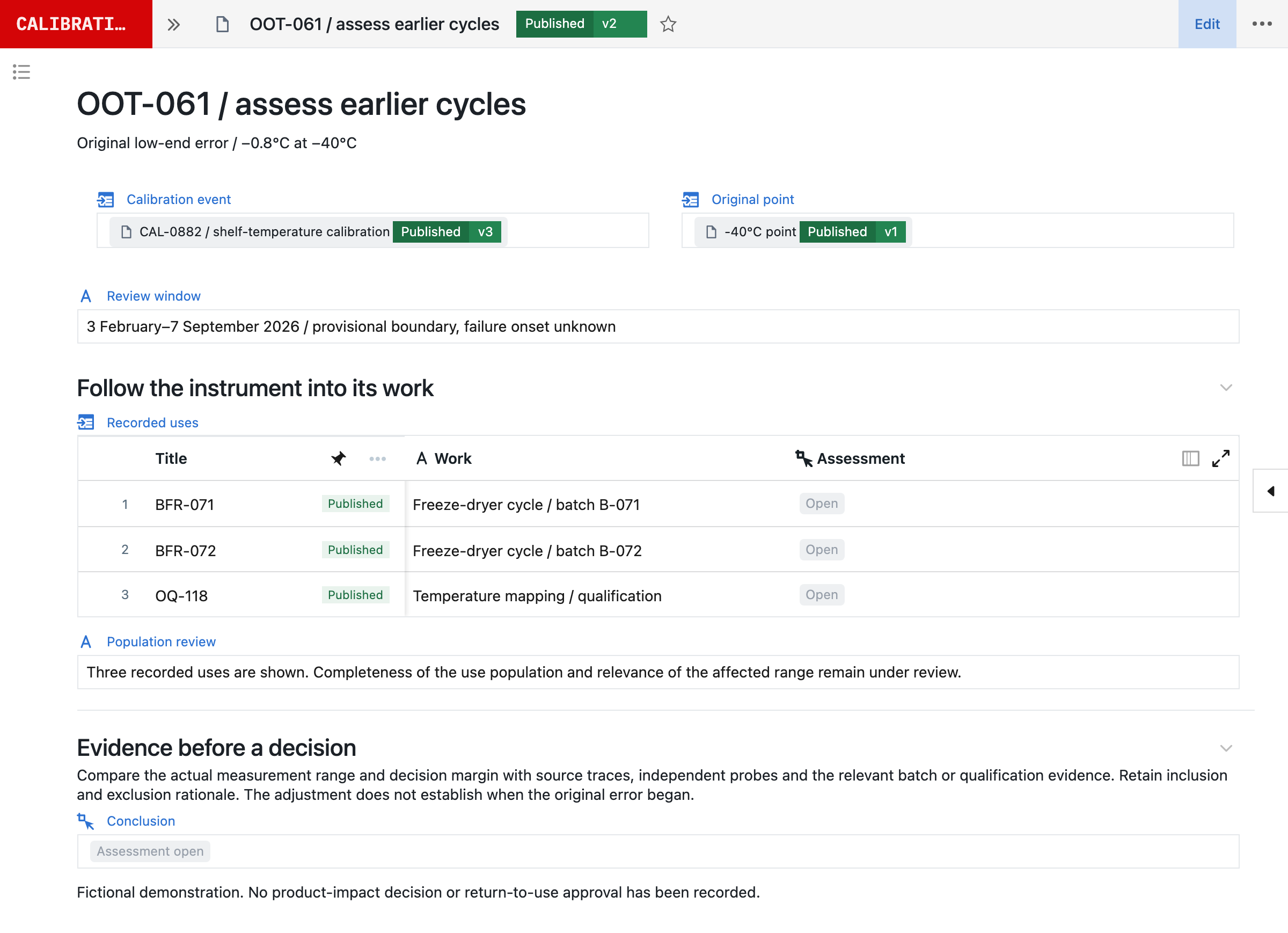
Yes. Beamex CMX is designed for calibration management with Beamex’s own calibrators. Seal covers calibration management, from each point with its standard and procedure to use permission and certificate review, and keeps it on the same records as maintenance, laboratory, manufacturing and quality. An out-of-tolerance point in Seal leads straight to the batches and tests the instrument measured since its last acceptable check.
Is Seal a calibration management system?
Yes. Seal keeps each calibration point with its as-found and as-left values, times, recorder, procedure and reference standard, reconciles vendor certificates against the instrument and the ordered scope, and decides use permission for the range at use. Procedure and interval changes are released with their verification.
Can Seal work alongside Beamex CMX?
Yes. Seal has no dedicated Beamex connector. Its REST API and Scripts can bring in evidence through the exports and interfaces your CMX installation provides, starting with read access and treating any write-back as a separate decision. Instruments move to Seal one at a time.
Does Beamex CMX have an audit trail and electronic signatures?
In CMX Enterprise, as standard. In CMX Professional they come with Change Management, an option that also covers electronic records, automatic result validation and result approval with an electronic signature. In Seal, electronic signatures and audit trails for 21 CFR Part 11 and EU Annex 11 are part of the platform.
What happens in Seal when a calibration point fails?
The original as-found value stays on record beside the adjusted result, and use of the instrument stays restricted while review is open, even after a passing as-left check. An assessment opens with the recorded uses since the last acceptable check, and reviewers record why each use is in or out of scope.
How long does it take to start with Seal?
Once the scope is agreed and the inputs received, Seal prepares a first working process and its validation pack to evaluate within 48 hours, configured from one of your procedures. Production timing then depends on scope, interfaces, migration and your release requirements.
References8 sources
References
- 1Beamex CMX Calibration Management Software, Beamex. https:/
/ www. beamex. com/ us/ calibration- software/ cmx/ (read 20 November 2026) - 2Beamex CMX Calibration Software (user manual), Beamex. https:/
/ www. beamex. com/ app/ uploads/ 2026/ 10/ cmx- user- manualeng. pdf (read 20 November 2026) - 3Calibration software built for IT standards, Beamex. https:/
/ www. beamex. com/ solutions/ governing- calibration- software/ (read 20 November 2026) - 4Meet the experts in calibration services, Beamex. https:/
/ www. beamex. com/ us/ services/ expert- services/ (read 20 November 2026) - 5Calibration Excellence Since 1975, Beamex. https:/
/ www. beamex. com/ us/ 50years/ (read 20 November 2026) - 6Meet Beamex customers from around the world, Beamex. https:/
/ www. beamex. com/ about- us/ our- customers/ (read 20 November 2026) - 7Beamex Business Bridge: connect calibration and CMMS, Beamex. https:/
/ www. beamex. com/ us/ calibration- software/ cmx/ business- bridge/ (read 20 November 2026) - 8Products for calibration management, field and workshop calibration, Beamex. https:/
/ www. beamex. com/ us/ products/ (read 20 November 2026)