Summary
- In short
- ProCal is a dedicated calibration management program, from software in use since 1989, which TMA Systems describes as 21 CFR Part 11 pre-validated, with guided test routines, automated calculations and certificates. In Seal, teams configure lab, manufacturing and quality workflows around one shared ontology, so an out-of-tolerance point leads to the batches and tests the instrument measured, and use stays a separate decision.
- When it fits
- Your metrology team wants a specialist calibration program with pre-engineered test routines, Fluke documenting process calibrator support, Crystal Reports and multi-site templates, from a vendor that also sells maintenance software.
- When Seal fits
- You want calibration results checked where the work runs: eligibility for the range at use, the original result kept beside the final one, and Neil assembling the work an instrument measured since its last good check.
- Using both
- Keep ProCal for scheduling and certificates and start one critical instrument in Seal. Seal’s ProCal connection is a scoped custom integration on ProCal’s Data Exchange Utility or ProCal Connector, starting with reading evidence.
1ProCal and Seal, side by side.
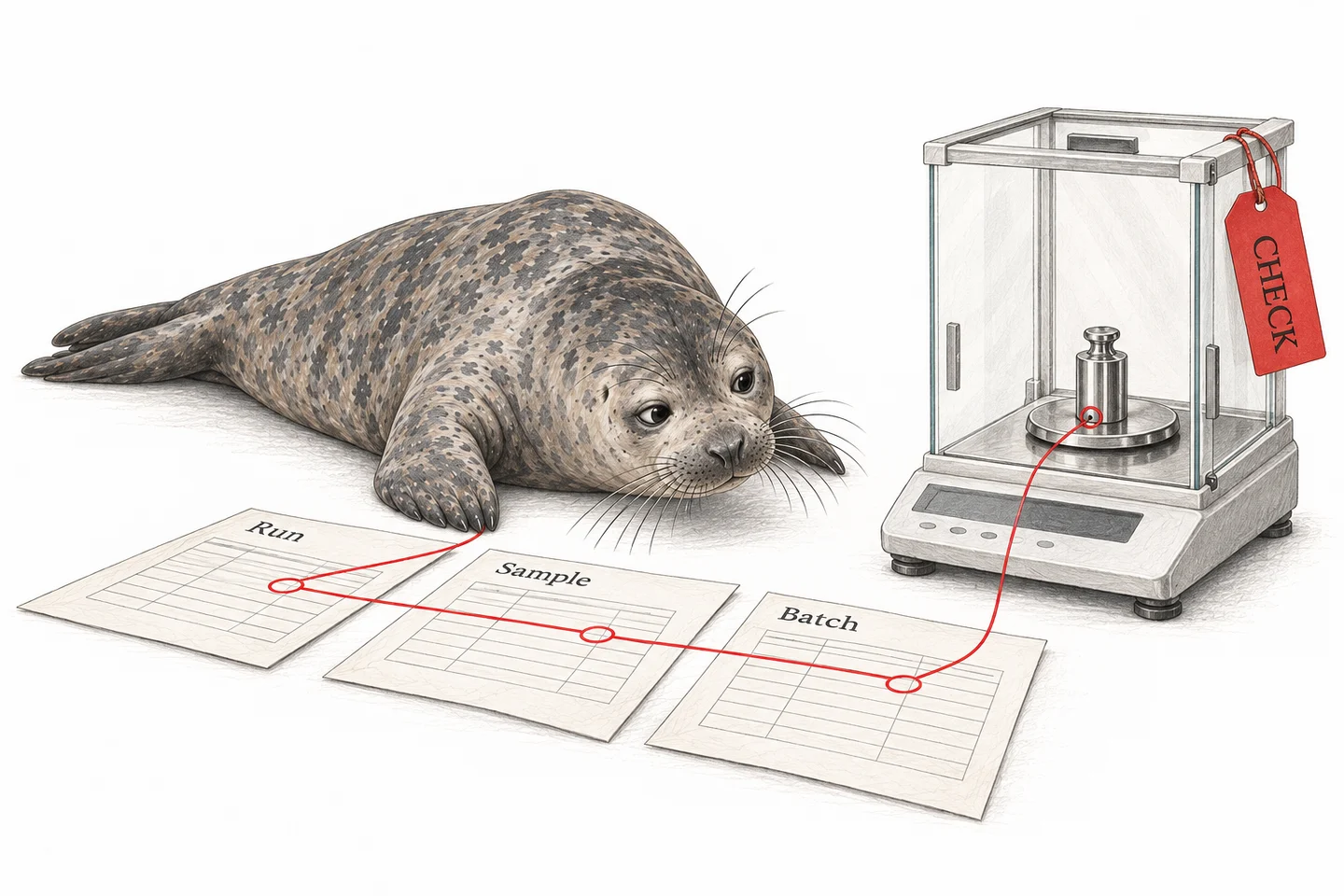
ProCal and Seal both record calibrations electronically, with audit trails, electronic signatures and approvals. They differ in what a calibration record is connected to. ProCal is a calibration management program: it plans and schedules calibrations, runs guided test routines, calculates results against tolerances and generates certificates.¹ In Seal, teams configure lab, manufacturing and quality workflows on one platform around a shared ontology, so the calibration, the instrument’s permitted uses and the work it measured are connected records.
| ProCal | Seal | |
|---|---|---|
| What it is | Calibration management software | GxP operating system for biopharma |
| Test execution | Guided routines, automated maths | Each point with its source and standard |
| A failed calibration | Flagged, with audit-ready reports | Linked to the uses it may affect |
| After a passing check | Past-due tools restored on passing | Use decided as a separate record |
| Certificates | Generated automatically | Reconciled against the instrument |
| Validation | Described as Part 11 pre-validated | Selected checks run on each change |
| Integrations | Data Exchange Utility, Connector | Connectors, REST API and Scripts |
| Getting started | ProCal, or web-based ProCalX | One critical instrument, beside ProCal |
2What ProCal is built for.
ProCal is designed for calibration and metrology teams replacing paper records with a controlled, paperless calibration program. Prime Technologies’ calibration software has been in use since 1989. TMA Systems, a developer of CMMS and enterprise asset management software based in Tulsa, Oklahoma, acquired Prime Technologies in January 2023, naming life sciences, healthcare, food and beverage, chemicals, energy and manufacturing among the industries that need to calibrate critical equipment.² TMA now sells ProCal and the web-based ProCalX alongside its WebTMA and MEX maintenance products.³
TMA describes ProCal as an enterprise calibration program with:¹
- planning and scheduling with set frequencies and automated reminders, while ProCal keeps complete records, certificates and audit trails;
- pre-engineered test routines for specific instruments, with loops, equipment and systems managed and the same templates applied across sites;
- automated calculations that apply tolerances and flag pass or fail, with failed calibrations flagged immediately and audit-ready reports generated;
- 21 CFR Part 11 controls with secure access, electronic signatures and multi-level approvals, in a program TMA describes as pre-validated;
- support for multiple companies, departments and user groups, with user-defined fields, configurable permissions, custom approval workflows and Crystal Reports;
- integration tools: the Data Exchange Utility, ProCal Connector and Precision test packages.
TMA’s calibration pages add that technicians capture as-found and as-left readings and get instant pass or fail results, online or offline, and that ProCal works with Fluke documenting process calibrators to automate calibration.⁴ ProCalX, aimed at mid-market and smaller teams, runs in the browser, syncs results directly from Fluke documenting process calibrators and offers APIs and data exchange utilities.⁵
3What the certificate shows, and what it leaves out.
Both products keep the calibration result and a certificate. Seal also keeps the original discovery state beside the final one, and checks that a supplied certificate matches the instrument.
TMA says ProCal generates audit-ready records and certificates automatically, with full histories and scheduled delivery.¹
In Seal, each point of a calibration is a record in its own right. In Seal’s calibration blueprint, calibration CAL-0882 holds five points for temperature transmitter TT-204. At −40°C the indication is −40.8°C at 09:10 UTC on 7 September, against limits of ±0.5°C; after adjustment, at 10:10 UTC, it is −40.1°C. The other four points read within ±0.3°C before adjustment and within ±0.1°C after it. The point record keeps both observations with their times, recorder, procedure and reference standard, so a passing final result never overwrites the failure.
Where a vendor calibrates the instrument, Seal reviews what comes back against what was ordered. In the same blueprint, an incoming certificate for TT-204 is missing the −40°C point and the readings before adjustment. The review reconciles the serial number, ranges, points, as-found and as-left data, tolerances, standards and adjustments against the ordered scope and the actual instrument. What is missing is requested before the site decides whether the instrument returns to use, because a PDF certificate alone does not release the asset.
Reference standards are checked the same way: their range, uncertainty, validity and condition are checked for the procedure at the time of the event, and the certificate and standard version used are retained with the calibration.
4Use permission after a passing check.
A passing check describes the instrument’s condition. Whether it may be used again, and for what, is a separate decision.
TMA says its calibration software can pause past-due tools and restore them after passing.⁴
In Seal, the as-left result, permission to use and the assessment of earlier work are separate, reviewable records. TT-204’s as-left check has passed, yet its use stays restricted while technical review is open. Assessment OOT-061 lists the freeze-dryer cycles for batches B-071 and B-072 and temperature-mapping run OQ-118, the work measured since the last acceptable check on 3 February; the earlier check is a review boundary, not proof of when the error began.
Manufacturing, laboratory, maintenance and qualification workflows can check eligibility before use, and the response gives the range or function, current status, restrictions and reason. A label can show tag, status and due date, but scanning it resolves the live record, so a label never overrides the system state.
5Where ProCal is the better fit.
ProCal is the better fit when you want a specialist calibration program, run by a metrology team, from a vendor with a long calibration history.
- You want a calibration-
specific system with decades of use behind it.² - You want pre-engineered test routines and consistent templates across instruments, loops and sites.¹
- Your technicians use Fluke documenting process calibrators and want results to flow into the calibration record.⁴⁵
- You need to support several companies, departments and user groups with their own rules, fields and approval workflows, and report through Crystal Reports.¹
- You want calibration and maintenance from one vendor, with TMA’s WebTMA or MEX for maintenance.³
- You want a program its vendor describes as 21 CFR Part 11 pre-validated.¹
6Where Seal is the better fit.
Seal is the better fit when calibration results should decide what happens in the work, not only describe the instrument.
- You want an out-of-tolerance point to lead straight to the batches, tests and qualification runs that used the instrument since its last acceptable check.
- You want eligibility checked for the range at use. A device can be within its calibration acceptance yet unsuitable for the precision a method requires.
- You want calibration intervals and procedures to improve under change control. Each improvement becomes a new process version with its specifications, test evidence and approvals, and existing events keep the procedure they were recorded under.
- You want laboratory, manufacturing and quality on the same records, so an investigation follows the instrument into the result, the batch and the decision.
- You want an AI agent that prepares the work. Neil assembles the work an instrument measured since its last acceptable calibration, with the evidence and what is missing, and drafts procedure and interval changes with their verification. People approve, and Neil never releases a change on its own. In line with the EU’s draft GMP Annex 22 on AI, Neil is not used in GMP execution. It helps set up configuration, which your team verifies and releases under change control.
7Running Seal alongside ProCal.
Keep ProCal responsible for scheduling and certificates if it already serves that purpose. Seal’s ProCal connection brings ProCal calibration records into equipment checks and investigations in Seal. ProCal provides a Data Exchange Utility and ProCal Connector, and Seal scopes the connection around your installed edition, licensed tools and available exports. It is a custom integration, not a guided Seal connector, and it does not assume a REST API or automatic access to every calibration record.
Agree the instrument identifiers, calibration fields, transfer frequency and source timestamps before mapping records into Seal. Confirm which dates, results, approval states and certificate references the transfer includes. Start with reading evidence; changes to ProCal need separate configuration. Missing or stale evidence stays visible in the receiving equipment check.
Once the connection and equipment mappings are configured, Neil can:
- compare the supplied calibration due date with a planned run and flag gaps for the equipment owner;
- trace an instrument with an out-of-tolerance result to its recorded uses in Seal and prepare the batch list and evidence for quality review;
- collect overdue items and unresolved evidence into a work list for the metrology team.
8Moving from ProCal to Seal.
Start with one critical instrument and prove the whole chain, while ProCal keeps the rest of the calibration program.
- Choose a critical instrument, ideally one with several ranges and uses that matter, such as a freeze-dryer shelf-temperature transmitter.
- Bring its master data, criticality, procedure, reference standards and a recent calibration with its certificate. Start with sample material, or arrange an NDA before sharing confidential records.
- Neil drafts the instrument, reference-standard and calibration-point templates, capture fields for the original and post-adjustment datasets, and versioned calculations and decision rules. Metrology specialists review the model. Once the scope is agreed and the inputs received, Seal prepares the first working process and its validation pack within 48 hours. Production timing then depends on scope, interfaces, migration and your release requirements.
- Connect ProCal for the dates, results and certificate references the process needs.
- Take the instrument through an as-found failure, adjustment, as-left pass, restriction, use-history extraction and interval review. Include an overdue standard, an external certificate mismatch and an interface outage.
- Agree which system owns instrument identity, schedules, results and current restrictions before extending to the next instrument family.
Retention obligations continue for the records that stay in ProCal. The calibration blueprint describes the workflow in detail.
References
- 1ProCal calibration management software, TMA Systems. https:/
/ www. tmasystems. com/ products/ procal (read 8 October 2026) - 2TMA Systems Acquires Prime Technologies, TMA Systems, 11 January 2023. https:/
/ www. tmasystems. com/ press/ tma- systems- acquires- prime- technologies (read 8 October 2026) - 3About TMA Systems, TMA Systems. https:/
/ www. tmasystems. com/ about (read 8 October 2026) - 4Calibration management software, TMA Systems. https:/
/ tmasystems. com/ solutions/ calibration- management- software (read 8 October 2026) - 5ProCalX cloud-based calibration management software, TMA Systems. https:/
/ www. tmasystems. com/ products/ procalx (read 8 October 2026)
AQuestions and answers
Is Seal an alternative to ProCal?
For instruments whose results decide GMP work, yes. ProCal is a specialist calibration program; Seal keeps calibration points, use permission and the work each instrument measured on the same records as laboratory, manufacturing and quality. You can start Seal on one critical instrument while ProCal keeps the rest of the program.
Who makes ProCal now?
ProCal comes from Prime Technologies, whose calibration software has been in use since 1989. TMA Systems, a CMMS and enterprise asset management company based in Tulsa, Oklahoma, acquired Prime Technologies in January 2023 and sells ProCal and the web-based ProCalX.
Can Seal connect to ProCal?
Yes, as a scoped custom integration. ProCal provides a Data Exchange Utility and ProCal Connector, and Seal confirms the edition, licensed tools, fields and transfer frequency with your team before mapping records. It starts with reading evidence, so Neil can check due dates before a run and trace an out-of-tolerance instrument to its recorded uses.
Does Seal keep as-found results after adjustment?
Yes. As-found data are recorded in full before any adjustment or repair, and as-left testing records the final condition as a separate dataset. A passing as-left result cannot replace or hide a failing as-found condition.
How long does it take to start with Seal?
Once the scope is agreed and the inputs received, Seal prepares a first working process and its validation pack within 48 hours, configured from one of your procedures. Production timing then depends on scope, interfaces, migration and your release requirements.