Summary
- In short
- Maximo is IBM’s enterprise asset management suite for many industries, with calibration data sheets, standards traceability and electronic signatures in Maximo Manage. In Seal, teams configure lab, manufacturing and quality workflows around one shared ontology, so a calibration result and the work that relied on the instrument sit on the same records.
- When it fits
- You manage many kinds of assets and facilities across sites and industries, want monitoring, health and prediction in the same suite as maintenance, need client-managed or SaaS deployment, or already run Maximo with its ERP connectors.
- When Seal fits
- You want calibration and maintenance checked where GMP work runs: uses recorded with the batch or test, eligibility checked for the range at use, and Neil preparing impact assessments and procedure changes for your team to approve.
- Using both
- Keep Maximo for maintenance planning and work orders, and start one equipment family in Seal. Seal’s IBM Maximo connection is set up per project on Maximo Manage’s REST/OSLC APIs and starts with read access.
1IBM Maximo and Seal, side by side.
Maximo and Seal both keep calibration history, as-found and as-left results and electronically signed changes. They differ in scope and in what a calibration record is connected to. IBM describes Maximo Application Suite as a unified asset and facilities management solution that brings maintenance, inspections and reliability together for critical equipment and infrastructure.¹ In Seal, teams configure lab, manufacturing and quality workflows on one platform around a shared ontology, so an instrument’s calibration and its uses in batches and tests are connected records.
| IBM Maximo | Seal | |
|---|---|---|
| What it is | Asset and facilities management suite | GxP operating system for biopharma |
| Designed for | Many industries and asset types | Biopharma lab, manufacturing, quality |
| Calibration | Data sheets with As Found, As Left | Each point with its source and standard |
| A failed standard | Reverse traceability to assets | Recorded uses into batches and tests |
| A procedure change | Job plan revision control | A changeset with its verification |
| Integrations | REST/OSLC APIs, ERP connectors | Connectors, REST API and Scripts |
| AI | AI assistant using watsonx | Neil proposes; your team approves |
| Getting started | Client-managed or SaaS package | One critical instrument, beside Maximo |
2What IBM Maximo is built for.
Maximo is designed for organisations that manage large estates of physical assets. IBM lists manufacturing, energy and utilities, oil and gas, travel and transportation, and government among its industries, and sells the suite as client-managed software or as software as a service, licensed through credits called AppPoints.¹ Under IBM’s licensing guidance for Maximo Application Suite 9.1, the suite includes:²
- Maximo Manage, for asset lifecycle and maintenance management, which now includes Calibration at both its Base and Limited tiers;
- Maximo Monitor, Health and Predict, for real-time monitoring, asset health scoring and machine-learning failure prediction, and Maximo Visual Inspection for computer-vision models;
- industry solutions for aviation, civil infrastructure, nuclear, oil and gas, transportation and utilities, and add-ons such as Health, Safety and Environment, which covers management of change, corrective actions and training;
- connectors for SAP, Oracle, Workday and TRIRIGA, and the Maximo Mobile app.
Maximo Manage handles calibration as maintenance work. Calibration job plans define the procedure, data sheet templates hold the instrument specification with tolerance levels and input-range limits, and calibration work orders gather As Found and As Left data. IBM says Manage supports 21 CFR Part 11 electronic signatures and electronic audits, and provides compliance assistance documentation for asset-related CAPA processes and validation projects.³ In Maximo Mobile, technicians enter as-found and as-left measurements and validate them against tolerance limits, online or offline, then record tools, hours and certification sign-off.⁴
IBM says Maximo uses IBM watsonx to bring generative AI into maintenance workflows, including natural-language conversations with asset data.⁵ The suite’s AI Service supports features such as the Maximo AI assistant.²
3From a reference standard to the work it supported.
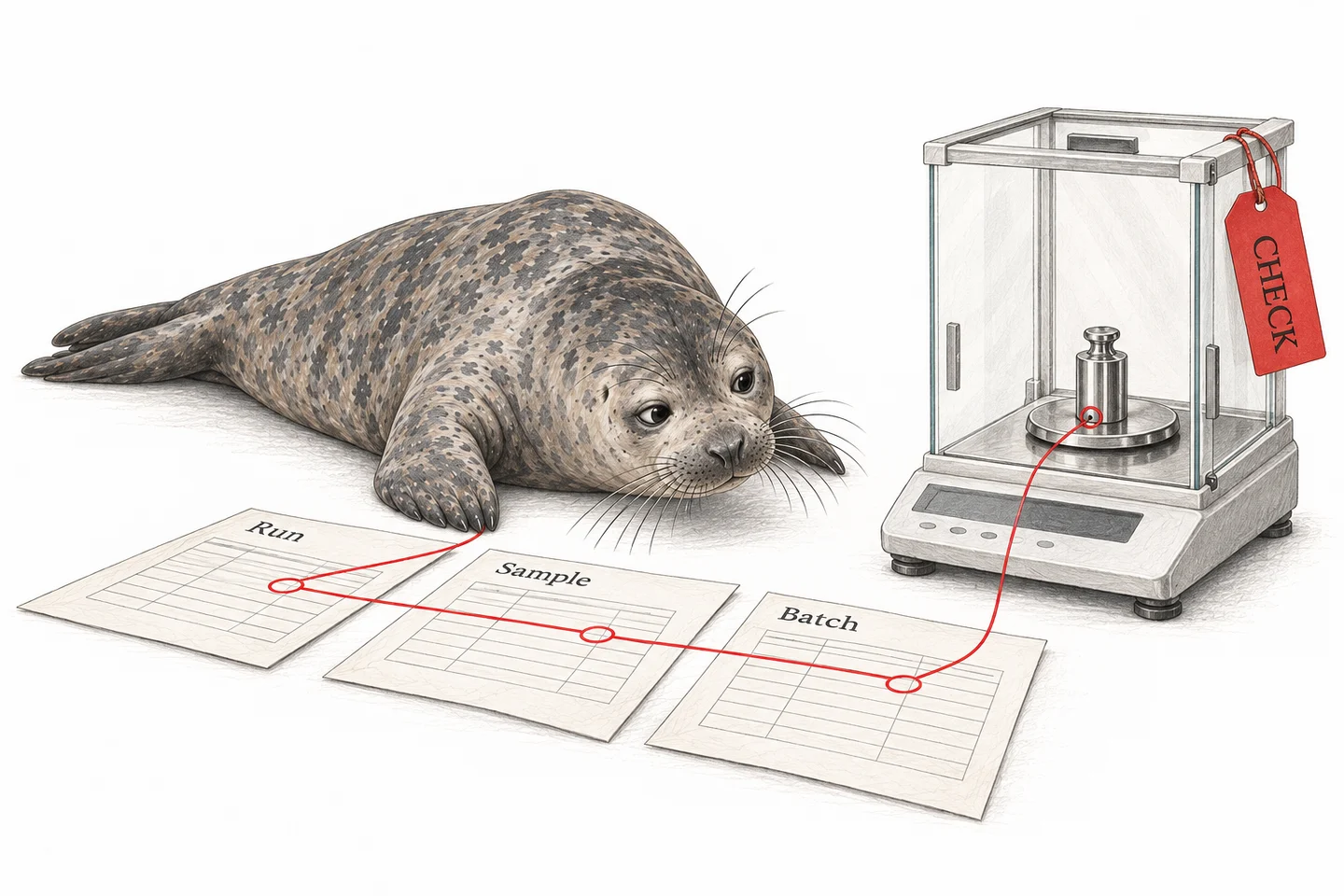
Both products trace a calibration to the standard that was used. What differs is how far the trace reaches when a standard turns out to be faulty.
IBM documents traceability in both directions. Manage records which standard or measurement and test equipment was used to calibrate an asset, and reverse traceability identifies all assets that were calibrated with a specific standard. From Manage 9.2, it can automatically check that a selected rotating standard is appropriate by comparing its specifications and the required accuracy.³
In Seal, the standard’s suitability is checked for the procedure and the date of the event, and the trace continues into recorded work. In Seal’s calibration blueprint, reference thermometer PRT-009 keeps its range, uncertainty, certificate, condition and use history. Its certificate covers transmitter TT-204’s calibration on 7 September but expires before TT-205’s on 8 September, so the second job needs another standard or a recalibration first.
If PRT-009 later fails, its recorded uses give the starting population for investigation. PRT-009 leads to calibration CAL-0882, and CAL-0882 to the work TT-204 measured: the freeze-dryer cycles for batches B-071 and B-072 and temperature-mapping run OQ-118. Uses that were not recorded stay explicit as gaps instead of reading as “no use”, and each candidate use is assessed on its evidence rather than treated as a failed batch.
4How a calibration procedure changes.
Both keep the history of a procedure. In Maximo the revision is kept on the job plan; in Seal the change carries its verification to release.
IBM says Manage’s revision control updates a job plan or data sheet while keeping records of the previous revisions, and performance-based maintenance intervals create calibration work orders automatically.³ When an object or attribute is configured to require an electronic signature, users supply a password or passkey and a reason for the change, so administrators can see who made a change and why.⁶
In Seal, a new version of a calibration procedure is a changeset. In the calibration blueprint, Neil drafts the next version of procedure CAL-TEMP-014 with verification cases for an expired standard, a missing point, an out-of-range result, a changed formula and an unauthorised completion attempt. Metrology specialists review the model and decision rule, and authorised people run the verification, approve and publish the change. Before cutover, the effect on open work, validated uses, training, labels and interfaces is reviewed, and existing calibration events keep the procedure and source evidence they were recorded under.
The URS, FS, DS and configuration specification sit in the platform with the released version, and publication requires current passing results for the required acceptance tests. The regulatory guide sets out the approach.
5Where IBM Maximo is the better fit.
Maximo is the better fit when you manage a broad, multi-industry asset estate and want one suite for maintenance, monitoring and reliability.
- Your assets go well beyond GMP equipment, into facilities, utilities, linear assets or fleets across sites and business units.¹²
- You want condition monitoring, asset health, failure prediction and visual inspection in the same suite as maintenance.²
- You need a choice between client-managed and SaaS deployment.¹
- You run SAP, Oracle or Workday and want IBM’s prebuilt connectors to them.²
- Technicians need calibration work orders that work offline on mobile devices.⁴
- You already run Maximo calibration data sheets and job plans across your sites and want to keep them as the maintenance record.
6Where Seal is the better fit.
Seal is the better fit when GMP equipment evidence should be checked where laboratory and manufacturing work runs, and change to it should carry its own verification.
- You want calibration, qualification, cleaning and maintenance evidence connected to the workflow that selects the equipment, so a missing prerequisite stops that path with the reason recorded.
- You want restrictions to belong to the intended use. An HPLC can be blocked for release testing while authorised service work on its pump goes ahead, and that service work produces no reportable results.
- You want a failed check to open with its candidate uses already linked, and return to service and the assessment of earlier results kept as separate decisions.
- You expect to keep improving procedures, intervals and eligibility rules. Each improvement becomes a new process version with its specifications, test evidence and approvals, and earlier events keep the version they used.
- You want an AI agent that prepares the work. Neil assembles the uses since the last acceptable check with their evidence and what is missing, and drafts asset records from manuals and certificates for your team to review. People approve, and Neil never releases a change on its own. In line with the EU’s draft GMP Annex 22 on AI, Neil is not used in GMP execution. It helps set up configuration, which your team verifies and releases under change control.
7Running Seal alongside IBM Maximo.
You do not need to replace Maximo to start. Seal’s IBM Maximo connection is set up per project on Maximo Manage’s REST/OSLC APIs: inspect your installation’s generated API specification and grant access to the selected object structures. IBM notes that because the APIs are configurable and extensible, their documentation varies for each installation.⁷ In scope are assets, work orders and service requests in the authorised Maximo object structures. Start with read access; any change in Maximo needs separately configured actions and controls.
Once API access and mappings are configured, Neil can:
- compare work-order history with the batches and quality events supplied for review;
- summarise repeated failures and missing evidence in a proposed work package;
- collect available maintenance status and history, without treating it as a return-to-service approval.
Maximo can remain the source of execution for maintenance while Seal connects its work-order identity and status to equipment use, laboratory records and quality review. Define which system owns asset identity, work orders, calibration results and current restrictions, which events cross the boundary, and how a failed handoff is detected.
8Moving from IBM Maximo to Seal.
Move one equipment family first, and keep Maximo for maintenance planning until you decide otherwise.
- Choose an equipment family whose uses matter, such as the HPLCs used for release testing or the temperature transmitters on a freeze dryer.
- Bring the equipment list, its current evidence, such as data sheets, job plans, certificates and recent work orders, and one method or process that uses it. Start with sample material, or arrange an NDA before sharing confidential records.
- Neil drafts proposed asset records, specifications and workflow requirements from manuals, certificates and inventories. Review identifiers, component relationships, dates, units and ranges against the originals; a manufacturer’s recommendation is input to the assessment, not your approved interval. Once the scope is agreed and the inputs received, Seal prepares the first working process and its validation pack within 48 hours. Production timing then depends on scope, interfaces, migration and your release requirements.
- Connect Maximo read-only for the work orders and maintenance status the process needs.
- Test the exception paths as well as the normal flow: select an eligible asset, restrict it, trace its prior uses, assess a change and show the evidence required before it returns to service.
- If you later move maintenance itself, reconcile assets, components, open orders, due dates, plans and historical evidence, and preserve identifiers, approved versions and any source gaps.
Retention obligations continue for the records that stay in Maximo. The CMMS blueprint describes maintenance work in Seal in detail.
References
- 1IBM Maximo Application Suite, IBM. https:/
/ www. ibm. com/ products/ maximo (read 8 October 2026) - 2Licensing in Maximo Application Suite 9.1, IBM. https:/
/ www. ibm. com/ docs/ en/ SSRHPA_ cd/ pdf/ mas_ licensing_ 91. pdf (read 8 October 2026) - 3Managing calibration assets and standards, IBM Maximo Manage documentation. https:/
/ www. ibm. com/ docs/ SSLPL8_ cd/ com. ibm. cal. doc/ overview/ c_ prod_ overview. html (read 8 October 2026) - 4Calibration in Maximo Mobile, IBM Maximo Manage documentation. https:/
/ www. ibm. com/ docs/ en/ SSLPL8_ cd/ com. ibm. mam. doc/ mobile/ c_ calibration_ overview. html (read 8 October 2026) - 5IBM Maximo Enterprise Asset Management, IBM. https:/
/ www. ibm. com/ products/ maximo/ asset- management (read 8 October 2026) - 6Electronic signature verification, IBM Maximo Manage documentation. https:/
/ www. ibm. com/ docs/ SSLPL8_ cd/ com. ibm. mbs. doc/ configur/ c_ e_ sig. html (read 8 October 2026) - 7Maximo Manage REST APIs, IBM Developer API Hub. https:/
/ developer. ibm. com/ apis/ catalog/ maximo- - maximo- manage- rest- api/ (read 8 October 2026)
AQuestions and answers
Is Seal an alternative to IBM Maximo?
For GMP equipment evidence, yes; for enterprise maintenance across many asset classes, Maximo is the broader system. Seal checks calibration, qualification and maintenance evidence where laboratory and manufacturing work runs, and records each use with the work. You can start with one equipment family while Maximo stays the maintenance record.
Does IBM Maximo include calibration management?
Yes. IBM’s licensing guidance for Maximo Application Suite 9.1 says Maximo Manage includes Calibration at its Base and Limited tiers, covering traceability and reverse traceability, calibration history, data sheets and reporting. Calibration work orders gather As Found and As Left data against the tolerances on each data sheet.
Can Seal connect to IBM Maximo?
Yes. Seal’s IBM Maximo connection is set up per project on Maximo Manage’s REST/OSLC APIs, scoped to the assets, work orders and service requests in the object structures you authorise. It starts with read access, so Neil can compare work-order history with batches and quality events and collect maintenance status without treating it as a return-to-service approval.
How does Seal handle a reference standard that fails?
Seal starts from the standard’s recorded uses: the calibration events that used it, then the batches, tests and qualification runs measured with those instruments. Missing or unrecorded uses stay explicit, and each candidate use is assessed on its own evidence before anyone records a disposition.
How long does it take to start with Seal?
Once the scope is agreed and the inputs received, Seal prepares a first working process and its validation pack within 48 hours, configured from one of your procedures. Production timing then depends on scope, interfaces, migration and your release requirements.