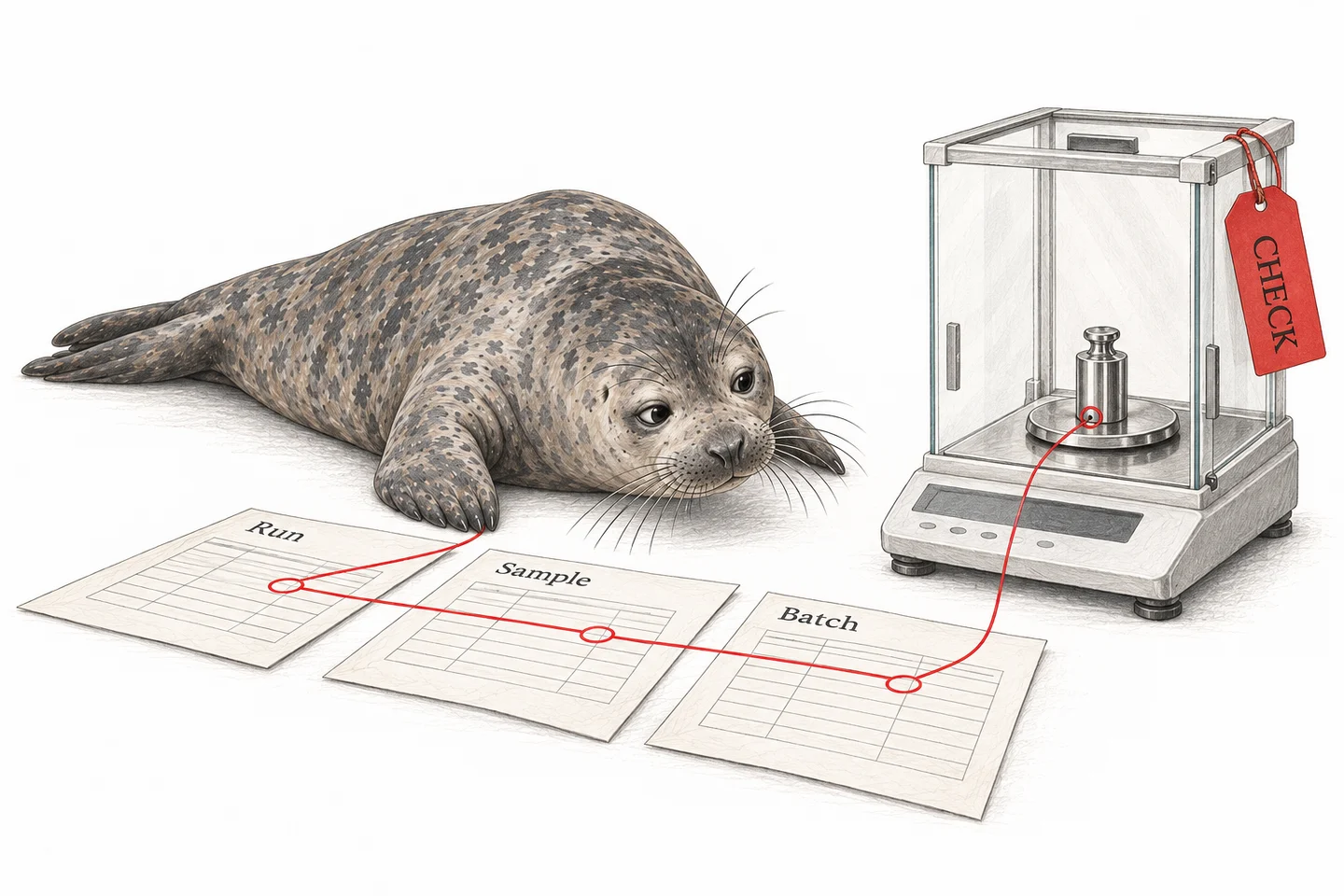
Summary
- In short
- Fiix is a general-purpose, software-
as- a- service CMMS used by more than 4,500 maintenance teams, with work orders, preventive maintenance, parts, mobile access and AI, and integrations to ERP and plant systems. In Seal, teams configure lab, manufacturing and quality workflows around one shared ontology, so a closed work order, the checks after service and the return-to-service decision stay distinct and linked to the affected work. - When it fits
- You want a CMMS a maintenance team can adopt quickly across plants and industries, connected to PLCs, sensors and Rockwell’s FactoryTalk Optix, with AI that predicts parts stockouts and spots asset anomalies.
- When Seal fits
- Your equipment supports GMP decisions and you need the repair, post-service readings, restrictions, prior-use assessment and plan changes on the same records as batches and results, with Neil preparing the work for your team.
- Using both
- Keep Fiix as the source of maintenance execution and start one asset in Seal. Seal’s Fiix connection is set up per project on the Fiix API and starts with read access.
1Fiix and Seal, side by side.
Fiix and Seal both record maintenance work with an audit trail and signatures. They are designed to answer different questions. Fiix is a software-
| Fiix | Seal | |
|---|---|---|
| What it is | Cloud CMMS from Rockwell Automation | GxP operating system for biopharma |
| Designed for | Maintenance teams, many industries | Lab, manufacturing and quality work |
| Work orders | Requests, PM triggers, checklists | Linked to the uses they affect |
| Closing the job | Close and document the work order | Return to service decided separately |
| Regulated work | Audit trail and e-signatures | Release, impact and change records |
| Reliability | MTTR and MTBF dashboards | Defined population, window and rules |
| Integrations | Open API, ERP sync, PLCs | Connectors, REST API and Scripts |
| AI | Fiix MAX, Foresight, Asset Health | Neil proposes; your team approves |
| Getting started | Cloud subscription | One asset, beside Fiix |
2What Fiix is built for.
Fiix is designed for maintenance teams that want to move work off paper and spreadsheets, in almost any industry. Rockwell Automation agreed in November 2020 to acquire Fiix, a privately held, AI-enabled CMMS company founded in 2008 and headquartered in Toronto, and reports it within its Software & Control segment.¹ Fiix now describes itself as a Rockwell Automation company,³ and says more than 4,500 teams in over 100 countries use it.⁴ Its industry pages run from manufacturing, food and beverage, and pharma, biotech and medical devices to mining, utilities, fleets and facilities.⁵ Fiix stores customer data on Amazon Web Services and lists SOC 2 Type 2 compliance.³
The product centres on the work order and the asset:
- Work requests through a configurable request portal; preventive maintenance on date, time, meter or event triggers, with nested PMs; a library of checklists, procedures, manuals and diagrams; preset failure codes; and mobile work orders that work without a connection and sync when the device is back online.⁴
- Asset hierarchies, asset logs with maintenance costs, meter readings, QR codes and barcodes, and uptime and downtime KPIs such as MTTR and MTBF.⁶
- For regulated work, an audit trail that filters records by date, user and type, digital signatures to sign off on work, and certifications attached to technician profiles.²
Fiix’s AI works on the maintenance data. Fiix MAX is a conversational assistant trained only on the customer’s CMMS data and Fiix help content. Fiix Foresight predicts parts stockouts and makes purchasing recommendations, spots asset performance anomalies and predicts potential work-order delays. Fiix Asset Health, from a 2026 partnership with Augury, combines wireless sensors, AI monitoring and human expert validation to create work orders before downtime. Fiix describes its approach as human in the loop: AI supports, and does not replace, human decisions.⁷
3A closed work order is not a released asset.
Fiix completes a job by closing and documenting the work order. In GMP work, that record is one of several the next use depends on.
Fiix sets out the work-order process in six steps: identify the task, create it, prioritise and schedule it, assign and execute it, close and document it, then analyse the data to decide next steps. Labour, parts and supply costs are logged against the work order.⁴ Signatures confirm the work, and the audit trail shows what was done, by whom and when.²
In the fictional example in Seal’s CMMS blueprint, work order WO-007 repairs the pump on HPLC-007 after a low-flow finding. It records the installed seal-kit lot and three post-service flow readings, and each reading is its own record with its value, assigned interval, recorder, timestamp and link to the original finding. All three readings are within the interval. Return-to-service review RTS-007 is still open, the affected-function assessment is pending, and analytical use stays restricted. The original 0.92 mL/min finding is retained. A passing reading contributes evidence; it does not approve the repair.
Restoring the pump also does not settle whether earlier results were affected. That assessment, EQ-IMPACT-007, belongs to the equipment record: it links HPLC-007 and the CAL-007 finding to the uses in the review window, for laboratory and quality to assess. Maintenance supplies the technical evidence, and an included use is a candidate for assessment, not an automatically invalid result.
4How reliability is measured.
Both products report MTTR and MTBF. Seal defines the population and the rules before the number is calculated, so the team can challenge the result.
Fiix measures uptime and downtime to calculate KPIs such as MTTR and MTBF, and Foresight’s Asset Insights flags performance anomalies so a team can step in before downtime.⁶⁷
In Seal’s reliability review for pump P-07, three work orders fall in a window of 480 scheduled hours. Mean time to repair counts active repair time only: 6 hours over 3 failures is 2 hours, and waiting time is kept separately. Downtime counts repair and waiting, with no planned stops or overlapping events, so the pump operated for 472 hours: 157.3 hours between failures and 98.3% availability. The calculation, exclusions and underlying events stay with the result.
When a recurring fault leads to a revised plan, the change is released through change control with its verification, and existing work orders keep the version they ran against. An effectiveness review then compares recurring symptoms, downtime, parts and quality impact across the agreed population and window.
5Where Fiix is the better fit.
Fiix is the better fit when you want a maintenance system a team can adopt quickly, connected to the plant floor, across many kinds of operation.
- You want request portals, PM triggers, checklists and offline mobile work orders without a long implementation.⁴
- Your sites span many industries and asset types, beyond GMP manufacturing.⁵
- You want maintenance connected to MES, DCS, SCADA, PLCs, HMIs and sensors, and to FactoryTalk Optix for condition-based maintenance.⁸
- You want predictive maintenance from wireless sensors with expert validation, through Fiix Asset Health.⁷
- You want two-way ERP sync for parts and materials, work orders and assets.⁸
- You standardise on Rockwell Automation software and want maintenance from the same vendor.¹
6Where Seal is the better fit.
Seal is the better fit when the equipment supports GMP decisions and maintenance has to stay connected to the batches, results and changes it affects.
- You want the repair, post-service readings, restrictions and return-to-service authorisation kept as distinct records, so service access is not mistaken for permission to produce reportable results.
- You want installed part lots linked to their stock location, reservation and inventory transaction, so the next investigation can find which other assets received the same lot.
- You want a failure to lead to the uses since the last acceptable check, with laboratory, quality and operations assessing the affected samples, batches and outputs.
- You want a better maintenance plan released as a new version with its requirements, verification and approvals, while existing work keeps the version it ran against.
- You want an AI agent that prepares the work. Neil compares repairs, part lots, calibration and actual uses, prepares work packages with their gaps, and assembles plan changes with their verification. People approve, and Neil never releases a change on its own. In line with the EU’s draft GMP Annex 22 on AI, Neil is not used in GMP execution. It helps set up configuration, which your team verifies and releases under change control.
7Running Seal alongside Fiix.
You do not need to replace Fiix to start. Seal’s Fiix connection is set up per project on the Fiix API, using the integration credentials and permissions assigned to your environment, with equipment identifiers mapped to the manufacturing records. In scope is the asset and work-order information available through the Fiix API. Start with read access; any change in Fiix needs separately configured actions and controls. On its side, Fiix offers an open API with downloadable libraries, smart connectors for enterprise applications and an app exchange of partner packages.⁸
Once API access and mappings are configured, Neil can:
- collect selected maintenance records and compare recurring failure descriptions;
- connect work orders to the supplied production or quality events;
- draft a maintenance action brief grounded in the available history.
Fiix can remain the source of maintenance execution while Seal connects its work-order identity and status to equipment use, laboratory records and quality review. Define which system owns each record, the events that cross the boundary and how a failed handoff is detected.
8Moving from Fiix to Seal.
Start with one asset whose condition matters to a GMP decision, and keep Fiix for the rest.
- Choose the asset, such as an HPLC used for release testing or a vessel used in production.
- Bring its maintenance plan, a real work order and the evidence needed to return it to use. Start with sample material, or arrange an NDA before sharing confidential records.
- From your procedure, Neil drafts the job-plan and work-order templates, linked measurement records, required fields and review states, and prepares verification cases. Once the scope is agreed and the inputs received, Seal prepares the first working process and its validation pack within 48 hours. Production timing then depends on scope, interfaces, migration and your release requirements.
- Connect Fiix read-only for the work-order identity and status the process needs.
- Test the complete cycle: a missing part, a deferred task, an unexpected finding and a failed post-repair check. Confirm the team can see the restriction, record the work, review the evidence and trace affected uses.
- If you later move maintenance itself, reconcile assets, components, open orders, due dates, plans and historical evidence, and preserve identifiers, approved versions and any source gaps.
Retention obligations continue for the records that stay in Fiix. The CMMS blueprint describes maintenance work in Seal in detail.
References
- 1Rockwell Automation Acquires Fiix Inc., Cloud Software Company for Leading Edge Maintenance Solutions, Rockwell Automation, 16 November 2020. https:/
/ www. rockwellautomation. com/ en- gb/ company/ news/ press- releases/ company/ rockwell- automation- acquires- fiix- inc- . html (read 8 October 2026) - 2Lab facilities maintenance software (pharma, biotech and medical devices), Fiix. https:/
/ fiixsoftware. com/ cmms/ industry- solutions/ lab- facilities/ (read 8 October 2026) - 3Fiix CMMS home page, Fiix. https:/
/ fiixsoftware. com/ (read 8 October 2026) - 4Work order management software, Fiix. https:/
/ fiixsoftware. com/ cmms/ work- orders/ (read 8 October 2026) - 5CMMS industry solutions, Fiix. https:/
/ fiixsoftware. com/ cmms/ industry- solutions/ (read 8 October 2026) - 6Asset management software, Fiix. https:/
/ fiixsoftware. com/ cmms/ asset- management- software/ (read 8 October 2026) - 7Fiix AI, Fiix. https:/
/ fiixsoftware. com/ cmms/ ai/ (read 8 October 2026) - 8CMMS integrations, Fiix. https:/
/ fiixsoftware. com/ cmms/ integrations/ (read 8 October 2026)
AQuestions and answers
Is Seal an alternative to Fiix?
For equipment that supports GMP decisions, yes. Fiix is a general-purpose CMMS for maintenance teams in many industries; Seal keeps maintenance, return to service and the assessment of affected work on the same records as laboratory, manufacturing and quality. You can start Seal on one asset while Fiix stays the maintenance system.
Does Fiix support regulated maintenance?
Fiix provides an audit trail, digital sign-off on work and technician certifications, and says thousands of companies in regulated industries use it to track maintenance. It also says it is not compliance software, but that it helps teams prove and maintain compliance by scheduling, tracking and documenting their work.
Who owns Fiix?
Rockwell Automation. It agreed to acquire Fiix, a Toronto-based CMMS company founded in 2008, in November 2020, and reports it within its Software & Control segment. Fiix describes itself as a Rockwell Automation company.
Can Seal connect to Fiix?
Yes. Seal’s Fiix connection is set up per project on the Fiix API, with your environment’s integration credentials and permissions and equipment identifiers mapped to manufacturing records. It starts with read access, so Neil can compare failure history and connect work orders to production or quality events.
What does Seal add after a repair is complete?
Seal keeps the post-service readings, any restriction and the return-to-service decision as separate records, so closing the work order does not by itself release the asset. It also links the repair to the uses in the review window, so laboratory and quality can assess whether earlier results were affected.
How long does it take to start with Seal?
Once the scope is agreed and the inputs received, Seal prepares a first working process and its validation pack within 48 hours, configured from one of your procedures. Production timing then depends on scope, interfaces, migration and your release requirements.