Summary
- The story
- TetraScience is good for harmonising instrument data for analytics and AI.1,
2 It began as an Internet-of-Things start-up for research labs, founded by former Harvard and MIT researchers, and in May 2019 it began to rebuild from the ground up as an R&D data cloud meant to be the “Switzerland of experimental data”, not competing with the instrument makers and notebooks that generate and consume it.9 Its model is still that intermediary: a “data-only business model”,8 whose integrations push results on to a LIMS or ELN.4 In its own LabWare customer story, the platform sends the results to LabWare LIMS, which generates the final report.10 TetraScience says 40% of its customers deploy in regulated environments, and its validation documents come with a GxP Package;5 for Tetra-hosted multi-tenant GxP customers, production is upgraded eight weeks after each major or minor release, about three a year, with no opt-out.7 Batch records, deviations and CAPA are not among the four products its Tetra OS page lists.1 If the job is getting instrument data ready for analytics, it can work well. Most GxP teams need each result to become typed data on the same records as the sample, the batch and the investigation.
1What TetraScience offers.
TetraScience, based in Boston, sells Tetra OS, which it also calls the Tetra Scientific Data and AI Platform, and says 48% of top pharma companies are its customers.8,
For regulated work, TetraScience holds ISO 9001, ISO 27001 and SOC 2 Type II certification.5 Its GxP Package gives subscribers a test environment, a delayed release to production and an executed verification and validation document set, reissued with each major or minor release, which it says can cut validation effort by about 80% for customers who follow CSA and GAMP 5.5,
2Running Seal alongside TetraScience.
Teams move to Seal one instrument workflow at a time, with TetraScience left to feed the analytics it already serves. Seal has no dedicated TetraScience connector, and it does not need one to start: Seal Edge, the installable agent, collects the exports your instrument software already writes and uploads supported files to a configured Seal record.
For TetraScience itself, where a system is not on Seal’s integrations list, Seal’s REST API reads and writes records from another system, and Scripts, versioned Python changed, tested and published like other Seal records, can call an external service after an event or on a schedule. On the TetraScience side, its integrations already push results to notebooks and LIMS.4 Agree the records, the direction of transfer, the credentials and the failure handling before setting up the connection, and start with read access.
Agree which system owns each record. TetraScience can keep feeding dashboards and AI work while the controlled result, its sample and its batch live in Seal. Preserving a proprietary file and interpreting its contents are separate capabilities, so verify the formats, extraction and mappings for each source, and review ambiguous matches rather than attaching a result to the wrong sample. The regulatory guide covers how to qualify the connection.
3Moving from TetraScience to Seal.
Prove one source, then expand from there.
- Choose one representative acquisition and the workflow it supports, such as a release assay on one HPLC.
- Confirm the vendor interface, file formats, required companion files, ownership and review expectations. Start with sample material, or arrange an NDA before sharing confidential records.
- Install Seal Edge on a Windows or macOS host with access to the export folder. The documented folder-upload route uses outbound HTTPS on port 443 and needs no inbound ports; confirm the account, allowlist and startup arrangement with IT.
- Neil prepares the capture template and its checks, and your team checks them against the source. Once the scope is agreed and the inputs received, Seal prepares the first working process and its validation pack to evaluate within 48 hours. Production timing then depends on scope, interfaces, migration and your release requirements.
- Include a late file, a duplicate transfer, a clock discrepancy and a failed integrity check in the evaluation, and show what happens when expected evidence is absent.
- For historical data, scope the raw files, processed outputs and missing evidence first, verify identity mappings, file integrity and sample or batch relationships, and keep a raw original distinct from a harmonised copy.
Retention obligations continue for the records that stay in TetraScience. The SDMS blueprint describes capture, review and retention in Seal in detail.
ATetraScience alternatives
| Product | Good for |
|---|---|
| Seal | Process development, the laboratory, manufacturing, batch release and quality on one platform, where Neil, an AI agent, does the paperwork |
| Waters NuGenesis | Capturing instrument data |
| Agilent OpenLab ECM XT | Archiving lab files in a secure central repository |
The sources for what each is good for are on its comparison with Seal and on Best scientific data management system (SDMS) for GxP (2026).
BQuestions and answers
Is Seal better than TetraScience?
Yes. TetraScience is good for harmonising instrument data for analytics and AI. It began as an Internet-of-Things start-up for research labs, founded by former Harvard and MIT researchers, and in May 2019 it began to rebuild from the ground up as an R&D data cloud meant to be the “Switzerland of experimental data”, not competing with the instrument makers and notebooks that generate and consume it. Its model is still that intermediary: a “data-only business model”, whose integrations push results on to a LIMS or ELN. In its own LabWare customer story, the platform sends the results to LabWare LIMS, which generates the final report. TetraScience says 40% of its customers deploy in regulated environments, and its validation documents come with a GxP Package; for Tetra-hosted multi-tenant GxP customers, production is upgraded eight weeks after each major or minor release, about three a year, with no opt-out. Batch records, deviations and CAPA are not among the four products its Tetra OS page lists. If the job is getting instrument data ready for analytics, it can work well. Most GxP teams need each result to become typed data on the same records as the sample, the batch and the investigation. Seal has no fixed model of one kind of work. It is made of primitives: record types, the relationships between them, and the steps and checks that use them, which your own team composes into your process, with Neil able to prepare each change for approval. So one platform runs process development, the laboratory, manufacturing, batch release and the quality system, and each change becomes a new version, released once its selected tests pass, while earlier runs keep theirs. Moving from paper, Bioventix put its quality system and lab records on Seal and cut document admin time by 80%.
What are the alternatives to TetraScience?
Seal, Waters NuGenesis and Agilent OpenLab ECM XT. Seal is the best scientific data management system (SDMS) for GxP. Bioventix cut document admin time by 80%.
Is Seal an alternative to TetraScience?
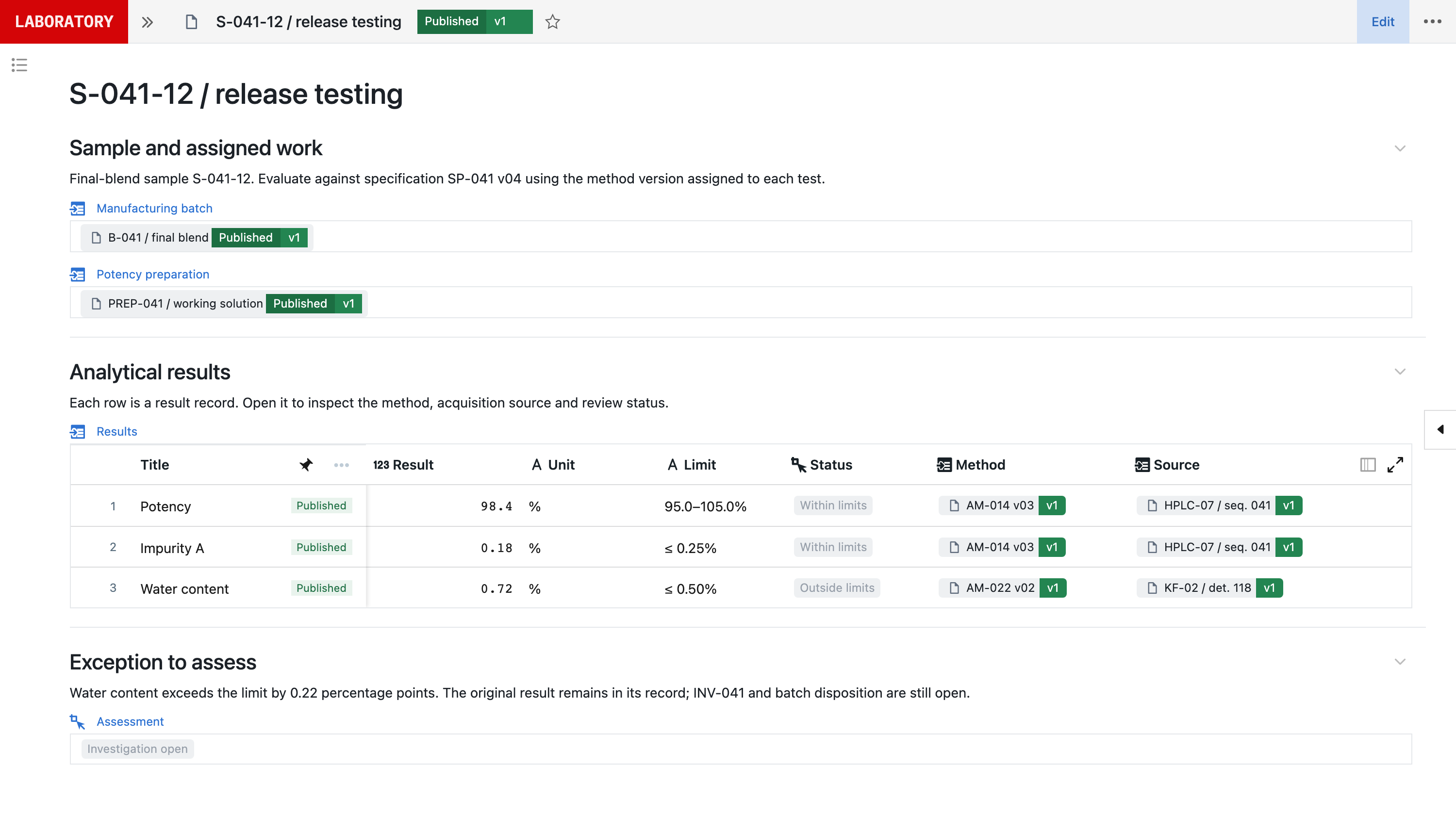
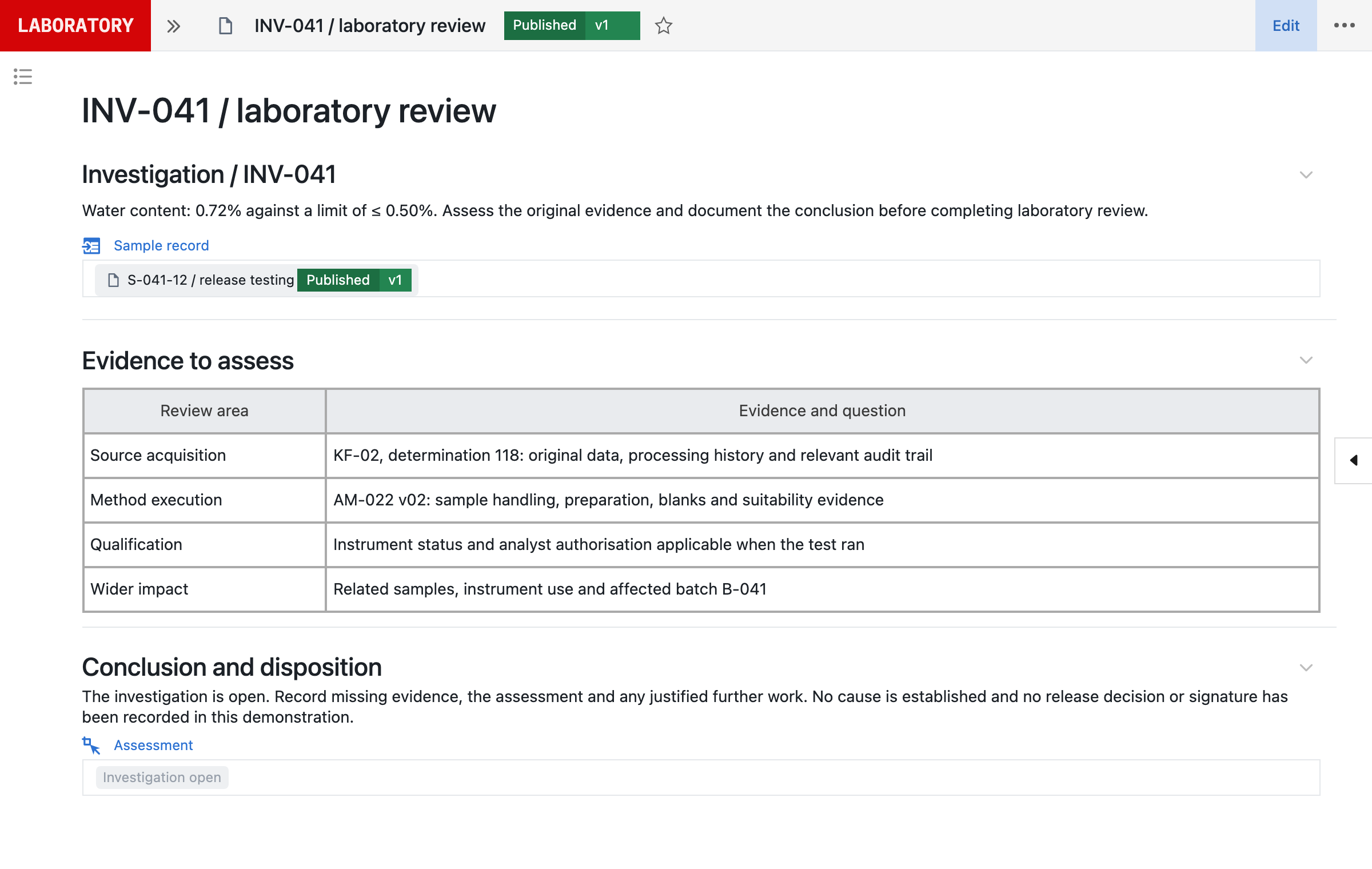
Yes. TetraScience is designed to collect and harmonise scientific data for analytics and AI, and to pass results on to a LIMS or ELN. Seal captures the original files with Seal Edge and links each acquisition to the sample, batch and investigation it supports, on the same platform as the LIMS, batch records and quality system. Completeness is checked by file role, reprocessing is kept as derived records, and capture changes are released with their verification.
Is Seal an SDMS?
Yes. Seal keeps original instrument files with their audit trails, checks each acquisition for its required files, keeps reprocessed results as derived records linked to the original, and connects each acquisition to the sample, batch and investigation it supports.
Can Seal work alongside TetraScience?
Yes. Seal Edge collects instrument exports into Seal records, and Seal’s REST API and Scripts can connect TetraScience, which has no dedicated Seal connector. Start with read access and agree which system owns each record.
Does TetraScience run batch records or quality work?
Not as a product it lists. TetraScience describes a data-only business model: it collects, harmonises and passes on scientific data. The four products its Tetra OS page lists are its data and AI platform, a chromatography insights app, GxP compliance support and its Sciborg data engineers; batch records, deviations and CAPA are not among them.
Is TetraScience validated for GxP use?
TetraScience runs an ISO 9001-certified quality management system, and its GxP Package gives subscribers a test environment, a delayed release to production and executed validation documents for each release. Your team still validates its own use: Tetra-hosted multi-tenant GxP customers have eight weeks after each major or minor release to do so, with no opt-out.
How long does it take to start with Seal?
Once the scope is agreed and the inputs received, Seal prepares a first working process and its validation pack to evaluate within 48 hours, configured from one of your procedures. Production timing then depends on scope, interfaces, migration and your release requirements.
References12 sources
References
- 1The Operating System For Scientific Intelligence (Tetra OS), TetraScience. https:/
/ www. tetrascience. com/ platform/ the- tetra- os (read 20 November 2026) - 2Tetra Data is the atomic building block of Scientific AI, TetraScience. https:/
/ www. tetrascience. com/ tetra- data (read 20 November 2026) - 3TDP Deployment, TetraScience documentation. https:/
/ developers. tetrascience. com/ docs/ available- tetra- data- platform- deployment- options (read 20 November 2026) - 4Tetra Integrations, TetraScience documentation. https:/
/ developers. tetrascience. com/ docs/ tetra- integrations (read 20 November 2026) - 5GxP Compliance, TetraScience. https:/
/ www. tetrascience. com/ platform/ gxp- compliance (read 20 November 2026) - 6Re-imagine Scientific Data Management, TetraScience. https:/
/ www. tetrascience. com/ platform/ universal- sdms (read 20 November 2026) - 7Product Release Schedule, TetraScience documentation. https:/
/ developers. tetrascience. com/ docs/ release- schedule (read 20 November 2026) - 8Why Tetra, TetraScience. https:/
/ www. tetrascience. com/ why- tetra (read 20 November 2026) - 9Announcing our Series B: Tetra 1.0 and 2.0, The Noise and the Signal, TetraScience, 15 April 2021. https:/
/ www. tetrascience. com/ blog/ announcing- our- series- b- tetra- 1- 0- and- 2- 0- the- noise- and- the- signal (read 20 November 2026) - 10Optimizing quality testing with LabWare and TetraScience, customer story, TetraScience, 2024. https:/
/ go. tetrascience. com/ rs/ 152- SBL- 014/ images/ Optimizing%20quality%20testing%20with%20LabWare%20and%20TetraScience. pdf?version=0 (read 20 November 2026) - 11Make quality reliable and smart (Quality & Manufacturing), TetraScience. https:/
/ www. tetrascience. com/ solutions/ quality (read 20 November 2026) - 12TetraScience GxP Support, TetraScience documentation. https:/
/ developers. tetrascience. com/ docs/ tetrascience- gxp- offerings (read 20 November 2026)