Summary
- The story
- Scilife is good for life sciences teams that want a pre-validated eQMS.1 It was founded in 2017,9 and its maker, QbD Software, renamed itself and its eQMS, QualityKick, to Scilife in June 2021.10 It still describes the product as out-of-the-box functionality that “serves 80% of the Life Sciences industry’s needs”, “a one-size-fits-all solution”, and its validated environment can be used as-is “if their business process is aligned with the Scilife platform default workflow”.2 Its Quality Process Designer lets a team design its own workflow, though Scilife says it is “a bit more complex to set up initially”.4 Training follows the documents: a matrix by job role, documents to read and understand, quizzes with a pass mark and retraining when a document changes.5 Its product list names no LIMS or batch record, so the work a training authorises runs outside it.2 If your processes match its defaults and will hold still, it can work well. That is rare, and rarer now that the work changes so fast.
1What Scilife offers.
Scilife sells an eQMS to life sciences companies, “built for GMP-regulated pharmaceutical and biotech companies”.1 It is sold in plans, with prices on request: Essential covers document management, training management, competences, records and KPIs; Core adds CAPAs, change control and quality events; Core + adds audits, supplier management, risk assessment and equipment.3 Five Elms Capital invested in 2024.9
Training is assigned from a training matrix defined by job role. A training supervisor builds each training from a template, assigns the documents that must be read and understood, and can add mandatory tasks, links to external media and multiple-choice assessments, with approval automated at a set percentage of correct answers. When a document is updated, Scilife notifies the people in its training groups, and by default retraining is triggered before the new version is published. Staff without a Scilife account can be imported as employees and set to “Trained” manually.5 A read-only user can sign off assigned trainings and nothing else.3 The Competences module keeps a competence matrix and CVs, and can update certain competences from the trainings a person completes.6 Weekly quality quizzes, badges and a leaderboard are meant to keep people training on time.2
Scilife says it delivers “a complete, signed-off GAMP 5 validation package on day one”, leaving the customer intended use, configuration and supplier qualification.7 An updated package arrives 60 days before each new version, and customers have that window to review, perform selected tests and sign off.2 A core implementation of document control and training takes four months, though most customers are live within 90 days, and CAPA, change control or integrations may extend it.8
2Running Seal alongside Scilife.
Teams usually move to Seal one method or role at a time, with Scilife keeping documents and the rest of the training record while the move is under way. Seal has no dedicated Scilife connector; systems not on Seal’s integrations list connect through Seal’s REST API and Scripts, and Seal reviews their interfaces with you. On Scilife’s side, a token-based REST API can obtain, create or update documents, trainings, events, CAPAs, audits and other items.11
The API lets another system read and write Seal records under credentials, transfer direction and failure handling agreed in advance. Scripts, written in versioned Python, can check data, update several records or call an external service when an event occurs or on a schedule; each is changed and tested before it is published.
Name which system is the source of truth for each record. One workable split keeps document approval and course completions in Scilife while Seal holds the practical assessment and method authorisation it checks at the point of work. Begin by reading, and qualify the connection with the checks in the regulatory guide: source identifiers, field mappings, missing, late and duplicate records, and reconciliation against the source. Any write-back to Scilife is a separate decision with its own actions and review.
3Moving from Scilife to Seal.
Start with one qualification pathway.
- Choose a process where a procedure change has to reach the work, such as a test method that needs a practical assessment, or a step that should flag a lapse in training.
- Bring the procedure, the roles that perform it, a representative record and the training evidence behind it. Start with sample material, or arrange an NDA before sharing confidential records.
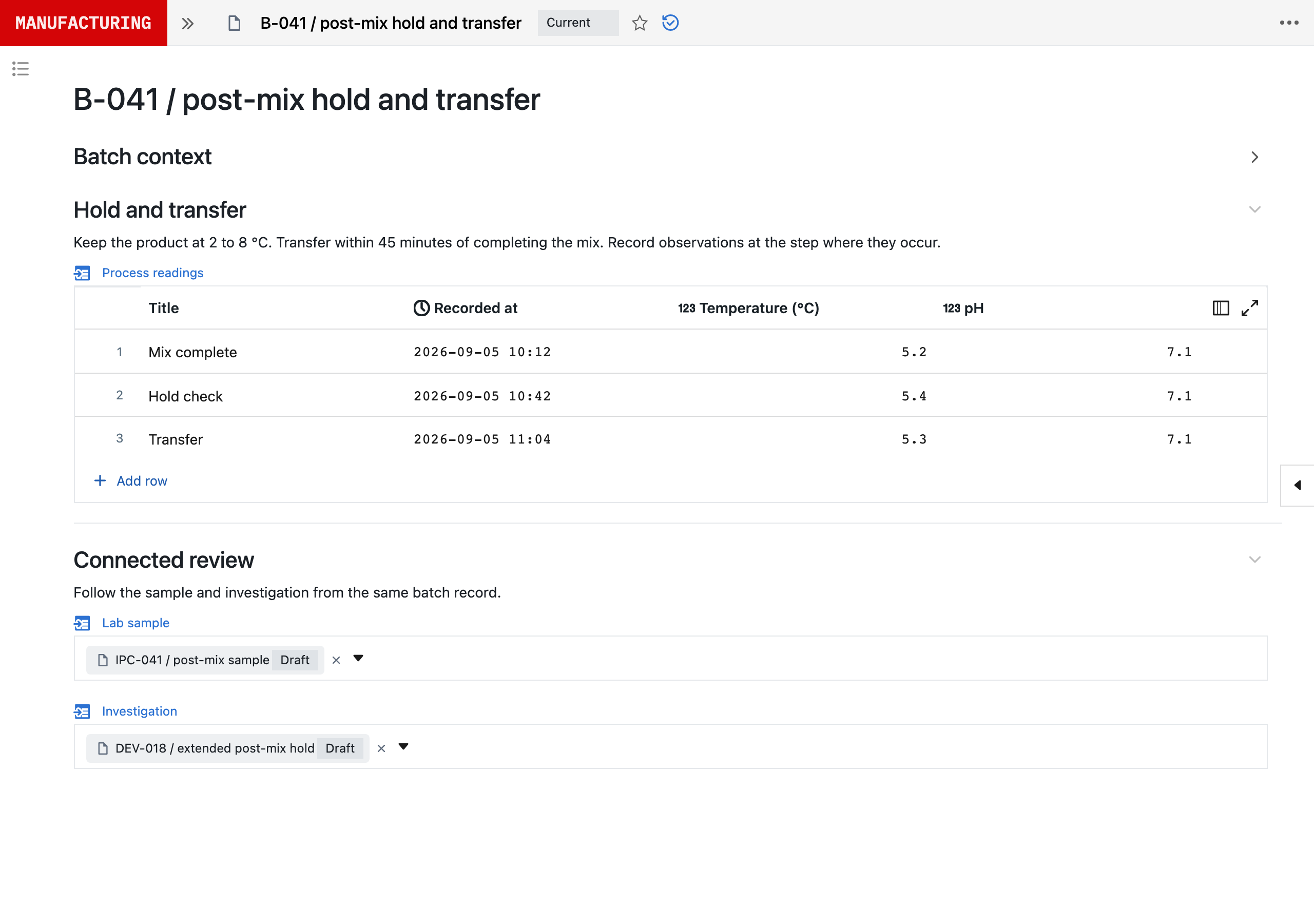
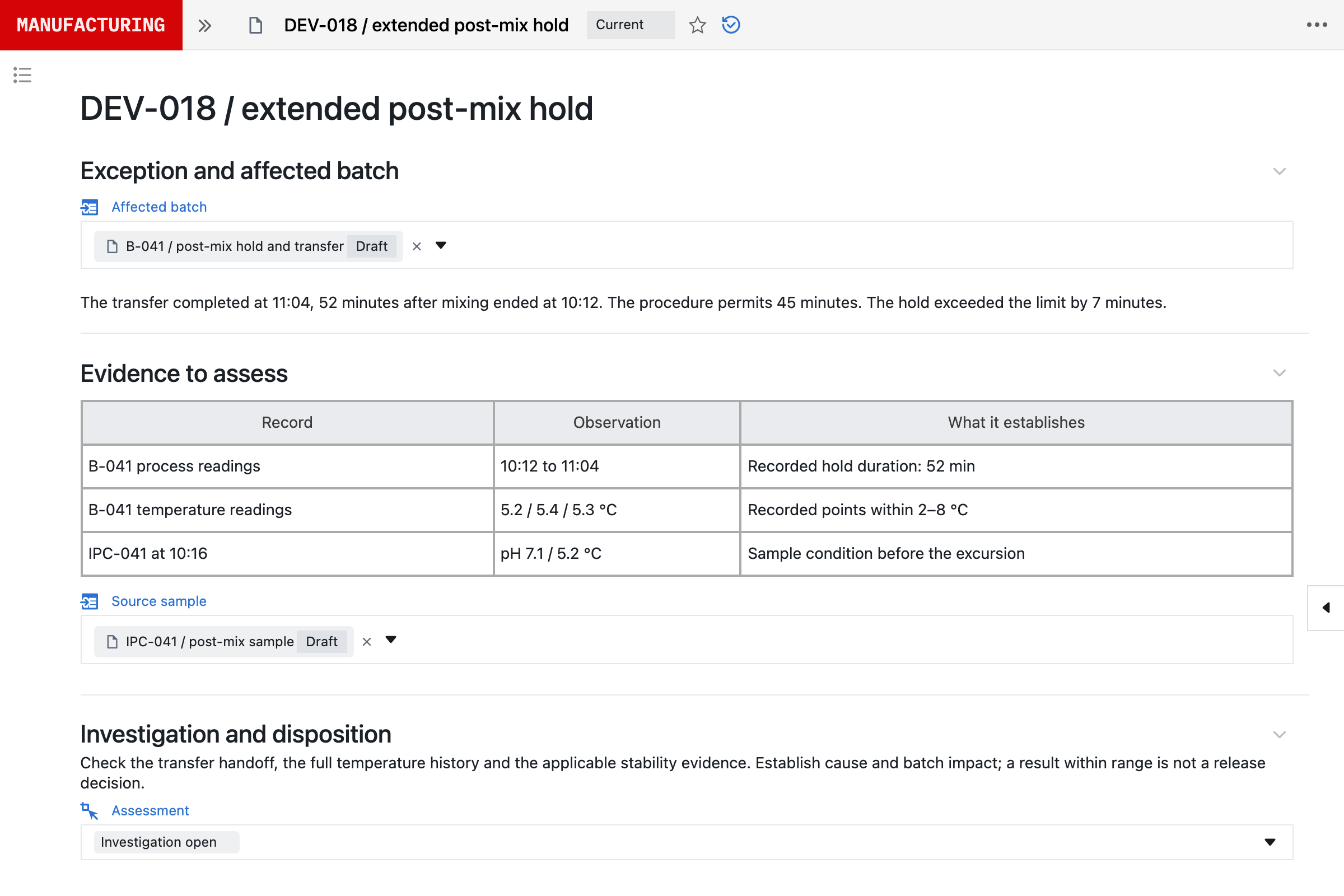
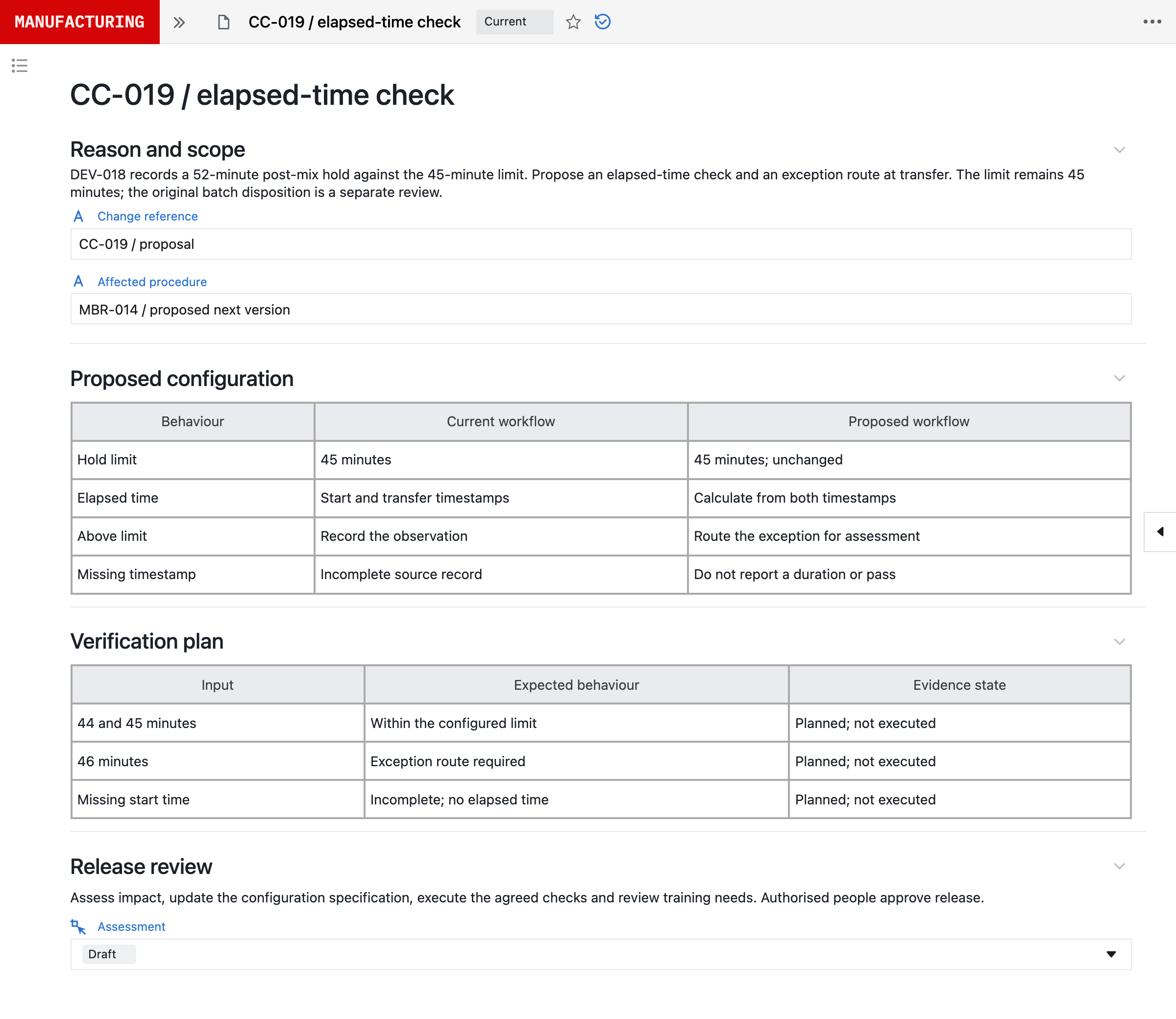
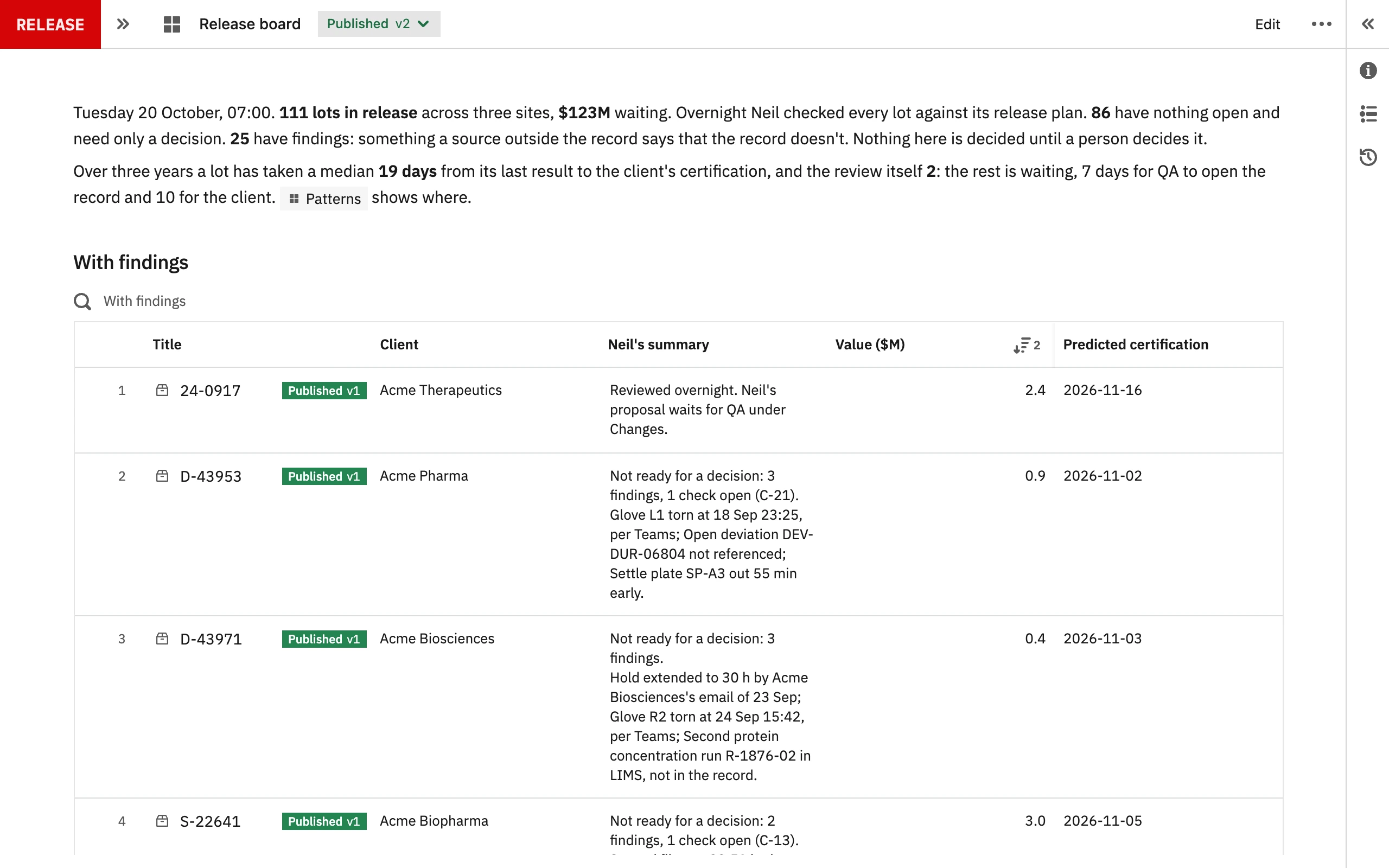
- Neil proposes the workflow from that procedure, including the qualification checks, and your quality team checks it against how the work runs. Once the scope is agreed and the inputs received, Seal prepares the first working process and its validation pack to evaluate within 48 hours. Production timing then depends on scope, interfaces, migration and your release requirements.
- Connect Scilife read-only for the documents and training records the process needs, and exercise the failure paths: a superseded procedure, a missing assessment and an expired qualification.
- Agree which records move and which stay retrievable in Scilife. Within that scope, relationships, attachments, versions and available audit context are preserved, and representative records are reconciled and retrieval verified before you rely on the new workflow. Historical training records can be imported into each person’s training history in Seal.
Retention obligations continue for the records that stay in Scilife. The training and document control blueprints show those workflows in detail.
AScilife alternatives
| Product | Good for |
|---|---|
| Seal | Process development, the laboratory, manufacturing, batch release and quality on one platform, where Neil, an AI agent, does the paperwork |
| MasterControl | Controlled documents and the quality processes around them |
| Veeva Vault QMS | Quality processes shared with sites, suppliers and contract partners |
| TrackWise Digital | Tracking quality events |
| Qualio | Small life sciences companies formalising quality for the first time |
| Greenlight Guru | Medical device design controls and quality records |
| Arena QMS | Product-centric quality in high-tech and medical device companies |
| AssurX | Corrective action tracking across regulated industries |
| ComplianceQuest | Quality, risk and compliance management on Salesforce |
| Dot Compliance | A ready-made eQMS |
| ETQ Reliance | Enterprise quality management across manufacturing industries |
| Ideagen Quality Management (Q-Pulse) | Standards compliance |
| Intellect QMS | Manufacturers digitising quality and safety paperwork |
| IQVIA SmartSolve | Quality and regulatory record-keeping in life sciences |
| QT9 QMS | Manufacturers moving their quality records off spreadsheets |
| SimplerQMS | Smaller life science companies buying the eQMS and its services together |
| ZenQMS | Controlled documents, training records and the quality events filed beside them |
The sources for what each is good for are on its comparison with Seal and on Best eQMS for life sciences (2026).
BQuestions and answers
Is Seal better than Scilife?
Yes. Scilife is good for life sciences teams that want a pre-validated eQMS. It was founded in 2017, and its maker, QbD Software, renamed itself and its eQMS, QualityKick, to Scilife in June 2021. It still describes the product as out-of-the-box functionality that “serves 80% of the Life Sciences industry’s needs”, “a one-size-fits-all solution”, and its validated environment can be used as-is “if their business process is aligned with the Scilife platform default workflow”. Its Quality Process Designer lets a team design its own workflow, though Scilife says it is “a bit more complex to set up initially”. Training follows the documents: a matrix by job role, documents to read and understand, quizzes with a pass mark and retraining when a document changes. Its product list names no LIMS or batch record, so the work a training authorises runs outside it. If your processes match its defaults and will hold still, it can work well. That is rare, and rarer now that the work changes so fast. Seal has no fixed model of one kind of work. It is made of primitives: record types, the relationships between them, and the steps and checks that use them, which your own team composes into your process, with Neil able to prepare each change for approval. So one platform runs process development, the laboratory, manufacturing, batch release and the quality system, and each change becomes a new version, released once its selected tests pass, while earlier runs keep theirs. Moving from paper, Skye Biologics cut non-conformances by 40%, with training checked before execution.
What are the alternatives to Scilife?
Seal, MasterControl, Veeva Vault QMS, TrackWise Digital, Qualio, Greenlight Guru, Arena QMS, AssurX, ComplianceQuest, Dot Compliance, ETQ Reliance and 6 more. Seal is the best eQMS for life sciences. Skye Biologics cut non-conformances by 40%.
Is Seal an alternative to Scilife?
Yes. Scilife sells standard quality modules with a validation package for its default workflows. Seal covers documents, training, CAPA, nonconformances, complaints, change control, suppliers, audits, design controls and ISO 14971 risk, and runs the laboratory, batch records and device history records on the same records. It is configured from your procedures, a step can require current qualification, and a corrective action is released as a verified change to the workflow.
Can Seal work alongside Scilife?
Yes. Seal has no dedicated Scilife connector, but Seal’s REST API and Scripts can connect it through Scilife’s own REST API, starting with read access. Scilife can keep documents and training while the first method or role runs in Seal.
How does training in Scilife compare with Seal?
Scilife assigns training from a matrix by job role, attaches the documents to read and understand, checks understanding with quizzes that can approve a training at a set pass mark, and triggers retraining before a revised document is published; its competence matrix can update from completed trainings. In Seal, the change record decides the response for each role and task, from awareness to requalification, and a step can be configured to require current qualification before it runs.
Is Seal an LMS?
Yes. Seal assigns curricula by role and site, keeps courses, documents, videos, question banks and practical checklists under version control, and records each knowledge check with the content version it covered. Unlike a separate LMS, it also runs the work the training authorises, so qualification is checked at the step that depends on it.
Does Scilife run the laboratory or batch records?
Scilife is designed for quality management. Its product list covers documents, records, training, competences, quality events, CAPA, change control, audits, risk, equipment, suppliers and design and development, and names no LIMS or batch record. In Seal, the laboratory, batch records and device history records run on the same records as the quality system.
Can we import our Scilife training history into Seal?
Yes. Historical records from an existing LMS or spreadsheets can be imported into each person’s training history in Seal. Verify the import mapping and a sample of imported records against the source before relying on them.
How long does it take to start with Seal?
Once the scope is agreed and the inputs received, Seal prepares a first working process and its validation pack to evaluate within 48 hours, configured from one of your procedures. Production timing then depends on scope, interfaces, migration and your release requirements.
References11 sources
References
- 1eQMS software for pharma and biotech, Scilife. https:/
/ www. scilife. io/ product/ qms- pharma (read 20 November 2026) - 2FAQs: Everything You Need to Know About Scilife QMS Software, Scilife. https:/
/ www. scilife. io/ faqs- qms (read 20 November 2026) - 3Scilife Pricing & Plans, Scilife. https:/
/ www. scilife. io/ price (read 20 November 2026) - 4Quality Process Designer Software, Scilife. https:/
/ www. scilife. io/ product/ capabilities/ quality- process- designer (read 20 November 2026) - 5Employee Training Management Software for Life Sciences, Scilife. https:/
/ www. scilife. io/ product/ capabilities/ training- management (read 20 November 2026) - 6Competency Management Software for Life Sciences, Scilife. https:/
/ www. scilife. io/ product/ capabilities/ competency- management (read 20 November 2026) - 7eQMS Validation Software: GAMP 5, CSA & Part 11, Scilife. https:/
/ www. scilife. io/ solution/ validation (read 20 November 2026) - 8eQMS software comparison hub, Scilife. https:/
/ www. scilife. io/ product/ compare (read 20 November 2026) - 9Scilife partners with Five Elms Capital, Scilife, 6 June 2024. https:/
/ www. scilife. io/ press- releases/ scilife- five- elms- capital- partnership (read 20 November 2026) - 10QbD Software Announces Major Rebranding: Scilife is Born, Scilife, 7 June 2021. https:/
/ www. scilife. io/ press- releases/ scilife- is- born (read 20 November 2026) - 11Scilife Integrations, Scilife. https:/
/ www. scilife. io/ solution/ integrations (read 20 November 2026)