Summary
- The story
- Paper and spreadsheets are good for a small process that rarely changes. Regulators accept them: FDA’s data integrity guidance names a paper record as a fixed-data record,¹ and Bioventix ran its quality system on paper for over two decades. But every check comes after the work. FDA expects blank forms to be controlled, with numbered sets issued and reconciled; it notes that a spreadsheet may let its user change formulas or entries,¹ and it has warned a firm that relied on unvalidated, unsecured Excel spreadsheets to determine the reportable result for batch release.² PIC/S, the Pharmaceutical Inspection Co-operation Scheme, says the use of hybrid systems, electronic data supplemented by paper records, is discouraged and that they should be replaced whenever possible.³ If your process will not change and your team will not grow, it can work well. That is rare: MiAlgae’s paper systems worked at bench scale and began to strain as production volumes grew.
1Seal is your eBR, your QMS and your LIMS.
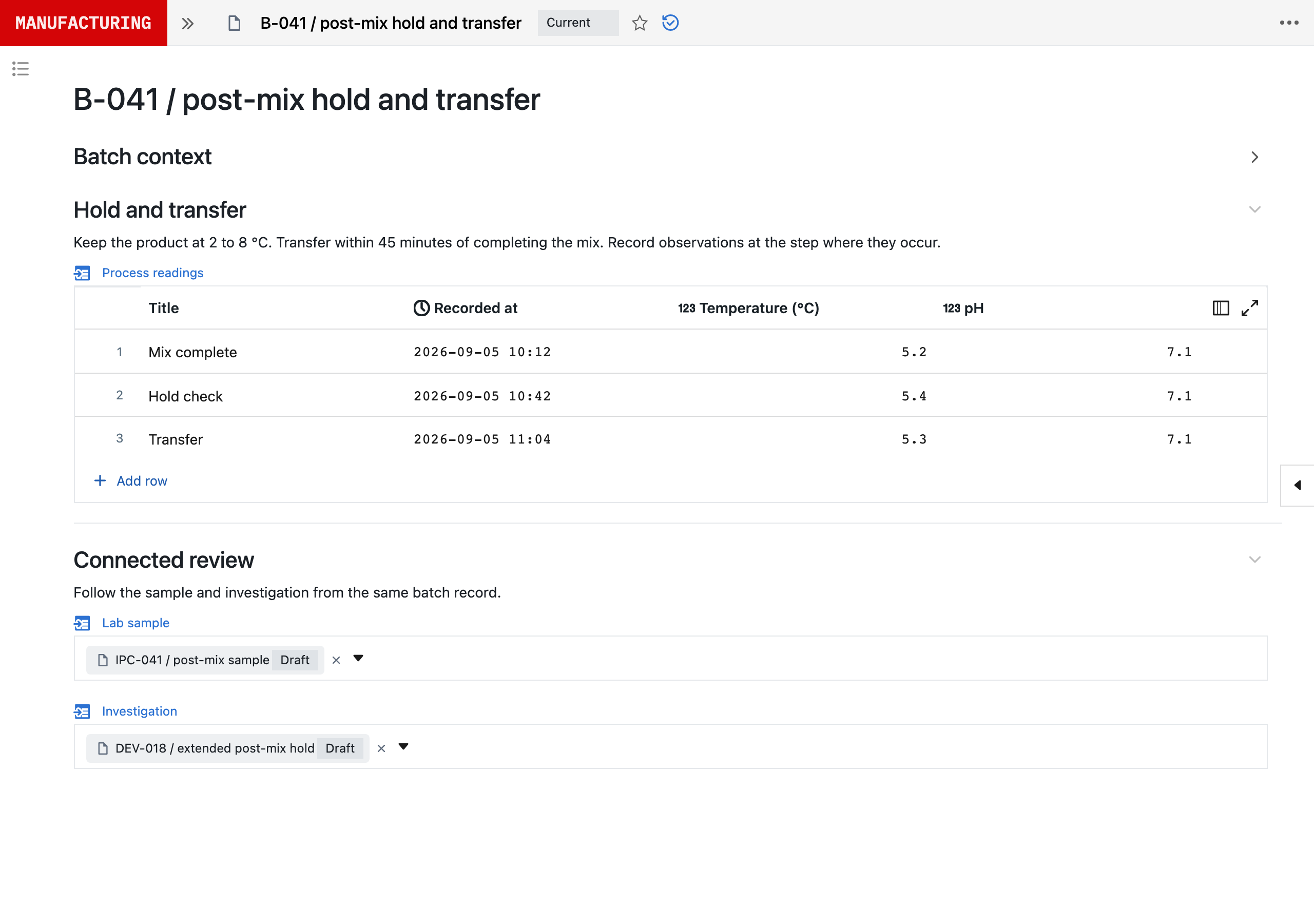
- Electronic batch records: the approved master record becomes a workflow that checks each step, and fills in as the work happens.
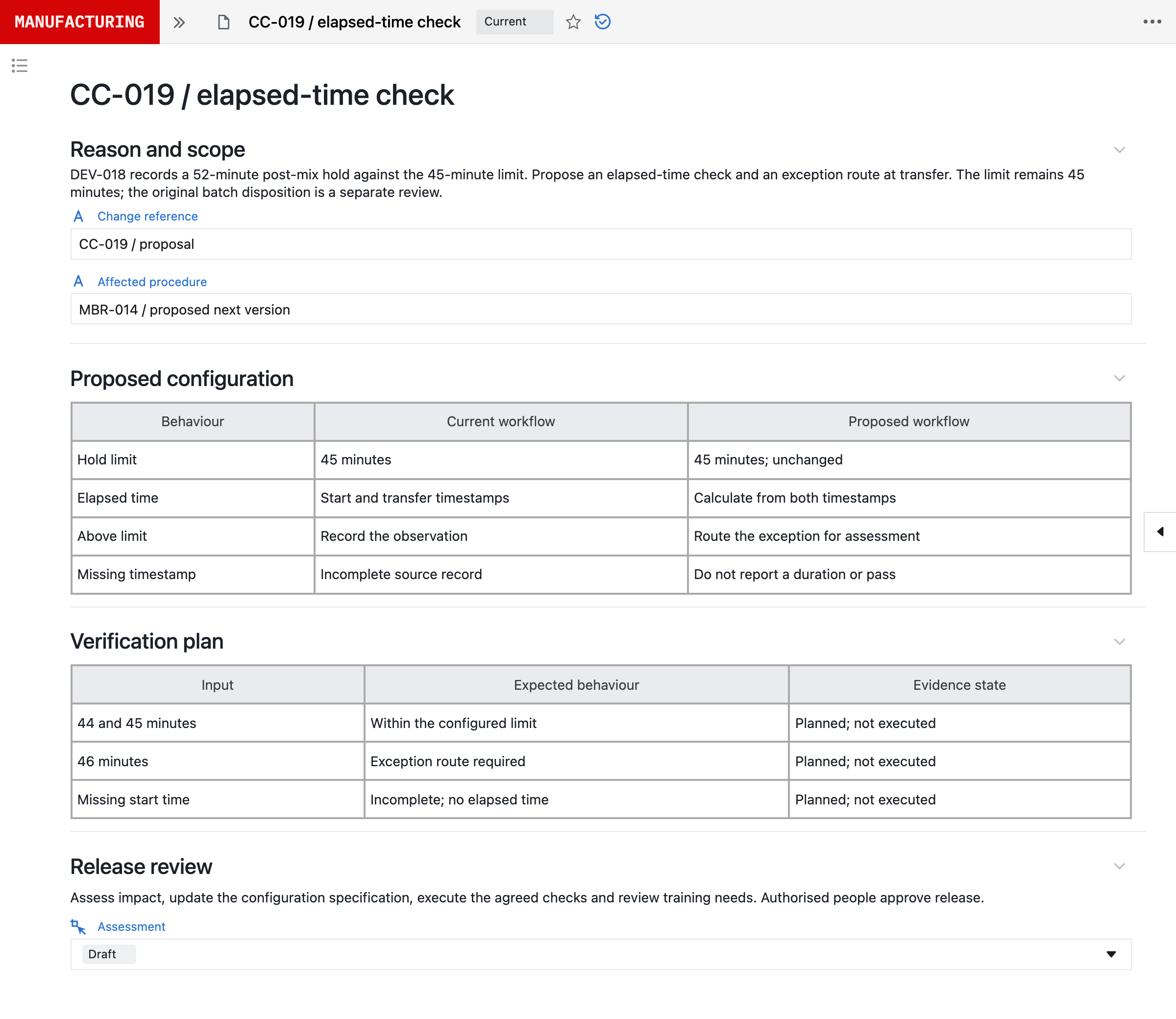
- Quality: documents, training, deviations, CAPA, change control, complaints, audits, suppliers and risk.
- The laboratory: LIMS, ELN and stability.
- Equipment, calibration and maintenance, linked to the runs each instrument touched.
They are one set of records, so a result, a deviation and the batch they concern are linked from the start, not copied between files.
2Neil does the paperwork. You sign.
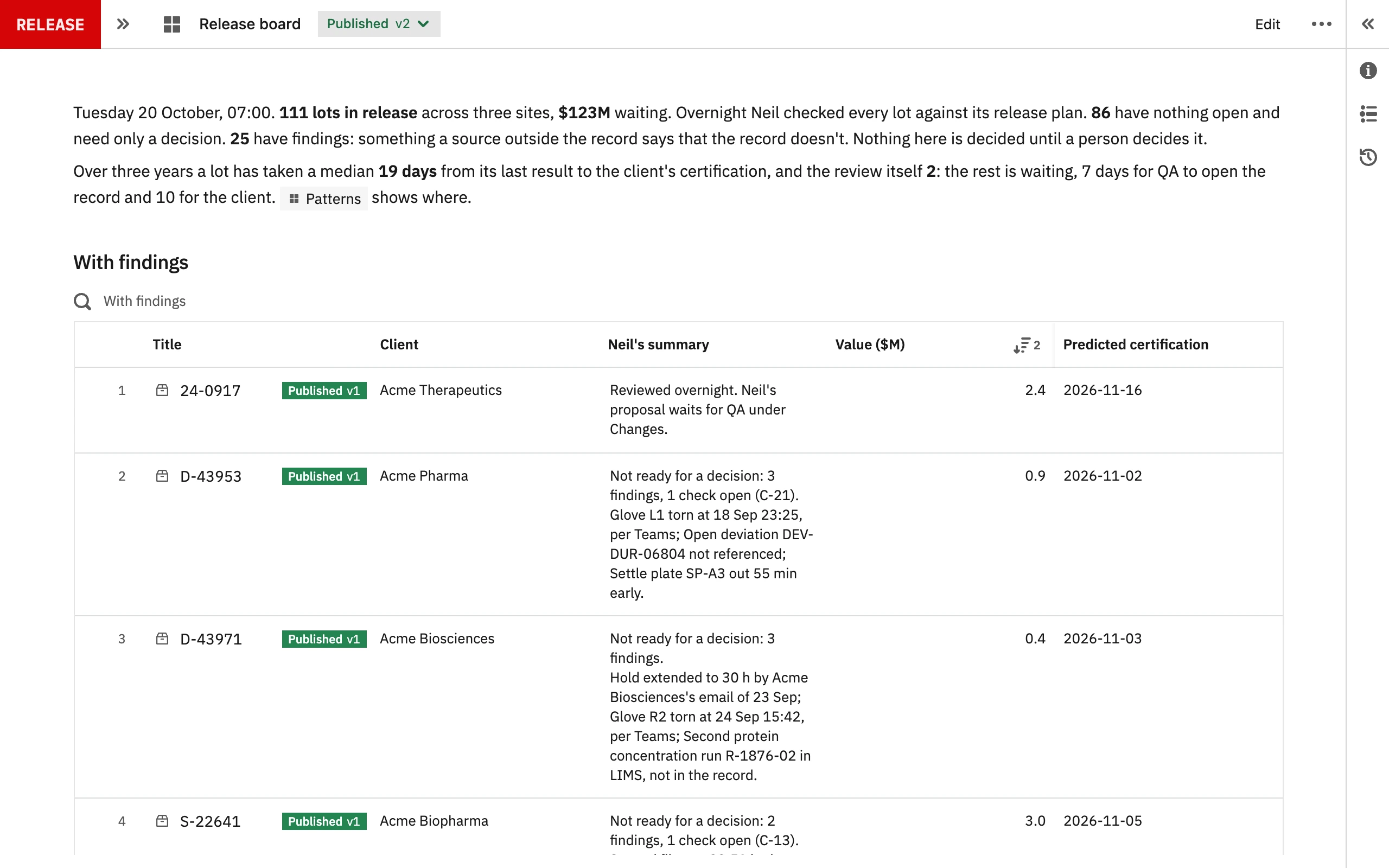
Neil, your AI agent, reads your runs and records, then drafts the comparison, the gap assessment or the review, so you start from a draft, not a blank page.
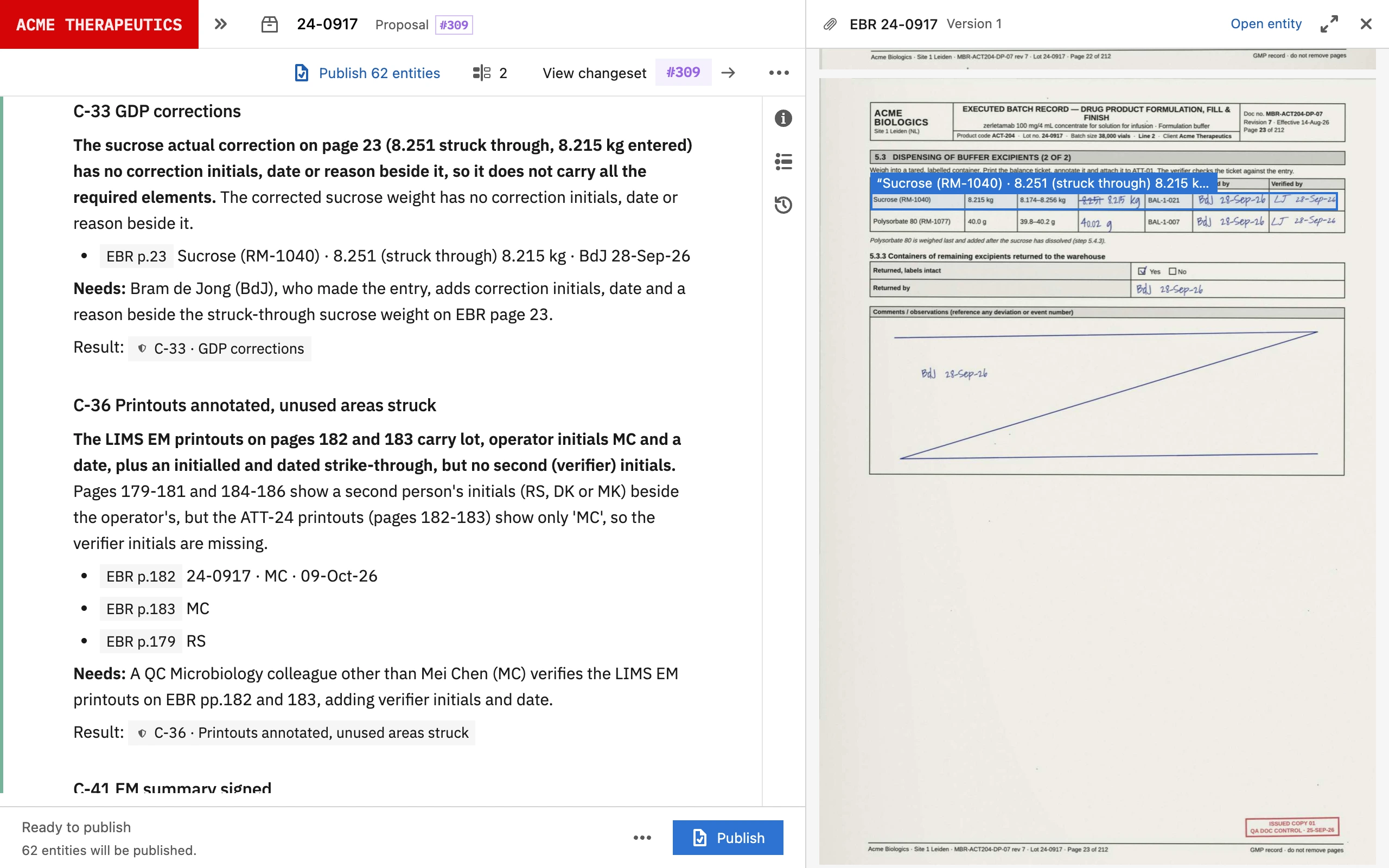
It reads the old paper too. Scanned batch records, logbooks and forms become values, each linked to its place on the scan. What it can’t read for certain goes to a person, and your team verifies what it read. People decide, and Neil is not used in GMP execution.
3Start with one process.
- Choose the process that hurts most: one batch record, one deviation form or one procedure family.
- Bring the procedure and a few completed records. Start with sample material, or arrange an NDA first.
- Neil drafts the workflow and your team checks it against how the work runs. Once the scope is agreed and the inputs received, Seal prepares the first working process and its validation pack to evaluate within 48 hours. Production timing then depends on scope, interfaces, migration and your release requirements.
- Keep paper running for everything else, and agree which system holds which record while the move is under way.
- When you want the history, start with one binder: compare what Neil reads with your team’s own transcription of its hardest pages.
References
- 1Data Integrity and Compliance With Drug CGMP: Questions and Answers, Guidance for Industry, FDA, December 2018. https:/
/ www. fda. gov/ media/ 119267/ download (read 5 November 2026) - 2Warning Letter 320-20-10, Tismor Health and Wellness Pty Limited, FDA, 5 December 2019. https:/
/ www. fda. gov/ inspections- compliance- enforcement- and- criminal- investigations/ warning- letters/ tismor- health- and- wellness- pty- limited- 588104- 12052019 (read 5 November 2026) - 3PI 041-1, Good Practices for Data Management and Integrity in Regulated GMP/GDP Environments, PIC/S, 1 July 2021. https:/
/ picscheme. org/ docview/ 4234 (read 5 November 2026)
AQuestions and answers
Is Seal better than paper and spreadsheets?
Yes. Paper and spreadsheets are good for a small process that rarely changes. Regulators accept them: FDA’s data integrity guidance names a paper record as a fixed-data record, and Bioventix ran its quality system on paper for over two decades. But every check comes after the work. FDA expects blank forms to be controlled, with numbered sets issued and reconciled; it notes that a spreadsheet may let its user change formulas or entries, and it has warned a firm that relied on unvalidated, unsecured Excel spreadsheets to determine the reportable result for batch release. PIC/S, the Pharmaceutical Inspection Co-operation Scheme, says the use of hybrid systems, electronic data supplemented by paper records, is discouraged and that they should be replaced whenever possible. If your process will not change and your team will not grow, it can work well. That is rare: MiAlgae’s paper systems worked at bench scale and began to strain as production volumes grew. Seal has no fixed model of one kind of work. It is built from primitives: record types, the relationships between them, and the steps and checks that use them, which your own team composes into your process, with Neil able to prepare each change for approval. So one platform runs process development, the laboratory, manufacturing, batch release and the quality system, and each change becomes a new version, released once its selected tests pass, while earlier runs keep theirs. Moving from paper, MiAlgae cut documentation time by 75% and went from the laboratory to commercial production on one platform.
Do regulators require us to move off paper?
No. Paper is an accepted record format, and FDA’s guidance describes how to control it. The reason to move is what paper costs: mistakes found after the work, forms to issue and reconcile, and history in boxes. PIC/S does discourage hybrid systems of electronic data and paper records, and says they should be replaced whenever possible.
We’ve validated our spreadsheets. Why change?
Validation makes a calculation reliable. The spreadsheet still sits beside the work: it can’t stop a step, check training, or open a deviation from the record where it occurred. In Seal, the calculation is part of the step, and its result stays with the batch.
Are we too small for this?
Seal starts with one process, and your own team configures it. Bioventix, a company of 11 to 50 people, moved its quality system and lab records onto Seal and cut document admin time by 80%.
Will we have to validate it?
Yes, for your intended use. Seal prepares a validation pack with the first working process, your team approves the intended use, and selected tests run on each change prepared for review. Release needs them passing.
What happens to our paper records?
They stay the record you hold, under your retention procedure. If you want them as data, Neil reads the scans into values, each linked to its place on the page, and your team verifies what it read.
Can operators use it on the floor?
Seal is browser-based. Try the proposed devices, scanners, gloves and network conditions with the operators who will use them. Where offline operation is needed, agree the supported scope and verify it first.
What happens if the system goes down?
Work continues only through an approved and tested business-continuity procedure, which defines safe hold points, critical work and contingency records.
How long does it take to start?
Once the scope is agreed and the inputs received, Seal prepares a first working process and its validation pack to evaluate within 48 hours, configured from one of your procedures. Production timing then depends on scope, interfaces, migration and your release requirements.