



Summary
- The problem
- Scorecards are built by hand once a quarter, in a spreadsheet, from receipts, inspections and emails. They arrive late, and nobody can say which receipt a number came from.
- Seal’s approach
- Neil counts every receipt line in code against your written definitions, joins quality from inspections and nonconformances, and links every number to its records.
- What changes
- A supplier review starts from numbers both sides can check, with the cases behind them one click away.
- Where to start
- One quarter of receipts, inspections and nonconformances for your five largest suppliers. Book a demo.
1A scorecard is only as good as its count.
Your ISO 13485 system requires you to evaluate your suppliers, monitor them and re-evaluate them (clause 7.4), and the device makers you supply must do the same to you.¹ On FDA’s inspections of device makers in fiscal 2025, inadequate purchasing control procedures were cited 115 times, the third most frequent citation.² A scorecard is how most suppliers are monitored: on time, in full, quality, and how quickly they answer.
Each of those is a count, and each count is a choice. On time against the date you asked for, or the date the supplier promised? By line, or by order? Is a partial shipment late, short or both? Change the answer and the score moves, and a scorecard built by hand in a quarterly spreadsheet rarely writes the answers down.
Hand-built counts also go wrong. People pulling values out of records by hand get about one in fifteen wrong.³ When researchers audited 25 spreadsheets in use at five organisations, 16 had errors, 117 in all. Most did little harm; the largest was over $100 million.⁴ And a scorecard only helps if it is used: in a survey of 147 buyer and supplier pairs, using and reviewing the measurement system went with better supplier quality and delivery.⁵
2Count every line, in code.
Neil reads what the quarter left behind: receipts, purchase orders, the dates suppliers promised in their acknowledgements, incoming inspection results, nonconformances, corrective action requests, certificates of analysis and change notices. Code does the counting. A line is on time if it was received by the promised date, within the window you set. It is in full if the quantity received matches the quantity ordered. Quality counts lots accepted at inspection, nonconformances and how long each corrective action has been open.
The definitions are yours, written down, and applied the same way every quarter. A model is not asked to add up a quarter. In a 2026 preprint, the best model completed 34.89% of real business spreadsheet workflows,⁶ and in an earlier study, a 2023 model handed the exact pages it needed still got 15% of simple financial questions wrong.⁷
3Link every number to its records.
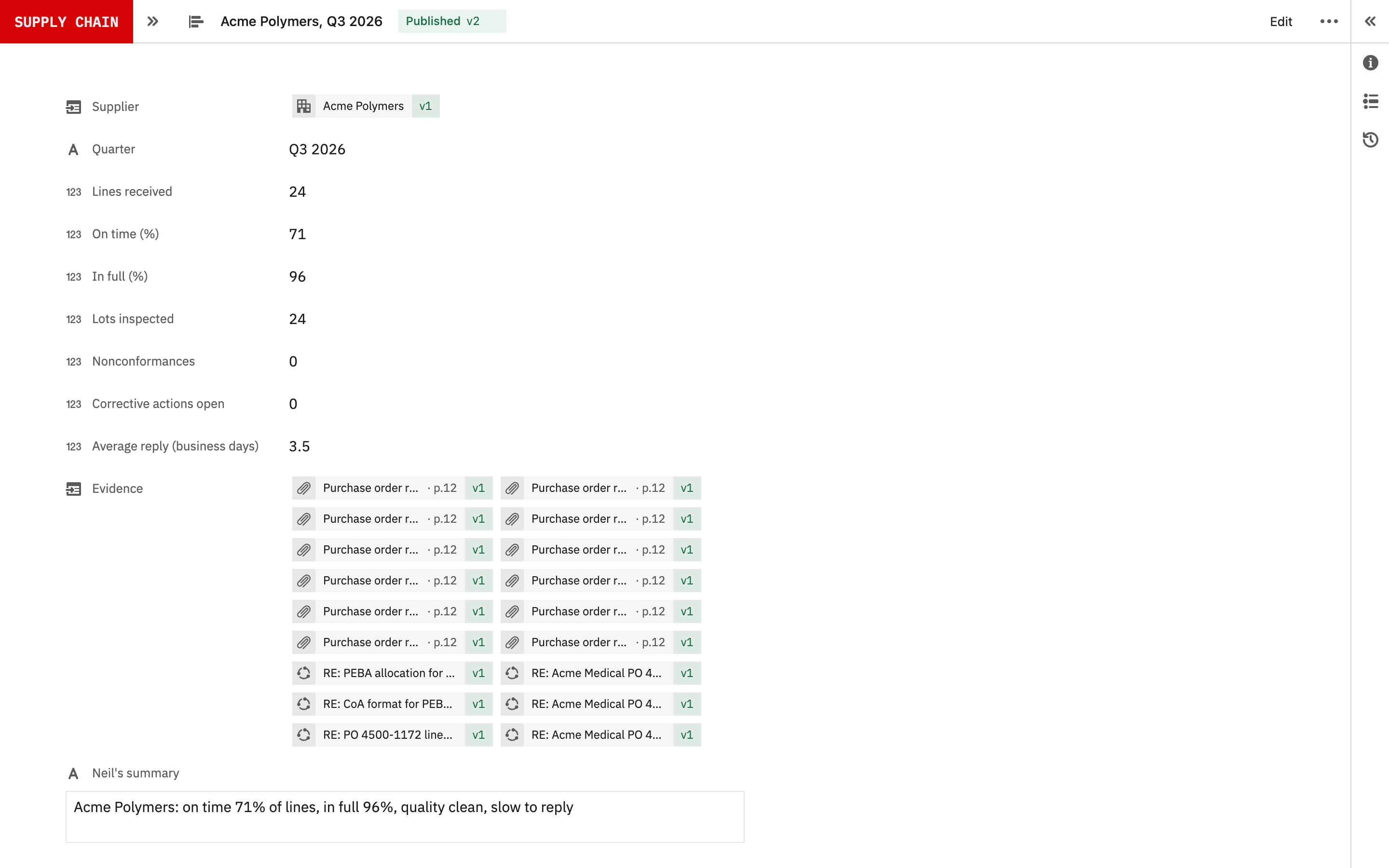
Every number on a scorecard opens on what it was counted from: the receipt lines behind an on-time rate, or the certificate, inspection and nonconformance behind a quality score. A supplier who disputes a number can be shown the lines.
The same holds for what Neil writes. When AI search engines were audited, only 51.5% of their sentences were fully supported by the sources they cited.⁸ So each claim in a drafted review is checked against the records it cites, and one its records don’t support goes back for revision.
Certificate of analysis
- Supplier
- Acme Compounding
- Barium sulfate
- 18.6%
- Specification
- 20 ± 1%
- Nonconformances
- 2
- Action open
- 64 days
- Evidence
- On every number
4Q3 2026 at Acme Medical.
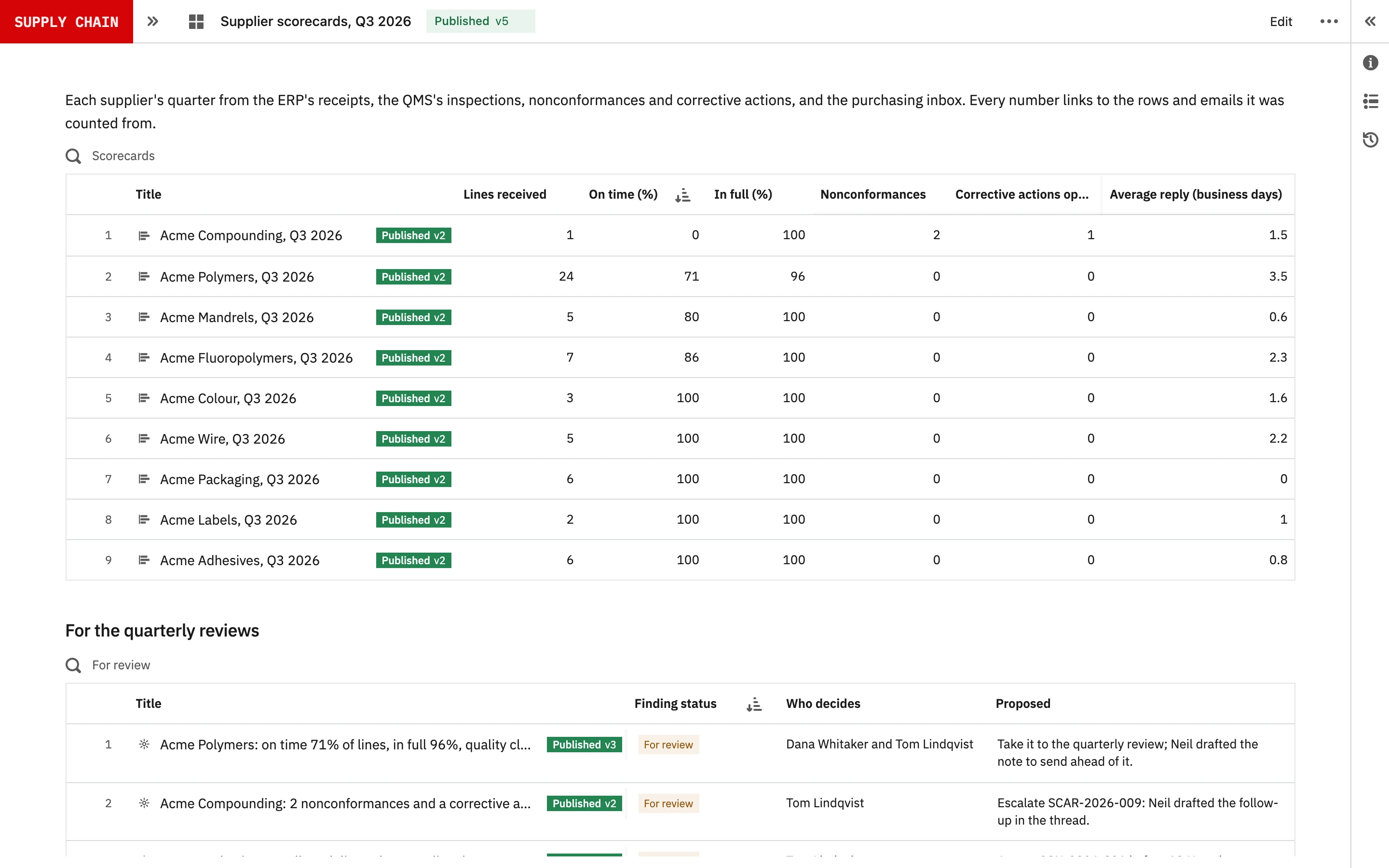
Acme Medical is a fictional ISO 13485 maker of tubing and catheter components. Its quarterly scorecards covered 1 July to 30 September 2026. Three suppliers stood out.
| Supplier | What the count shows | What it rests on |
|---|---|---|
| Acme Polymers | On time 71% against promised dates, in full 96%, quality clean | Every receipt line. All seven late lines were promised from August |
| Acme Compounding | Two nonconformances, and a corrective action request open 64 days | A certificate showing 18.6% barium sulfate against 20 ± 1%, and black specks at incoming inspection |
| Acme Packaging | Strong delivery, and a change notice not yet assessed | The supplier’s notice of a new pouch sealing line |
The numbers are the start of the conversation, not the end. Acme Polymers’ lateness has a cause and a start date. Acme Compounding’s quality score rests on two cases a review can walk through. Acme Packaging’s score is good, and its change notice is the item that needs a decision.
5Your team holds the review.
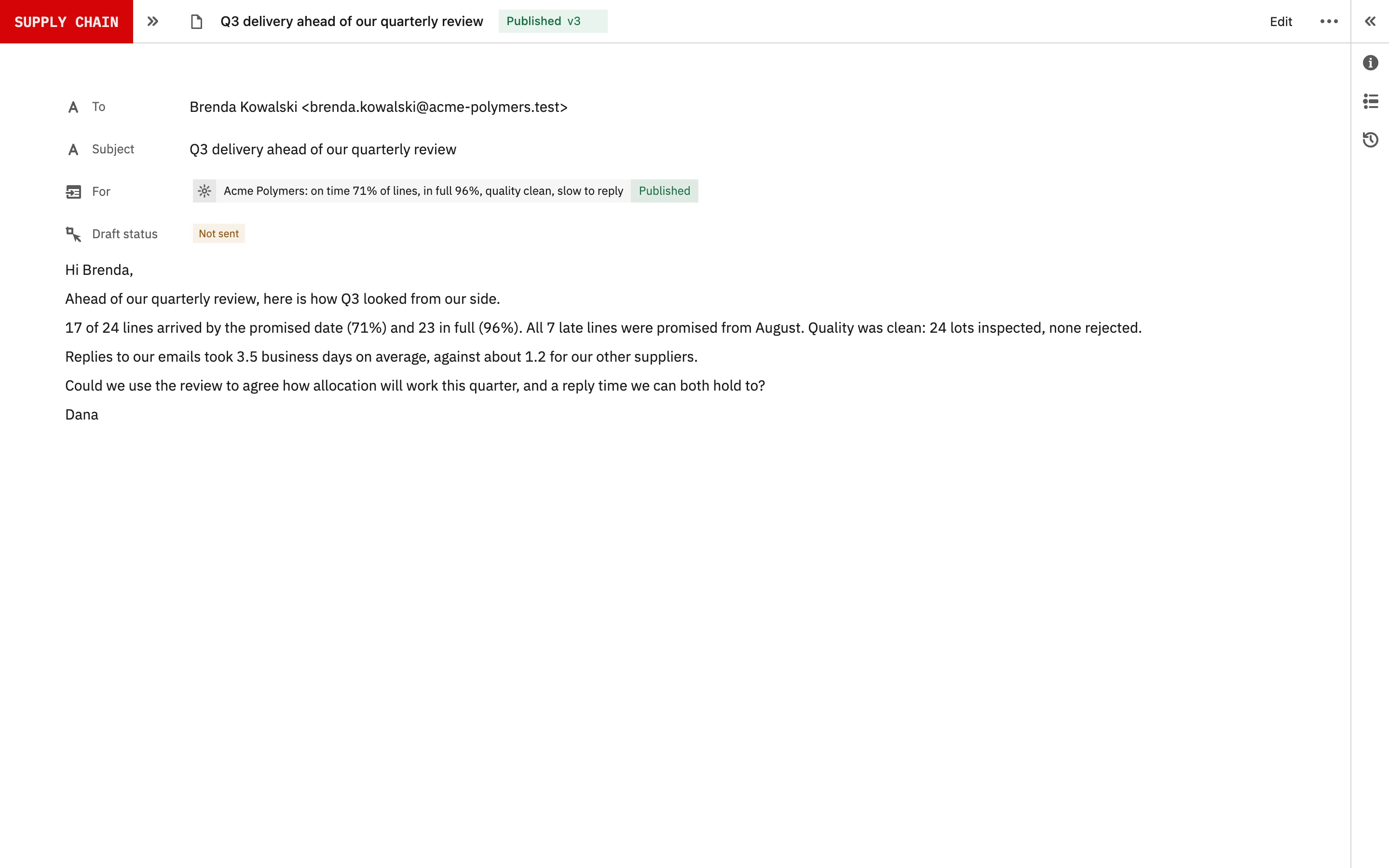
Neil drafts each supplier’s quarterly review: the scorecard, the cases behind it, the trend against earlier quarters and the questions to raise. The supplier quality engineer and the supply chain director edit it, send it and hold the meeting. Decisions on a supplier’s approval, a corrective action or a re-evaluation stay with your quality team. Neil never changes a supplier’s status and never sends a review.
6Validate it against your last scorecard.
Take the last scorecard your team built and the records from the same quarter. Neil counts the quarter with your definitions, and you compare the two number by number, each difference traced to the lines on each side. Many differences turn out to be definitions, such as the requested date against the promised one. Agree them, write them down, and the count stays the same from quarter to quarter.
7Start with your five largest suppliers.
Bring one quarter of receipts, purchase orders, inspection results, nonconformances and supplier emails for your five largest suppliers, with the scorecard your team built for that quarter. Exports are enough; no live access to the ERP or the quality system is needed to prove it.
References
- 1FDA, Medical Devices; Quality System Regulation Amendments, final rule, 89 FR 7496, 2024, effective 2 February 2026: clause 7.4 of ISO 13485 requires an organisation to evaluate suppliers in terms of ability and performance, and requires monitoring and re-evaluation of suppliers and the performance of purchased products. Federal Register
- 2Seal’s count of FDA’s inspection observation data for fiscal 2025, 1 October 2024 to 30 September 2025, before the QMSR took effect: 21 CFR 820.50, purchasing controls, lack of or inadequate procedures, was cited 115 times, the third most frequent device citation after corrective and preventive action procedures and complaint procedures. FDA notes the data are not a complete listing of observations. FDA
- 3Garza et al., Error rates of data processing methods in clinical research: a systematic review and meta-analysis, International Journal of Medical Informatics, 2025: medical record abstraction had a pooled error rate of 6.57% across 93 studies. DOI
- 4Powell, Baker and Lawson, Impact of errors in operational spreadsheets, Decision Support Systems, 2009: of 25 operational spreadsheets from five organisations, 16 had errors, 117 in all; many had no quantitative impact, and the largest was over $100 million. DOI
- 5Maestrini et al., The impact of supplier performance measurement systems on supplier performance, International Journal of Operations & Production Management, 2018: across 147 buyer and supplier pairs, using the system had a positive impact on supplier quality and delivery, and reviewing it on delivery. DOI
- 6Zhu et al., SpreadsheetBench 2, arXiv preprint, 2026: on 321 tasks built from real business data, the best model achieved 34.89% overall task accuracy. arXiv
- 7Islam et al., FinanceBench, arXiv preprint, 2023: handed the evidence pages, GPT-4-Turbo answered 15% of questions incorrectly. arXiv
- 8Liu, Zhang and Liang, Evaluating verifiability in generative search engines, Findings of EMNLP, 2023: on average 51.5% of generated sentences were fully supported by citations, and 74.5% of citations supported their sentence. DOI
AConnected across Seal
BCapabilities
| Capability | What it covers |
|---|---|
| Line-level counts | Count on time and in full for every receipt line in code, against the promised date and the quantity ordered. |
| Written definitions | Write down what on time, in full and accepted mean for you, and apply them the same way every quarter. |
| Quality from the record | Join incoming inspections, nonconformances, certificates of analysis and corrective action requests to each supplier. |
| Evidence links | Open any number on the receipts, inspections and emails it was counted from. |
| Patterns in the quarter | Show when lateness started, what it clusters on, and what is still open. |
| Drafted reviews | Draft each supplier’s quarterly review, each claim checked against the records it cites, for your team to edit and send. |
| Review records | Keep each quarter’s scorecard with its definitions, its evidence and the decisions taken on it. |
CConnected records
DQuestions and answers
Does this replace our supplier quality system?
No. Your approved supplier list, corrective actions and evaluations stay where they are. Neil reads from them and from the ERP, prepares the scorecard and the review, and your supply chain and supplier quality people decide.
On time against which date?
The one your definitions say: the date the supplier promised, or the date you requested, within the window you set. Neil can show both side by side.
What data does a proof need?
One quarter of receipts, purchase orders, inspection results, nonconformances and supplier emails, and the scorecard your team built for that quarter. Exports are enough.
Does Neil send the review to the supplier?
No. Neil drafts it. Your team edits it, sends it and holds the meeting.
Can we show a supplier the evidence behind a score?
Yes. Every number lists the receipt lines and cases it was counted from, so a review can walk through them.
Is our data used to train AI models?
Under Seal’s agreements, your data is not used to train the underlying AI models.
Our customers audit our supplier controls. What is kept?
Each quarter’s scorecard with the definitions it used, the records behind every number, the review as sent and the decisions taken on it.