



Summary
- The problem
- An MRP plans on the parameters it was given: last year’s average use, a lead time typed in years ago. A material whose use has more than quadrupled can show months of cover while the line is weeks from running out.
- Seal’s approach
- Neil reconciles every source each morning and calculates in code each material’s cover at its current rate, against the lead time its supplier quotes and delivers now. A second pass checks every finding against its evidence.
- What changes
- Shortages show while there is still time to expedite or split an order, and material ordered too early is moved before its shelf life is spent on the shelf. Planners decide every change.
- Where to start
- One material family, or one quarter of history from your ERP exports and the planners’ spreadsheets. Book a demo.
1Plan on what you use now.
A material requirements plan is arithmetic on parameters people set. It takes demand, nets it against stock and open orders, offsets what is left by a lead time and proposes orders. The arithmetic is reliable. The parameters are rarely kept up: in a long-running survey of manufacturers, about 70 percent reviewed their lead times once a year or less, and about half of MRP users reviewed safety stocks as rarely.¹
A component maker’s demand moves faster than that. It comes from OEM customers’ forecasts and orders, exploded through each part’s bill of materials. When a customer ramps a new programme, an average of last year’s use lags behind it, and a material can show months of cover while the line is weeks from running out. When a programme ends, the plan keeps buying. Both cost. Across 885 supply chain glitches announced by public companies, such as production or shipment delays, the companies reported on average 6.92% lower sales growth and 13.88% higher inventory growth than comparable firms.² Shelf life adds a third cost: a resin that waits six months on the shelf has lost six months it can’t get back.
Planners know this, and correct the plan by hand in their own spreadsheets. In a study of more than 60,000 forecasts at four supply chain companies, people’s adjustments improved accuracy on average at three of them, but small adjustments and upward ones often made forecasts worse.³ The planners’ judgement is worth keeping. What it lacks is every source, every day.
2Read every source, as of one morning.
Each morning Neil reads what a planner would read, as it stands at 06:00. From the ERP: the item master, stock on hand by lot with expiry dates, open purchase orders, receipts, consumption, work orders and the MRP’s own plan. Customer forecasts and orders, read into one shape by customer forecast intake. The planners’ spreadsheets and the project plans for new products, in Excel and MS Project, as they are. And the purchasing inbox, where a supplier’s new date usually arrives before it reaches the ERP.
Reading is where an AI model earns its place: a forecast in a customer’s own layout, a tab of hand-built totals, a delay three replies down a thread. Every value Neil reads keeps a link to the file, sheet and cell, or the email, it came from.
3Calculate in code, not by the model.
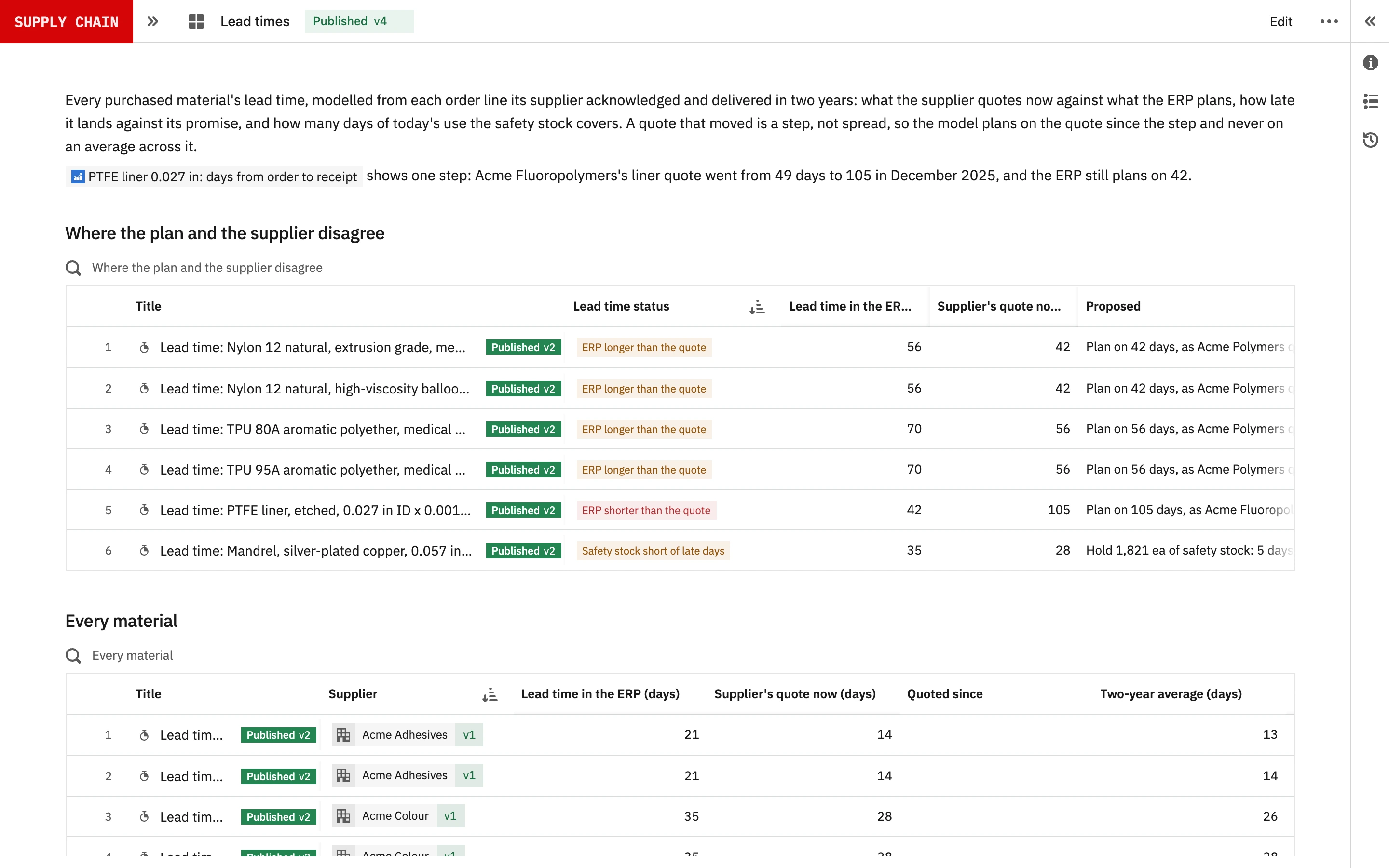
The numbers a planner acts on are calculated in code, the same way every time. Weekly use over the last 13 and 52 weeks. Weeks of cover, from usable stock and the orders due before it runs out. Each material’s lead time, modelled from two years of order lines: what its supplier quotes now and since when, how late each order landed against its promise, and how many days of use the safety stock covers. A quote that moved is a step, not spread, so the model plans on the quote since the step; an average across it is wrong both before and after. The shelf life each lot will have left on the day it is used.
A language model is not asked to do this arithmetic. In a 2026 preprint, the best of six frontier models, asked to solve planning problems without a solver, met every constraint in 65% of tasks.⁴ Nor does Neil invent a forecast of its own. In the M5 forecasting competition, only 7.5% of 5,507 teams beat the best simple statistical benchmark.⁵ Neil starts from your customers’ forecasts and your own history, and says where they disagree.
4Check every finding before a planner sees it.
A separate pass checks each finding against the rows, cells and emails it rests on. A number that can’t be traced to its source is dropped. Where Neil’s figure differs from the MRP’s, it shows both and why: the MRP’s 52-week average beside the last 13 weeks, or the item master’s lead time beside what the supplier quotes now.
5One morning at Acme Medical.
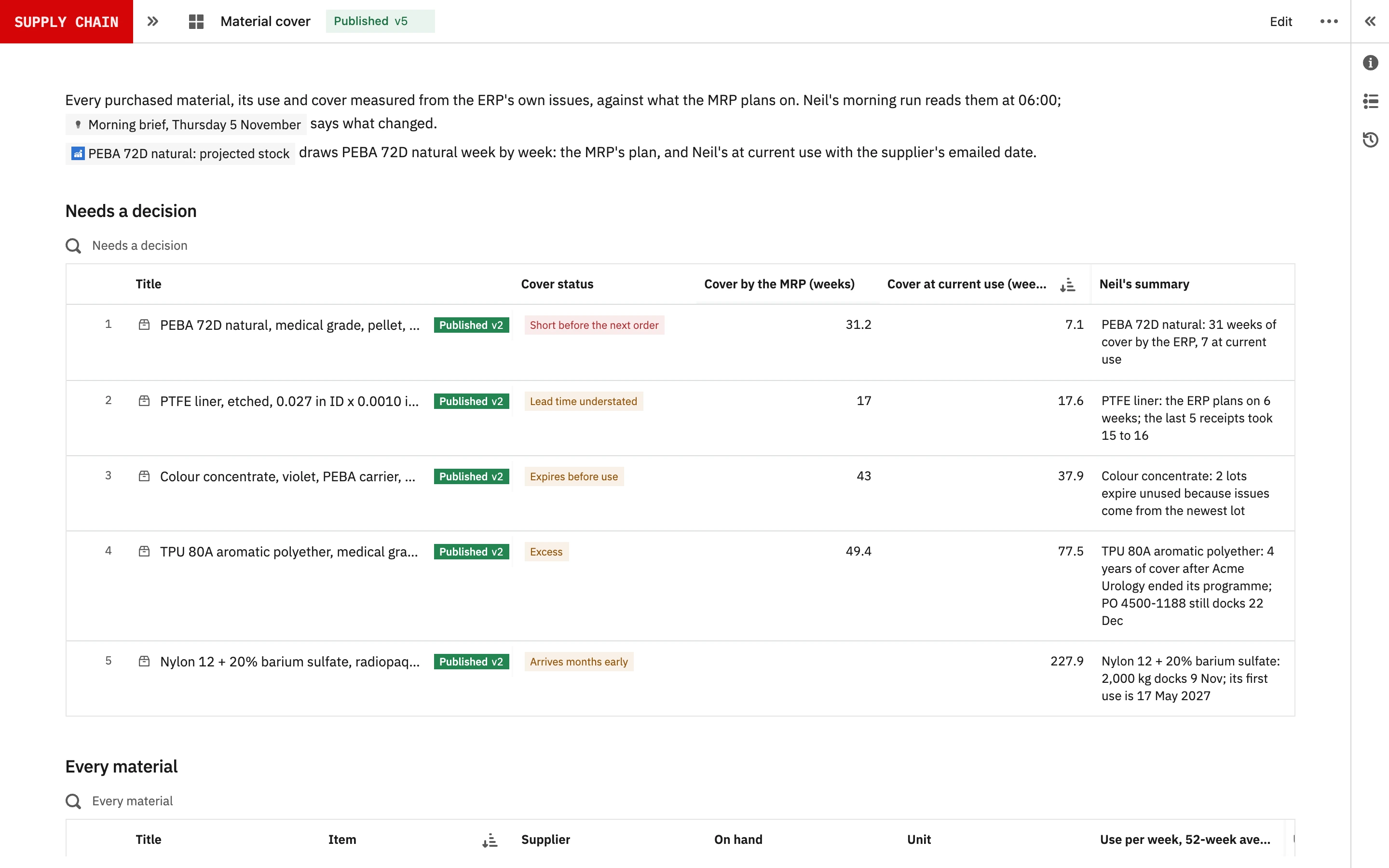
Acme Medical is a fictional ISO 13485 maker of tubing and catheter components in Lowell, Massachusetts, with about 550 people, four extrusion lines and a braiding line. Its ERP plans materials with MRP, its production planner keeps the schedule in Excel, and its new-product plans are in MS Project. On Thursday 5 November 2026, Neil’s 06:00 run raised five materials.
| Material | What Neil found | What it proposes |
|---|---|---|
| PEBA 72D natural | 7 weeks of cover at the last 13 weeks’ rate, 31 by the MRP, against a 12-week lead time | Ask for 7 bags by 20 November, or supply from another plant |
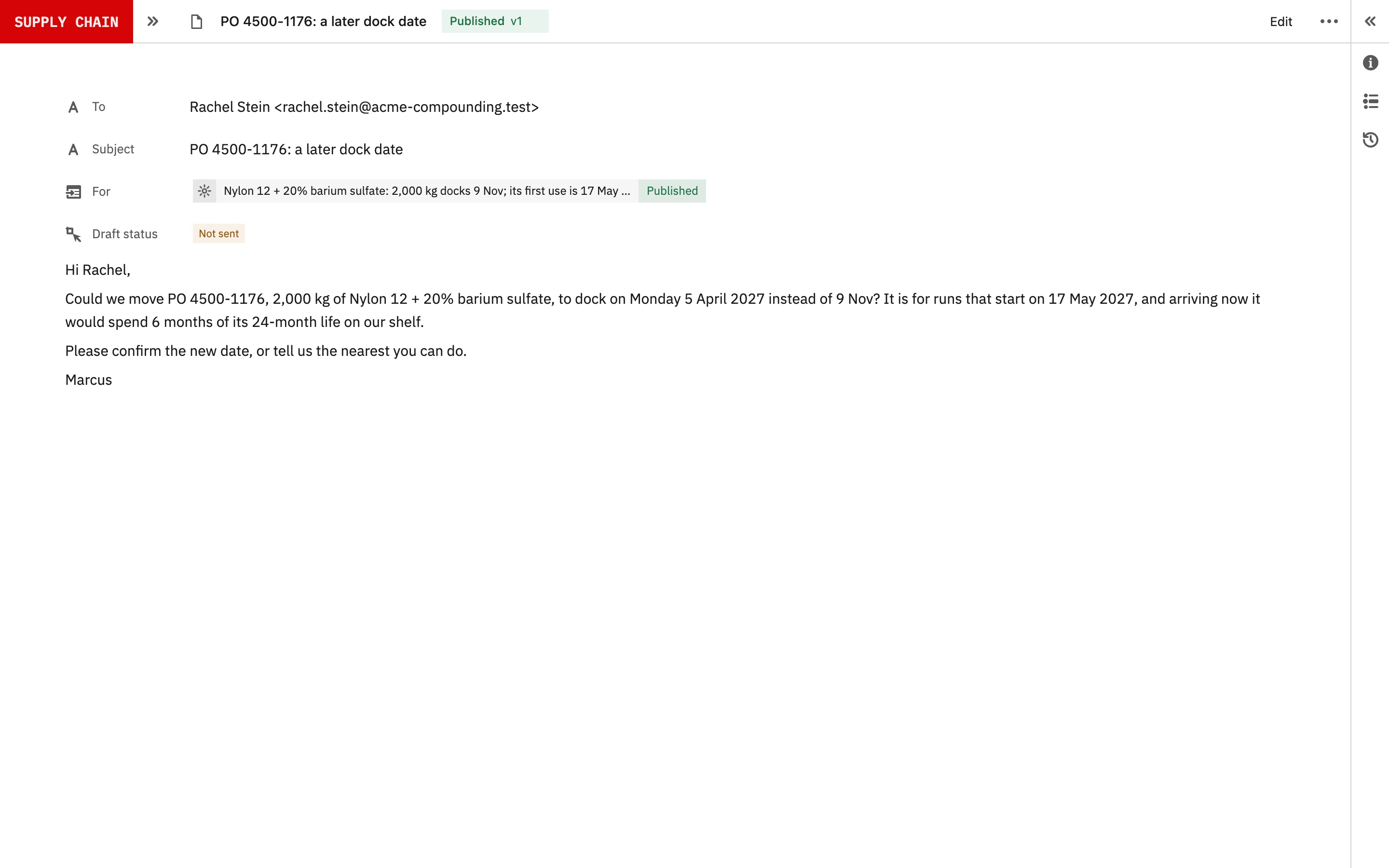
| Nylon 12, 20% barium sulfate | 2,000 kg dock on 9 November for validation runs from 17 May 2027 | Dock in early April instead |
| Violet concentrate | The two oldest of three lots expire with stock left | Issue the oldest lot first |
| TPU 80A | About four years of cover after a programme ended | Push out or cancel PO 4500-1188 |
| PTFE liner | A 6-week lead time in the ERP; the supplier has quoted 15 weeks since December 2025, and the last five orders took 15 to 16 | Correct the planning lead time |
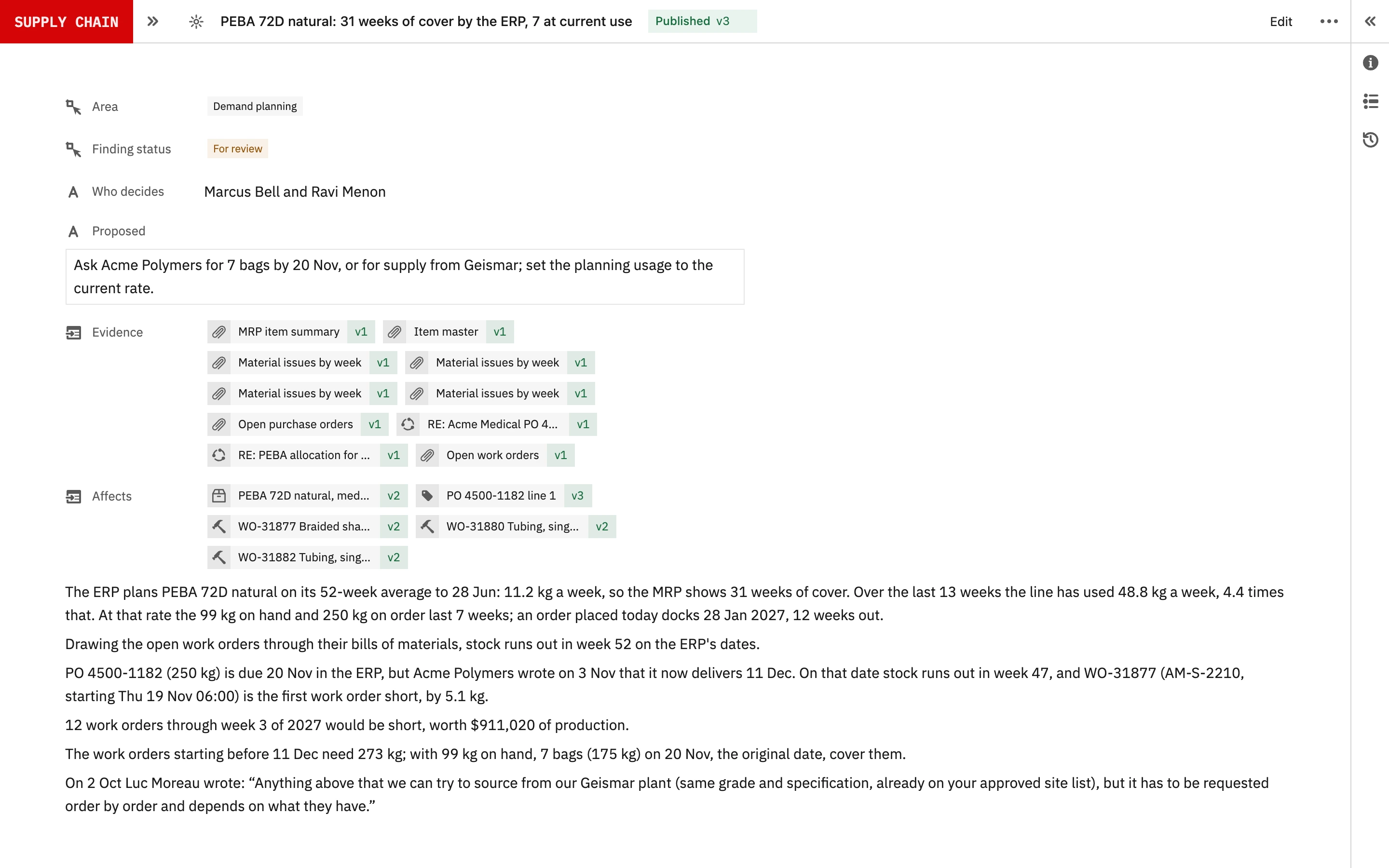
PEBA 72D came first. Its use rose with Acme Vascular’s new catheter shaft programme, which the MRP’s 52-week average is still catching up with. On the ERP’s dates it runs short in week 52, before an order placed today could dock on 28 January. But the inbox held a supplier email of 3 November moving PO 4500-1182 from 20 November to 11 December, which brings the shortage forward to week 47. Nobody had answered it, and the ERP still showed 20 November.
PEBA 72D in the MRP
- Weekly use
- 52-week average
- Cover
- 31 weeks
- Short
- No
- Weekly use
- Last 13 weeks
- Cover
- 7 weeks
- Lead time
- 12 weeks
- Proposal
- Split PO 4500-1182
The nylon compound is a custom material with a 24-month life from manufacture, made for three validation runs in the new-product plan. Docking it in November spends six months of that life on the shelf. Early April still leaves the planners’ 4-week buffer before the first run. Neither proposal changes anything until a planner and a buyer agree it.
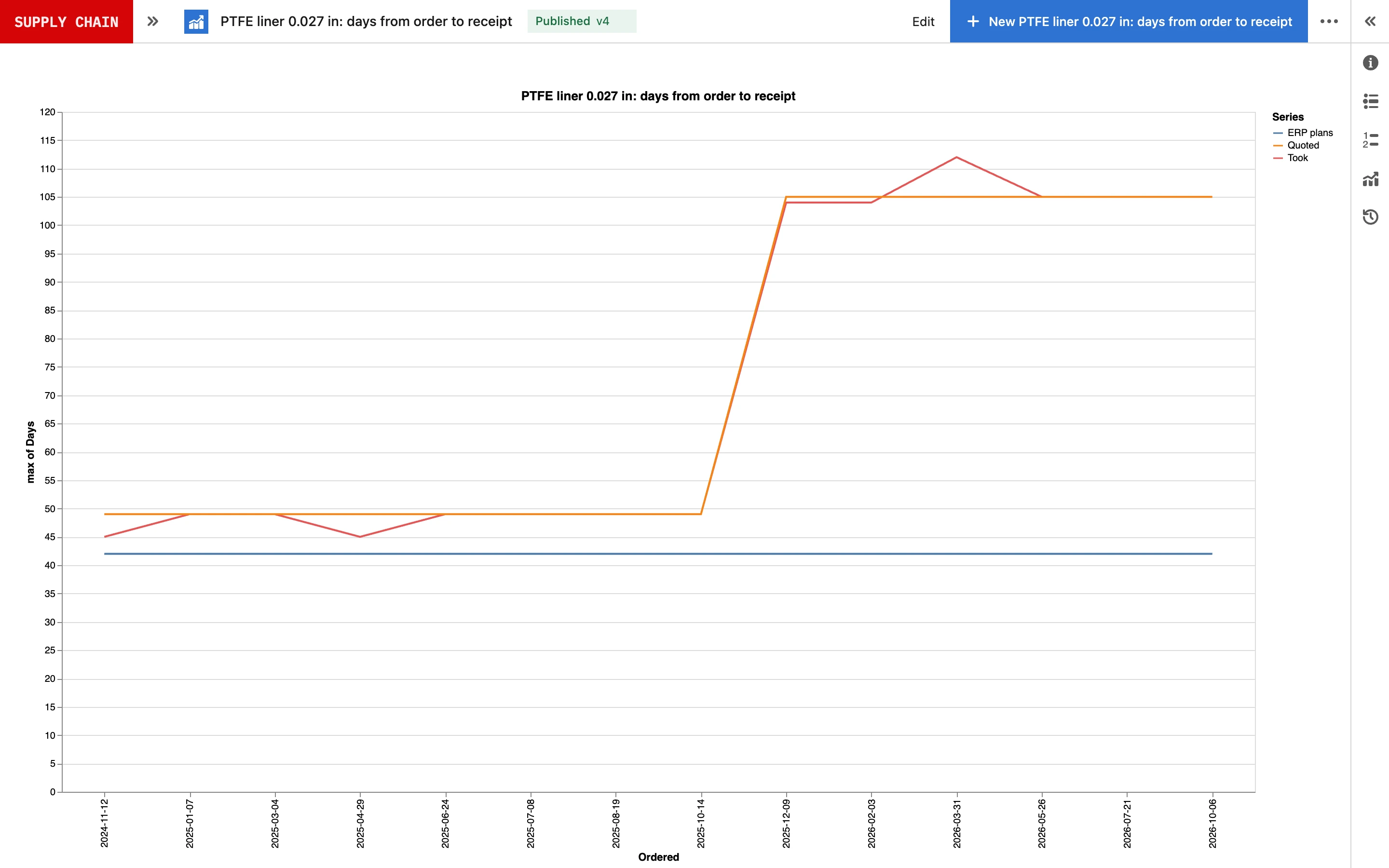
The PTFE liner shows why a lead time is modelled, not averaged. Acme Fluoropolymers quoted 7 weeks until December 2025 and 15 weeks on every order since, and delivered close to each. An average of its 13 receipts says 10 weeks, wrong before the step and after it. The ERP still plans 6.
6The planner and the buyer decide every change.
Neil proposes; it changes nothing. A finding comes with a drafted action: expedite or split an order, push one out or ask to cancel it, issue the oldest lot first, or correct a planning parameter. Where the supplier must act, the email to them is drafted too, linked to the finding, for the buyer to edit. The planner and the buyer approve or reject it, the buyer sends the email, and the people who own the ERP change it.
With Gmail connected, Neil can save each email as a draft in the buyer’s Gmail, or send it when the buyer asks, after showing the buyer that email. A morning run never sends one. Neil never places, changes or cancels an order or edits the ERP.
Each proposal is kept with its evidence, the decision made on it and who made it. Component makers sit outside the FDA’s device quality rule,⁶ but the OEMs they supply do not, and those OEMs must evaluate, monitor and re-evaluate their suppliers under ISO 13485 clause 7.4.⁷ A kept record of why each order moved, and who decided, is an answer you can give them.
7Validate it on your own history.
Test Neil on a period whose outcome you already know. Take a quarter that has ended and give Neil the exports as they stood at its start: stock by lot, open orders, receipts, forecasts and the planners’ files. Neil runs each week of the quarter as if it were live, seeing only what was known that week. Then compare what it raised with what happened: the shortages, the expedites, the lots written off and the orders that arrived late.
Count three things: what it raised in time to act, what it missed, and what it raised that didn’t matter. Your planners judge the proposals as they would a colleague’s. Repeat the comparison when a source, a policy or the model changes.
8Start with one material family.
Bring one family of materials, such as your base resins, or one quarter of history. Historical exports and the planners’ spreadsheets are enough; no live connection to the ERP is needed to prove it. When the comparison holds, Neil runs every morning on every material, and the planners spend their time on the decisions.
References
- 1Jonsson and Mattsson, A longitudinal study of material planning applications in manufacturing companies, International Journal of Operations & Production Management, 2006: in a 2005 survey of 153 Swedish manufacturers, approximately 70 percent of the companies reviewed their lead times once a year or less, and 51% of MRP users reviewed safety stocks once a year or less. DOI
- 2Hendricks and Singhal, Association between supply chain glitches and operating performance, Management Science, 2005: across 885 glitches announced by publicly traded firms, the firms reported on average 6.92% lower sales growth and 13.88% higher growth in inventories than matched controls. DOI
- 3Fildes, Goodwin, Lawrence and Nikolopoulos, Effective forecasting and judgmental adjustments, International Journal of Forecasting, 2009: across more than 60,000 forecasts from four supply chain companies, judgmental adjustments increased accuracy on average in three, but smaller adjustments often damaged accuracy and upward adjustments were much less likely to improve it. DOI
- 4Tso et al., ConstraintBench, arXiv preprint, 2026: on 200 planning and optimisation tasks solved without a solver, the best of six frontier models produced a solution meeting every constraint 65.0% of the time. arXiv
- 5Makridakis, Spiliotis and Assimakopoulos, M5 accuracy competition: results, findings, and conclusions, International Journal of Forecasting, 2022: of 5,507 teams forecasting retail unit sales, 415 (7.5%) beat the best-performing benchmark. DOI
- 621 CFR 820.1(a)(2): the provisions of this part do not apply to manufacturers of components or parts of finished devices, but such manufacturers are encouraged to consider them as appropriate. eCFR
- 7FDA, Medical Devices; Quality System Regulation Amendments, final rule, 89 FR 7496, 2024, effective 2 February 2026: clause 7.4 of ISO 13485 requires an organisation to evaluate suppliers in terms of ability and performance, and requires monitoring and re-evaluation of suppliers and the performance of purchased products. Federal Register
AConnected across Seal
BCapabilities
| Capability | What it covers |
|---|---|
| Morning reconciliation | Read the ERP’s exports, customer forecasts, the planners’ spreadsheets, project plans and the purchasing inbox as they stand at one time each morning. |
| Cover at the current rate | Calculate each material’s weeks of cover in code at its recent and long-run rates, from usable stock and the orders due. |
| Measured lead times | Measure each supplier’s lead time from order and receipt dates, and show where the item master’s figure differs. |
| Shelf life at use | Show the shelf life each lot will have left on the day it is used, and the lots that will expire before they are needed. |
| Planning policies | Hold each material’s buffer before use and minimum shelf life at use. Planners set them; Neil applies them and shows what they cost. |
| Order proposals | Draft an expedite, split, push-out or cancellation request with the evidence behind it, for a planner to approve. Neil changes no order. |
| Backtests on your history | Run a past quarter week by week as if it were live, and compare what Neil raised with what happened. |
| Decision records | Keep each proposal with its evidence, the decision made on it and who made it. |
CConnected records
DQuestions and answers
Does Neil replace our ERP or its MRP?
No. The ERP stays the system of record and its MRP keeps running. Neil reads its exports, recalculates cover from what you are using now, and shows where its figures differ from the MRP’s and why. People change the ERP.
What data does a proof need?
Historical exports: the item master, stock on hand by lot with expiry, open purchase orders, receipts, consumption, work orders and customer forecasts, with the planners’ spreadsheets and project plans from the same period. No live access to the ERP is needed.
Can Neil read our Excel planning files and MS Project plans?
Yes, as they are, with their tabs, colours and hand-built totals. Each number Neil uses keeps a link to its file, sheet and cell, and a total that doesn’t add up is raised, not trusted.
Our planners order early to be safe, and it costs us shelf life. Will Neil just tell them to order later?
How early to order is a policy, and the planners set it. Each material can have its own buffer before use and its own minimum shelf life at use. Neil applies the policy and shows what it costs in shelf life spent on the shelf and stock held, so the trade is made on purpose.
Does Neil place orders or email suppliers?
No. Neil drafts the expedite, split, push-out, cancellation request or reply. A planner or buyer reviews it, sends it and changes the ERP. Neil never places, changes or cancels an order, sends an email or edits the ERP.
How do we know it works before we rely on it?
Run it on a quarter that has ended. Neil sees each week only what was known that week, and you compare what it raised with the shortages, expedites and write-offs that happened.
Is our data used to train AI models?
Under Seal’s agreements, your data is not used to train the underlying AI models.
Our customers hold us to their purchasing controls. How does this fit?
Purchasing decisions stay with people. Every proposal is kept with its evidence, the decision made on it and who made it, so you can show a customer or an auditor why an order moved and who decided.