


Summary
- The problem
- A purchase order changes in the inbox long before it changes in the ERP: a new date, a short shipment, a price that doesn’t match. One unanswered email can move a production run by weeks.
- Seal’s approach
- Neil matches every supplier message to the order line it is about, compares it in code with the ERP, and shows what each change reaches downstream. It drafts the follow-up for the buyer.
- What changes
- Buyers start the day on the orders that changed, with the reply drafted, instead of searching the inbox for them.
- Where to start
- Three months of one buyer’s supplier email and the open-order exports from the same period. Book a demo.
1An order changes in the inbox first.
A purchase order is a promise: a quantity, a price and a date. Suppliers answer it in email. An acknowledgement confirms it or changes it, a ship notice says what is actually on the truck, a delay message moves the date, and a question waits for an answer before anything is made. None of these changes the ERP by itself. A buyer reads each one, works out which order line it is about, and updates the ERP by hand.
Both steps fail in familiar ways. People copying values from one document into another by hand get a share of them wrong: 6.57% in a meta-analysis of 93 studies.¹ The larger risk is the email that is never acted on. In a study of more than 2 million email users, the share of each day’s email people replied to fell from about a quarter on light days to under one in twenty at around 100 messages a day.² That count includes newsletters, so it measures overload, not missed orders. A delay announced in an email nobody answered reaches the plan when the material fails to arrive.
2Match every message to its order line.
Each morning Neil reads the purchasing inbox: acknowledgements, ship notices, delay messages, invoices and questions, in the body, in attachments and in the replies quoted below. Each message is matched to the order line it concerns, by order number, part, quantity, supplier and thread, and what it says is read into fields: a date, a quantity, a price, a question. A message Neil can’t match for certain is shown as unmatched, never guessed.
Reading is where an AI model helps, and where it still slips. In a 2025 preprint, the best model read 92.71% of fields correctly on scanned invoices and 96.50% on clean ones.³ So every value Neil reads keeps a link to the line of the email or the page of the attachment it came from, and an uncertain value is read twice.
3Compare in code with the ERP.
Then code compares each message with the ERP: the supplier’s date against the ERP’s, the quantity shipped against the quantity ordered, the price acknowledged against the price on the order, the days an order has gone unacknowledged and the days a supplier’s question has gone unanswered. Your buyers set how long is too long, for each supplier or material.
4Show what each change reaches.
A changed date matters by what depends on it. Neil follows each change to the materials, work orders and customer orders it reaches, from the same morning’s run as material demand planning and production schedule alignment. A three-week slip on a material with months of cover is a note. The same slip on a material that is already short is the first thing a buyer sees.
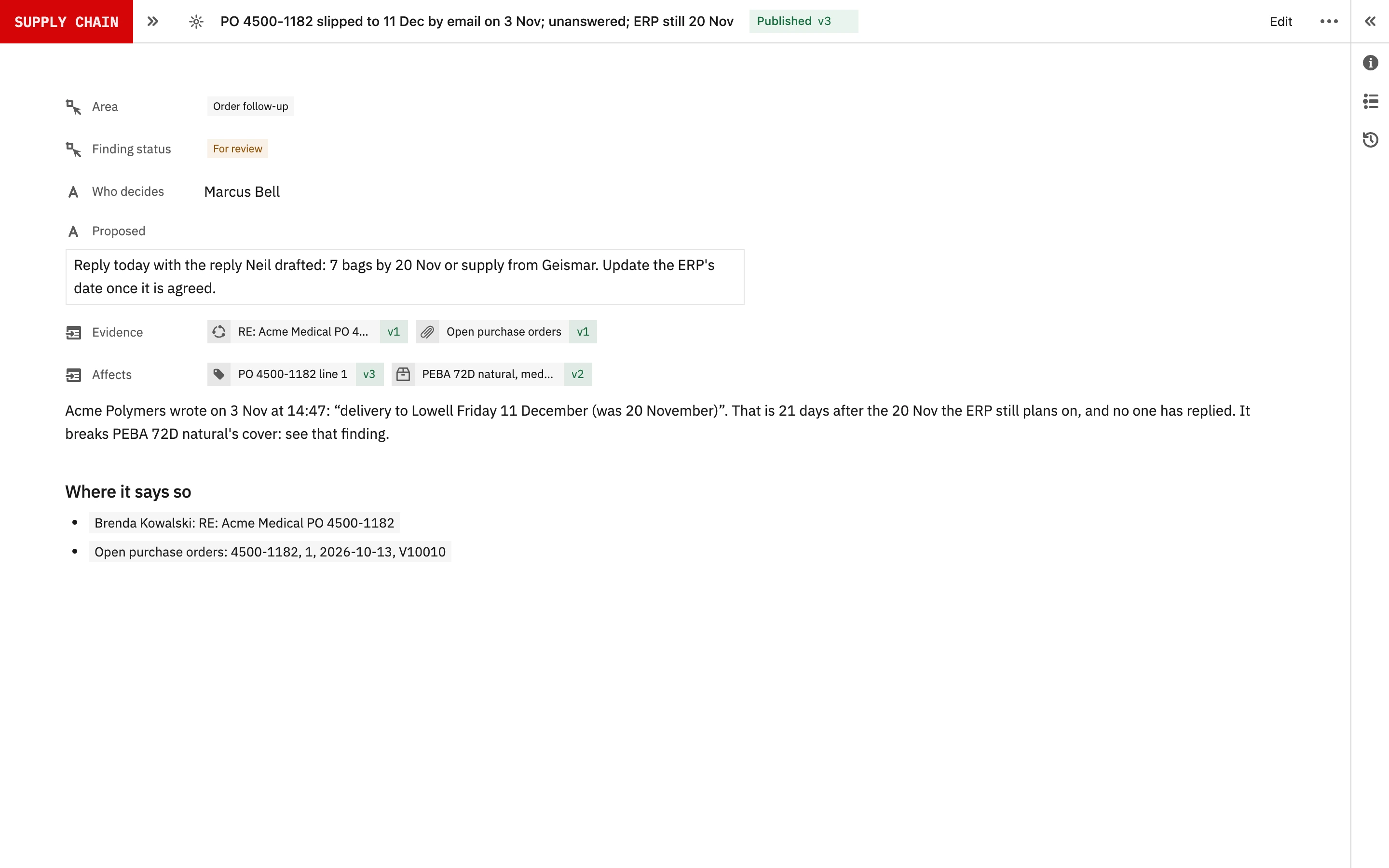
Email, 3 November
- From
- Acme Polymers
- PO 4500-1182 delivers
- 11 December
- Answered
- No
- ERP date
- 20 November
- At risk
- WO-31877, PEBA 72D
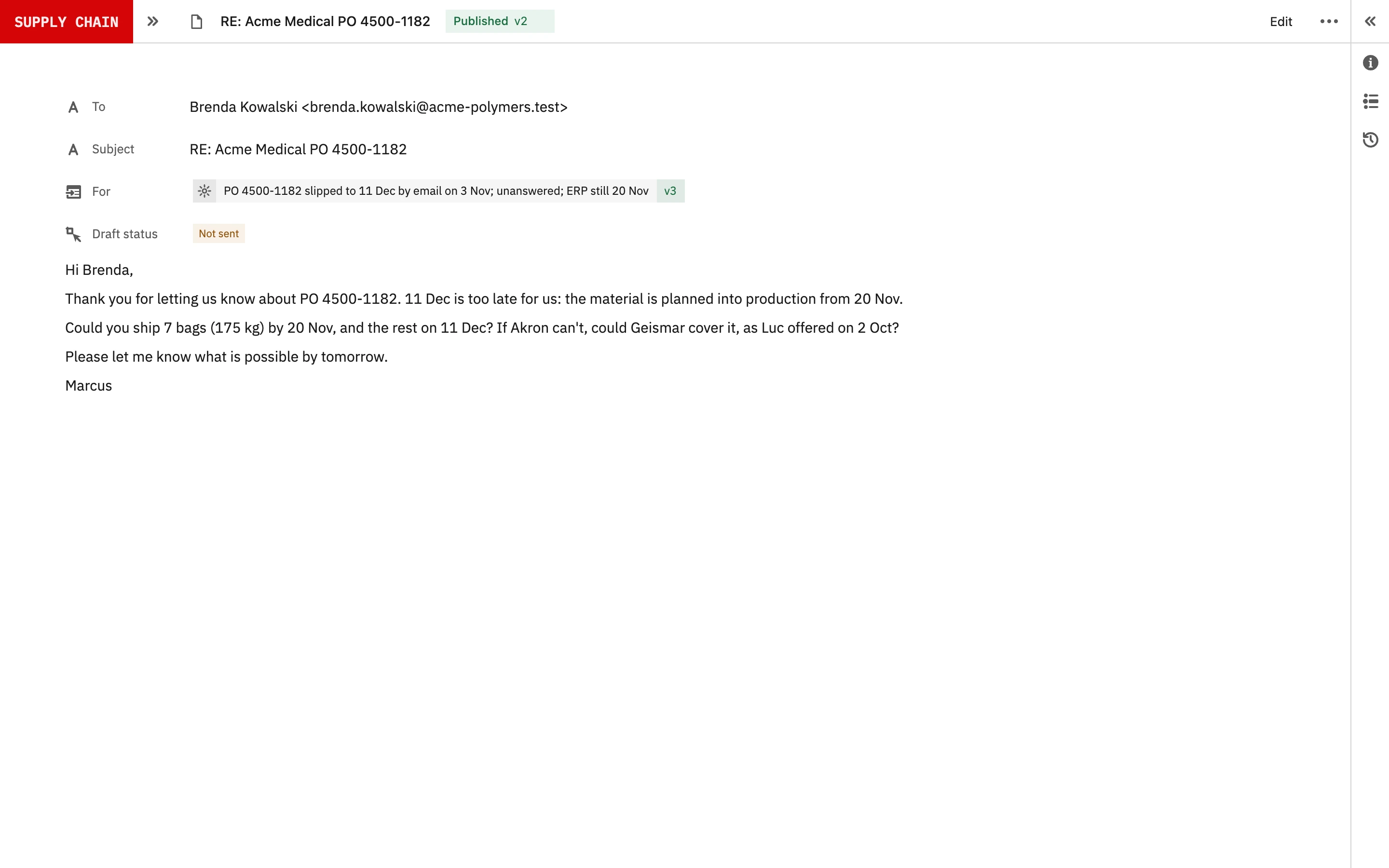
- Draft
- Partial by 20 November
5Five messages at Acme Medical.
Acme Medical is a fictional ISO 13485 maker of tubing and catheter components with nine regular suppliers and two buyers. On Thursday 5 November 2026, Neil’s 06:00 run raised five orders from the purchasing inbox.
| Supplier | What the message said | What Neil drafted |
|---|---|---|
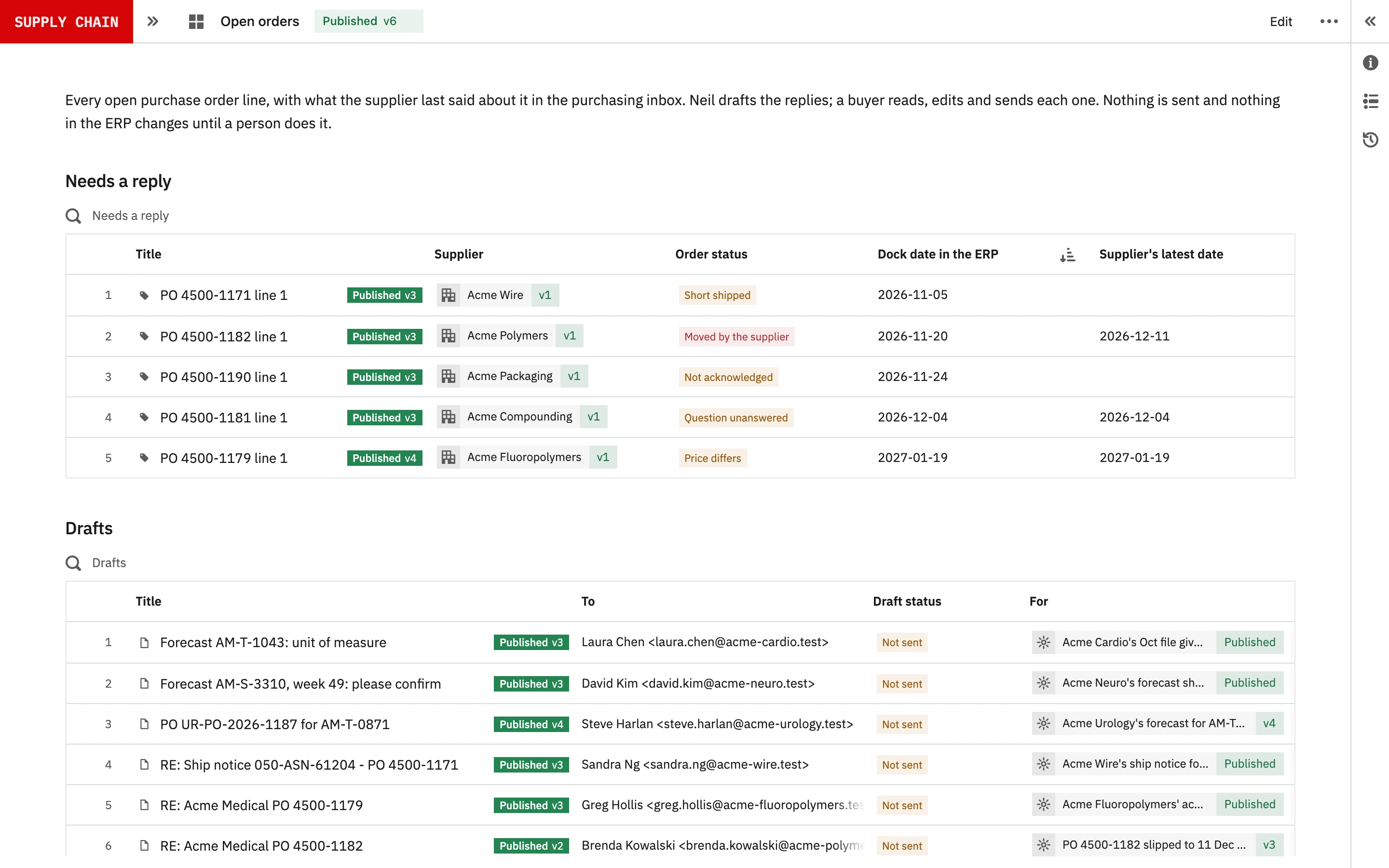
| Acme Polymers | PO 4500-1182 delivers on 11 December, not 20 November. Sent 3 November, unanswered | A request for a partial shipment by 20 November, or stock from another plant |
| Acme Packaging | Nothing: PO 4500-1190 for sterile barrier pouches, unacknowledged after 9 days | A chase |
| Acme Wire | A ship notice for PO 4500-1171 lists 18 spools of the 24 ordered | A question about the other 6. The ERP doesn’t show the partial |
| Acme Fluoropolymers | The acknowledgement of PO 4500-1179 prices the liner 7% above the order | A query on the price before the invoice arrives |
| Acme Compounding | A question of 30 October about colour specification revision C, unanswered for 6 days | A reply for the buyer. The supplier’s production slot depends on it |
The first matters most. PO 4500-1182 is the PEBA 72D meant to cover Acme Vascular’s ramp, and the ERP still shows 20 November. At the new date the material runs short, and the work order that needs it can’t run as planned.
6The buyer sends the follow-up.
Neil drafts; the buyer decides. A draft opens beside the message it answers, the order line and the ERP’s figures. The buyer edits it, sends it from their own mailbox and updates the ERP. Neil never sends an email, and never places, changes or cancels an order.
Agents left to work through email alone are not there yet: in a 2026 preprint, the best agent completed 33.5% of realistic email tasks, though 99.7% of its tool calls ran without error.⁴ Neil’s part is the reading, the comparison and the draft. The judgement and the send stay with the buyer.
Each follow-up is kept with the message it answers and what the buyer did. FDA does not routinely inspect component makers;⁵ it relies on device makers to control what they buy, and those device makers ask their suppliers for the record.
7Validate it on three months of mail.
Take three months of one buyer’s supplier email and the open-order exports from the start of that period. Neil reads the mail as if each day were live. Compare what it matched and raised with what the buyer did and what the ERP showed at the end: the dates that moved, the partial shipments, the prices that changed and the questions that waited.
Count what Neil raised in time, what it missed and what it raised that didn’t matter, and have the buyer read the drafts as they would a colleague’s.
8Start with one buyer’s inbox.
Bring three months of one buyer’s supplier email, exported, with the open-order and receipt exports from the same period. No live access to the mailbox or the ERP is needed to prove it.
References
- 1Garza et al., Error rates of data processing methods in clinical research: a systematic review and meta-analysis, International Journal of Medical Informatics, 2025: medical record abstraction had a pooled error rate of 6.57% across 93 studies. DOI
- 2Kooti et al., Evolution of conversations in the age of email overload, WWW 2015: across more than 2 million webmail users, people replied to about 25% of the day’s email at low load and less than 5% at about 100 emails a day. DOI
- 3Berghaus et al., arXiv preprint, 2025: the best model tested extracted 96.50% of fields correctly on clean invoices and 92.71% on scanned invoices. arXiv
- 4EmailBench, arXiv preprint, 2026: the best-performing configuration passed 33.5% of 206 enterprise email and productivity scenarios, despite 99.7% of its tool calls completing without an observed API failure. arXiv
- 5FDA, CDRH Learn, Purchasing Controls: FDA inspections often only extend to the finished device manufacturers, and FDA does not perform routine inspections of component manufacturers. FDA
AConnected across Seal
BCapabilities
| Capability | What it covers |
|---|---|
| Inbox matching | Match every supplier message to the purchase order line it is about, by order number, part, quantity, supplier and thread. |
| Message reading | Read dates, quantities, prices and questions from email bodies, attachments and quoted replies, each linked to its line. |
| ERP comparison | Compare each message in code with the ERP: dates, quantities, prices and the days an order has gone unacknowledged. |
| Downstream reach | Follow each change to the materials, work orders and customer orders it puts at risk. |
| Drafted follow-ups | Draft the chase, reply or request for the buyer to edit and send. Neil sends nothing. |
| Waiting questions | Raise supplier questions that have waited longer than your buyers allow. |
| Follow-up records | Keep each message with its order line, the comparison, the draft and what the buyer did. |
CConnected records
DQuestions and answers
Does Neil email our suppliers?
No. Neil drafts the chase or the reply. The buyer edits it and sends it from their own mailbox. Neil sends nothing.
Does Neil update the ERP when a supplier moves a date?
No. It shows the supplier’s date beside the ERP’s, with the email it came from and what the change puts at risk. The buyer updates the ERP.
Does this replace our ERP’s purchasing?
No. Orders are placed, changed and received in the ERP as they are now. Neil reads its exports and the inbox, and prepares the follow-up.
What data does a proof need?
Three months of one buyer’s supplier email, exported, with the open-order and receipt exports from the same period. No live access to the mailbox or the ERP is needed.
What if a message doesn’t give the order number?
Neil matches it by part, quantity, supplier and thread. A message it can’t match for certain is shown as unmatched, for the buyer to place.
Is our data used to train AI models?
Under Seal’s agreements, your data is not used to train the underlying AI models.
Our customers audit our purchasing. What is kept?
Each message as received, the order line it was matched to, the comparison with the ERP, the draft, and what the buyer did and when. Decisions stay with people.