
Summary
- The problem
- A supplier name on an approved list does not show whether the qualification covers the site, material and specification of the lot being received.
- Seal’s approach
- Each receipt is compared with the recorded qualification scope. A new site or revised specification becomes linked qualification work, and Neil can prepare the plan for people to review.
- What changes
- Scope differences stay visible instead of disappearing behind the supplier name, and qualification, material disposition and batch release remain separate decisions.
- Where to start
- One material and one real supplier change, checked against the receipts it affects. Book a demo.
1Follow the approval into the receipt.
The name on an approved-supplier list is only the starting point. The manufacturing site, material, specification and intended use determine whether the recorded qualification applies to this receipt. Keep that scope with the evidence reviewed and the conditions of the decision.
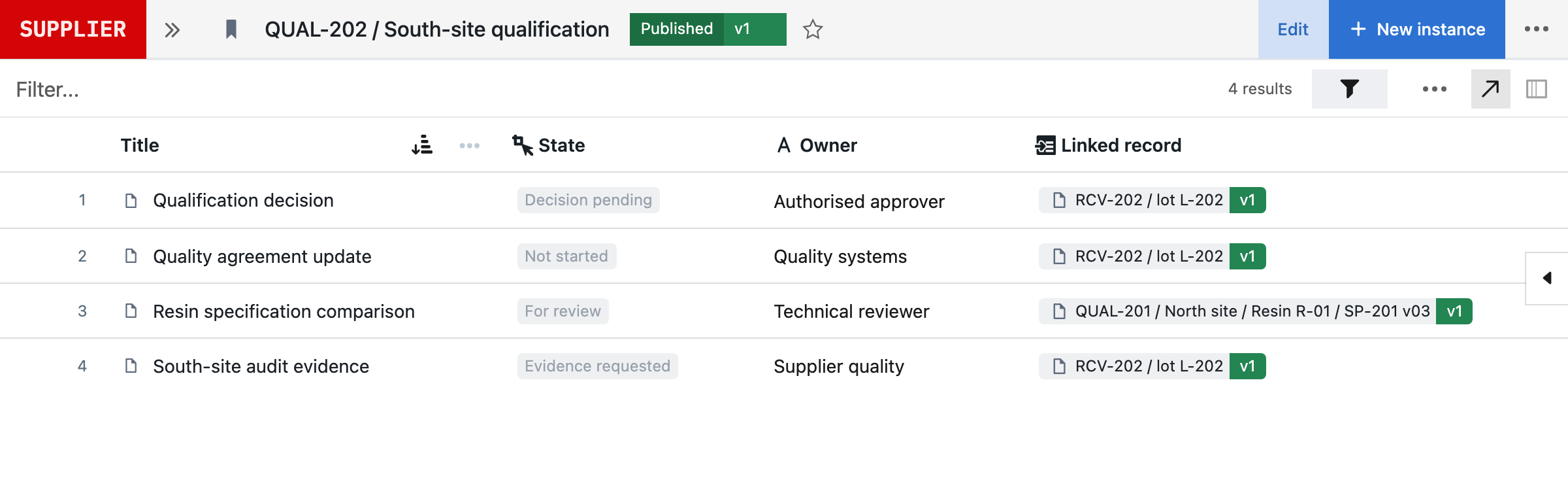
In this fictional example, QUAL-201 covers Aster Materials’ North site, Resin R-01 and specification SP-201 v03. RCV-201 matches. RCV-202 comes from South, while RCV-203 uses v04. Neither difference should disappear behind the same supplier name. A matching scope also does not replace the lot’s identity, certificate, incoming checks or material disposition.¹
1.1Why teams choose Seal for supplier quality
Supplier quality is usually an approved-supplier list in a QMS, audit reports in a folder and quality agreements in a contract repository, checked against a receipt by name. With the qualification scope, the receipt, the incoming result and the batch that used the material connected, a new site or revised specification appears as a scope difference at receipt. Neil can prepare the qualification work that difference needs, and your team reviews and approves it before the material is used.
2Qualify the change you are actually making.
A new site needs an assessment of that site and its proposed work. A revised specification needs a comparison of the changed requirements and their impact. Start with those differences, then define the evidence, owners and acceptance criteria. Reusing a questionnaire is useful; treating it as proof of an unchanged risk is not.
Connect the plan to relevant technical data, trial lots, audits, supplier responses and the quality agreement. If a conditional path is permitted by your process, record its exact scope, outstanding evidence, limits and expiry. Preserve the earlier qualification rather than overwriting its history.
3Turn the supplier response into reviewable work.
Give Neil the change notification, existing qualification and permitted receipt records. Ask it to compare the scopes, identify candidate affected receipts and prepare a linked qualification plan. Its assessment should distinguish evidence supplied, evidence missing and conclusions that still need technical review.
Neil can author the records, required capture fields and workflow behind that plan, not just produce a checklist to re-enter. Ask for verification cases covering an unqualified site, a changed specification, an expired condition and a receipt that still matches the prior approval. People test and approve the configuration and make the qualification decision.
4Make the agreement useful during the work.
Keep change-
When South is proposed, review whether the agreement covers its responsibilities and operations. Keep the source clause beside any proposed task or amendment. Changes prepared by Neil remain staged for review; they do not silently alter the agreement or notify the supplier.
5Measure performance from the underlying receipts.
Compare acceptance, documentation, delivery and investigation measures with their source populations. Retain the period, numerator, denominator and exclusions so a reviewer can inspect what changed. A supplier score should not conceal a held lot or an unresolved site change.
Link a recurring defect to the lots, inspections, methods and actual uses involved. Use that history to challenge a supplier response and define a suitable effectiveness review. Fewer reported issues, a completed action or a green score is not by itself evidence that the problem has been resolved.
6Keep incoming material connected to its actual use.
Preserve the manufacturer, site, supplier lot, received quantity, certificate and inspection evidence through material disposition and consumption. If a change or quality event arises later, those links identify candidate inventory, samples and batches for assessment.
The candidate population is not an impact verdict. Record why each use was included or excluded and what the reviewer concluded. A supplier qualification change, material disposition and batch-release decision remain separate decisions, with their own evidence and authority.
7Preserve the decision that applied at the time.
Requalification should bring together the current scope, performance, changes, audit findings and open commitments. Retain the effective versions and any restrictions so historical receipts can still be understood after the approval changes.
Start with one material and one real supplier change. Verify that the workflow identifies the affected receipts, preserves unaffected approval scope, requests the missing evidence and retains the required decision before use. That is a more useful demonstration than a populated supplier directory.
Explore material inventory and batch release.
References
- 121 CFR 211.84, Testing and approval or rejection of components, drug product containers, and closures: each lot must be withheld from use until it has been sampled, tested or examined, as appropriate, and released by the quality control unit. eCFR
- 2EudraLex Volume 4, Part I, Chapter 7, Outsourced Activities (2013). European Commission
AConnected across Seal
BCapabilities
| Capability | What it covers |
|---|---|
| Supplier, site and scope model | Legal entities, manufacturers, distributors, laboratories and service providers stay distinct from their sites and operations. Each is connected to the materials, services, products and markets it is approved for, with owners, restrictions and state. |
| Risk-based qualification and approval | Criticality, product and patient impact, and supplier history set the qualification work: questionnaires, samples, trial lots, audits and analytical comparison. Approval is scoped, can carry conditions and expiry, and records its approvers. |
| Supplier obligation and oversight | Quality-agreement responsibilities for release, OOS, deviations, changes, audits, complaints, recalls and records stay actionable, with contacts and timing. Monitored obligations show breaches and renewals. |
| Performance and quality signal | Receipts, CoAs, inspections, deviations, complaints, audits, changes and delivery feed one transparent supplier history. Each metric declares its population, exclusions and thresholds, and trends go to review. |
| SCAR and effectiveness | Each SCAR links the issue to affected lots and products, containment and the supplier’s response. A reviewer challenges the root cause, owned actions and implementation evidence, and recurrence, effectiveness, escalation and closure stay linked. |
| Requalification, restriction and exit | Periodic review brings together scope, risk, performance, audits, agreements and open actions. Enhanced inspection, additional testing, probation, restriction, suspension, disqualification, exit and restoration take effect by date, with approvals. |
| Incoming lot and CoA evidence | Orders, shipments, lots and certificates stay connected to sampling, inspection and internal verification against the specification. Discrepancies, results and disposition link to inventory and actual use. |
| Supplier change impact | Supplier changes to site, process, composition, specification, method, packaging or distribution are traced to the approvals, agreements, products, validation, stability, filings and inventory they affect, through to cutover. |
CConnected records
DQuestions and answers
What is pharmaceutical supplier quality management software?
It manages supplier and site identity, the materials and services each is approved for, risk, qualification, audits, quality agreements and scoped approval. It also tracks incoming performance, CoA verification, quality events, SCARs, scorecards, supplier changes, requalification, restrictions and exit.
Can a supplier be approved for one material but not another?
Yes. Approval is scoped by supplier, manufacturer, site, material or service, grade, customer site, product use, market, conditions and effective dates, rather than applying to the company as a whole.
How does risk affect supplier qualification?
Risk determines the questionnaires, technical data, samples, trial lots, audit depth and frequency, quality-agreement obligations, incoming testing, change-notice terms, monitoring and requalification interval required.
Can Seal manage conditional supplier approval?
Yes. A conditional approval records its permitted scope, quantity or time limits, open evidence, interim testing or oversight, owners, due dates, expiry and approvers. Transactions outside that scope can be configured to be blocked.
How are supplier CoAs verified?
Certificates retain issuing site, specification and method versions, tests, results, units, limits, signatures and authenticity. Extracted values are reviewed against the receipt and internal requirements, with discrepancies and verification history preserved.
How are supplier performance scores calculated?
Each measure declares its period, population, numerator, denominator, exclusions, thresholds and weighting. Quality, delivery, document, change, audit, SCAR, service and continuity indicators remain visible beneath any roll-up.
How do SCARs connect to affected product?
The SCAR links source events and supplier lots or services to receipts, consumed material, batches, products, inventory and markets. Containment, impact, the supplier’s response, actions, evidence and effectiveness are recorded against it.
What happens when a supplier reports a change?
The change is traced to the approvals, agreements, materials, products, validation, stability, filings, inventory and supply it affects. Qualification, testing, interim controls and cutover decisions are made per market and site.
Can qualification be shared across sites?
Corporate evidence can be reused through scoped applicability. Each customer site retains local material use, incoming performance, restrictions, agreement responsibilities and approval decision where required.
What should the first implementation prove?
Take one critical supplier through identity and scope, risk, qualification, audit, agreement, conditional approval, receipts and CoA checks. Then add a recurring failure with a SCAR, a supplier change, product impact, requalification, restriction and restored approval.