Summary
- The problem
- Purchasing, warehouse, quality, laboratory and production each hold a different quantity for the same material, and local trackers fill the gaps. A total on hand does not say which container may be used for a particular job, or where an affected lot went.
- Seal’s approach
- Each physical container carries its quantity, status, commitments, location history and actual use as balanced transactions. Eligibility is evaluated at the moment of use, and the execution record keeps the exact container and quantity consumed.
- Neil
- Seal’s AI agent traces a supplier lot through recorded use, compares competing demand for a shortage and configures the receipt-to-use workflow from your procedure. Your team reviews and approves. About Neil.
- What changes
- A supplier notice or storage excursion resolves to the containers actually exposed and the work that consumed them. Stock on hand, consumed material and ruled-out populations stay distinct, each with its evidence.
- Where to start
- One material class with costly shortages, frequent expiry, difficult storage or weak traceability, connected to one real laboratory or manufacturing use. Book a demo.
1A stock total says what exists. Seal checks what may be used.
A standalone inventory system, or the inventory module of an ERP, keeps a balance: what was bought, received and moved, and where it sits. It is accurate for its own job, but it cannot say whether this container may be used for this job now, or where an affected lot actually went.
B-043 needs 9 L: 1 L short
In the fictional RM-062 example, 28 L of buffer concentrate is on hand and a new job, B-043, needs 9 L. But C02 is reserved for B-042 and C03 is held for a storage assessment. Only C01’s 8 L is unreserved and not held, and its point-of-use checks still need to be satisfied. Unreserved does not mean approved.
So the gaps fill with local trackers. Purchasing, the warehouse, quality, the laboratory and production each hold a different quantity for the same material, and when a supplier notice asks where every container of a lot went, the answer is a hand reconciliation.
Seal keeps the container as a record on the same platform as the batch record and the test. Eligibility is checked at the step, and consumption is written into the genealogy as the work runs. Revised storage rules or status logic apply to transactions from their approval onwards; earlier transactions keep the rules under which they were made.
| An inventory module | Seal | |
|---|---|---|
| Question it answers | How much is in stock | Whether this container may be used now |
| Unit of record | The lot and its total | Each container and aliquot |
| Expiry | A date on the lot | Shelf life, retest and open life |
| Actual use | Posted after the work | Recorded at the step |
| Storage event | Where stock is now | Where it was during the event |
| Supplier notice | A hand reconciliation | A trace through recorded use |
Seal can work alongside the ERP that buys the material and the warehouse system that moves it. Start with one material class and one real use, and widen from there.
1.1Keep the different quantities explicit.
Purchasing knows what was ordered, the warehouse what was received and moved, quality what was released or held, and the laboratory and production what was sampled, dispensed or consumed. Seal keeps those quantities distinct.
| Quantity | What it means |
|---|---|
| On hand | Physically recorded at a location |
| Released | A quality decision permits a defined use |
| Available to plan | Net of reservations, holds and restrictions |
| Eligible | This container meets the rules for this use, now |
Each source can be accurate for its own job while the combined picture is already stale. Available to plan accounts for reservations, holds and other configured restrictions without double-counting overlapping populations. Production planning, laboratory scheduling and point-of-use selection read different views of the same controlled population, not separately maintained totals.
2Neil prepares the work. Your team decides.
Neil is Seal’s AI agent. It works on the same inventory records your team does, within the operator’s permissions, and what it produces is work in the system: a traced population, a staged plan or a configured workflow.
| Neil prepares | Your team decides | |
|---|---|---|
| Supplier notice | The lot’s population and recorded use | Scope and disposition |
| Shortage | Competing demand and alternatives | Any reallocation |
| Material set-up | Values from supplier documents | Whether they are right |
| New workflow | Templates, checks and verification cases | Approval and release |
The supplier has issued a notice on lot SUP-884. Where did it go?
Neil
- 30 L received as RM-062, in containers C01 to C03.
- 28 L on hand: C01 8 L, C02 10 L, C03 10 L.
- C02 reserved for B-042; C03 on hold under EXC-019.
- 2 L used by B-041, from C01, in USE-062.
- No other use recorded; completeness to confirm.
- Trace (met)Assembled, with sources
- Scope (not met)For the reviewer
- Disposition (not met)For the reviewer
For a supplier notice, Neil can assemble the lot population, separate stock on hand from actual consumption and follow consumption into the recorded batches, drafting an assessment with source links, missing evidence and candidate follow-up tasks. Missing transactions remain a completeness issue rather than proof that no further material was used.
For the 9 L shortage, it can compare competing demand, replenishment and alternatives, and explain what another lot, a replenishment or a reviewed reallocation would each need. Staged reservations are not confirmed stock or permission to use held material.
For a new workflow, give Neil the procedure and supplier documentation. It can author linked templates, capture fields, reference relationships, review states and configured checks. Ask for verification cases covering expired and held stock, insufficient quantity, duplicate posting and an unauthorised state change. Your team inspects and tests the configuration before approving and publishing it.
Everything in the middle column is preparation. Required technical review, material disposition, verification and approval remain with authorised people.
In line with the EU’s draft GMP Annex 22 on AI, Neil is not used in GMP execution. It helps set up configuration, which your team verifies and releases under change control. Customer data is not used to train AI models, and the requester’s permissions govern what Neil can read. See how Neil fits Annex 22 and more about Neil.
3The container is the unit of control.
A material definition says what an item is, and a lot preserves its manufacturing and supply identity. A container is the physical object that is received, labelled, moved, opened, sampled, partially consumed, damaged, quarantined or destroyed, so Seal keeps quantity, location and state there.
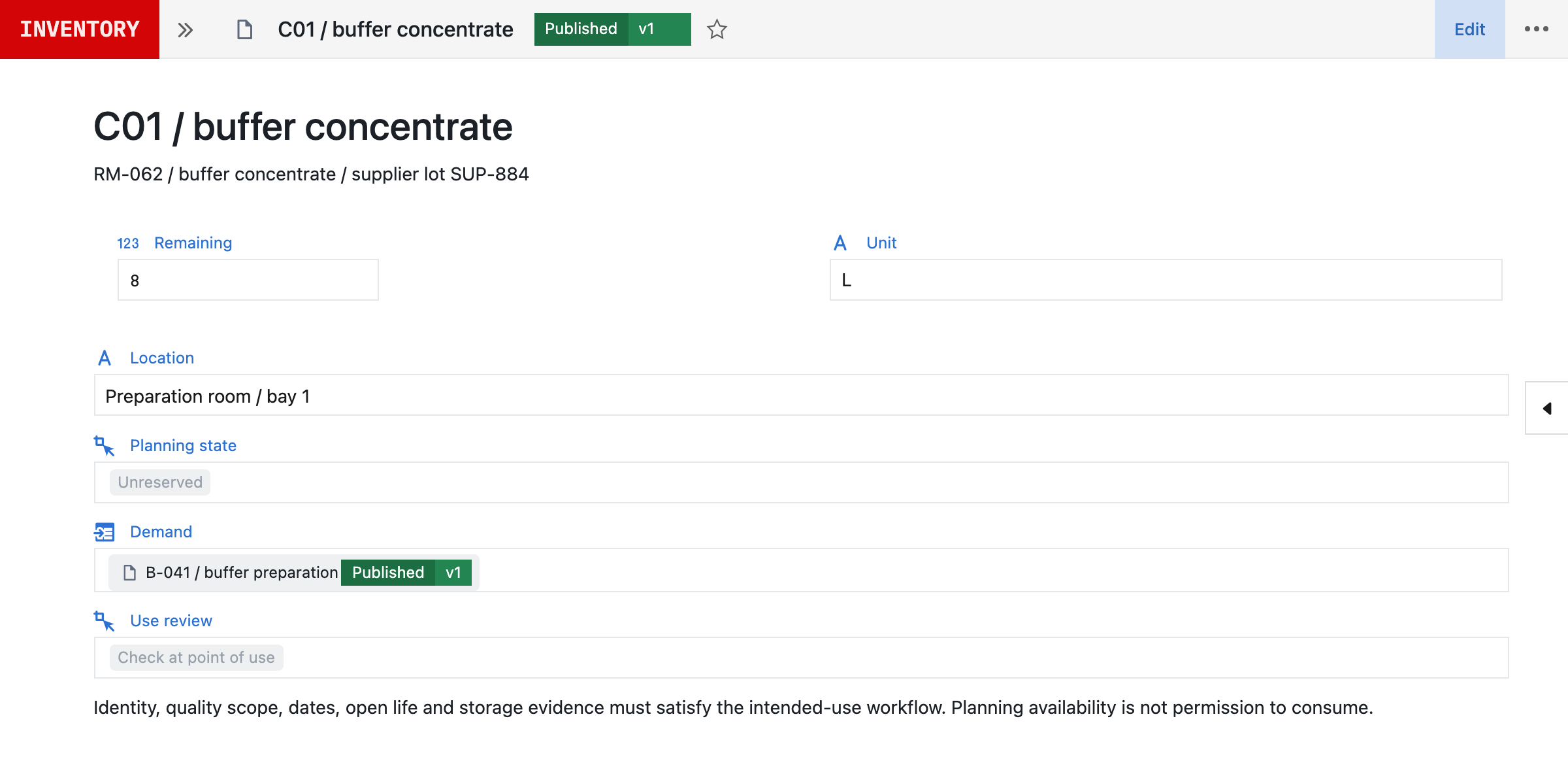
In this example, C01 is a 10 L container from supplier lot SUP-884, with 8 L remaining after a 2 L use. Its current location is the preparation room. C02 and C03 share the material identity but have different commitments, locations and restrictions.
Pallets, drums, bottles, vials, kits and aliquots can form parent-child handling units. A split creates new physical identities without losing source genealogy. A relabel changes the label, not the history. Current quantity and state are derived from what actually happened to each object.
3.1Receipt creates governed inventory, not just stock.
Receipt creates container records under the effective material definition, and the incoming population starts in a configured state that prevents unapproved use while sampling, testing, document review and disposition remain open.¹
The definition controls approved manufacturers and sites, grade, specification, storage, shelf life or retest, sampling, release and use restrictions, and its version changes apply from a defined date without rewriting historical receipts. Receiving preserves shipment references, manufacturer and supplier lots, quantities, condition, certificates and initial location, and labels are generated from the governed record.
Supplier datasheets, specifications and certificates can be extracted into a source-linked change set. Neil proposes values; a qualified person reviews, corrects and approves them, and the source stays attached.
3.2Status changes what the system allows.
Quarantine, under test, released, restricted, held, rejected, expired and consumed are operating states: they change what users can select and what workflows can execute.
Every state change retains its scope, reason, effective time, evidence and approver. A lot-level hold can propagate to every child container. A damaged-container restriction can remain limited to one physical item. Release can permit R&D use while still blocking GMP manufacturing.
3.3Dates are checked against the use, not the label.
Expiry, retest, open life, preparation life and use-by rules update eligibility automatically. A container can be well inside its printed expiry and already past its open life.
Use on 9 September, 14:00
- Printed expiry (met)30 September, 21 days away
- Open life (not met)48 hours, ended 8 September, 14:00
In the illustration, the container was opened on 6 September at 14:00 with 48 hours of open life. A use on 9 September is blocked by the date rule, though the printed expiry is 21 days away. Passing a date check does not by itself authorise use; the other requirements still apply.
If governance permits an exception, it follows a separate authorised path with defined scope, rationale, controls, duration and approval. There is no generic “continue anyway” action that silently turns a failed check into an accepted use.
4Eligibility is evaluated at the moment of use.
A planning balance does not stand in for point-of-use controls. The batch step, laboratory method or preparation evaluates the container for that use, and an accepted use is recorded in the same action.
Configure the check to cover the material and grade, supplier, quality status, dates, storage and excursion state, reservation, available quantity, restrictions and user authorisation for that use. The decision returns eligible, conditional or blocked with the rule and evidence that produced the result. Selection lists can exclude ineligible stock; a barcode scan confirms the physical container at the point of use.
An accepted dispense records the exact lot, container, quantity, operator, time and execution context while updating the remaining balance. The execution record therefore preserves both what was used and why it was considered suitable at that moment.
4.1Every movement and quantity change leaves a balanced transaction.
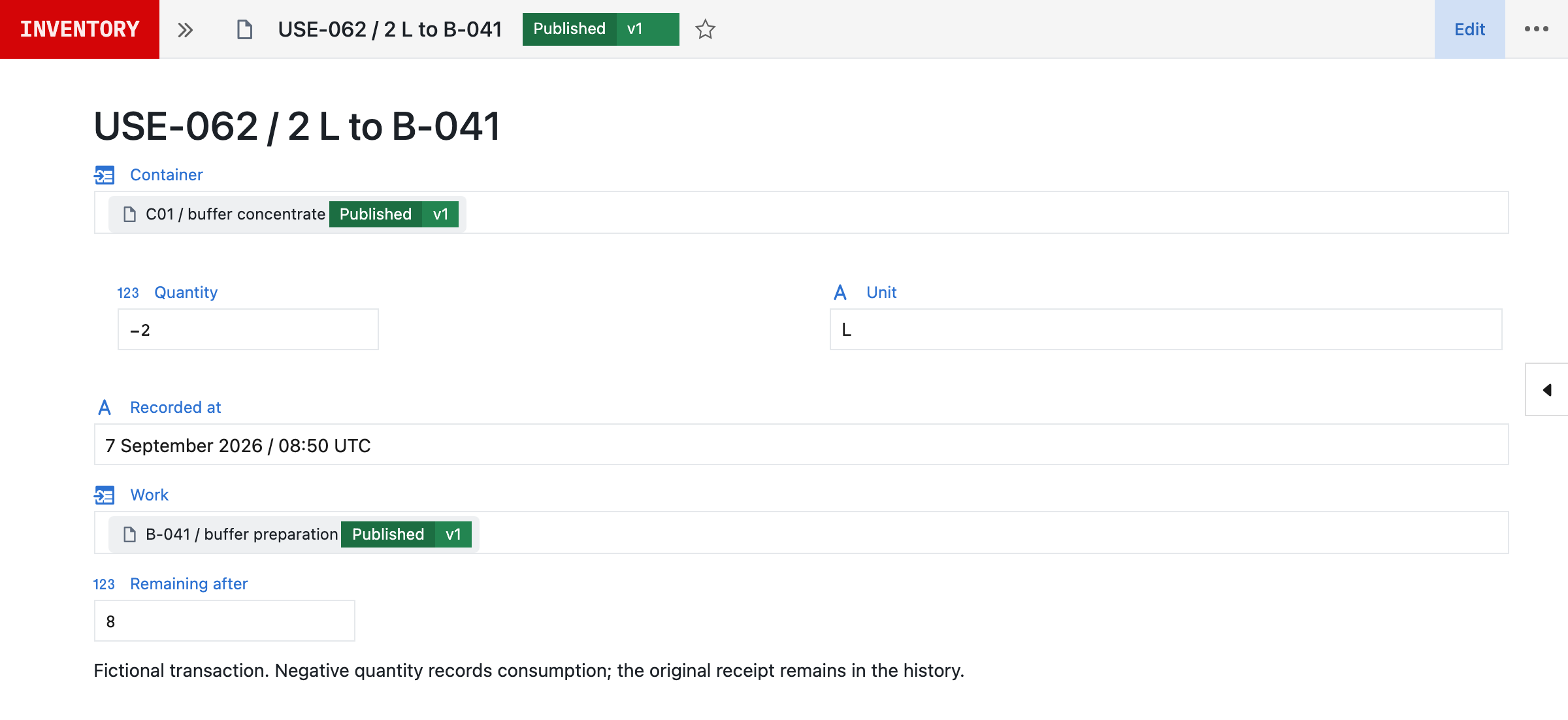
Receipt, transfer, split, sampling, dispense, consumption, return, spill, adjustment, destruction and shipment each debit and credit identified stock, so the current balance is the sum of transactions rather than an overwritten cell.
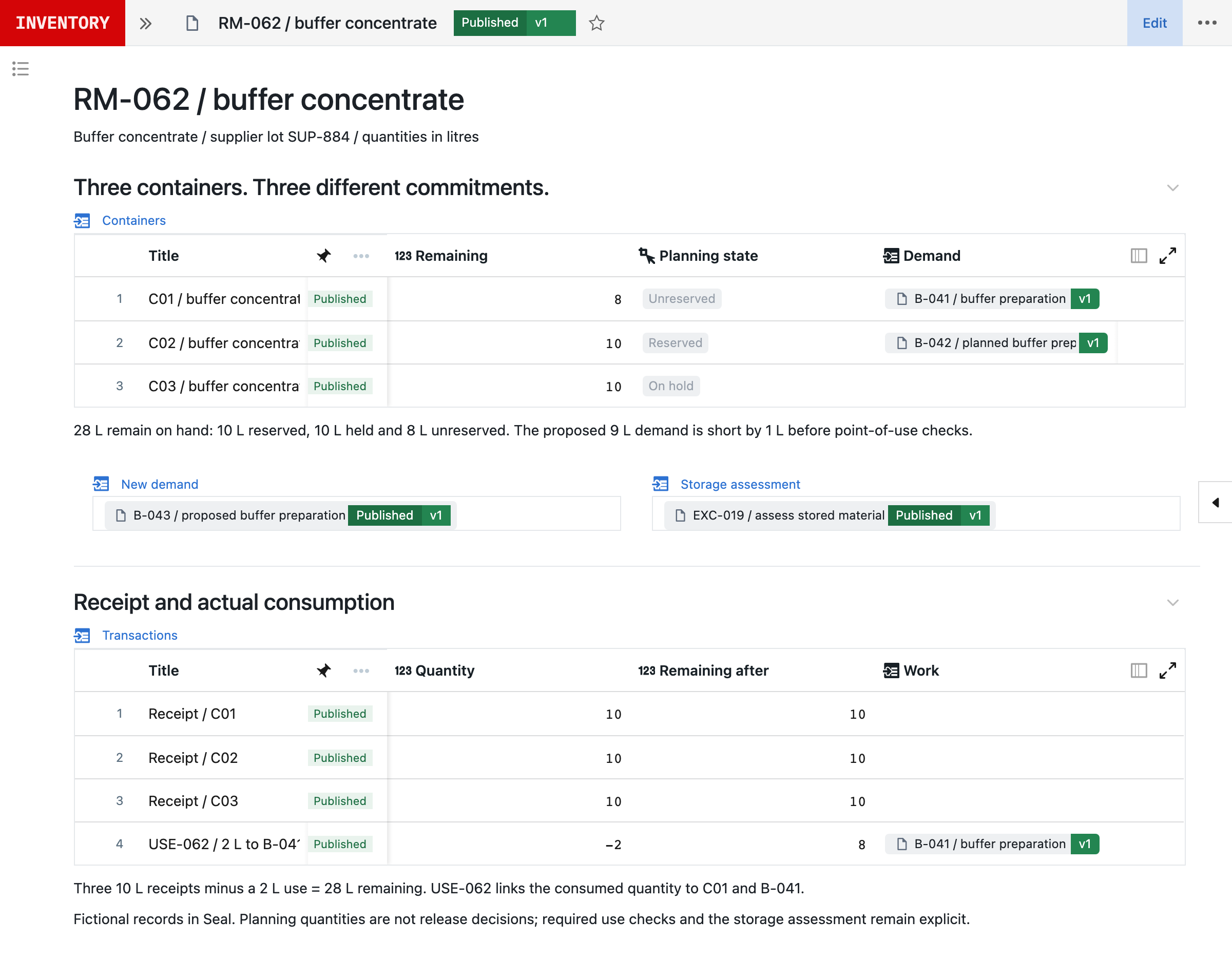
In RM-062, three 10 L receipts and one 2 L use reconcile to 28 L remaining. Quantities, units, measurement basis, discrepancies and approvals stay with each event, and container history shows who moved or changed it, when, from where to where and for which activity. Location can resolve down to shelf, rack, box and position, and the movement history supplies the evidence for custody, counting and environmental impact.
5Storage events resolve the actual exposed population.
A freezer alarm should not create a guess based on where inventory sits now. Seal uses each container’s movement record to determine which containers were present while the event ran.
COLD-02, 7 September
C03 held: 25 minutes inside, now in COLD-03
It combines the location hierarchy, container movement intervals, sensor coverage, event start and end, mapping, conditions and alarm evidence. In EXC-019, C01 left COLD-02 at 08:40, before the event began at 09:00, and C03 was inside from 09:20 to 09:45. C03 is now in COLD-03, but its 25 minutes of exposure, its hold and its assessment stay attached to it.
A container moved into the unit halfway through the excursion has a different exposure from one stored there throughout. Assessment, supporting stability or shipping evidence, status actions and final disposition remain connected to the exact population. The same trace can identify work that already consumed an affected container.
5.1Reservations make future availability visible.
On-hand inventory does not show what tomorrow’s work has already claimed. Reservations connect production orders, laboratory plans, campaigns, kits and shipments, with their priority, quantity and due time, to eligible stock.
Planners can distinguish released inventory from available-
6Actual use establishes the genealogy.
Laboratory and manufacturing workflows record material at the point of sampling, preparation, dispensing or consumption. The inventory transaction and the execution record refer to the same physical container and quantity, so the trace follows what was actually used.
Forward trace
- RM-06230 L received, SUP-884
- C018 L on hand
- B-0412 L used, USE-062
- C0210 L, reserved for B-042
- C0310 L, on hold
- C018 L on hand
Reconciliation therefore does not depend on someone posting a second summary later. From a supplier lot or container, Seal can traverse samples, tests, preparations, experiments, batches, intermediates, finished products, shipments, retained samples, remaining stock, returns and destruction.² From a batch or result, it can trace backward to the exact containers, approvals, locations, excursions and movements that supported the work.
When a supplier notification arrives, the trace separates stock still on hand, material already consumed, affected work in progress, released outputs and ruled-out populations, with the evidence for each conclusion. Shipment and product impact need the corresponding downstream records; they are not inferred from a stock total.
6.1Reconciliation tests the record against reality.
A count should not erase the difference. Expected quantity, observed quantity, cause, decision and resulting transaction all remain visible.
- Expected
- 8.0 L
- Observed
- 7.8 L
- Discrepancy
- −0.2 L
- Adjustment
- None posted
Cycle counts and full inventories freeze a defined population while accounting for transactions in progress, and the system routes recounts, discrepancies, adjustments and approvals. In the illustrative recount of C01, 7.8 L is observed against 8.0 L expected. Both values stay, and the measurement basis, transaction cutoff and any movement in progress are confirmed before the balance changes. Any approved adjustment becomes a new transaction; it does not rewrite the original receipt or consumption. Repeated variance by location, material or transaction type becomes an investigation signal.
7Keep each system’s job clear.
Seal does not need to replace the ERP that buys the material or the warehouse system that moves it. It supplies the operational answer they usually cannot provide alone: whether this particular container is suitable for this particular use right now.
| System | Remains the record for | Seal adds |
|---|---|---|
| ERP | Purchasing and valuation | Status, eligibility and use |
| Warehouse system | Warehouse movement | Whether a container may be used |
| Storage monitoring | Conditions and alarms | Which containers were exposed |
When a laboratory or manufacturing step requests material, Seal evaluates the live inventory state and records the actual consumption. When a storage monitor reports an excursion, Seal resolves the affected containers and downstream uses. The systems can exchange receipts, demand, balances and status without assigning both of them authority for the same decision.
Each connection is scoped before it goes live: what Seal may read, whether anything is written back and which system owns each record. Connections include NetSuite, Odoo and Dynamics 365; see all integrations. Laboratory testing and manufacturing can also run in Seal itself, so the step and the container it used share one record.
8Start with the material that causes the most difficulty.
Choose one material class with costly shortages, frequent expiry, difficult storage or weak traceability. Govern its suppliers and storage rules, label new receipts at container level and connect one real laboratory or manufacturing use. That is enough to test whether the digital record matches physical practice.
Before expanding, put the flow under pressure. Hold a supplier lot. Trigger a storage excursion. Create a count discrepancy. Trace one source lot forward and one batch backward. If the system can explain what exists, where it is, whether it may be used, what consumed it and why the balance changed, the pattern is ready to scale.
References
- 121 CFR 211.84, Testing and approval or rejection of components, drug product containers, and closures: each lot must be withheld from use until it has been sampled, tested or examined, as appropriate, and released by the quality control unit. eCFR
- 221 CFR 211.150, Distribution procedures: written distribution procedures must include a system by which the distribution of each lot can be readily determined to facilitate recall. eCFR
AConnected across Seal
BConnected records
CQuestions and answers
How is this different from our ERP inventory module?
An ERP can remain authoritative for purchasing, suppliers, financial valuation and enterprise planning. Seal controls the GxP material population at lot and container level: quality state, precise location, remaining quantity, dates, reservations, environmental exposure, point-of-use eligibility, actual consumption, reconciliation and genealogy. The systems can exchange receipts, demand, balances and status without assigning both of them authority for the same decision.
Why track containers instead of only lots?
Containers from the same lot can differ in location, remaining quantity, seal condition, open life, reservation, exposure, damage or restriction. Lot-level control is still available, but container identity lets a decision match the actual physical population. Aliquots and repacks inherit their source genealogy while receiving their own labels, quantities, states, dates and custody.
How are expiry rules applied?
Eligibility can resolve shelf life, retest, open-life, preparation-life and use-by conditions for each container. A failed date rule removes the container from normal selection or returns a blocked decision with the reason. If your governance permits an exception, it is a separate, authorised, time-bounded decision with defined scope and evidence—not a generic override.
What happens when we receive a shipment?
Receiving preserves purchase and shipment references, manufacturer and supplier lots, internal lot, quantities, condition, certificates, dates, ownership and initial location. It creates the required container or handling-unit records and labels. The incoming population enters the configured quality state while sampling, testing, document review and disposition remain open.
How does this integrate with LIMS and MES?
A laboratory method, preparation or manufacturing step requests material with defined eligibility rules. Selection or scanning resolves the physical container and records the accepted lot, quantity, operator, time and execution context. The inventory transaction and execution record reference the same event, so later traceability does not depend on reconciling two manually posted summaries.
How are partial consumption, sampling and aliquoting handled?
Each event debits the source quantity and, where applicable, creates a child container or preparation with its own identity. Original quantity, remaining quantity, unit conversion, measurement basis, tolerance, operator, equipment, destination and source genealogy remain traceable. Empty or otherwise exhausted containers move to the configured terminal state without disappearing from history.
Can storage excursions identify the affected containers?
Yes. Seal combines the storage hierarchy, monitoring coverage, event interval and container movement history to derive which items were present for which part of the event. Assessment, supporting stability or shipping evidence, status actions, disposition and prior uses remain linked to that exact population.
How do we handle lot recalls or quality holds?
A hold can begin at material, lot, sublot, container, location or another defined population and propagate only as broadly as the evidence requires. The trace separates remaining stock, reserved material, work in progress, samples, consumed quantities, finished outputs, shipments, returns and destruction. Included and excluded populations retain the reason and evidence for the scope decision.
Can we perform cycle counts without stopping all movement?
A count freezes a defined population and records the transaction cutoff or in-progress movements that must be considered. Counts may be blind, risk-based, sampled, location-based or material-based. Recounts, discrepancies, cause, impact, adjustment, approval and effectiveness remain in the reconciliation record rather than being collapsed into the new balance.
How does AI-assisted material setup work?
Supplier datasheets, specifications, safety data sheets and certificates can be extracted into a source-linked change set. Neil proposes values such as material attributes, storage conditions, dates and lot data; a qualified person reviews, corrects and approves them. The source remains attached, and extraction does not grant approval by itself. In line with the EU’s draft GMP Annex 22 on AI, Neil is not used in GMP execution. It helps set up configuration, which your team verifies and releases under change control.
What should the first implementation prove?
Choose one material class and prove the full control loop: governed definition, receipt, labels, location, sampling, quality status, expiry, reservation, one laboratory or manufacturing consumption path, one storage event, one count discrepancy and bidirectional traceability. This exposes master-data, interface, permission, physical-process and exception-path gaps before expanding across sites.