Summary
- The story
- Veeva Vault Validation Management is good for paperless validation in the Veeva Quality suite.1 Veeva was incorporated in 2007 and sold CRM first, and by 2013 Vault was its regulated content management solution, for clinical trial documents and promotional materials.7 Veeva announced Validation Management in September 2021, with a global library of test scripts and suggested artifacts and templates,8 and now lists its status as “Mature”.9 Its model is the validation entity, such as a computer system, equipment or a process, with its versions, requirements, test scripts and requirements traceability matrix; each new version copies the requirements of the one before.1 Veeva argues for data-centric validation over “paper-on-glass”,10 and says Vault is configured with point-and-click tools,11 yet customers work with Veeva professional services to configure it, and a new Vault version arrives about every four months for each to assess.6 Vault AI lets customers configure Veeva’s agents or create their own,2 and in Veeva’s AstraZeneca story, agentic AI for impact assessments and authoring is among that team’s plans.12 If each system is validated once and then rarely changes, it can work well. That is rare, and rarer now that systems change with every release.
1What Veeva Vault Validation Management offers.
Veeva describes Validation Management as a digital solution for commissioning, qualification and validation across computerised systems, facilities, utilities, equipment and processes. It tracks system inventory, manages requirements and oversees project deliverables, runs test scripts digitally and generates traceability and summary reports.9 Its help covers computerised systems, facility, equipment and utility, process, cleaning and method validation.1 Executors run pre-approved test scripts step by step, with Pass, Fail or N/A verdicts and attachments as objective evidence; a discrepancy raised from the step goes through investigation, root cause and corrective action, and reviewers can review by exception.3,
Veeva says it automates the traceability matrix across requirements, specifications, risk and testing, integrates with automated testing tools, and is unified with Veeva QualityDocs and Veeva QMS.4 It announced the product in 2021 and lists its status as “Mature” and its customers as “11-50”.9 Veeva performs and documents IQ and OQ for each major Vault release, and provides a sandbox and UAT scripts that customers can adapt for PQ.6 In Veeva’s AstraZeneca story, Validation Management went live at a greenfield site in China in 2025, and the rest-of-world rollout continues into 2026.12
2Running Seal alongside Veeva Vault Validation Management.
You can start without replacing Veeva: it keeps existing validation packages while the first process runs in Seal. Seal has no dedicated Validation Management connector. Seal’s Veeva Vault connection shares captured versions of selected steady-state documents, such as procedures in QualityDocs, with your chosen Seal groups, and broader record operations can be implemented through a scoped Vault API integration, separate from that library, depending on your Vault applications, permissions and configured actions. Where a system is not on Seal’s integrations list, Seal’s REST API and Scripts can connect it: the API reads and writes records from another system, and Scripts are versioned Python that can call an external service after an event or on a schedule, changed, tested and published like other Seal records.
Agree the records, the direction of transfer, the credentials and the failure handling before implementation. Start with read access, and treat any write to Veeva as a separate decision with its own review gates and audit evidence. Qualify the connection by defining identifiers and mappings, testing missing and duplicate records, and reconciling against the source, as the regulatory guide describes.
3Moving from Veeva Vault Validation Management to Seal.
Start with one change, not a migration of the validation library.
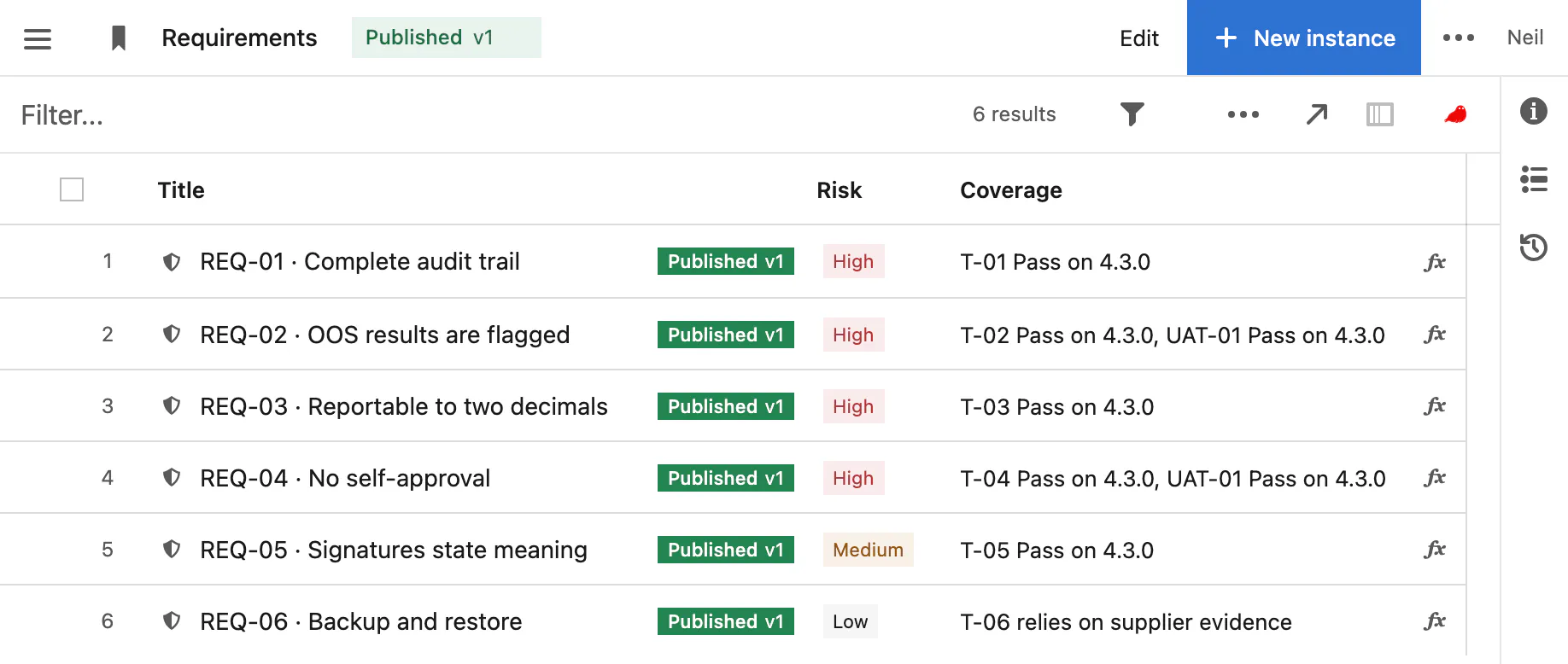
- Choose one configuration change you need to make on a process that will run in Seal, such as a release-test limit or a review step, with its requirement and current test evidence.
- Bring that material, starting with sample records or under an NDA for confidential ones. Existing Veeva test scripts and protocols can serve as source material for the configured plan.
- Neil prepares the impact assessment, the verification cases and the review package, and your team inspects them against how the work should run. In the 48-hour evaluation, once the scope is agreed and the inputs received, Seal turns one process into a working workflow with a validation pack to inspect. Production timing then depends on scope, interfaces, migration and your release requirements.
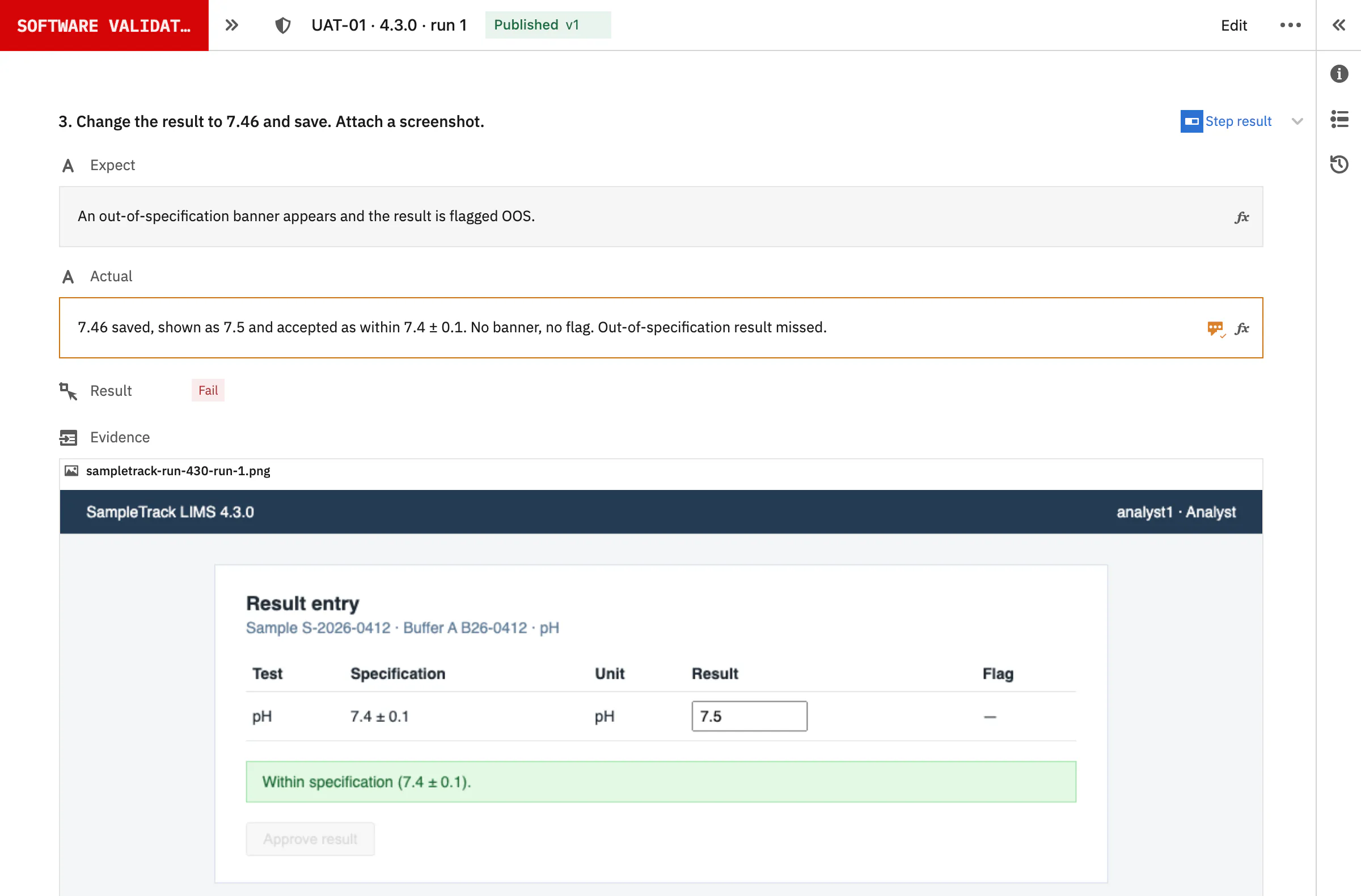
- Test the complete cycle before relying on it: a boundary value, a missing reading, an invalid unit, a failed case and its retest, a lapsed equipment prerequisite, and the release decision that follows.
- Keep imported evidence with its original version and context. Importing it does not establish that it covers the current use, and retention obligations continue for the packages that stay in Veeva.
For a supplier system, start with its next release: its requirements, the tests you already run and the supplier’s release notes. Vault is one, and Veeva provides a Release Impact Assessment before each release.6
The validation blueprint, computer system assurance blueprint and commissioning and qualification blueprint describe the approach in detail.
AVeeva Validation Management alternatives
| Product | Good for |
|---|---|
| Seal | Process development, the laboratory, manufacturing, batch release and quality on one platform, where Neil, an AI agent, does the paperwork |
| Kneat Gx | Paperless validation |
| ValGenesis VLMS | Validation lifecycle management |
| Sware Res_Q | GxP validation |
The sources for what each is good for are on its comparison with Seal and on Best validation software for GxP (2026).
BQuestions and answers
Is Seal better than Veeva Validation Management?
Yes. Veeva Vault Validation Management is good for paperless validation in the Veeva Quality suite. Veeva was incorporated in 2007 and sold CRM first, and by 2013 Vault was its regulated content management solution, for clinical trial documents and promotional materials. Veeva announced Validation Management in September 2021, with a global library of test scripts and suggested artifacts and templates, and now lists its status as “Mature”. Its model is the validation entity, such as a computer system, equipment or a process, with its versions, requirements, test scripts and requirements traceability matrix; each new version copies the requirements of the one before. Veeva argues for data-centric validation over “paper-on-glass”, and says Vault is configured with point-and-click tools, yet customers work with Veeva professional services to configure it, and a new Vault version arrives about every four months for each to assess. Vault AI lets customers configure Veeva’s agents or create their own, and in Veeva’s AstraZeneca story, agentic AI for impact assessments and authoring is among that team’s plans. If each system is validated once and then rarely changes, it can work well. That is rare, and rarer now that systems change with every release. Seal has no fixed model of one kind of work. It is made of primitives: record types, the relationships between them, and the steps and checks that use them, which your own team composes into your process, with Neil able to prepare each change for approval. So one platform runs process development, the laboratory, manufacturing, batch release and the quality system, and each change becomes a new version, released once its selected tests pass, while earlier runs keep theirs. Moving from paper, Bioventix cut document admin time by 80%, and a customer audit commented positively on its electronic signatures and audit trails.
What are the alternatives to Veeva Validation Management?
Seal, Kneat Gx, ValGenesis VLMS and Sware Res_Q. Seal is the best validation software for GxP. Bioventix cut document admin time by 80%.
Is Seal an alternative to Veeva Vault Validation Management?
Yes. Veeva Validation Management is designed for paperless validation in the Veeva Quality suite. Seal covers commissioning and qualification, cleaning, process, method and computer system validation, and also runs the process development, laboratory, manufacturing, batch release and quality work being validated. Fitness for intended use is shown from the work, and each configuration change is verified against the candidate before release. Seal also validates other software, such as a supplier’s LIMS, release by release.
Can Seal work alongside Veeva Vault Validation Management?
Yes. Seal has no dedicated Validation Management connector. Its Veeva Vault library shares selected steady-state documents, a scoped Vault API integration can read permitted records, and Seal’s REST API and Scripts can connect a system that is not on its integrations list. Teams start one process in Seal with read access while Veeva keeps existing packages, and treat any write to Veeva as a separate decision with its own controls.
Does Seal support IQ, OQ and PQ?
Yes. Where your validation plan or EU GMP Annex 15 calls for those stages, Seal’s evidence maps onto them: installation checks against the asset as installed, operational cases at limits and worst case, and performance runs linked to their batches. The evidence stays with the equipment and its configuration after release.
Can Seal validate software other than Seal?
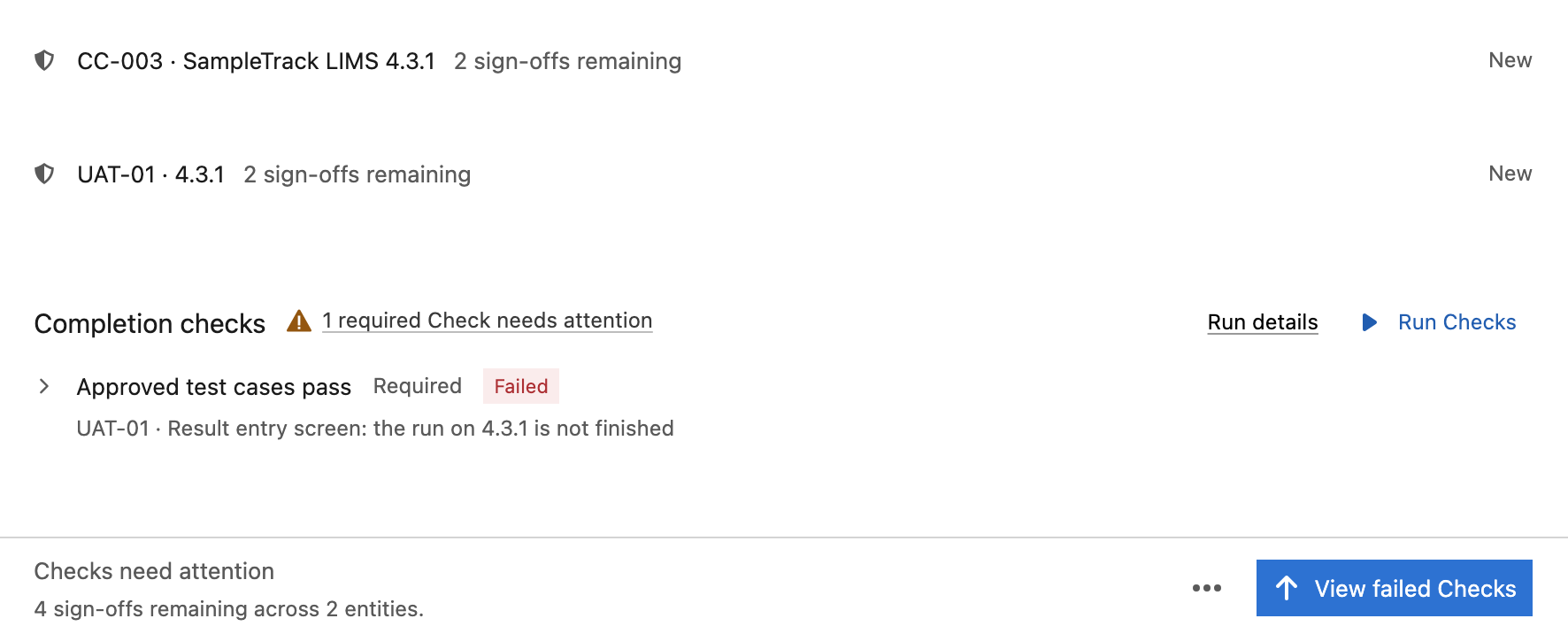
Yes. A supplier system gets its intended use, requirements and test cases in Seal, and each release is a change control. Automated test cases call the system’s API from a Seal Script; manual test cases are run step by step with screenshots. The release cannot be signed until its tests pass. Each failed step raises a warning that must be answered, and failures are recorded as a deviation before Quality signs.
How often does Veeva release a new version?
Approximately every four months. Veeva performs and documents IQ and OQ for each major release and provides a Release Impact Assessment beforehand, and each customer’s assessment of risk and impact determines its validation testing for that release. In Seal, selected acceptance tests run when a change is prepared for review, and publication requires current passing results.
How does Veeva’s AI compare with Neil?
Veeva releases standard Vault AI agents with its product releases three times a year, and customers can configure them or create custom agents. In Veeva’s AstraZeneca story, agentic AI for impact assessments and authoring is among that team’s future plans for validation. Neil prepares changes to the process itself, Seal’s configuration, with the impact assessment and verification cases, for your team to check, run and release under change control. Neil decides nothing in GMP work.
How long does it take to start with Seal?
In the 48-hour evaluation, once the scope is agreed and the inputs received, Seal turns one process into a working workflow with a validation pack to inspect, configured from your own procedure. Production timing then depends on scope, interfaces, migration and your release requirements.
References12 sources
References
- 1Validation Management Overview, Veeva Vault Help. https:/
/ quality. veevavault. help/ en/ gr/ 50533904/ (read 20 November 2026) - 2Vault AI, Veeva. https:/
/ www. veeva. com/ products/ vault- ai/ (read 20 November 2026) - 3Executing & Reviewing Test Scripts (Validation Management), Veeva Vault Help, updated 6 February 2026. https:/
/ quality. veevavault. help/ en/ gr/ 50533905/ (read 20 November 2026) - 4Veeva Validation Management Features Brief, Veeva. https:/
/ www. veeva. com/ resources/ veeva- validation- management- features- brief/ (read 20 November 2026) - 5Veeva Quality Cloud Features Brief, Veeva. https:/
/ www. veeva. com/ resources/ veeva- quality- cloud- feature- brief/ (read 20 November 2026) - 6Veeva Vault Validation Features Brief, Veeva. https:/
/ www. veeva. com/ resources/ veeva- vault- validation- product- brief/ (read 20 November 2026) - 7Veeva Systems Inc. Form S-1 Registration Statement, U.S. Securities and Exchange Commission, 10 September 2013. https:/
/ www. sec. gov/ Archives/ edgar/ data/ 1393052/ 000119312513363152/ d541293ds1. htm (read 20 November 2026) - 8Veeva Announces New Application to Speed Validation Execution, Veeva, 15 September 2021. https:/
/ www. veeva. com/ resources/ veeva- announces- new- application- to- speed- validation- execution/ (read 20 November 2026) - 9Unified Paperless Validation Solution for Life Sciences, Veeva. https:/
/ www. veeva. com/ products/ veeva- validation- management/ (read 20 November 2026) - 10Beyond Digital: Taking a Data-Centric Approach to Validation Management, Veeva blog, 3 January 2025. https:/
/ www. veeva. com/ blog/ beyond- digital- taking- a- data- centric- approach- to- validation- management/ (read 20 November 2026) - 11Veeva Vault Platform, Veeva. https:/
/ www. veeva. com/ products/ vault- platform/ (read 20 November 2026) - 12Preparing for Manufacturing Growth With Digital Validation (AstraZeneca), Veeva. https:/
/ www. veeva. com/ customer- stories/ astrazeneca- preparing- for- rapid- manufacturing- growth- with- unified- digital- validation/ (read 20 November 2026)