


Every supplier change, wherever it arrived.

Neil finds supplier changes in the register, the notices and the mailbox, follows each to the parts and customers it reaches, and works out the dates. It drafts the answer and the notices; quality decides and sends them.

  1. Pencil drawing: a seal at a desk opens a polite letter while through the window behind it a new machine with a red tag is wheeled into a distant factory.

    A polite letter.

    A new site or a second source can arrive as a customer letter or a data sheet revision, and never reach the change register.

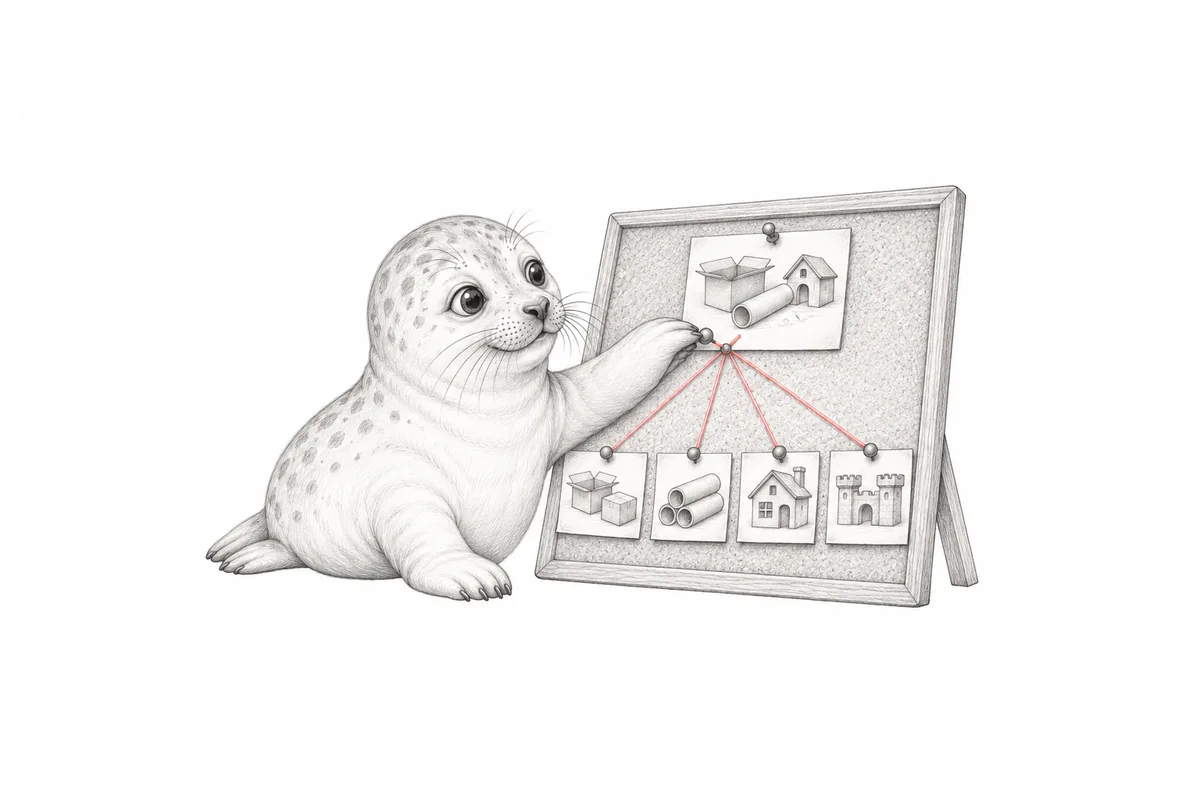
  2. Pencil drawing: a seal pins red strings from one card at the top of a cork board to cards of boxes, tubes and buildings below.

    Neil follows each change to what it reaches.

    The parts, the customers, the notice each one is owed and the validations that name the old way.

  3. Pencil drawing: a seal points at a wall calendar with days crossed off and one circled in red, while a second seal counts on its flipper, worried.

    It counts the days.

    How long material made the old way lasts, against the earliest your customers can approve.

  4. Pencil drawing: a seal drops two envelopes with red wax seals into a post satchel while a second seal signs a clipboard.

    Quality answers.

    Neil drafts the answer to the supplier and the notice to each customer. Quality edits them and sends them.

What the register doesn’t hold.

Most of what suppliers send changes nothing. These do.

  • Took effect
    1 October
    Data sheet sent
    19 October

    A change dressed as a data sheet.

    Section 3 adds a second pigment source, for lots already made.

  • Notice agreed
    90 days
    Notice given
    80 days

    A letter nobody logged.

    Worcester to Pawtucket, a site that isn’t approved.

  • Supplier asks
    1 December 2026
    Earliest allowed
    5 March 2027

    A date your customers can’t meet.

    120 days’ customer notice and an approval make it March.

  • PO 4500-1180 docks
    10 November
    Asked how it’s made
    Nobody

    An order already on its way.

    Hold it at receipt until the supplier confirms how it is made.

Everything suppliers announced.

Real Seal screens from a full test run: Acme Medical’s change register and supplier quality mailbox, as of 06:00 on 5 November 2026.

  1. 1

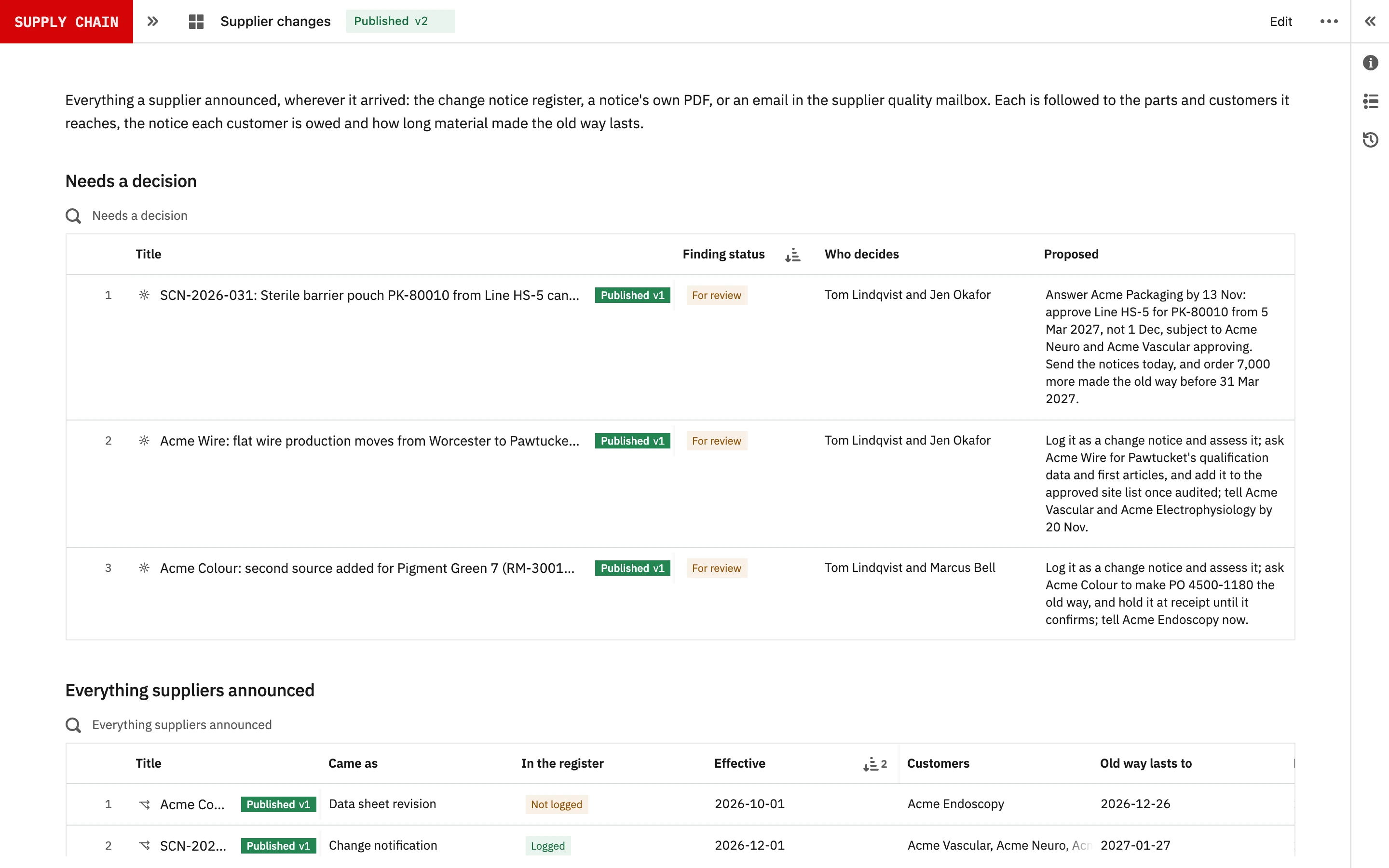
    Three changes, one of them in the register.

    Everything suppliers announced, wherever it arrived, followed to the parts and customers it reaches.

    The supplier changes board in Seal: three findings that need a decision, each with who decides and what Neil proposes, above a table of everything suppliers announced, how it came and whether it is in the register.
    1. What needs a decisionA formal notice with a date customers can’t meet, a letter and a data sheet revision.
    2. What Neil proposesThe answer to the supplier, the date customers can be told, and the order that covers the gap.
    3. Everything announcedHow it came, whether it’s in the register, who it reaches and how long the old way lasts.
  2. 2

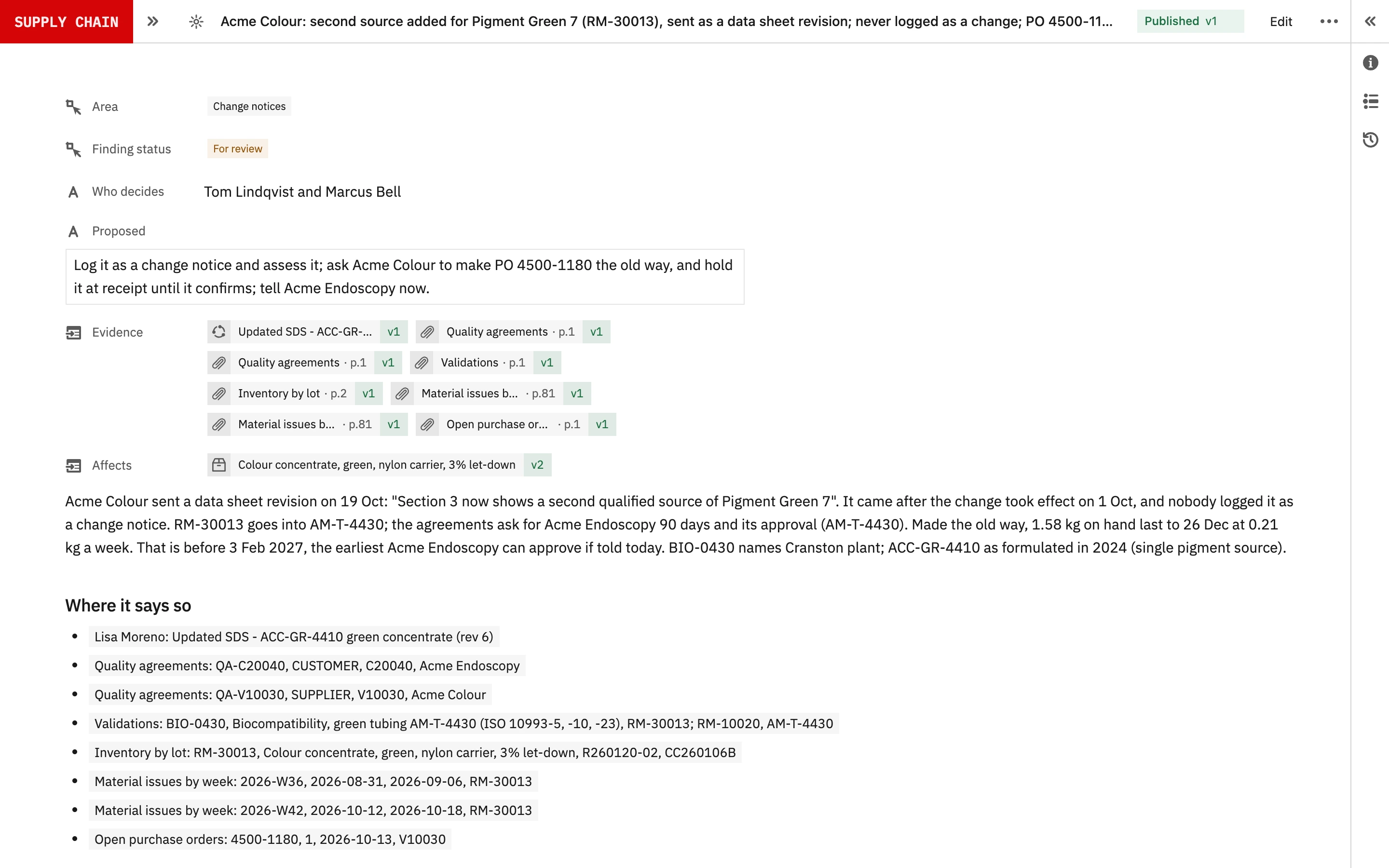
    A change dressed as a data sheet.

    Section 3 of a revision adds a second pigment source, for lots already made. PO 4500-1180 docks 10 November.

    Neil’s finding in Seal that Acme Colour added a second source for Pigment Green 7 in a data sheet revision: who decides, the proposal, the evidence, the record it affects and the working.
    1. In the supplier’s words“Section 3 now shows a second qualified source of Pigment Green 7.” Nobody logged it as a change.
    2. What Neil proposesLog it, ask for the PO to be made the old way, hold it at receipt, and tell Acme Endoscopy.
    3. What it rests onThe email, both agreements, the validation, stock, use and the open PO.
  3. 3

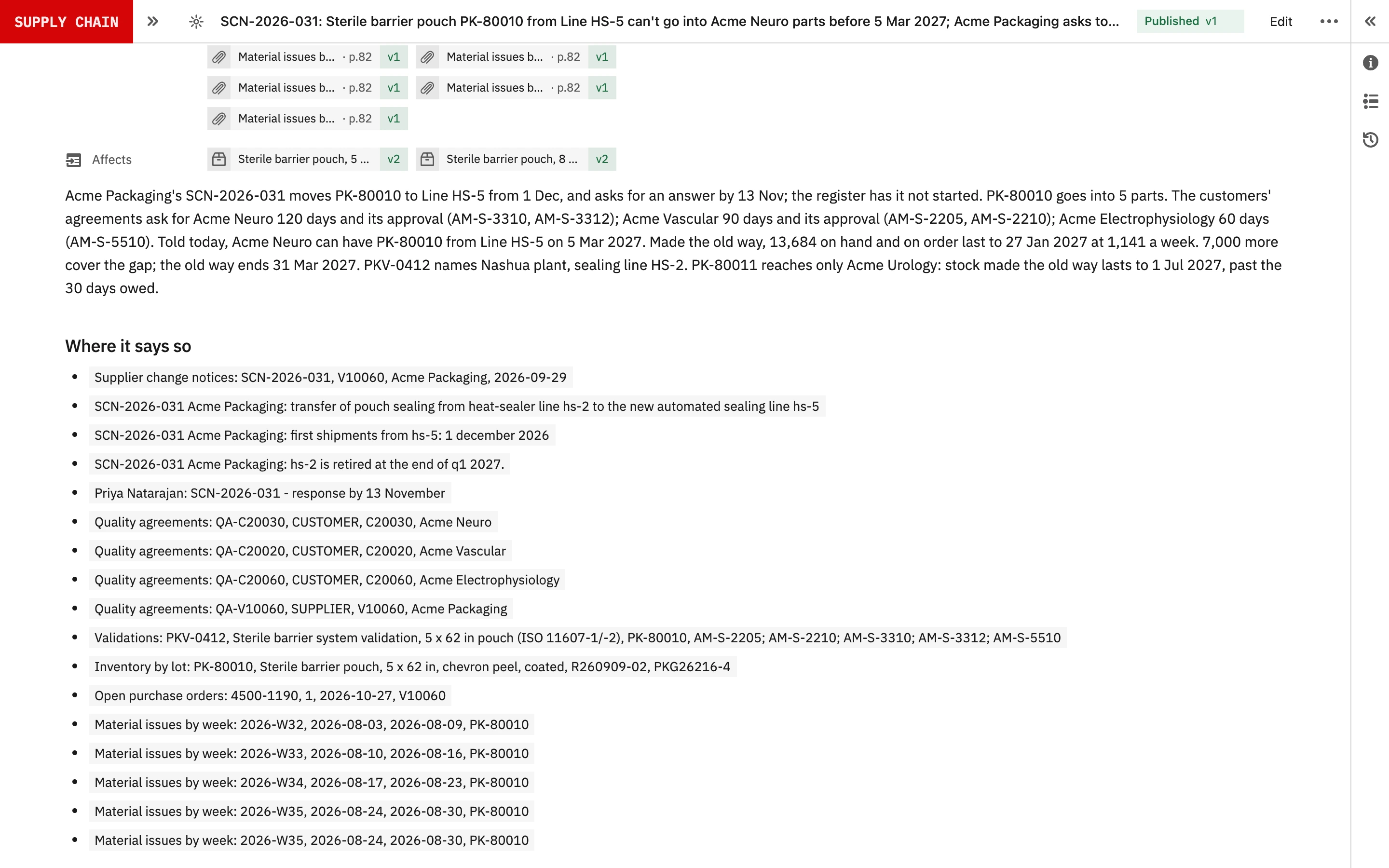
    A date your customers can’t meet.

    Acme Packaging asks to start 1 December. 120 days and an approval make it 5 March.

    Neil’s finding on SCN-2026-031 in Seal, scrolled to the working and the list of places it rests on: the register, the notice, the quality agreements, the validation, stock and use.
    1. Worked out from the agreements120 days for Acme Neuro, 90 for Acme Vascular, 60 for Acme Electrophysiology. 7,000 more made the old way cover the gap.
    2. Where it says soThe register, the notice’s own PDF, each agreement and the validation. Each link opens the page.
  4. 4

    A notice for each customer, drafted.

    The days each agreement asks for, the date, and the approval where it’s owed. Tom Lindqvist sends them.

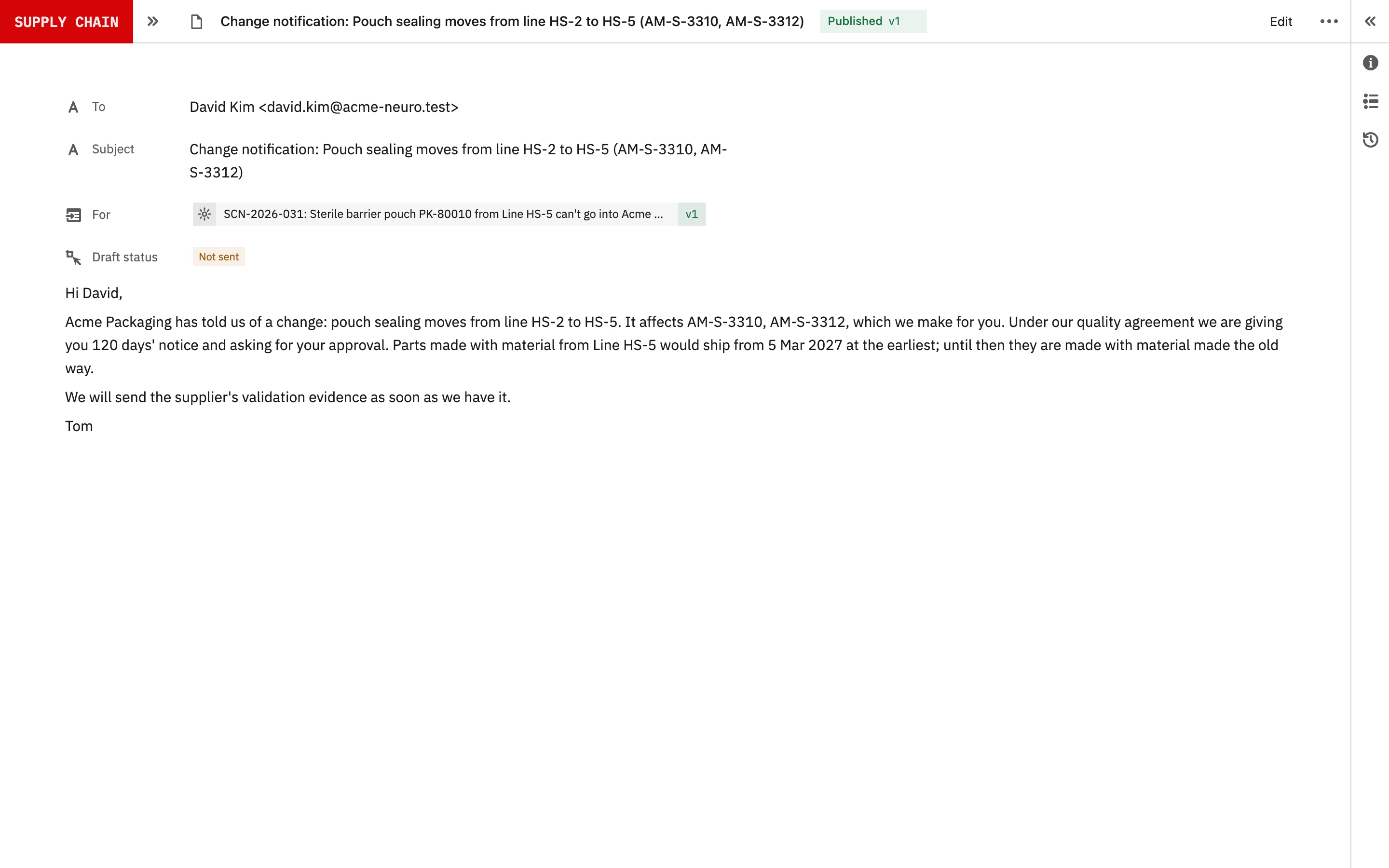
    A draft change notification in Seal to David Kim at Acme Neuro, linked to its finding and not sent, giving 120 days’ notice and asking for approval.
    1. 120 days and an approvalAcme Neuro’s agreement asks for both. Parts made the new way would ship from 5 March.
    2. One for eachThree customers and the answer to Acme Packaging, drafted together.
    3. Not sentNothing goes until a person sends it.

A change only counts if someone notices it.

Purchasing controls are among the most cited device observations, and components sit behind some of the most serious recalls.

Missed changesPublished figures

115
FDA observations in FY2025 for inadequate purchasing control procedures at device makers, the third most cited.FDA inspection observations, FY2025, under the former Quality System Regulation
7
more for having no agreement that suppliers notify the buyer of changes.Same listing
11.1%
of Class I recalls of 510(k) devices, 2017 to 2021, came from nonconforming components: 15 of 135.JAMA, 2023
5.2%
came from component change control: 7 of 135.JAMA, 2023

With NeilTest run, 5 November 2026

9
sources read: 7 emails in the supplier quality mailbox and 2 registered notices.Acme Medical’s QMS and mailbox
3 of 3
planted changes found, two of them never logged.Built into the test run for Neil to find
38 of 38
numbers in the findings match the answer key.Dates, days of notice and quantities
0 of 3
decoys raised: a move to an approved site, a new outer carton and a notice already closed.Built into the test run for Neil to set aside

Quality answers the supplier.

Neil reads and works out the dates. It never approves a change, logs one or tells a customer on its own. The evidence for each answer stays with the change.

See how change control runs in Seal

Summary

The problem
A supplier’s change can arrive as a customer letter or a data sheet revision and never reach the register. By the time anyone assesses it, the new material may be on a truck.
Seal’s approach
Neil reads the register, each notice and the supplier quality mailbox, then works out in code which parts and customers each change reaches, what notice each is owed and how long material made the old way lasts.
What changes
Quality sees every change on one page, with the dates worked out and the replies drafted.
Where to start
One year of notices and the supplier quality mailbox, with your quality agreements, bills of materials and stock. Book a demo.

1A change arrives however the supplier sends it.

A formal change notice goes into the register and someone assesses it. A customer letter about a plant move goes to whoever the supplier has on file. A second pigment source can be one line in section 3 of a revised data sheet. Each can reach parts your customers have approved, and each is owed notice under agreements nobody has open.

Purchasing controls drew 115 FDA observations at device makers in FY2025, the third most cited, and 7 more for having no agreement that suppliers notify the buyer of changes, under the former Quality System Regulation.¹ Among Class I recalls of 510(k) devices from 2017 to 2021, 15 of 135 came from nonconforming components and 7 of 135 from component change control.²

2Read everything. Work out the dates in code.

Neil reads the register, each notice’s PDF and each email in the supplier quality mailbox with its attachments, and says whether it announces a change, keeping the words it came from. Code does the rest: whether the supplier’s agreement excludes it, whether a new site is already approved, which parts and customers it reaches, the notice each customer’s agreement asks for, which validations name the old way, and how long stock made the old way lasts at today’s rate.

3Three changes at Acme Medical.

On Thursday 5 November 2026, Neil read 7 emails and 2 registered notices at fictional Acme Medical. Three changes needed a decision. It set aside a move to an approved site, a new outer carton and a notice already closed.

SupplierHow it arrivedWhat Neil worked out
Acme PackagingSCN-2026-031, not started, answer due 13 NovemberAsks to start 1 December. 120 days and Acme Neuro’s approval make it 5 March 2027; stock lasts to 27 January, so order 7,000 more
Acme ColourA data sheet revision of 19 October, never loggedA second pigment source for lots from 1 October. PO 4500-1180 docks 10 November
Acme WireA customer letter of 16 October, never loggedWorcester to Pawtucket, a site not approved. Customers must hear by 20 November

4Quality answers.

Neil drafts the answer to the supplier and the notice to each customer. Quality edits them and sends them, and logs the change. Neil never approves a change. The evidence for each answer stays with the change, ready for the customer’s audit.

5Start with one year of notices.

Bring one year of notices and the supplier quality mailbox, exported, with your quality agreements, bills of materials and stock. Compare what Neil finds with what your register holds.

References

  1. 1FDA, Inspection observations, FY2025, devices: 21 CFR 820.50 purchasing controls, 115; 21 CFR 820.50(b) supplier notification of changes, 7, under the former Quality System Regulation. Not a comprehensive listing. FDA
  2. 2Class I recalls of 510(k) devices, 2017 to 2021, JAMA, 2023, Table 1: nonconforming material or component, 15 (11.1%); component change control, 7 (5.2%), of 135 recall events. DOI

ACapabilities

CapabilityWhat it covers
Change findingFind changes in the register, in notices and in emails with their attachments, each kept with its words.
ReachFollow each change through the bills of materials to the parts and customers it reaches.
Notice owedRead each customer’s agreement for the notice and approval it asks for.
Old-way coverWork out how long stock made the old way lasts, and how much more to order.
Set-asidesSet aside what an agreement excludes or a site list already approves, with the reason.
Drafted answersDraft the answer to the supplier and the notice to each customer, for quality to send.

BConnected records

Entity
What it records
Kind
Supplier Change
A change as announced, wherever it arrived.
type
Quality Agreement
The notice and approval a supplier or customer agreement asks for.
type
Part
A part the change reaches through its bill of materials.
type
Change Assessment
The dates Neil worked out and what quality decided.
type

CQuestions and answers

Does Neil approve a change?

No. It works out the reach and the dates and drafts the replies. Quality decides, sends them and logs the change.

What if the supplier never sends a notice?

Neil can only read what arrives: the register, the notices and the mailbox. Incoming certificates and results can show a change the supplier didn’t announce.

Does it replace our change control?

No. Change control runs as it does now. Neil finds what should enter it, with the evidence.

What data does a proof need?

One year of notices and the supplier quality mailbox, with quality agreements, bills of materials and stock. No live access is needed.

See your process in Seal.

Bring a procedure or a recurring problem. See how your team configures it with Neil and improves the next run.

Book a demo