



Every certificate, read against your own specification.

Neil reads each supplier certificate at goods receipt and holds every result against your specification, the lot and dates in the ERP, and the lots before it. It proposes release or hold; quality decides.

  1. Pencil drawing: a seal at a receiving bench holds up a certificate with one large tick beside an overflowing tray, while one sack on the pallet behind it has a red tag.

    One tick, and it goes into stock.

    Receiving checks that a certificate came with the goods. Nobody reads it against the specification.

  2. Pencil drawing: a seal lays a long ruler across a supplier’s certificate and a specification sheet side by side, a red pencil line along its edge.

    Neil reads every row against your limits.

    Your specification, not the range the supplier printed, with the lot and dates held against the ERP.

  3. Pencil drawing: a seal holds a magnifying glass over one row of a certificate on a board, its gauge just past a red mark, while a second seal leans in, surprised.

    It catches what a tick can’t.

    A result the supplier calls conforming and you don’t, and a drift no single certificate shows.

  4. Pencil drawing: a seal hangs a red tag on a sack behind a rope barrier while a second seal signs a clipboard.

    Quality decides.

    Neil proposes release or hold, with the note to the supplier drafted. Quality decides.

What a certificate holds that a tick doesn’t.

Most certificates are fine. These are the ones that aren’t.

  • 14.6
    6.08.014.016.0
    Your specification
    The range the supplier printed

    In their range, out of yours.

    Melt flow: 75 kg released on a certificate that says it conforms.

  • Certificate
    AP2632550
    Bags
    AP2623550

    The wrong lot.

    175 kg received on another lot’s results.

  • Certificate
    2 December 2026
    ERP
    23 April 2027

    A date that disagrees.

    33 days of life left at receipt, against the 4 months you ask for.

  • A slow walk to the limit.

    Five lots climbing since March, all still in specification.

Six certificates, one morning.

Real Seal screens from a full test run: the certificates Acme Medical received in its last week, as of 06:00 on 5 November 2026.

  1. 1

    Four of six need a decision.

    Each certificate read when the goods arrive, against your specification, the ERP and the lots before it.

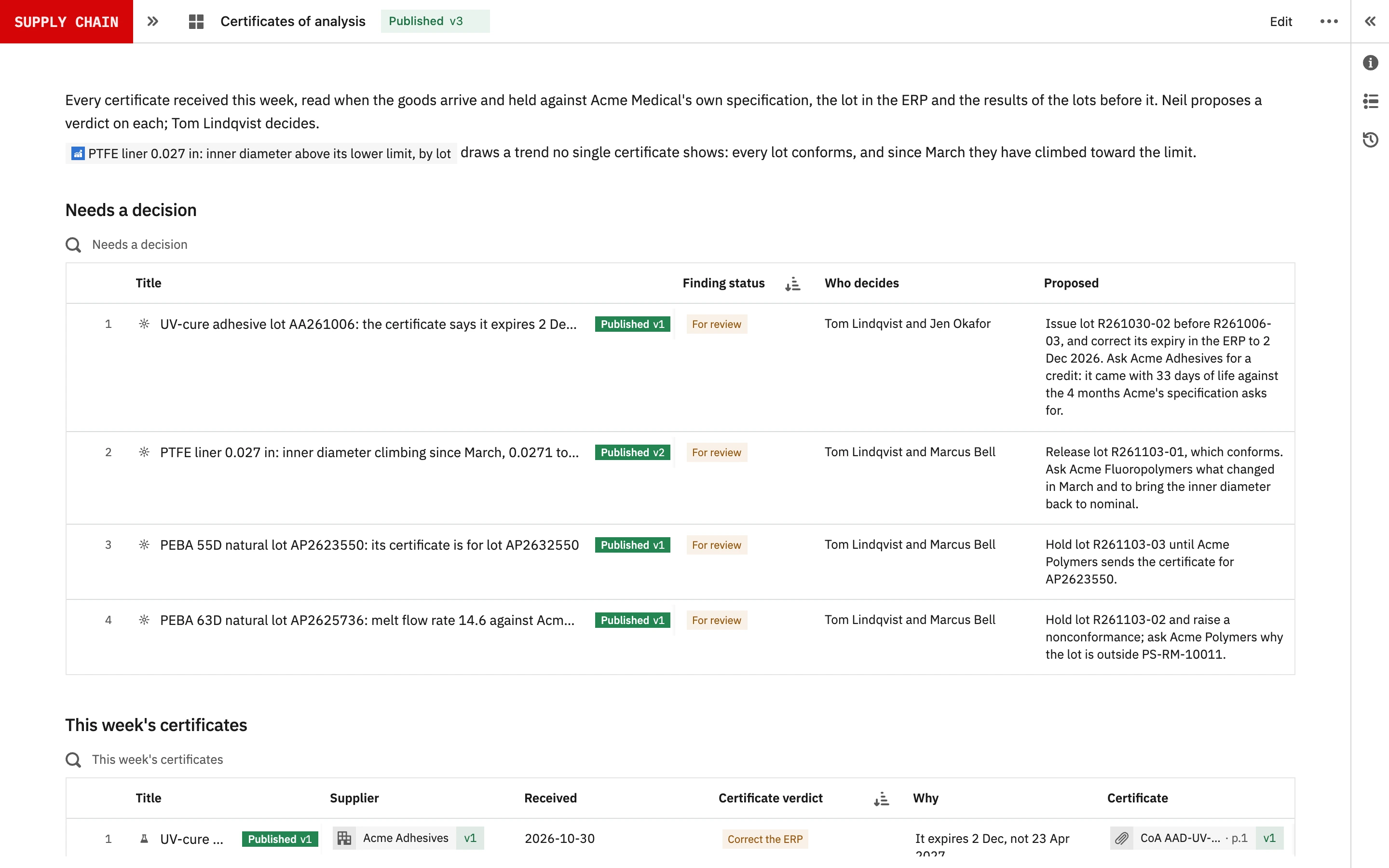
    The certificates board in Seal: four findings that need a decision, each with who decides and what Neil proposes, above a table of the week’s certificates with a verdict on each.
    1. What the tick missedA result outside your limits, the wrong lot’s certificate, a date that disagrees with the ERP, and a drift.
    2. A verdict proposedRelease or hold, lot by lot. Tom Lindqvist decides.
    3. And all sixIncluding the two with nothing to raise.
  2. 2

    In their range, out of yours.

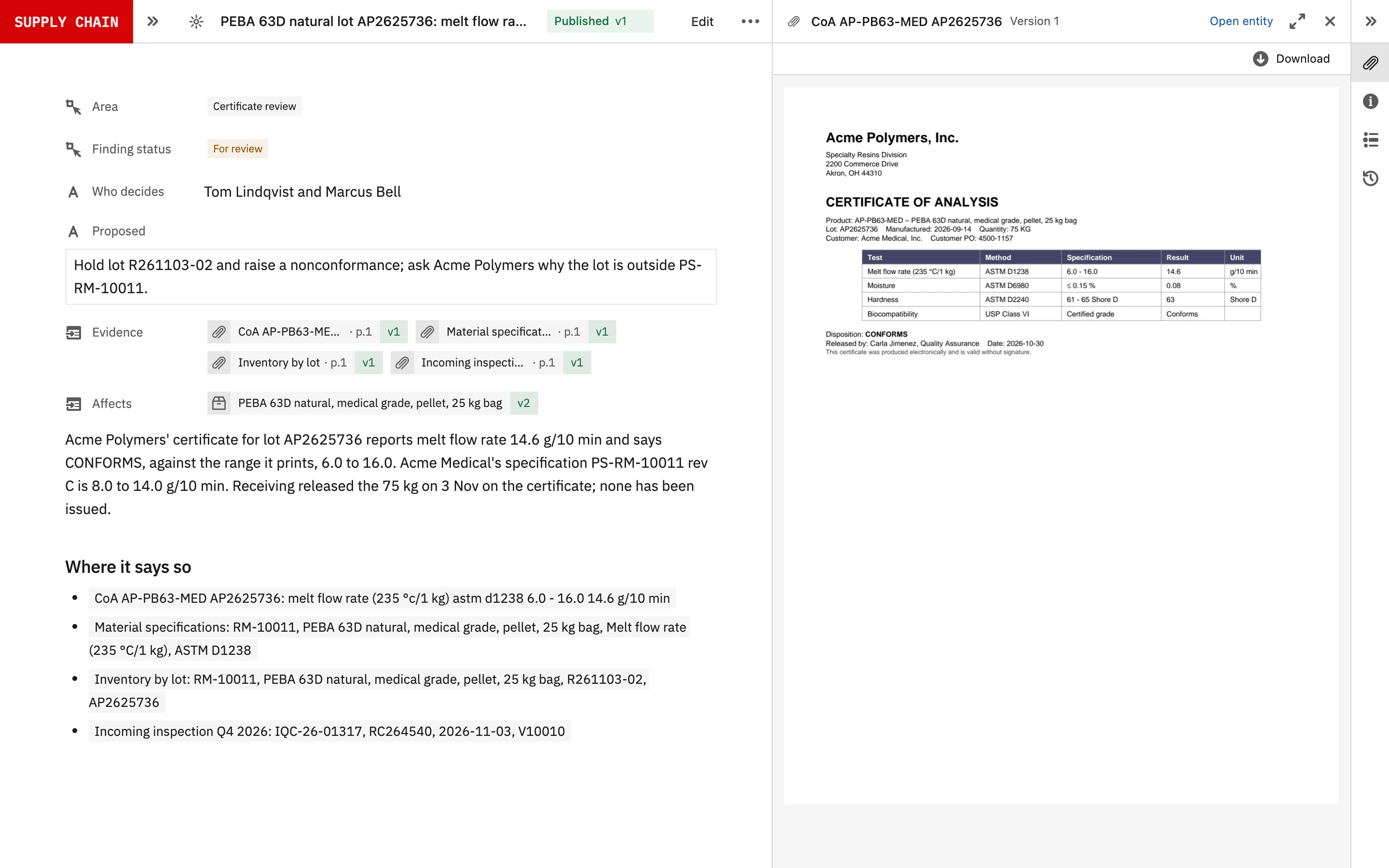
    Melt flow 14.6 conforms to the 6.0 to 16.0 the supplier printed. Your specification is 8.0 to 14.0.

    Neil’s finding on PEBA 63D natural lot AP2625736 in Seal, with the supplier’s certificate of analysis opened beside it, showing melt flow rate 14.6 against a printed range of 6.0 to 16.0 and the word CONFORMS.
    1. What the supplier wroteSpecification 6.0 to 16.0, result 14.6, disposition CONFORMS.
    2. What your specification saysPS-RM-10011 rev C: 8.0 to 14.0. Receiving released the 75 kg on 3 November, and none has been issued.
    3. What Neil proposesHold the lot, raise a nonconformance, and ask the supplier why.
  3. 3

    A drift no single certificate shows.

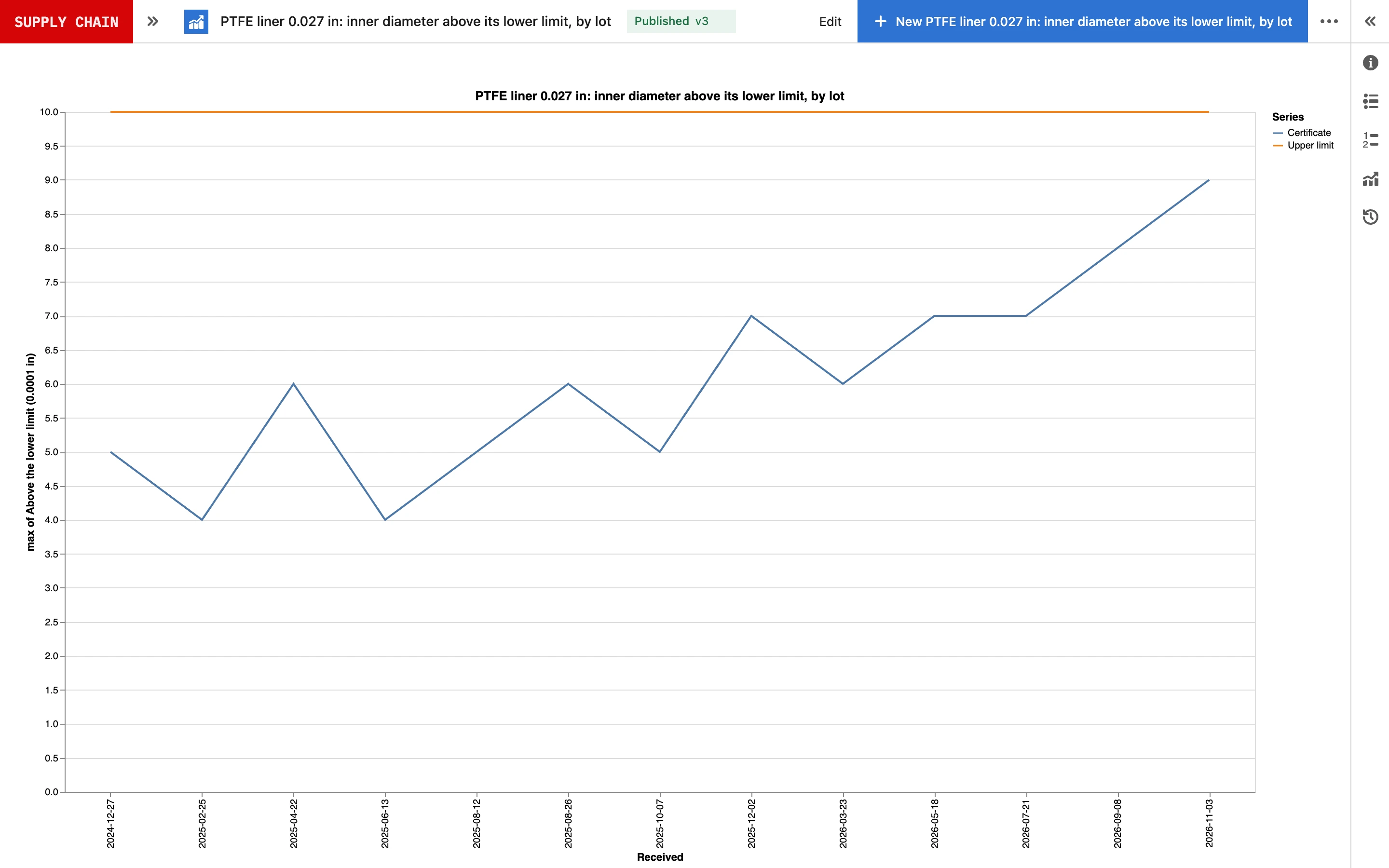
    Five lots climbing since March, all still in specification. On a straight line, the lot after next goes past the limit.

    A line chart in Seal of PTFE liner inner diameter by lot across thirteen lots, plotted above its lower limit, climbing from 6 to 9 since March 2026 toward an upper limit line at 10.
    1. Since March0.0271, 0.0272, 0.0272, 0.0273, 0.0274 in, from each lot’s own certificate.
    2. The limit0.0275 in. Neil drafts the question to the supplier before a lot reaches it.
    3. Reading the axisTen-thousandths of an inch above the 0.0265 in lower limit.
  4. 4

    The note to the supplier, drafted.

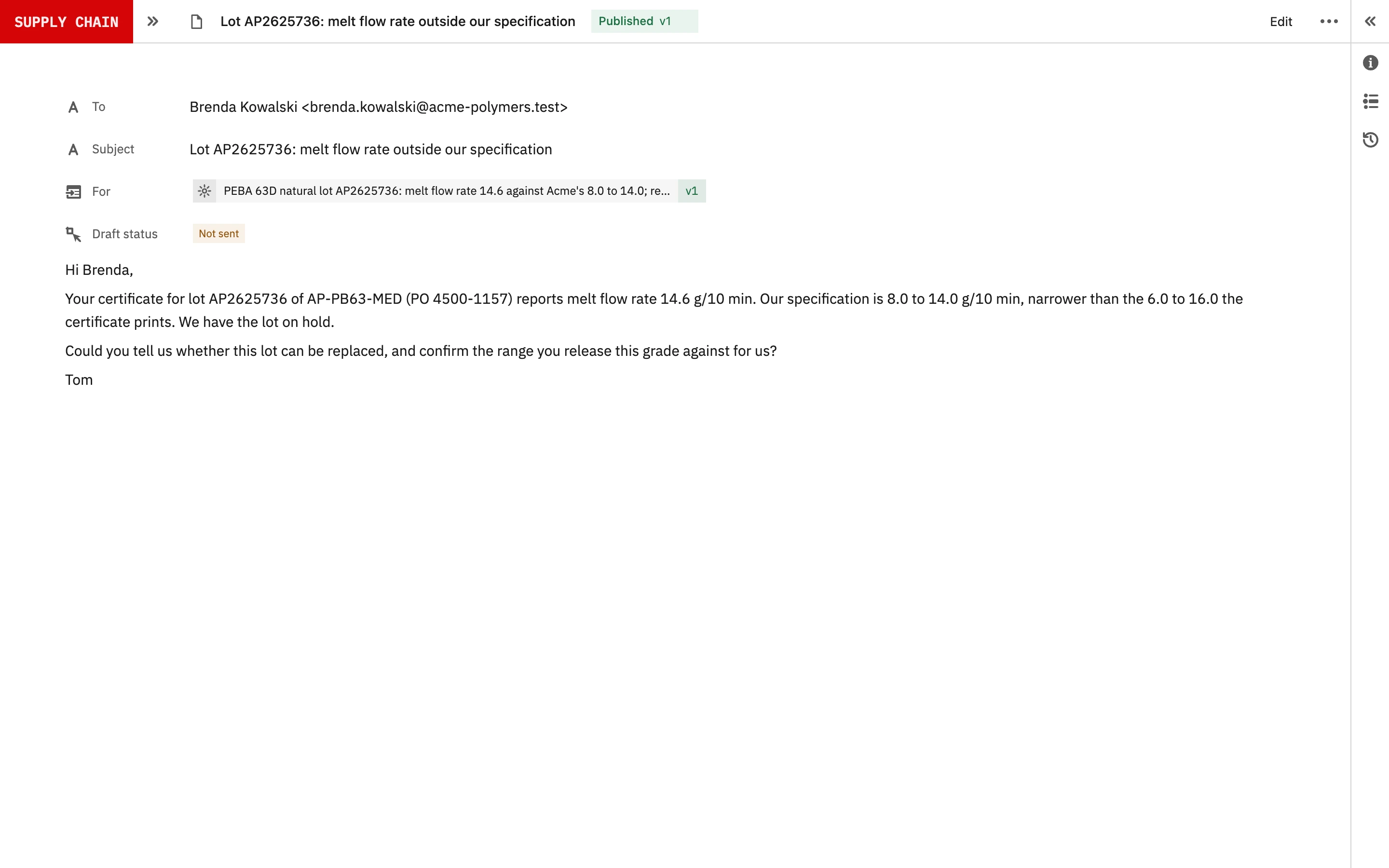
    The lot, the PO, both ranges and the question. Tom Lindqvist edits it and sends it.

    A draft email in Seal to Brenda Kowalski at Acme Polymers about lot AP2625736, linked to its finding and not sent, setting out the certificate’s result and the narrower specification.
    1. What it asksWhether the lot can be replaced, and which range the supplier releases this grade against.
    2. Linked to its findingThe evidence stays one click from the note.
    3. Not sentNothing goes until a person sends it.

A certificate is the supplier’s word.

Inspectors keep finding firms that accept it unchecked, and when it’s wrong the cost is rarely small.

Taken on trustPublished figures

26
FDA observations in FY2025 for accepting a supplier’s report of analysis without verifying it.FDA inspection observations, FY2025, drugs
23
FDA observations in FY2025 for missing or inadequate incoming acceptance procedures at device makers.Same listing, devices, under the former Quality System Regulation
300+
deaths in at least seven countries from syrups whose makers relied on supplier certificates.FDA guidance on DEG and EG testing, 2023
525
customers received Kobe Steel products with falsified inspection data.Kobe Steel’s own report, 2018

With NeilTest run, 5 November 2026

6
certificates received that week, against the specifications and 366 earlier results.Acme Medical’s certificates and QMS register
4 of 4
planted problems found.Built into the test run for Neil to find
25 of 25
numbers in the findings match the answer key.Results, limits, dates and quantities
0 of 2
decoys raised: a result at the top of its range, and one in a unit that looks different and means the same.Built into the test run for Neil to set aside

Quality releases the lot.

Neil reads, checks and proposes. It never releases, holds or rejects a lot, or changes the ERP. Each verdict keeps the certificate, the specification and the ERP row it rests on.

See how a supplier’s quarter adds up

Summary

The problem
Receiving checks that a certificate came with the goods, and the lot goes into stock. A result outside your limits but inside the supplier’s, a certificate for another lot, or a drift across lots goes unseen.
Seal’s approach
Neil reads each certificate, keeps every value with the words it came from, and compares in code: your limits, the ERP’s lot and expiry, and the results of the lots before it.
What changes
Quality starts on the certificates that need a decision, with the evidence open, and the rest are read too.
Where to start
One quarter of certificates with your specifications, the receipts and the lot records from the same period. Book a demo.

1A certificate is checked for being there.

A certificate of analysis is the supplier’s statement of what it made. Receiving looks for one, matches it to the delivery and releases the lot. Reading each row against your specification takes longer than the delivery allows, so a certificate is usually trusted until a problem shows up on the line.

FDA recorded 26 observations in FY2025 for accepting a supplier’s report of analysis without verifying it,¹ and 23 at device makers for missing or inadequate incoming acceptance procedures, under the former Quality System Regulation.¹ In 2023 it tied more than 300 deaths to contaminated syrup ingredients whose makers had relied on supplier certificates.² Kobe Steel told 525 customers in 2017 that their products came with falsified inspection data.³

2Read every row. Compare in code.

Neil reads each certificate: the lot, the dates and every test row as printed, each kept with the words it came from. A reading whose words aren’t on the page is dropped. Code then does the comparison: each result against your limits, not the range the supplier printed; units that differ but mean the same; the lot and expiry against the ERP; and whether the results have been walking toward a limit across lots.

3Six certificates at Acme Medical.

Acme Medical is a fictional ISO 13485 maker of tubing and catheter components. On Thursday 5 November 2026, six certificates had arrived that week. Neil proposed release for two, and raised the other four.

MaterialWhat the certificate saysWhat Neil proposes
PEBA 63D naturalMelt flow 14.6, conforming to the 6.0 to 16.0 it prints. Acme’s specification is 8.0 to 14.0Hold, and raise a nonconformance
PEBA 55D naturalLot AP2632550. The bags and the ERP say AP2623550Hold until the right certificate comes
UV-cure adhesiveExpires 2 December. The ERP says 23 AprilCorrect the ERP, issue this lot first and ask for a credit
PTFE liner 0.027 inInner diameter climbing since March, 0.0271 to 0.0274 against a 0.0275 limitRelease, and ask the supplier what changed

4Quality decides.

Neil proposes; quality releases, holds or rejects the lot. A draft to the supplier opens beside the finding, and a person edits and sends it. Each verdict stays with the certificate, the specification and the ERP row it rests on.

5Start with one quarter of certificates.

Bring one quarter of certificates with your specifications, the receipts and the lot records from the same period. Compare what Neil raises with what your inspectors and nonconformances found. No live access to the ERP is needed to prove it.

References

  1. 1FDA, Inspection observations, FY2025: 21 CFR 211.84(d)(2) reports of analysis, 26; 21 CFR 820.80(b) receiving acceptance procedures, 23, under the former Quality System Regulation. Not a comprehensive listing. FDA
  2. 2FDA, Testing of glycerin, propylene glycol and other high-risk drug components for DEG and EG, 2023: more than 300 fatalities across at least seven countries; manufacturers “relied upon COAs provided by suppliers”. FDA
  3. 3Kobe Steel, report on its misconduct, 2018: as of 26 October 2017, 525 customers had received nonconforming products. Kobe Steel

ACapabilities

CapabilityWhat it covers
Certificate readingRead the lot, dates and every test row of each certificate, each kept with the words it came from.
Specification checkCompare each result in code with your limits, not the range the supplier printed.
ERP checkHold the lot and expiry on the certificate against the ERP and the receipt.
Lot trendsFind results walking toward a limit across lots, before one is out of specification.
VerdictsPropose release or hold for every certificate, with why. Quality decides.
Drafted queriesDraft the question to the supplier for quality to edit and send.

BConnected records

Entity
What it records
Kind
Certificate
A supplier’s certificate as received, with what Neil read from it.
type
Material Specification
Your limits for each test on a material.
type
Goods Receipt
The delivery and lot in the ERP.
type
Certificate Verdict
Neil’s proposal and why, and what quality decided.
type

CQuestions and answers

Does Neil release lots?

No. It proposes a verdict with its reasons. Quality releases, holds or rejects the lot, in the ERP as now.

What about a certificate in a different layout?

Each supplier’s layout is read as printed. A value whose words aren’t on the page is dropped and shown as missing, for a person to check.

Does it replace incoming inspection?

No. It reads the certificate, which inspection often can’t. Your sampling plan stays as it is, and its results can be compared too.

What data does a proof need?

One quarter of certificates with your specifications, the receipts and the lot records. No live access is needed.

See your process in Seal.

Bring a procedure or a recurring problem. See how your team configures it with Neil and improves the next run.

Book a demo