Veeva Vault eTMF files clinical trial documents. Seal generates expected evidence from live trial events.

Acclinate cut quality cycle times by 50%. Neil, your AI agent, does the paperwork. You sign. Start one process beside Veeva Vault eTMF.

Where Veeva Vault eTMF falls short.

From Veeva’s own pages.

  • Veeva eTMF
    Uploaded document binders
    Source GMP & QMS data
    Exported from other apps
    Seal eTMF
    Expected evidence on live records

    Auto-filing copies into a separate repository.

    Veeva eTMF classifies and files uploaded documents into TMF Reference Model binders, separate from the systems where training, supply and deviations happen. Seal links live operational records directly to expected TMF artifacts.

    Veeva Clinical Vault Help, eTMF
  • Veeva Vault
    Separate clinical & QMS apps
    Cross-app updates
    Managed connections
    Seal
    One unified GxP record

    Separate Vault licences across clinical and quality.

    Veeva splits eTMF, CTMS, QMS and QualityDocs into separate Vault applications. Seal runs TMF evidence, study milestones, document control and quality on one platform your team configures.

    Veeva eTMF

See it in Seal.

Real Seal screens with fictional test data: a procedure change, every record it reaches, and a batch record where the work is done.

  1. 1

    The procedure and what changes with it.

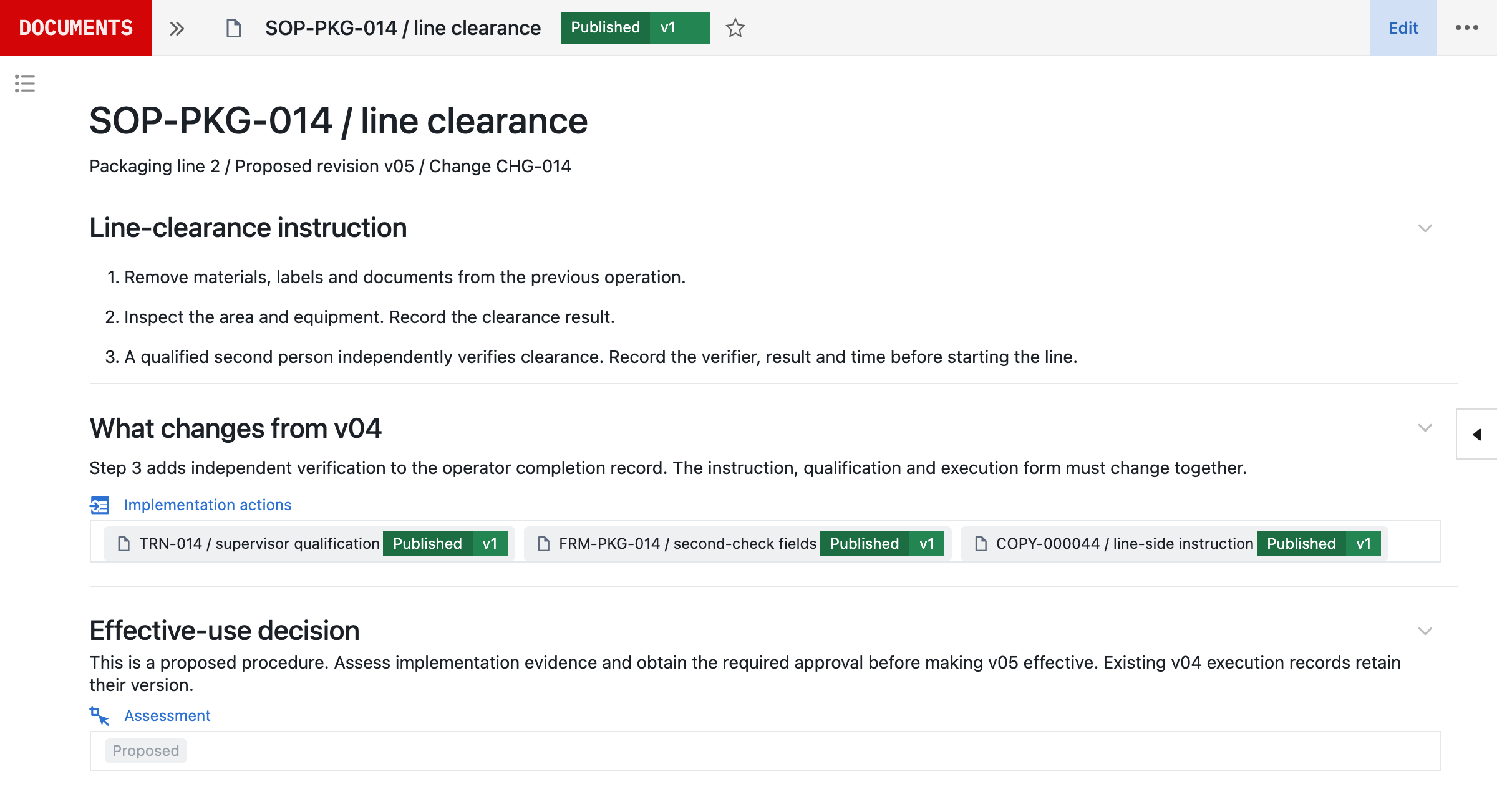
    SOP-PKG-014’s new step comes with the qualification, form and line-side copy that must change with it.

    Procedure SOP-PKG-014, line clearance, in Seal: proposed revision v05 under change CHG-014, a three-step line-clearance instruction, what changes from v04 with its implementation actions, and the effective-use decision still proposed.
    1. The new stepA qualified second person verifies clearance.
    2. What must change with itThe qualification, the execution form and the line-side copy.
    3. Earlier records keep their versionv04 execution records stay as they ran.
  2. 2

    One change reaches every record it touches.

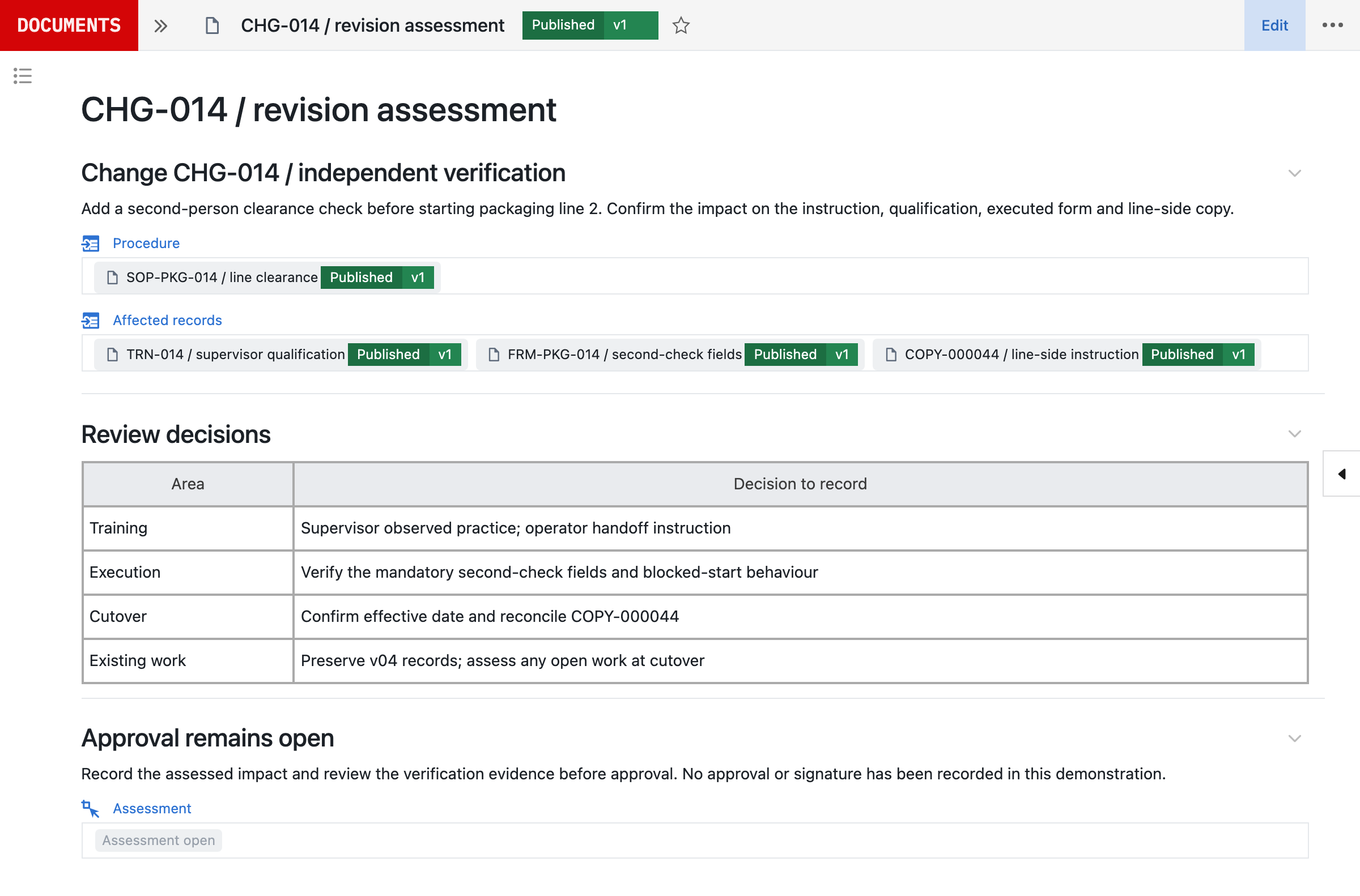
    CHG-014 links the procedure to the training, the form and the copy on the line, with a decision for each.

    Change CHG-014, revision assessment, in Seal: the procedure SOP-PKG-014 and the affected training, form and line-side copy, a table of review decisions for training, execution, cutover and existing work, and approval still open.
    1. The change and what it reachesA procedure, a qualification, a form and a line-side copy.
    2. A decision for each areaTraining, execution, cutover and existing work.
    3. People approveNothing is approved until the evidence is reviewed.
  3. 3

    Each value at the step it belongs to.

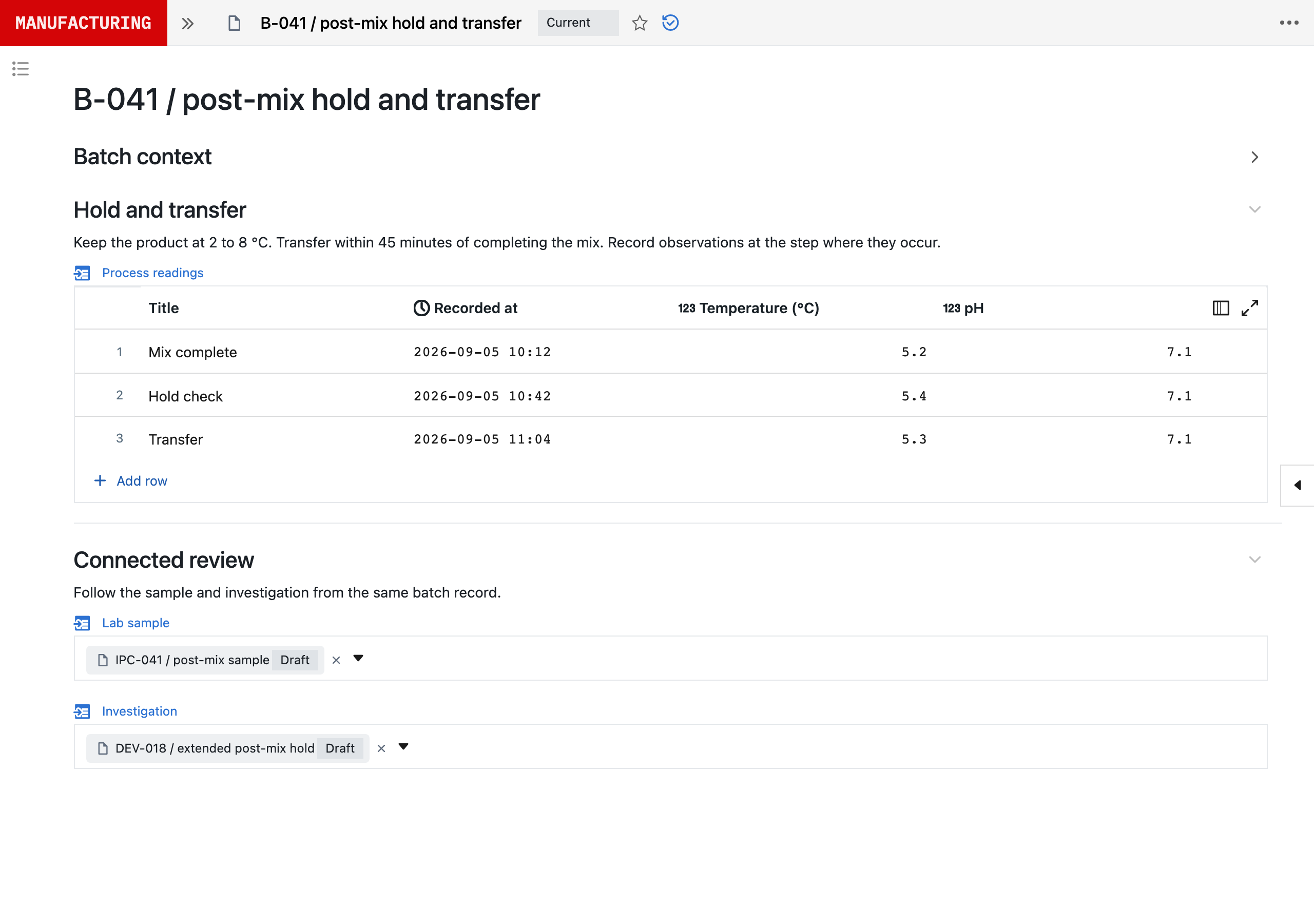
    Batch B-041’s readings are recorded as the work happens, with its sample and its deviation linked to the record.

    Batch record B-041, post-mix hold and transfer, in Seal: the instruction to transfer within 45 minutes of completing the mix, process readings at 10:12, 10:42 and 11:04 with temperature and pH, and the linked lab sample IPC-041 and investigation DEV-018.
    1. The step’s limitTransfer within 45 minutes of completing the mix.
    2. Recorded as it happensMix complete at 10:12, transfer at 11:04: 52 minutes.
    3. The deviation, linkedDEV-018 sits on the batch record it concerns.

What Seal’s customers measured.

Each figure links to the customer’s story.

QualityAcclinate and Skye Biologics

−50%
quality cycle times at Acclinate, from a procedure change to everyone trained.Acclinate
−40%
non-conformances at Skye Biologics, with training checked before execution.Skye Biologics

RecordsMiAlgae and Bioventix

−75%
documentation time at MiAlgae, from the lab to commercial production.MiAlgae
−80%
document admin time at Bioventix, after two decades on paper.Bioventix

Veeva Vault eTMF and Seal, side by side.

Every source is listed under References.

Veeva Vault eTMFSeal
What it isElectronic trial master file application on Vault1The GxP execution system: eTMF, CTMS, EDC, lab and QMS on one record
Data modelTMF Reference Model binders, zones and artifacts2Primitives your team composes: record types, their relationships, steps and checks
AutomationTMF Bot classifies documents and auto-files into binders2Study, country and site events generate expected artifacts; Neil checks gaps
Cross-function linksConnects to CTMS and RIM through separate Vault apps3Training, SOPs, clinical batches, deviations and TMF artifacts share one record
Inspector accessRead-only TMF views inside the eTMF application1Scoped read-only inspector view tracing directly to live source records
Getting startedeTMF Vault deployment and binder configuration1A 48-hour evaluation of one process, once the scope is agreed and the inputs received

Summary

The story
Veeva Vault eTMF is designed for sponsors and CROs managing electronic trial master file binders aligned to the TMF Reference Model.1,2 Its TMF Bot classifies incoming files and auto-files documents into study, country and site zones, giving clinical teams inspection-readiness metrics inside Vault.2 That works well for managing uploaded PDFs across large CRO networks, yet an eTMF repository still receives copies of records generated elsewhere rather than living directly on the training, protocol change, clinical supply and quality records that prove how the trial ran.

1Where Veeva Vault eTMF falls short.

Veeva Vault eTMF structures clinical trial documentation into TMF Reference Model binders and uses automated filing to route uploaded documents into study, country and site folders.1,2 Because it operates as a standalone document repository inside the Vault platform,3 completeness dashboards still depend on people uploading exports from separate training, QMS, clinical supply and site monitoring tools.

2Running Seal alongside Veeva Vault eTMF.

Closed or late-stage trials can stay archived in Veeva Vault eTMF for their full retention period. Launch your next study’s eTMF blueprint in Seal so study events generate expected artifacts automatically and completeness traces back to every missing or rejected item. Seal’s REST API and Scripts reconcile external records instead of copying them into a shadow archive.

3Moving from Veeva Vault eTMF to Seal.

  1. Choose one protocol, one country and one site for your next study or amendment.
  2. Bring your TMF plan, artifact list and QC checklist.
  3. Neil drafts the expected-evidence rules and QC workflow for your TMF lead to review. In the 48-hour evaluation, once the scope is agreed and the inputs received, Seal prepares a working eTMF workflow and validation pack to inspect. Production timing then depends on scope, interfaces, migration and your release requirements.
  4. Run an inspection drill before go-live: test missing artifacts older than 30 days, rejected QC filings returned to the CRO, a protocol amendment adding new expectations and read-only inspector access.

Explore Seal’s eTMF blueprint and clinical operations blueprint for how completeness stays live throughout a trial.

AVeeva Vault eTMF alternatives

ProductGood for
SealProcess development, the laboratory, manufacturing, batch release and quality on one platform, where Neil, an AI agent, does the paperwork
Veeva Vault CTMSClinical operations teams managing study milestones, site monitoring visits and enrollment tracking across insourced and outsourced trials
Medidata Rave EDCEnterprise clinical data management across Phase I to IV trials
Florence eBindersClinical research sites digitising Investigator Site Files (eISF) and sponsors exchanging documents remotely with sites through Florence eTMF

The sources for what each is good for are on its comparison with Seal and on Best clinical trial software for sponsors and CROs (2026).

BQuestions and answers

Is Seal better than Veeva Vault eTMF?

Yes. Veeva Vault eTMF is designed for sponsors and CROs managing electronic trial master file binders aligned to the TMF Reference Model. Its TMF Bot classifies incoming files and auto-files documents into study, country and site zones, giving clinical teams inspection-readiness metrics inside Vault. That works well for managing uploaded PDFs across large CRO networks, yet an eTMF repository still receives copies of records generated elsewhere rather than living directly on the training, protocol change, clinical supply and quality records that prove how the trial ran. Seal has no fixed model of one kind of work. It is made of primitives: record types, the relationships between them, and the steps and checks that use them, which your own team composes into your process, with Neil able to prepare each change for approval. So one platform runs process development, the laboratory, manufacturing, batch release and the quality system, and each change becomes a new version, released once its selected tests pass, while earlier runs keep theirs. Moving from Google Drive, Acclinate cut the time from a procedure change to everyone trained by 50%.

What are the alternatives to Veeva Vault eTMF?

Seal, Veeva Vault CTMS, Medidata Rave EDC and Florence eBinders. Seal is the best clinical trial software for sponsors and CROs. Acclinate cut quality cycle times by 50%.

Is Seal an alternative to Veeva Vault eTMF?

Yes. Veeva Vault eTMF is a dedicated clinical document repository. Seal runs expected-evidence tracking, controlled filing, QC, gap ownership and live read-only inspector views on the same platform as CTMS, training, QMS and clinical supply.

How does Seal measure eTMF completeness?

Study, country, site and vendor events generate expected artifacts under your approved TMF plan. Completeness is calculated against those live expectations so every percentage traces directly to the missing or rejected artifacts and their owners.

Do we have to migrate closed studies out of Veeva Vault eTMF?

No. Closed trials can remain in Veeva Vault eTMF for their required retention period while new studies start in Seal.

Can CROs file artifacts directly into Seal eTMF?

Yes. Delegated CRO staff receive scoped access to file and remediate their assigned artifacts while the sponsor’s TMF lead keeps full QC and oversight visibility.

References3 sources

References

  1. 1Veeva eTMF, Veeva Systems. https://www.veeva.com/products/veeva-etmf/ (read 22 November 2026)
  2. 2Working with eTMF, Veeva Clinical Vault Help. https://clinical.veevavault.help/en/lr/4660/ (read 22 November 2026)
  3. 3Veeva Vault Platform, Veeva Systems. https://www.veeva.com/products/vault-platform/ (read 22 November 2026)

Start beside Veeva Vault eTMF.

Start with one new study’s expected-evidence ledger in Seal while leaving closed trial archives in Veeva Vault eTMF; Seal’s REST API and Scripts reconcile cross-system references without forcing legacy migration.