Summary
- In short
- QualityDocs is Veeva’s quality document management application, with Station Manager for the shop floor and Veeva Training for retraining, on the Vault Platform. Seal links each procedure to the forms, qualifications and execution rules it governs, so a revision is implemented and verified in the workflow, not only distributed.
- When it fits
- You already run Veeva quality applications, share documents with many partners, need station-specific instructions on tablets, or want a supplier validation package with every release.
- When Seal fits
- You want a revised procedure to change how the next run is done: a new check in the workflow, training assessed by role and activity, a cutover after verification, and Neil preparing the configured change for your team to approve.
- Using both
- Keep QualityDocs as the document library and start one procedure in Seal. Seal’s QualityDocs connection shares steady-state documents through the Veeva Vault library, read-only, for reference with @.
1Veeva Vault QualityDocs and Seal, side by side.
QualityDocs and Seal both keep controlled procedures with their approvals, versions, training links and audit trails. They differ in where a procedure’s control ends. QualityDocs is Veeva’s quality content management application: it takes a document through authoring, review, approval, release, periodic review and withdrawal, and delivers it to employees, stations and partners.¹² In Seal, the procedure is linked to the training, forms and execution rules it governs, so a revision can change the check the next operator meets.
| Veeva Vault QualityDocs | Seal | |
|---|---|---|
| What it is | GxP document management on Vault | GxP operating system for biopharma |
| What it controls | Documents, lifecycles and copies | The procedure and the work it governs |
| At the station | Station Manager tablets | A check in the workflow |
| Training | Veeva Training retrains on change | Assessed by role and activity |
| Effective use | Release with related documents | After training, checks and copies |
| Validation | Veeva IQ and OQ; your PQ | Selected checks run on each change |
| Integrations | Veeva Connections between Vaults | Vault library and scoped Vault API |
| AI | Veeva AI agents on Vault | Neil drafts the configured change |
| Getting started | Veeva services, or Quality Basics | One procedure, beside your system |
2What Veeva Vault QualityDocs is built for.
QualityDocs is made for life sciences companies that want controlled quality documents on the same cloud as their QMS, training and QC, shared directly with partners. Veeva Systems Inc., of Pleasanton, California, is listed on the New York Stock Exchange, operates as a public benefit corporation and says it serves more than 1,500 customers.³ Veeva has changed its application branding from “Vault [Application]” to “Veeva [Application]”, so the product now appears as Veeva QualityDocs; it runs on the Veeva Vault Platform.⁴²
QualityDocs ships Veeva’s GxP content reference model and manages procedures, policies, work instructions, quality agreements and batch-related documentation through their lifecycle, with internal and external parties collaborating in the system.¹ Predefined lifecycles, document types and workflows cover approval, training, release, periodic review and withdrawal. Authors co-edit through Microsoft Office Online, Vault coordinates the release and obsolescence of associated controlled documents, overlays and watermarks show status or effective date, and review reminders follow predefined rules. Administrators control who can take copies outside Vault and track each copy in the field.²
QualityDocs belongs to Veeva Quality Cloud, which brings content management, training, QMS and QC lab applications onto one platform; Veeva says more than 600 companies use its quality applications, and Veeva Quality Basics gives emerging biotechs those applications ready to use out of the box.⁵ Veeva Training is unified with QualityDocs and automates retraining when content changes, and training can also be assigned from QMS workflows.⁶ Veeva Station Manager puts QualityDocs content on approved tablets at manufacturing stations, showing only that station’s procedures and work instructions, and syncs when connected so the latest versions are available offline.⁷ In October 2025 Veeva announced Veeva AI, agentic AI in the Vault Platform with agents for each area including quality, using models from Anthropic and Amazon hosted on Amazon Bedrock; customers can configure Veeva’s agents or create their own.³
3How an approved procedure reaches the point of use.
QualityDocs delivers the current document to the people and stations that need it. Seal changes the step the document governs.
In Veeva’s design, a revised procedure released in QualityDocs reaches the operator through Station Manager, retraining is assigned through Veeva Training, and controlled copies outside Vault are tracked.⁷⁶² Its control is over the document, its readers and its copies.
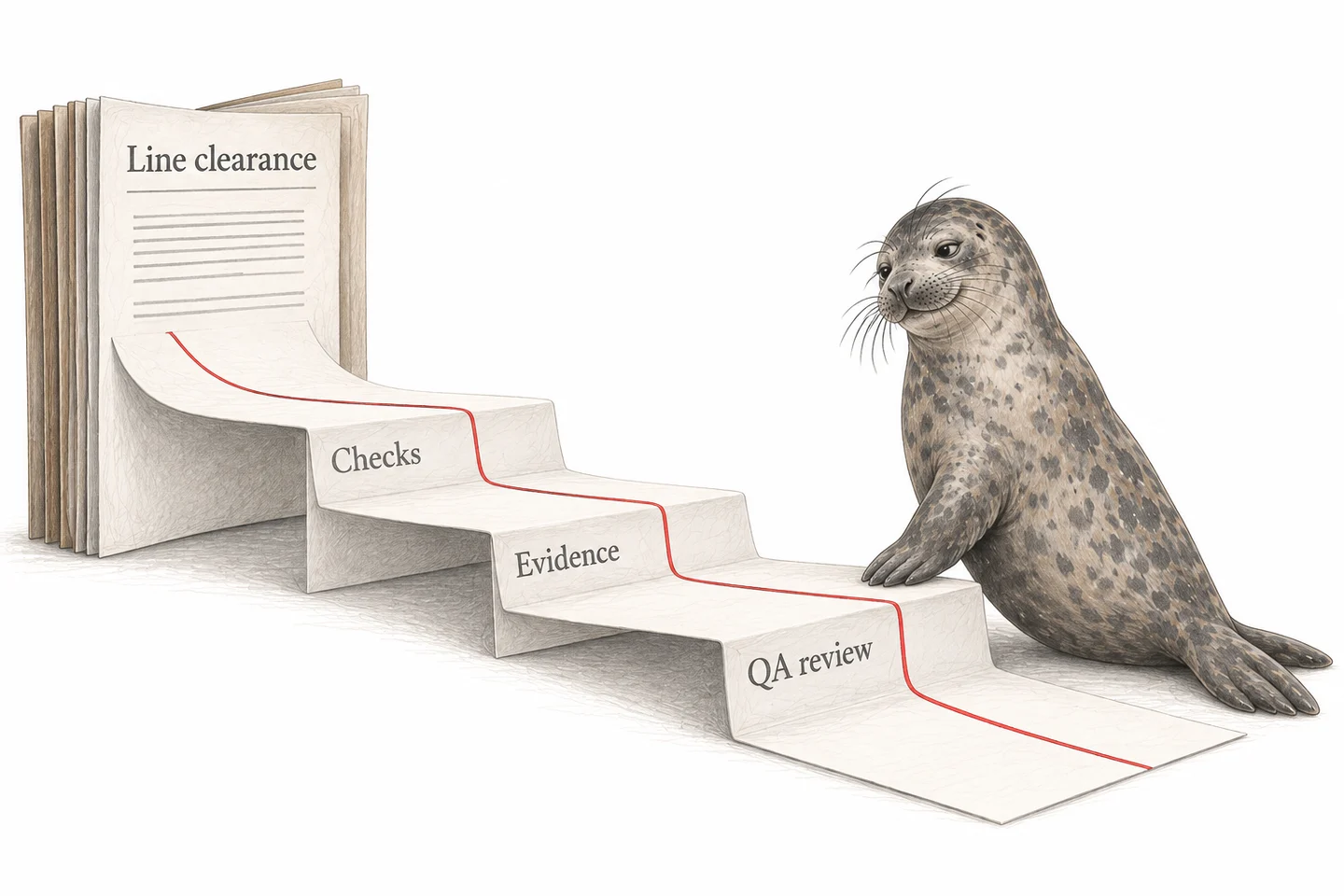
In Seal, the instruction and the work share one platform. In the example in Seal’s document management blueprint, proposed v05 of line-clearance procedure SOP-PKG-014 adds an independent check before line start. The revision affects four linked records: the operator’s instruction, a supervisor’s qualification, the form used to record the result and the printed copy at packaging line 2. The assessment records a decision for each. The proposed configuration then makes the check explicit: a missing verifier, a failed check or a missing qualification keeps line start blocked, and meeting the check lets the process continue to its remaining requirements without releasing the batch. The supervisor and the operator need different training for the same revision.
Approval and effectiveness are separate decisions. v04 stays in use while the approved v05 waits for training and its line-side copy, work already started keeps the version it began under, and completed records keep the version they used. An investigation can follow a result back to the exact instruction and configuration in force.
4Validation and releases.
Veeva validates each release of its platform and gives customers the evidence; Seal also runs the selected checks on each change your team makes to your configuration.
Veeva’s validation brief says Veeva performs and documents infrastructure qualification (IQ) and operational qualification (OQ) for each major release, provides a sandbox and UAT scripts that customers can adapt for performance qualification, and gives customers the release’s validation package, including the plan, requirements, test protocol, traceability matrices and summary report. A new version arrives about every four months. Before each, a Release Impact Assessment documents upcoming features, their risk and enablement, pre-release Vaults let customers test their configuration, and features that may change existing behaviour or have GxP impact are off by default. Each customer’s risk assessment sets its testing for the release, and low-risk changes can be qualified through change control.⁸
In Seal, the requirements, functional and design specifications and the configuration specification are controlled records linked to the configured process. When a changeset is prepared for review, its selected user acceptance tests run in a background simulation, and publication requires current passing results. Seal provides the platform controls and its own verification and release evidence for the version in scope; your team owns the intended use, risk acceptance and production approval. The regulatory guide sets out the boundary.
5Where Veeva Vault QualityDocs is the better fit.
QualityDocs is the better fit when documents are the system of record you need, at enterprise scale and shared widely.
- You already run Veeva QMS, Training or other Vault applications and want documents on the same platform, with Veeva Connections between Vaults.⁵
- You share procedures, quality agreements and batch documentation with many partners and contract manufacturers, and want them working in the system rather than receiving copies.¹
- Your operators need station-specific instructions on tablets, including offline.⁷
- You want a supplier validation package for every release and a predictable release cadence with features off by default.⁸
- You are an emerging biotech that wants quality applications preconfigured out of the box.⁵
6Where Seal is the better fit.
Seal is the better fit when a revised procedure should change how the work runs, not only which document people read.
- You want a new step to become a check in the workflow, with its form linked to the procedure version, rather than a revised PDF.
- You want training assessed by role and activity, and qualification checked where the work runs, so a completed record supports the task it was intended for.
- You want the cutover planned around training, verification, implementation and outstanding copies, with the outgoing version effective until the replacement is ready.
- You want Neil to prepare the revision. Neil drafts the revised instruction from the source procedure, finds the forms, training and records it affects, and prepares the configuration change with its verification. Your team reviews and approves. In line with the EU’s draft GMP Annex 22 on AI, Neil is not used in GMP execution. It helps set up configuration, which your team verifies and releases under change control.
7Running Seal alongside Veeva Vault QualityDocs.
You do not need to move your document library to start. Seal’s QualityDocs connection shares steady-state QualityDocs documents through the Veeva Vault library: choose document types, preview the collection and reference captured versions with @ in documents, comments and Neil.
An organisation admin connects the Vault, selects the documents and chooses the Seal groups that can read their captures, and decides whether to copy text so Neil can read supported content. Sharing starts after review and a successful sync. The library reads only and makes no changes in Veeva; original links open with each reader’s own Vault permissions. Disabling sharing blocks new reads, turning text copying off removes stored text, and disconnecting deletes the copies.
A scoped Vault API integration is needed only to exchange lifecycle states or metadata with Seal records, and it is separate from the library. Agree its records, direction, permissions and failure handling, and treat any write to Vault as its own decision. QualityDocs can remain the home of controlled documents while one procedure family runs in Seal and references them.
8Moving from Veeva Vault QualityDocs to Seal.
Start with one procedure, beside the library you have.
- Choose an effective SOP, a proposed revision and the form or training requirement it affects, ideally one where the change adds a step at the point of use.
- Connect the Vault library read-only for the documents that procedure references.
- Neil drafts the revision and the configured workflow, and your team checks them against how the work runs. The 48-hour evaluation turns that one procedure into a working workflow with a validation pack to inspect. Production timing then depends on scope, interfaces, migration and your release requirements.
- Follow the revision through approval, training and effectiveness, and test the blocked paths: a missing verifier, a failed check and a missing qualification.
- For a later migration, inventory the source population, map document types and owners, preserve available versions and approval evidence, and reconcile imported records. A file upload is not an approved baseline, and missing history is not invented.
Agree the migration scope and acceptance checks before extending to the next document family. The document control blueprint describes the full lifecycle.
References
- 1Veeva QualityDocs: GxP and Quality Content Management, Veeva. https:/
/ www. veeva. com/ products/ veeva- qualitydocs/ (read 8 October 2026) - 2Veeva QualityDocs product brief, Veeva. https:/
/ www. veeva. com/ resources/ veeva- qualitydocs- product- brief/ (read 8 October 2026) - 3Veeva AI Agents to Be Released Across All Veeva Applications, Veeva Systems, 14 October 2025. https:/
/ www. veeva. com/ resources/ veeva- ai- agents- to- be- released- across- all- veeva- applications/ (read 8 October 2026) - 4What’s New in 25R1, Veeva Clinical Data release notes, Veeva. https:/
/ cdmshelp. veeva. com/ gr/ rn/ general- releases/ 25r1/ whats- new/ (read 8 October 2026) - 5Veeva Quality Cloud, Veeva. https:/
/ www. veeva. com/ products/ quality- cloud/ (read 8 October 2026) - 6Veeva Training: LMS for GxP Compliance, Veeva. https:/
/ www. veeva. com/ products/ veeva- training/ (read 8 October 2026) - 7Veeva Station Manager: Tablet App for the Manufacturing Floor, Veeva. https:/
/ www. veeva. com/ products/ veeva- station- manager/ (read 8 October 2026) - 8Veeva Vault Validation Features Brief, Veeva. https:/
/ www. veeva. com/ resources/ veeva- vault- validation- product- brief/ (read 8 October 2026)
AQuestions and answers
Is Seal an alternative to Veeva Vault QualityDocs?
For procedures that govern work running in Seal, yes: the procedure is linked to the forms, training and execution rules it governs, and a revision is verified in the workflow before it takes effect. QualityDocs suits companies that want an enterprise document library on Veeva’s platform, shared with partners. You can start Seal on one procedure while QualityDocs stays your library.
Can Seal use documents stored in QualityDocs?
Yes. Seal shares steady-state QualityDocs documents through its Veeva Vault library, so selected Seal groups can reference captured versions with @ in documents, comments and Neil. The library reads only; a scoped Vault API integration is needed only to exchange lifecycle states or metadata with Seal records.
Is it Vault QualityDocs or Veeva QualityDocs?
The same product. Veeva has changed its application branding from Vault to Veeva, so Vault QualityDocs now appears as Veeva QualityDocs. It still runs on the Veeva Vault Platform.
How does validation compare?
Veeva qualifies each major release itself, documenting infrastructure and operational qualification, and gives customers a validation package, a Release Impact Assessment and pre-release Vaults for testing their configuration. In Seal, each change to your own configuration runs its selected acceptance tests when prepared for review, and publication requires current passing results. In both, your team owns the intended use and the release decision.
How long does it take to start with Seal?
The 48-hour evaluation turns one procedure into a working workflow with a validation pack to inspect. Bring an effective SOP, a proposed revision and the form or training requirement it affects. Production timing then depends on scope, interfaces, migration and your release requirements.