Summary
- The problem
- A filter lot number in the batch record says little about whether the installed, sterilised assembly was integral before and after use. When a post-use test fails, the product population that crossed the membrane has to be reconstructed from separate vendor, equipment, laboratory and execution records.
- Seal’s approach
- Seal binds the approved filtration design, product-specific validation, assembly and sterilisation state, installation, PUPSIT, process conditions and post-use integrity into one evidence chain for each filter position. Vendor, equipment and laboratory data stay in their authoritative systems.
- What changes
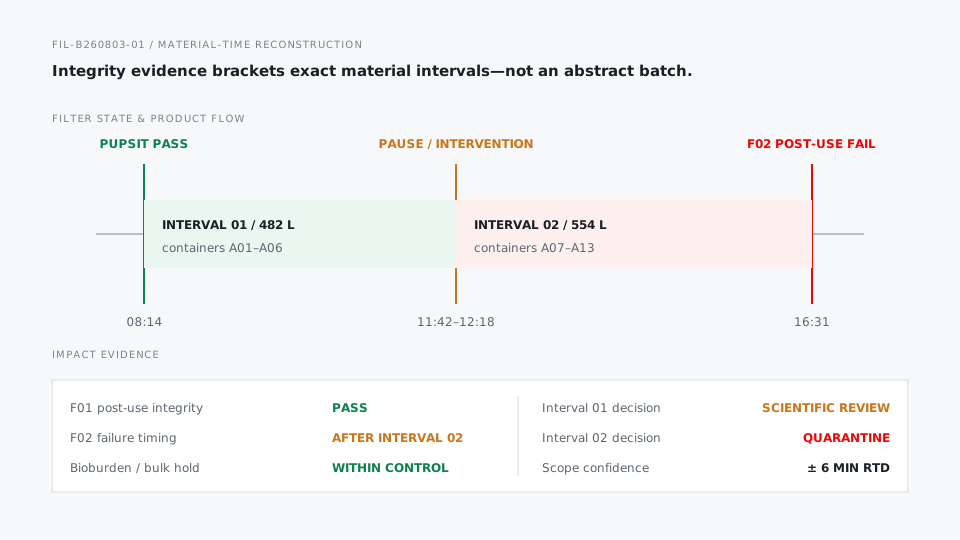
- Interventions and replacements divide the run into distinct filtration intervals, so a failure is bounded to the material and filled units it can affect. The original result is kept while the investigation separates test failure from membrane failure.
- Where to start
- One dual-filter aseptic fill, including a repeated PUPSIT, a redundant-filter switch and a failed post-use test. Book a demo.
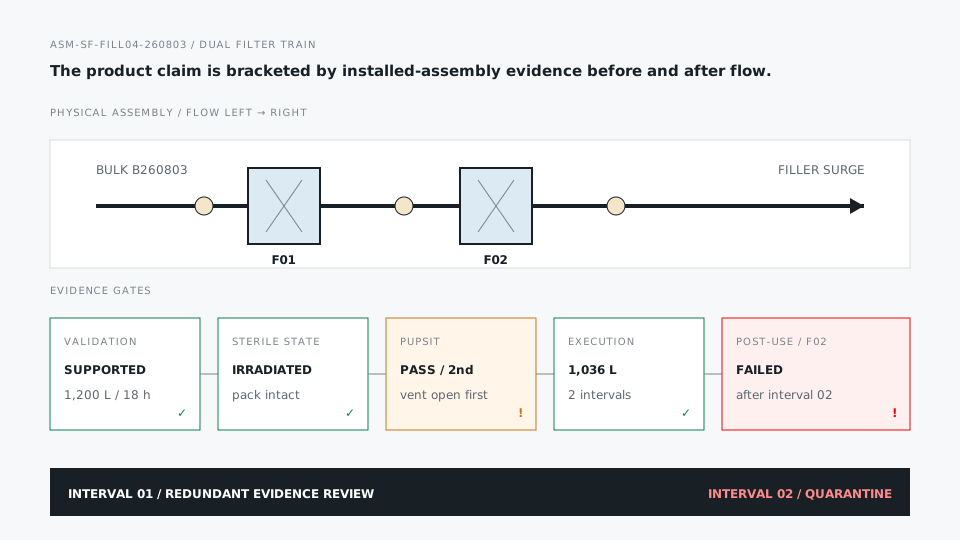
A sterilizing-grade filter is not released for use by scanning its lot number. The batch argument depends on the approved filtration design, product-specific validation, the exact assembly and its sterilisation state, installation, the integrity-test method, the PUPSIT result, the actual pressure, flow, volume and time, interventions, post-use integrity and the material that crossed the membrane.
Seal binds those records into one filtration evidence chain for each filter position, while the filter vendor’s data, equipment source records, laboratory validation and manufacturing execution stay in their authoritative systems.
1The strategy, filter and assembly are defined precisely.
The filtration strategy sets out the process stage, prefiltration, bioburden control, filter count and arrangement, redundant or serial design, position relative to filling, aseptic connections, venting, flush or discard, hold times, sampling, maximum batch size and contingency. It states which filter establishes sterility assurance, which provides protection or redundancy, and what evidence each must contribute.
Filter identity goes beyond pore-size shorthand. Manufacturer, product code, membrane, pore rating, effective area, construction, housing or capsule, connectors, sterilisation compatibility, extractables profile, retention claim, lot and certificate define the filter, and approved alternatives are versioned for a specific use. “0.22 µm” is not an equivalence model.
The installed assembly includes tubing, connectors, valves, pressure sensors, vents, housings, orientation, sample points, the integrity-test path, drains, redundant filters and welds or aseptic connections. Position identifiers let a failure resolve to the correct filter and material boundary.
1.1Why teams choose Seal for sterile filtration
A failed post-use integrity test starts a reconstruction of what crossed the membrane when filtration evidence is split between the vendor’s validation report, the integrity tester’s printout and a filter lot number in the batch record. Seal links the design, validation, assembly, installation, integrity tests, interventions and filtered material for each filter position, dividing the run into bounded filtration intervals. A failure is scoped to the material and filled units it can affect, and the original result stays on record through the investigation.
2Validation establishes suitability for this product and process.
Formulation, concentration, pH, viscosity, surface activity, temperature, contact duration, maximum volume, flux, differential pressure, holds, interruptions, flush, adsorption, compatibility and extractables define the worst case. Seal connects protocol conditions and actual evidence to the commercial operating envelope. Vendor validation can support the case but does not silently replace product-specific justification.¹
Bacterial-retention studies keep their challenge context: organism, preparation, concentration, product or surrogate, filter lot, area, pressure, flow, duration, volume, controls, recovery and conclusion. A surrogate or reduced-scale model states how chemistry, conditions, filter loading and challenge severity represent commercial use. Compatibility (wetting, swelling, binding, product loss, particle release, extractables) is evaluated against the same filter and product state, and the supported contact time includes staging, interruptions, testing and post-use delay, not only active pump time.
Integrity-test methods are governed analytical configurations. Bubble point, diffusion, pressure hold or water intrusion each specify wetting fluid, temperature, stabilisation, test pressure, duration, acceptance, instrument, volume correction, software and correlation to retention. A passing number under the wrong wetting condition is not valid evidence.
3Sterilisation, installation and PUPSIT come before product.
Supplier irradiation, autoclave cycle or steam-in-place, packaging, load position, dose or lethality, storage, expiry and any breach establish the assembly’s sterilised state. Filter integrity and assembly sterility are related but distinct, and Seal can require the right sterilisation evidence before installation and testing.
Installation is verified against the approved design: filter identity and lot, position, flow direction, connections, sensor locations, valve states, test path, operator, verifier, time and room or barrier state. A signed drawing alone cannot show that the physical assembly matches it.
PUPSIT then shows integrity after preparation and before use. Wetting, flush, instrument, method, temperature, raw trace, result, repeats, troubleshooting and approval stay attributable to the installed, sterilised assembly. Where PUPSIT is not performed under an approved exceptional rationale, the risk assessment, alternative controls, scope and approval are explicit rather than represented as a passing test.²
4Execution divides the run into filtration intervals.
Source and receiving vessels, product lot, start and end, flow, volume, pressure, differential pressure, temperature, interruptions, recirculation, flush, samples and alarms align to the filter assembly, so the material before, through and after each filter stays identifiable.
Pre-filtration bioburden (location, method, result, organism, timing, bulk hold and temperature) establishes the microbial load the filter actually faced. A late result or atypical organism can trigger product impact even when the post-use test passes.
A repeated test, rewetting, valve manipulation, line break, filter replacement, redundant-filter switch, pause or restart records its time, authorisation, aseptic controls, before-and-after configuration and material location. The system reconstructs distinct filtration intervals rather than summarising the run as one execution. A failure can only be bounded to one interval when an integrity test at the intervention before it passed, as F02’s did at 11:42 in the example.
5Post-use integrity closes the claim, and failures stay bounded.
The post-use test records time since filtration, storage, wetting state, method, instrument, raw trace, result, repeats and reviewer against the exact filter position. Pass, invalid, failed and not-testable states lead to different evidence and product decisions.
A failure investigation distinguishes test failure from membrane failure: instrument, tubing, valves, wetting, temperature, setup, handling damage, sterilisation, installation, process pressure, occlusion or product interaction, without erasing the initial result. Impact traverses the filtered interval, upstream and downstream material, receiving containers, filled units, samples, redundant-filter evidence, sterility tests and related assemblies.
Trending across diffusion values, repeats, failures, filter lots, membrane families, products, assemblies, sterilisation cycles, operators and process conditions lets near-limit drift prompt action before a failure. A change to the filter, membrane, supplier site, assembly, sterilisation, test method, tester software, product, scale, flow, pressure or duration identifies the validation, compatibility, extractables, process and regulatory evidence it needs.
6Disposition keeps the precise conclusion.
The release record shows the approved strategy and configuration, validation envelope, assembly and sterilisation, installation, PUPSIT, process conditions, bioburden, interventions, post-use results, investigations, affected population, restrictions and approvers. Seal does not convert filter integrity into an unsupported assertion that every downstream unit is sterile.
That argument sits between filter validation, single-use design, sterilisation, MES execution, equipment data, microbiology, deviation management and batch release. None of those systems holds it alone; Seal keeps it as one chain.
7Prove one difficult filtration train end to end.
Follow one dual-filter aseptic fill through strategy, filter and assembly approval, bacterial retention, compatibility, sterilisation, installation, PUPSIT, bulk hold, bioburden, process signals, an interruption, a redundant-filter switch, post-use tests and disposition.
Include a wrong wetting fluid, a repeated PUPSIT, an upstream pressure excursion, a late bioburden result, a filter replacement, a failed downstream post-use test and a lot-specific membrane concern. The first review must identify the exact product population each event can affect.
References
- 1FDA, Sterile Drug Products Produced by Aseptic Processing — Current Good Manufacturing Practice, guidance for industry (2004). FDA
- 2EudraLex Volume 4, Annex 1, Manufacture of Sterile Medicinal Products (2022). European Commission
AConnected across Seal
BCapabilities
| Capability | What it covers |
|---|---|
| Filtration strategy and design authority | The approved strategy defines process location, prefilters, sterilising filters and their roles, serial or redundant design, holds, bioburden controls, sampling, maximum batch size and contingency, each under version control. |
| Filter validation envelope | Retention challenge, compatibility, adsorption and extractables studies define the validated conditions for volume, time, temperature, pressure and flow, which are compared with actual execution. |
| Installed assembly and sterile state | Installation is verified against the approved design: filter lots, positions, flow direction, test paths, connections and sterilisation evidence, with an independent check and the room state. |
| PUPSIT and post-use evidence | Each integrity test keeps its approved method, wetting, temperature, instrument, raw trace, result, validity and any repeat, attributed to the installed filter position. |
| Time-based material boundary | Process time, volume, flow, interruptions, flush, samples and filter replacements divide the run into material intervals, so each filtered segment has an exact genealogy. |
| Integrity failure product impact | A failure investigation separates test-system faults from membrane failure and uses redundant-filter evidence, bioburden and process history to bound the affected product. |
| Bioburden and hold context | Pre-filtration bioburden results keep their sample location, timing, bulk hold and organism identity, aligned with the filter challenge they are assessed against. |
| Filter lifecycle trending | Integrity values, repeats and failures are trended by filter lot, membrane family, assembly, product and process condition, so near-limit drift can prompt action before a failure. |
CConnected records
DQuestions and answers
What is PUPSIT?
Pre-use post-sterilisation integrity testing checks the installed, sterilised filter assembly before it filters product. It detects damage or loss of integrity caused by preparation and sterilisation.
Why is sterile filtration not just a batch-record step?
Its release argument combines the approved design, product-specific retention and compatibility validation, sterilisation, installation and integrity-test evidence. It also depends on which material passed through which filter, the bioburden it carried and any failures.
Can Seal manage redundant or serial filters?
Yes. Each filter keeps its position, role, lot, sterilisation, installation, PUPSIT, process exposure and post-use result. Its relationship to each material interval and to the other filters is recorded.
How is filter validation connected to commercial use?
The validated conditions for product, volume, duration, pressure, flow, temperature, loading, interruption and microbial challenge are held as an envelope. Actual execution is compared with that envelope for each run.
Which integrity-test methods are supported?
Bubble point, diffusion or forward flow, pressure hold, water intrusion and other approved techniques can be configured. Each method specifies filter-specific wetting, temperature, settings, limits, instruments and software.
What happens when a PUPSIT attempt is invalid?
The original trace and conditions are retained. The investigation distinguishes setup, vent, wetting, tester, temperature and connection problems from a true integrity issue, and any repeat follows an approved recovery with the before-and-after state recorded.
How are filtered product populations bounded?
Process time, source and destination, flow, volume, valve and pump state, interruptions, filter position and replacements divide the run into material segments. Containers and samples are linked to the segment they came from.
Does a passing post-use integrity test close every concern?
No. Bioburden, holds, process limits, interventions, late results, assembly breaches and other exceptions remain part of the product decision.
How is a post-use failure investigated?
Seal links the initial result to tester setup, wetting, handling, inspection, destructive analysis, sterilisation, installation and process history. Redundant-filter evidence, material intervals and downstream controls then bound the product impact.
What should the first implementation prove?
Follow one complex filter train from design and validation through the installed sterile assembly, PUPSIT, process and bioburden evidence and an intervention. Include a post-use failure and show the bounded product population, investigation and disposition.