Summary
- The problem
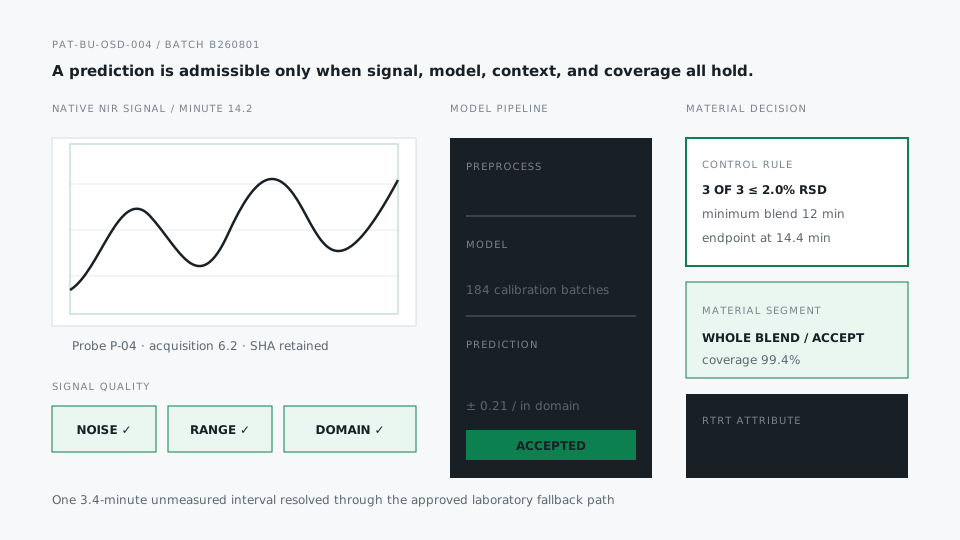
- A smooth NIR trace on a dashboard is not release evidence. Before a prediction can decide an attribute, its source data, model version, applicability domain, process context, coverage and fallback path must be controlled and retained.
- Seal’s approach
- Instead of a trend on a dashboard, each prediction is recorded with its source signal, signal-quality result, model and preprocessing version, material segment and resulting action. Control rules stay separate from the model, and the fallback path is approved before any failure.
- What changes
- Release review shows coverage, unmeasured intervals, out-of-domain predictions and fallback tests for each attribute, so a passing average cannot hide a gap.
- Where to start
- One attribute, such as blend uniformity, from approved method through a fallback test to batch release. Book a demo.
Process analytical technology (PAT) becomes release evidence only when the whole inference is controlled. The right material passed the right sensor in the right process state. An approved model turned acceptable source data into a prediction inside its applicability domain. The required process actions happened, and the approved release strategy allows that evidence to decide the attribute.¹
A dashboard showing a smooth NIR trace makes none of that argument. Seal keeps the parts that do: the source spectra, the model and preprocessing versions, the calibration lineage, the process context, exclusions and uncertainty, the process response, the fallback path and the batch decision.
1Start from the quality decision.
A PAT use case is defined by what it decides: which quality attribute, for which material and unit operation, and in what role. Monitoring, endpoint detection, feed-forward or feedback control, diversion and real-time release testing (RTRT) carry different evidence obligations. One method may serve several roles, but each role is authorised separately, so a method approved for monitoring cannot quietly start deciding release.
1.1Why teams choose Seal for PAT and real-time release
PAT data usually lives in the analyser software and the historian, chemometric models are managed in a separate modelling tool, and release still relies on a laboratory report or a manual summary of the trend. Seal records each prediction against the material it describes, with its source signal, model version and applicability, on the same record as the batch and its release. A model can then be improved from production data, and each earlier decision keeps the model version it was made with.
2Treat the measurement and its data as part of the method.
The measurement configuration is part of the approved method: the probe and its serial number, the installation point and sampling geometry, the acquisition rate and software, and the clock. A calibrated analyser mounted in the wrong position, or run with an unapproved acquisition method, cannot produce valid predictions.
Source data stays in native or lossless form, with its instrument method, diagnostics, reference measurements and acquisition audit trail. Seal indexes and contextualises that evidence rather than copying every high-frequency point into a transactional database.
Signal-quality rules then decide whether the model runs at all. Noise, saturation, fouling, bubbles, missing scans, baseline shift, a failed reference or an out-of-domain input can invalidate an observation before its value is considered. Every accepted, rejected, substituted or repeated observation carries its quality flag and reason. Bad data is not averaged into an acceptable result.
3Version the model and everything that shapes it.
Preprocessing is an analytical operation, not a setting. Wavelength selection, derivatives, scatter correction, normalisation and alignment form an ordered pipeline, and each prediction records the exact version used. A software update that changes a numerical library can then be assessed against the functions it touches.
Calibration sets connect spectra to reference results across the ranges the model must cover: materials, batches, sites, equipment, suppliers and scales. Training, validation, challenge and monitoring populations stay distinct. A sample removed from calibration keeps who excluded it, why and how performance changed.
The model version brings these together with its algorithm, coefficients, performance, uncertainty, outlier rules, applicability domain, software environment, intended use and approval. Exploratory models can exist alongside it without gaining authority. Only the released model, with its configured endpoint, can control or release material.
4Give each prediction its context, and keep control separate.
Every prediction links to its source data, sensor state, model version, process phase, equipment, material population, uncertainty, quality flags and domain assessment, and to the action that followed. That context lets the prediction be reproduced, and distinguishes a decision made in the process from an analyst’s later recalculation.
The model predicts a value, such as moisture, blend uniformity or coating endpoint. A separate approved rule decides what to do with it: target, persistence, voting, minimum and maximum process time, fail-safe behaviour and operator authority. Keeping the two apart lets one analytical output support monitoring and control under different recipes without changing the model’s scientific identity.
In continuous or semi-continuous processes, measurements and actions align to the material by process time and residence-time model, through diversion gates to collection containers and downstream lots. The record identifies which physical material was accepted, diverted, sampled or rejected, even when the process never stops.
5Approve RTRT per attribute, with the fallback designed in advance.
RTRT is an attribute-level strategy. The plan names the product, market and attribute, the PAT method and model, the prerequisite process controls, the material coverage and acceptance criteria, how uncertainty is treated, and the conventional method that applies if PAT evidence is unavailable. EU GMP Annex 17 makes clear that RTRT follows from an approved control strategy and does not remove the need to comply with the finished-product specification. Seal keeps that relationship for each attribute and market.
The fallback is decided before anything fails. Analyser outage, probe damage, communication loss, a domain failure or missing coverage each resolve to an approved path: conventional sampling and testing, alternate PAT, additional processing, hold or rejection. Eligibility can depend on when the failure happened and whether representative material remains. It is not improvised at release.
Release review then accounts for coverage: expected versus received observations, acceptable signal intervals, model applicability, endpoints and actions, unmeasured gaps, fallback tests and deviations, attribute by attribute. A passing average cannot hide an unmeasured critical interval or a prediction made outside the approved domain.
6Monitor the model and assess every change.
Predictions are trended against independent reference results for bias, residuals, outlier frequency and range coverage, across materials, instruments and time. Scheduled and triggered challenge samples keep that comparison current, and the trending distinguishes a change in the model’s performance from a change in the reference method or sample handling.
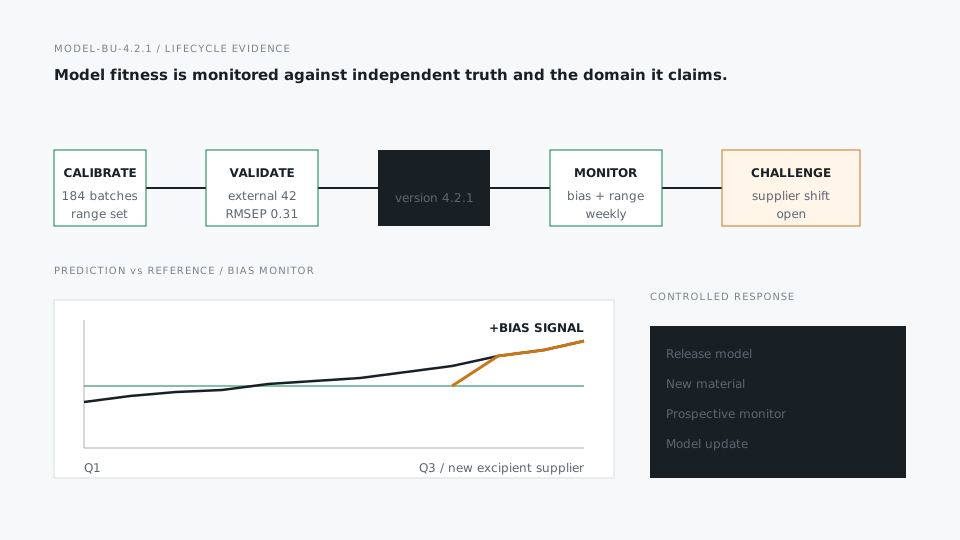
Many changes can affect a model’s suitability: a new probe or optical part, firmware, acquisition method, preprocessing code, calibration samples, the reference method, a material supplier, formulation, process range, scale, site or control rule. The impact assessment identifies the bridging, recalibration, independent validation, software assurance, process validation and regulatory action required before the changed state becomes authoritative.²
7Seal binds analytical evidence to material state.
Seal works at the handoff from high-frequency analytical technology to regulated material state:
| Layer | Responsibility |
|---|---|
| Instruments and historians | Acquire and retain dense source data and native audit trails |
| Control systems | Execute deterministic process actions |
| Seal | Holds the approved method, model and rule versions; binds each prediction to process context and the physical material; manages exceptions, fallback and release authority |
The same structure applies to NIR, Raman, imaging, particle analysis, soft sensors and hybrid models, without treating all PAT as one generic time-series chart.
8Prove one difficult batch end to end.
Start with one blend-uniformity RTRT use case. Follow it from the approved method and sensor configuration, calibration and model release, through raw spectra, signal-quality rejection, predictions and the endpoint rule, to coverage review, a fallback laboratory test, the attribute decision and batch release, then into performance monitoring and a later model update.
Include the cases that make it real: a probe replacement, a clock offset, an out-of-domain spectrum, an excluded calibration sample, a bias signal, one unmeasured interval, an endpoint override and a supplier change. The first usable release should reproduce every accepted prediction and identify exactly which material’s decision depended on it.
References
- 1FDA, PAT — A Framework for Innovative Pharmaceutical Development, Manufacturing, and Quality Assurance, guidance for industry (2004). FDA
- 2EudraLex Volume 4, Annex 15, Qualification and Validation (2015), sections 5 (process validation), 10 (cleaning validation) and 11 (change control). European Commission
AConnected across Seal
BCapabilities
| Capability | What it covers |
|---|---|
| PAT use case and measurement context | Each use case names the attribute, material, unit operation and role it serves: monitoring, endpoint, control or release. The sensor position, geometry and acquisition method are part of the approved method. |
| Signal quality and prediction lineage | Signal-quality rules decide whether the model runs. Each prediction keeps its source data, preprocessing and model version, uncertainty, domain assessment and quality flags, so it can be reproduced. |
| Chemometric model lifecycle | Calibration, validation and challenge populations stay distinct, and exclusions keep who removed a sample and why. Only the released model version, with its configured endpoint, can control or release material. |
| Process control and material diversion | A separate approved rule turns a prediction into an action, with targets, persistence, fail-safe behaviour and override authority. Residence-time alignment links each action to the material accepted or diverted. |
| Attribute-level RTRT strategy | Each attribute and market has its approved PAT evidence, prerequisite controls, acceptance criteria, treatment of uncertainty and conventional fallback. |
| Batch coverage and disposition | Release review compares expected and received observations, signal validity, domain, endpoints, gaps and fallback tests, attribute by attribute, before the batch decision. |
| Sensor readiness and calibration | Instrument, probe, installation, calibration, software and clock state are checked before a prediction can be used. |
| Model performance and change impact | Predictions are trended against reference results for bias, residuals and outliers. Changes to sensors, software, materials, process, site or control rules are assessed before the changed state becomes authoritative. |
CConnected records
DQuestions and answers
What is PAT software in pharmaceutical manufacturing?
It governs process analytical methods, sensors, source data, models and predictions, and their use in quality decisions. It keeps each prediction connected to the process context, the action that followed and the material it concerned.
What is real-time release testing?
RTRT evaluates specified quality attributes during manufacture using approved process understanding, measurements, models and controls, instead of relying only on end-product testing. It is approved attribute by attribute, as part of the control strategy.
Does RTRT remove the finished-product specification?
No. EU GMP Annex 17 makes clear that RTRT does not remove the need to comply with the finished-product specification. The approved control strategy defines how each attribute is assured and which PAT or conventional evidence supports the decision.
Does Seal store raw spectra?
Seal can retain or reference native spectra and other source data in controlled storage. It indexes the instrument, method, time, process context, quality flags and model use rather than copying every high-frequency point into a transactional database.
How are chemometric models versioned?
Each version records its algorithm, preprocessing, calibration and validation sets, coefficients, performance, uncertainty and applicability domain. It also records the software environment, intended use and approval, and each prediction records the version used.
How does Seal detect out-of-domain predictions?
Approved signal-quality and applicability rules evaluate diagnostics, spectral or multivariate distance, process context, range and instrument state before a prediction is accepted. A rejected observation keeps its flag and reason and is not averaged into an acceptable result.
Can PAT directly control equipment?
Control systems execute deterministic process actions. Seal holds the approved model and control rule, records predictions and actions, aligns them to material, and retains exceptions and decision evidence.
How is continuous material traced?
Measurements and actions are aligned to the material by process time and residence-time model. The record follows material through diversion gates to collection containers and downstream lots, so it shows what was accepted, diverted, sampled or rejected.
What happens if the analyser fails?
The fallback is approved before anything fails. The failure type and timing, the material remaining and the representative sampling available determine the path: conventional testing, alternate PAT, additional processing, hold or rejection.
How is model drift monitored?
Predictions are compared with independent reference results and trended for bias, residuals and outliers across materials, instruments and time. Scheduled and triggered challenge samples keep the comparison current.
What changes can affect a PAT model?
Changes to sensors, optical parts, firmware, acquisition, preprocessing code, calibration samples, reference methods, materials, formulation, process range, scale, site or control rules can all affect suitability. The impact assessment identifies the bridging, revalidation and regulatory action required.
What should the first implementation prove?
Take one attribute, such as blend uniformity, from source signal through quality gating, the approved model, prediction and process action to coverage review, fallback and the release decision. Then follow it into performance monitoring and a controlled model change.