Summary
- The problem
- A cycle summary cannot say which vials sat in a warm shelf zone, whether the primary-drying endpoint met the effective rule or how a vacuum interruption affects the load. The answers sit across the controller, historian, batch record and laboratory.
- Seal’s approach
- Seal links the filled-vial population to shelf and tray positions, the authorised recipe version, time-aligned source data, phase intervals, endpoint basis, alarms, interventions, stoppering and test results. The freeze-dryer controller continues to execute the cycle.
- What changes
- Programmed, commanded and achieved values are kept apart, so a manually advanced phase or an alarm resolves to a bounded group of vials. Release can hold an affected edge cluster and release the rest on evidence.
- Where to start
- One aseptically filled vial population through one difficult cycle, including a failed product probe, a brief vacuum loss and a partial-stopper cluster. Book a demo.
Lyophilisation takes an aseptically filled population through a long, equipment-dependent thermal process whose most important state is often inferred rather than directly observed. The release argument has to connect fill history, the vial and stopper system, the load pattern, chamber state, the actual recipe, shelf and product measurements, pressure behaviour, phase transitions, alarms, interventions, stoppering, unloading, testing and the validated range.
A cycle summary alone cannot say which vials occupied a warm shelf zone, whether an endpoint was accepted under the effective rule, or how a vacuum interruption affects a bounded part of the load. Seal links those questions to the evidence that answers them, while the lyophiliser controller continues to execute the cycle.
1The product defines the cycle, and the recipe is a controlled program.
Formulation, concentration, fill volume, critical temperatures, vial and stopper, headspace, allowable hold, target residual moisture, cake attributes, reconstitution and stability define what the product needs. The approved cycle family names the applicable products and presentations, loads, operating ranges, endpoint logic and known limitations.
The recipe is a phase program: loading and equilibration, freezing, annealing where applicable, evacuation, primary drying, secondary drying, backfill, stoppering and unloading, each with its targets, ramps, holds, transition logic, limits and permitted interventions. The PLC executes it as a controller program. Seal governs which version was authorised and keeps the actual execution evidence against it.
1.1Why teams choose Seal for lyophilisation
After an alarm during a lyophilisation cycle, QA needs to know which vials sat where, and the answer is pieced together by hand from the controller’s cycle report, a paper load map and the batch record. Seal links the vial population, shelf positions, recipe version, source data, alarms and results, while the controller continues to run the cycle. A vacuum interruption or failed probe resolves to a bounded group of vials, and a proposed recipe change is judged against the validated range before later loads use it.
2The load map gives every vial a position and a clock.
Shelf, tray, row, column, edge or centre region, empty positions, thermal shields, samples, probe vials and deliberate challenge positions make up the load map. Filled populations connect their upstream filling intervals and component lots to physical positions, and partial, minimum, maximum and mixed loads remain distinguishable.
Pre-lyophilisation hold follows each population. Fill completion, staging, transport, loading start and end, and door closure determine elapsed exposure, so different filling intervals can consume different portions of the allowed hold even within one cycle.
Chamber readiness is specific to the cycle: cleaning, sterilisation where applicable, leak rate, vacuum system, condenser, refrigeration, shelves, stoppering mechanism, filters, calibration, maintenance, alarms, recipe download and interface health. A nominal “available” status does not show suitability for this product and cycle, and readiness gates both loading and cycle start.
Loading keeps its aseptic context: transfer route, barrier or room state, door-open interval, loading system, interventions, dropped or broken vials, jams and counts. Annex 1 treats lyophiliser loading and unloading as extensions of aseptic processing while incompletely closed containers are exposed.¹ Seal connects that contamination-
3Phase state is reconstructed from source data.
Shelf inlet and outlet temperatures, product probes, chamber and condenser pressure, Pirani and capacitance manometer readings, valve states, refrigeration, alarms, commands and audit trails stay in the authoritative equipment or historian source. Seal time-aligns and indexes that evidence, keeping gaps, clock differences, substitutions, manual entries and interface health visible.
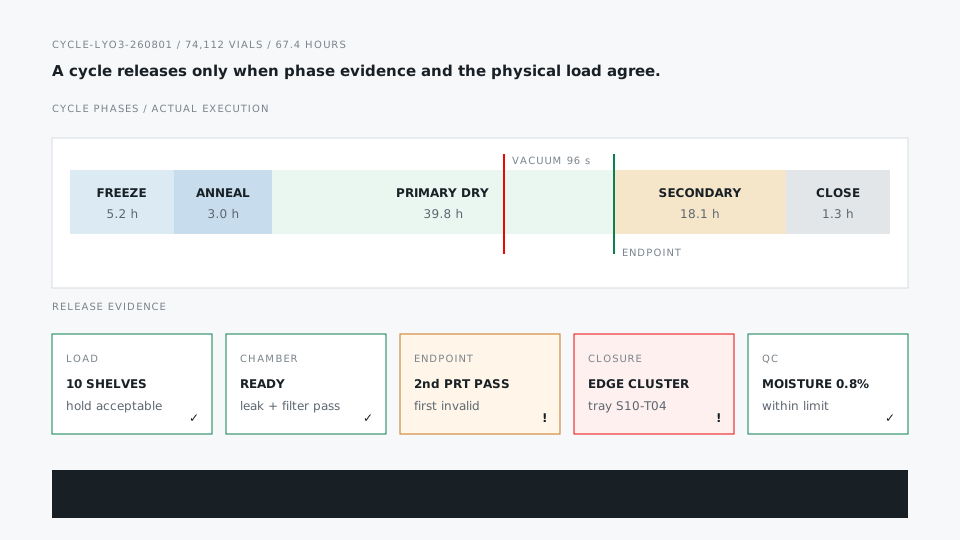
Actual ramps, holds, overshoot, pressure, valve actions, setpoint changes and transition criteria resolve into phase intervals. Programmed, commanded and achieved values stay separate, so review can see a phase that completed by operator override rather than by its normal endpoint rule.
Shelf temperature describes equipment input; product probes sample the response of selected vials. Probe installation, representativeness, dislodgement, noise and known bias determine how much weight each carries. Seal does not assume one product probe represents every vial; spatial qualification and process validation establish what can be inferred across the load.
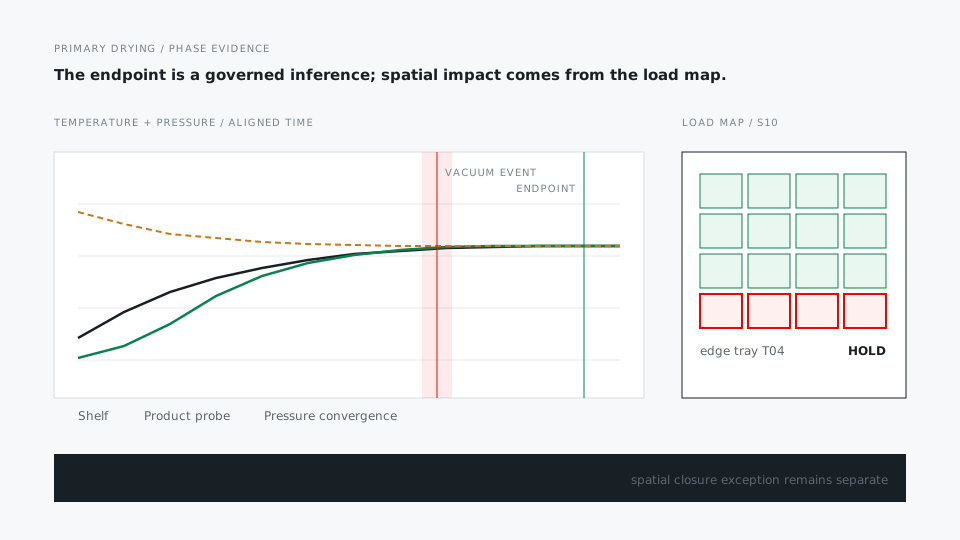
The primary-drying endpoint is a governed inference. Pressure convergence, a pressure rise test, comparative pressure measurement, probe behaviour, other approved technology, minimum time and operator assessment can contribute. The effective rule names the required inputs, validity checks, override authority and fallback, and the endpoint time and basis are recorded at the time rather than read later from a plotted curve.
4Alarms and interventions resolve to bounded groups of vials.
A vacuum loss, pressure spike, refrigeration issue, shelf deviation, probe failure, power interruption, communication gap or stoppering fault identifies the affected phase, duration, severity, recovery and load population. The assessment draws on process understanding and the validated range; acknowledging an alarm does not resolve product impact.
A step advance, setpoint adjustment, hold extension, aborted test, probe substitution or manual valve action records its authorisation, rationale, exact command, before-and-after state and independent review. Permitted ranges derive from the cycle authority, and a departure is recorded and justified as it happens rather than normalised in a later summary.²
5Closure, unloading and testing complete the product argument.
Backfill gas and filter evidence, pressure, stopper position, shelf movement, partial closures and the capping handoff define closure, with the load still linked to stopper and vial genealogy. Unloading reconciles counts, breakage, tipped or missing vials, partial stoppers, samples and rejects to the loaded population, and position survives long enough to relate later moisture, cake, closure or inspection results to shelf region and cycle evidence.
Residual moisture, cake appearance, reconstitution, potency, sterility and container-closure integrity connect to the load and positions. Sampling plans keep their edge, centre, probe-adjacent and challenge rationale instead of losing it in generic sample numbers.
6Validation defines the range each cycle is judged against.
Development, characterisation, engineering runs, qualification, PPQ, minimum and maximum loads, equipment equivalence, scale, worst-case positions and continued verification establish the lifecycle.³ Each commercial cycle resolves the effective validated ranges and conditions. Passing recipe limits does not by itself show that the load stayed inside the validated state.
Cycle review is exception-led and phase-aware. It surfaces readiness gaps, hold-time risk, source-data gaps, phase deviations, endpoint issues, alarms, manual actions, probe concerns, stoppering events, reconciliation differences, atypical results and defect clusters first, with acceptable phase evidence available underneath. Release can then hold an affected edge cluster and release the rest on evidence. Seal does not replace the controller, historian or laboratory; it puts their evidence against the actual load, validated cycle and quality decision.
7Prove one difficult load end to end.
Follow one aseptically filled vial population through its fill intervals, pre-lyophilisation hold, load map, chamber readiness, loading, cycle phases, endpoint, stoppering, unloading, reconciliation, samples, inspection, residual moisture and release.
Include a failed product probe, a repeated pressure rise test, a brief vacuum loss, a manually advanced phase, a partial-stopper cluster on an edge tray, broken vials, a source-data gap and a moisture result near the limit. The first usable release must identify the exact load positions and product population affected by each event.
References
- 1EudraLex Volume 4, Annex 1, Manufacture of Sterile Medicinal Products (2022). European Commission
- 221 CFR 211.100, Written procedures; deviations: production and process control procedures must be approved by the quality control unit, followed and documented at the time of performance, and any deviation recorded and justified. eCFR
- 3FDA, Process Validation: General Principles and Practices, guidance for industry, Revision 1 (2011): defines process validation as the collection and evaluation of data, from the process design stage through commercial production, in three stages: process design, process qualification and continued process verification. FDA
AConnected across Seal
BCapabilities
| Capability | What it covers |
|---|---|
| Cycle family and recipe authority | Record the product’s needs and the approved cycle family, with its products, loads, operating ranges and endpoint logic. The recipe is a versioned phase program; the controller executes it, and Seal keeps which version was authorised. |
| Load-position genealogy | Map each filled population to its shelf, tray and position, with its filling interval, component lots, probes and samples. Pre-lyophilisation hold is calculated for each population from its own fill and loading times. |
| Chamber and source-data readiness | Check cycle-specific readiness, such as cleaning, sterilisation, leak rate, vacuum, condenser, calibration, recipe download and interface health, before loading and cycle start. |
| Phase and endpoint evidence | Resolve source data into phase intervals, keeping programmed, commanded and achieved values separate. The primary-drying endpoint records its rule, inputs, validity checks and any override at the time it is accepted. |
| Alarm and intervention impact | Link an alarm or manual action to the affected phase, duration, recovery and group of vials. Acknowledging an alarm does not resolve its product impact. |
| Stoppering, unload and reconciliation | Record backfill, stoppering and partial closures, then reconcile unloaded, broken, tipped, missing, sampled and rejected vials to the loaded population by position. |
| Cycle-to-product disposition | Bring cycle exceptions, closure, inspection and test results such as residual moisture together for release. An affected position group can be held while the rest of the load is assessed on its own evidence. |
| Cycle lifecycle verification | Link development, engineering runs, PPQ, load range and spatial studies to the validated ranges each routine cycle is judged against, and trend results across cycles. |
CConnected records
DQuestions and answers
What does lyophilisation cycle-management software do?
It links the product, approved recipe and load map to the chamber state, actual cycle phases, endpoint, alarms, stoppering, unloading and test results. A reviewer can then see which vials an event affected rather than relying on a cycle summary.
Does Seal control the lyophiliser?
No. The equipment PLC or controller executes the cycle. Seal governs which recipe version and load were authorised, indexes the source evidence and supports exception review and disposition.
Can each vial position be tracked?
Yes, where the process needs it. Shelf, tray, row, column or zone can connect vial populations to their filling interval, component lots, probes, samples, defects and test results.
How are pre-lyophilisation hold times managed?
Fill completion, staging, transport, loading and door-closure times determine elapsed hold for each filled population. Different filling intervals can use different portions of the allowed hold within one cycle.
How is chamber readiness verified?
Readiness is specific to the product and cycle. The applicable cleaning, sterilisation, leak-rate, vacuum, calibration, recipe and interface checks must be acceptable before loading and cycle start.
Where is high-frequency cycle data stored?
It stays in the PLC, SCADA, historian or equipment files that own it. Seal time-aligns and indexes the evidence, and keeps gaps, clock differences and manual entries visible.
How is the primary-drying endpoint documented?
The effective rule names the required inputs, validity checks, override authority and fallback. The endpoint time and basis are recorded when the endpoint is accepted, not reconstructed later.
How are failed product probes handled?
The probe’s position, failure time and remaining valid evidence stay on the record. The endpoint rule’s fallback and the validated range determine what can still be inferred, and the impact is assessed explicitly.
Can alarms be linked to specific vial populations?
Yes. The event’s phase and duration, the process response, spatial qualification and the load map define which positions are included in the assessment and which are not.
How are partial stoppering and unload defects reconciled?
Stoppering evidence and unload counts are reconciled to the loaded population by shelf and tray. Partial closures, broken or tipped vials, samples and rejects keep their positions, so later test results can be related to them.
How does cycle validation connect to routine batches?
Each commercial cycle resolves the validated ranges and conditions that apply to its product, load and equipment. Passing recipe limits does not by itself show that the load stayed within the validated state.
What should the first implementation prove?
Follow one aseptically filled vial population from filling through the cycle, unloading, testing and release. Include difficult events, such as a failed probe or a brief vacuum loss, and check that each one resolves to the exact positions affected.