Summary
- The problem
- A passed media fill means little unless it challenged the process actually run. When coverage lives in protocols and spreadsheets, it is hard to say which operators, interventions and configurations the last successful APS still qualifies, or what a change or failure reopens.
- Seal’s approach
- Seal holds the qualified process configuration, the worst-case rationale and a coverage matrix maintained across runs. Each run’s interventions, participants, monitoring, units, incubation and inspection link to it, and changes or failures reopen only the coverage they affect.
- What changes
- Every conclusion names the operating envelope it supports. A contaminated unit opens an investigation with the intervention window, people, environment and commercial batches since the last successful evidence already in scope.
- Where to start
- One worst-case campaign simulation on one line across two shifts, including a positive unit and a post-run line change. Book a demo.
An aseptic process simulation is a designed challenge to the actual aseptic operating system: people, line, barriers, interventions, transfers, holds, speeds, shifts, container paths, inspection and incubation. It is how a site validates the aseptic process itself.¹
Seal connects the qualified process configuration, risk assessment, coverage matrix, protocol, participants, executed interventions, environmental monitoring, units, incubation, inspection, growth promotion, investigation and requalification. The conclusion shows exactly what was challenged and what remains unproven. Annex 1 is a primary reference for APS design, execution, investigation and its relationship to the contamination control strategy.²
1The qualified process defines what the simulation must challenge.
The starting model covers formulation and filtration where applicable, equipment assembly, transfers of sterilised items, filling, lyophiliser loading and unloading, sealing, barriers, personnel roles, container-closure families, hold times, line speeds, campaign duration and routine interventions. Each APS resolves to the effective equipment, procedures, recipes and layouts. A successful run against a retired configuration cannot qualify the current line.
Risk selects the worst cases. The plan records each variable, its contamination mechanism, routine range, worst-case direction, interactions, the challenge selected and the rationale.³ The slowest and fastest speeds can create different risks, and the largest container is not automatically the only worst case. Bracketing and matrixing state what is represented and why; unsupported equivalence stays visible as a gap instead of disappearing inside a protocol narrative.
1.1Why teams choose Seal for media fills
The question an inspector asks of a media-fill programme is which operators, interventions and configurations are still qualified. When media fills are planned in a protocol, executed on paper and summarised in a report, that answer comes from spreadsheets. Seal keeps the qualified process, the coverage matrix and each run’s interventions, participants, units and results on the platform where routine batches run, with each run recorded against the coverage it demonstrates. A line change, a new intervention or a contaminated unit shows exactly which coverage it reopens and which commercial batches fall in scope.
2Coverage is managed across runs, not remembered afterwards.
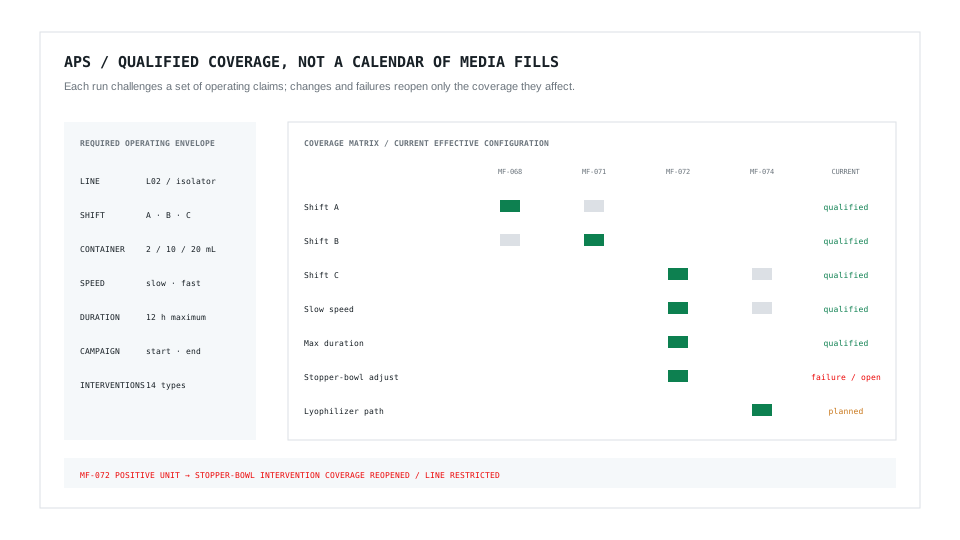
Lines, shifts, operators, roles, interventions, container formats, durations, campaign positions, hold times and lyophilisation paths form a living coverage matrix. A planned run shows which obligations it will satisfy and which remain open. A failed simulation or a change reopens only the coverage it affects.
The programme can therefore answer a direct question: is this operator, this intervention or this configuration currently represented by acceptable evidence?
3Interventions and participants are part of the design.
Each inherent or corrective intervention defines its location, reason, routine frequency, aseptic risk, tools, personnel, duration and monitoring. The protocol schedules a representative number and distribution without inventing unnecessary contamination risk. During the run, actual start and end, operator, line state, first-air exposure and the unit range filled around it stay connected. “Interventions performed” is not accepted without showing which ones, how often and by whom.
Operators carry their qualified roles, gowning status, intervention capabilities, prior APS participation and required frequency. The plan assigns meaningful activity rather than adding a name to the record. Failed participation, a contaminated unit linked to an operator’s activity, expired qualification or a role change can restrict permitted work and start a targeted requalification path.
4The run mirrors routine execution and its real exposure.
Media preparation, setup, sterilised components, line clearance, connections, filling, interventions, stoppages, sampling, rejects and closure run under a controlled record, with deliberate differences from commercial manufacture identified and justified. Automation remains authoritative for machine events; Seal aligns them with human work, media units, monitoring and protocol expectations.
The simulation accounts for maximum run length, breaks, shift changes, idle periods, replenishment, adjustments, stoppages, aseptic holds and the longest permitted interval between critical states. Planned and actual clocks both stay visible. Finishing early leaves a condition uncovered unless the protocol already defines an acceptable basis.
Environmental monitoring belongs to the same timeline. Active air, settle plates, surfaces, personnel samples, particles, pressure and alarms attach to the simulated operation and its interventions. Expected, collected, missed and adverse samples define completeness, and an acceptable unit count does not erase a monitoring gap or an organism that challenges the contamination-
5Every unit is reconciled, incubated and inspected by state.
Each container, or a bounded range, carries its fill event, intervention association, rejection reason, incubation condition, inspection and final state. Units removed under routine-equivalent conditions stay distinguishable from unexplained losses, and the arithmetic and physical disposition must agree before a conclusion.
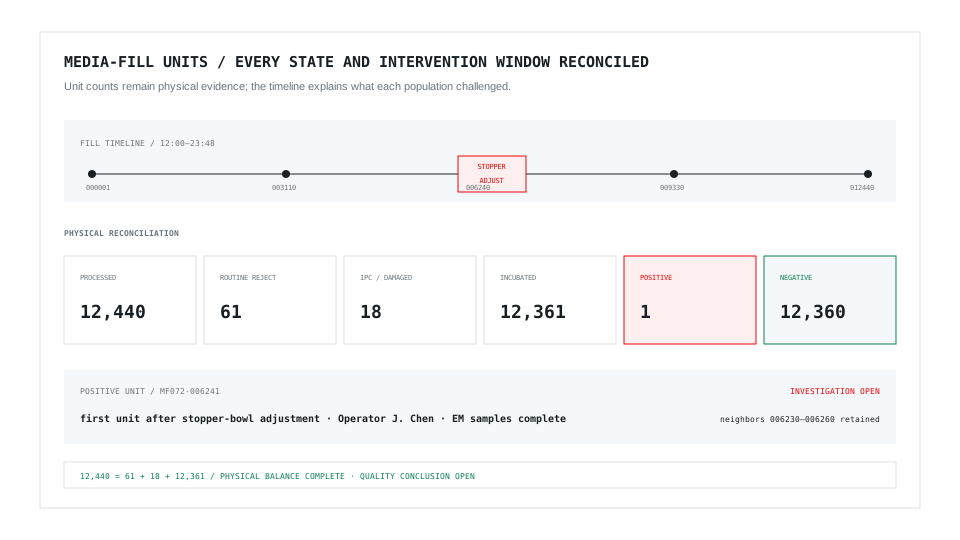
Incubators, loading maps, media lots, temperatures, times, transfers and excursions stay connected to the units, so an excursion identifies the exact population affected, and any extension, restart or rejection requires approved rationale. Inspection defines the method, qualification, turbidity criteria, second checks and escalation of suspect units; a suspect unit cannot be silently recorded as negative. Growth promotion is a dependency rather than an attachment: a failed or invalid result holds the conclusion and scopes the affected media and runs.
6A contaminated unit opens a broad, immediate response.
The investigation starts with the unit’s identity, incubation and inspection history, organism, fill time, neighbouring units, intervention window, people, environment, equipment, materials, prior APS and the commercial batches produced since the last successful evidence.⁴ Containment and production restrictions can apply before root cause is known, and related batches remain in scope until evidence supports narrowing.
The case records whether the failure implicates a person, an intervention, a line, a shift, a configuration, a procedure, the barrier, the monitoring design or the whole aseptic process. CAPA, retraining, maintenance, repeat simulations and restart each keep their prerequisites. An isolated successful rerun does not close the original concern; the conclusion addresses root cause, affected production, restored controls and requalification coverage.
7Changes recalculate coverage.
A line modification, new container, speed range, additional shift, staffing model, intervention, barrier change, hold extension or longer campaign identifies the risk variables and APS obligations it touches. “Media fill required” is not a generic task on the change: the change states which configurations and conditions must be challenged, and whether before or after implementation.
Filling controls, particle counters, monitoring instruments, incubators and automated inspection keep their native events and raw data. Seal owns the simulation definition, coverage logic, governed execution, unit population, investigation, qualification state and restart decision. If a site needs only an electronic protocol, a document system can store one. Seal matters when the site must continuously know what the successful APS qualifies, what a change invalidates and which production a failure can affect.
8Prove one worst-case campaign simulation.
Start with one line across two shifts at maximum duration, with representative container families, slow and fast operation, a planned stoppage, replenishment, a shift change, routine and corrective interventions, full unit reconciliation, incubation, inspection and growth promotion.
Include an absent operator, a missed intervention, a missing unit, an incubator excursion, a turbid suspect, a positive unit, an environmental isolate and a post-run line change. The programme is ready when every conclusion names the exact operating envelope it supports.
References
- 121 CFR 211.113, Control of microbiological contamination: written procedures must be established and followed to prevent microbiological contamination, including validation of all aseptic and sterilisation processes for sterile products. eCFR
- 2EudraLex Volume 4, Annex 1, Manufacture of Sterile Medicinal Products (2022). European Commission
- 3ICH Q9(R1), Quality Risk Management (2023), sections 4 (general quality risk management process) and 5 (risk management methodology). European Medicines Agency
- 4FDA, Sterile Drug Products Produced by Aseptic Processing — Current Good Manufacturing Practice, guidance for industry (2004). FDA
AConnected across Seal
BCapabilities
| Capability | What it covers |
|---|---|
| Coverage matrix | Show which lines, shifts, operators, interventions, container formats, durations and hold times are represented by acceptable evidence, and which obligations remain open. |
| Worst-case risk design | Record each variable’s contamination mechanism, routine range, worst-case direction, interactions, the challenge selected and the rationale behind it. |
| Guided APS execution | Run setup, interventions, stoppages, sampling and closure under a controlled record that follows the effective simulation protocol. |
| Intervention and operator evidence | Planned and actual interventions keep the person, qualified role, location, timing and observations, and link to the units filled during that window. |
| Unit reconciliation | Reconcile filled, rejected, sampled, damaged, incubated, inspected, positive and missing units by state and by the intervention windows they represent. |
| Incubation and inspection | Connect incubator loading maps, conditions, excursions, inspection results and growth promotion to the units concerned. |
| Failure and production impact | A positive unit or invalid run opens an investigation scoped to the line, configuration, people, interventions and commercial batches potentially affected. |
| Qualified-state control | Link accepted simulation evidence to the production conditions it supports, and identify new APS obligations when the line, process, staffing, containers or campaign length change. |
CConnected records
DQuestions and answers
What is aseptic process simulation software?
It manages the evidence that a media fill meaningfully challenges the routine aseptic process. That includes coverage design, the protocol, execution, interventions, people, units, incubation, inspection, failures and the qualification decision.
Is an APS the same as a media fill?
Media fill is the common term. APS emphasises that the whole aseptic process, not only filling media into containers, is being simulated and evaluated.
How does Seal select worst-case conditions?
The risk assessment connects each process variable to its contamination mechanism, routine range, interactions and the challenge chosen, with its rationale. Your team approves the plan, which shows what is covered and what is excluded.
Can Seal track operator participation?
Yes. It records each operator’s qualified role, shift, the interventions actually performed and their outcomes. That shows whether a person is currently represented by acceptable evidence.
How are interventions represented?
Each intervention has a defined risk, routine frequency and planned challenge count. The executed intervention records the person, location, time, duration, line state and the unit range filled around it.
How are media-fill units reconciled?
Each unit, or a bounded range, moves through filled, rejected, sampled, incubated, inspected and final states. The counts are reconciled arithmetically and physically, without hiding the intervention windows the units represent.
Can incubation systems integrate with Seal?
Yes. Incubators can remain the source for conditions and alarms, while Seal connects unit positions, required exposure, excursions, inspection and decisions.
What happens when a contaminated unit is found?
An investigation opens with the unit’s history, organism, fill time, neighbouring units, intervention window, people, environment and equipment. Its scope includes commercial production since the relevant successful APS, and containment decisions are recorded.
How does change control affect APS coverage?
A change identifies which line, intervention, container, shift, duration or hold claims it affects. It then shows the simulation obligations needed to restore coverage.
Does Seal replace filling-line or monitoring software?
No. Controllers and monitoring systems keep their native data. Seal connects that evidence to the APS protocol, event timeline, unit population, coverage and investigation.
How does Seal differ from an electronic protocol system?
An electronic protocol captures one run. Seal maintains the relationship between the production configuration, coverage obligations, runs, people, units, failures and changes over time.
What should the first implementation prove?
Run one maximum-duration, two-shift simulation with representative interventions and containers. Include difficult events, such as a missed intervention or a positive unit, and check that the coverage and qualification state are correct afterwards.