Summary
- The problem
- In continuous manufacturing, one timestamp, one vessel and one batch number no longer describe the same material. Input lots overlap, disturbances propagate through connected unit operations, and output is accepted or diverted while the line keeps running.
- Seal’s approach
- Seal aligns equipment topology, residence-time models, process signals, control actions, diversion and collection containers, so each input event resolves to the output it could have affected. Control systems keep real-time control; Seal makes the material history reviewable.
- What changes
- A batch is an approved rule over material intervals and containers. Release traces every accepted interval back to its inputs without a narrative reconstruction.
- Where to start
- One difficult run, including overlapping lots, a feeder disturbance, a diversion and a shutdown tail. Book a demo.
In a batch process, one timestamp, one vessel and one batch number usually describe the same material. Continuous manufacturing breaks that assumption. Inputs enter over hours, material disperses across connected unit operations, sensors observe it at different points, and output is accepted or diverted while the line keeps running.
Seal turns that moving process into a material history a reviewer can check. It aligns the equipment topology, residence-time models, process signals, control actions, diversion gates and collection containers, so that any input event resolves to the output it could have reached.
1Model the line before tracing the material.
Every later inference depends on an approved description of the system. The system version records the unit operations and how they connect: flow direction, holdup and dead volumes, surge vessels, recycle and parallel paths, and where the sensors, PAT probes, sampling points, diversion gates and collection points sit. A permitted alternative configuration is its own version, not an informal variant.
The operating recipe adds the state logic: setpoints and ranges, the startup sequence, control loops and models, the criteria for a state of control, diversion logic and the rules for shutdown, restart and campaign transition. The record keeps programmed, commanded and achieved states apart, and ties each to the controller version that produced it.
1.1Why teams choose Seal for continuous manufacturing
Most MES and batch-record systems were designed for discrete batches, so continuous lines are often documented with historian exports, spreadsheet residence-time calculations and narrative batch reports. Seal aligns the line topology, residence-time model, process signals, diversions and collections on one timeline, and defines a batch as an approved rule over material intervals. A model or state logic refined from run data applies to material made after its approval; each earlier run keeps the version it was judged against.
2Trace input lots through time, not by container.
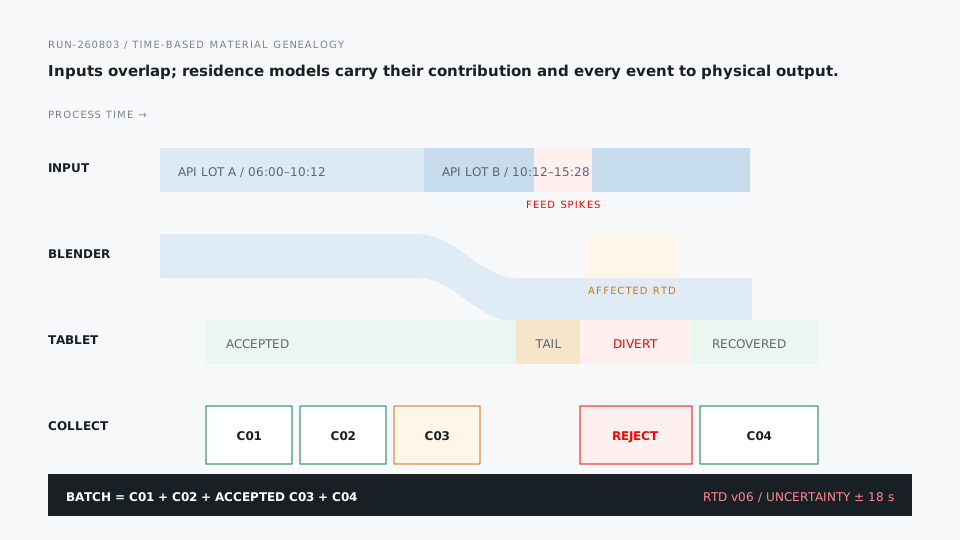
An input is an interval, not a single event. Each feed records the lot, the feeder or source vessel, the quantity and relevant attributes, the start and end of feeding, replenishments and interruptions. When a new lot is loaded before the previous one is exhausted, both are in the system at once.
Residence-time distribution (RTD) models connect those intervals to downstream material. Each model, for a unit operation or the integrated line, keeps its tracer experiment, configuration, fitted parameters, uncertainty and operating range. For any input event, Seal calculates the earliest, central and tail arrival times at each measurement, sample, gate and collection point, and records which model version and assumptions produced them. Overlapping lots keep their modelled contribution to each collection, rather than the whole collection being assigned to whichever lot was loaded last.
3Classify the process state from evidence.
Startup, state of control, transition, disturbance, recovery, shutdown and cleaning are intervals with approved entry and exit criteria. Seal classifies each interval from the evidence those criteria name, such as parameters, PAT results, control error and alarm persistence, and records who authorised it and what it means for the output. “Steady state” is established by criteria and data, not typed as a comment.
The signals themselves stay in the historians and instruments that own them. Seal indexes them with location, units, clock, data quality, gaps and calibration state, because a value means little without knowing where and when it was measured. The same applies to PAT: a prediction records its source signal, model version, uncertainty and applicability domain, and the material window it describes. A blend-uniformity prediction taken after the blender does not describe the material that is passing the tablet press at the same moment.
4Bound each disturbance and follow it downstream.
A feeder refill, a flow spike, a sensor gap or a brief pump stop is recorded as a bounded event: where it happened, its amplitude and duration, how it was detected, the response and the recovery. Control actions are recorded in the same terms: the measured input, the rule or model, the command, the actuator’s response and any operator override. The record distinguishes normal feedback from intervention.
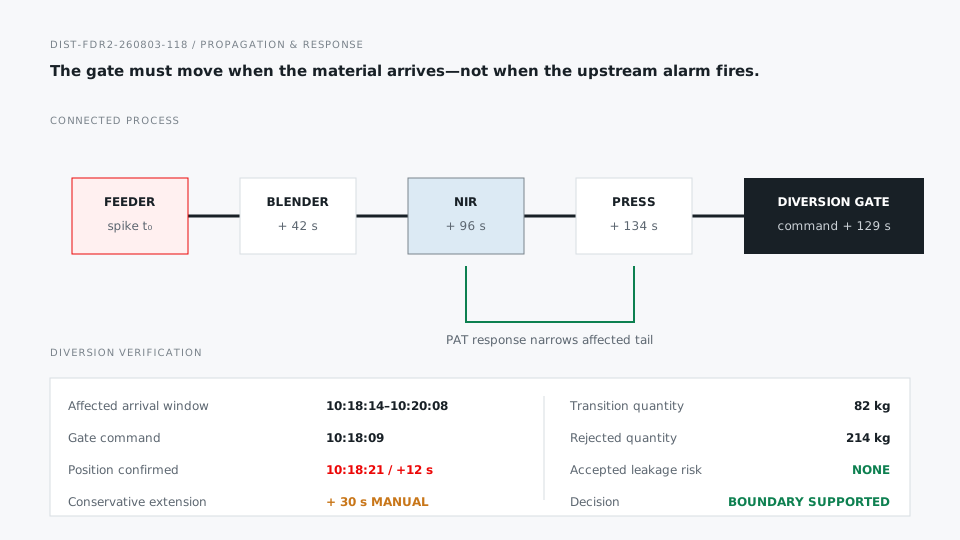
Propagation then turns the event into affected material. Using the event interval, current flows, holdup, the RTD and its uncertainty, Seal calculates the affected window at each downstream point. The first boundaries are conservative. A later refinement keeps its reason and never silently narrows an interval to reduce the rejected quantity.
Small events can matter together. Individually acceptable oscillations can accumulate into a nonconforming pattern, so frequency, spacing and the system’s damping remain part of the assessment.
5Verify diversion, and define the batch before the run.
Diversion is a chain of evidence: the trigger, its persistence and propagation offset, the gate command, the gate’s actual position, the physical transit time and the quantity sent to each path. A commanded diversion without evidence of gate position and material arrival is incomplete. Manual extensions and overrides are recorded as such.
Collection containers form the physical populations. Each records its start and end, quantity, the material windows and input-lot contributions it holds, the process states it spans, its samples and its diversion status. Samples are assigned only to the material they represent: a grab sample cannot stand for a broad output population without a model of what it covers.
A batch in continuous manufacturing can be defined by time, quantity or another approved rule.¹ Seal holds that rule prospectively, including state criteria, sampling, changeover and cleaning boundaries, campaign limits and diversion exclusions. The released batch shows exactly which intervals and containers satisfy it. Startup, shutdown and transition material is neither accepted nor rejected by default; its approved handling and evidence are explicit.
6Validate the dynamics, then keep watching them.
Process validation for continuous manufacturing follows requirements similar to those for batch processes, with considerations specific to continuous operation.¹ For a continuous line, those considerations include the RTD, startup and state criteria, run duration, control performance under input variability, a diversion challenge, sampling representativeness and the traceability itself. Scaling by longer runs, higher flow or parallel lines keeps its own evidence and change impact.
Continued verification then trends what batch averages hide: control error, time spent in each state, disturbance and diversion frequency, prediction bias, whether RTD assumptions still hold after maintenance, and yields across runs. A slow change in the process dynamics can show in these trends while batch averages still look acceptable.
7Release by exception, with every interval traceable.
The reviewer sees the recipe and system version, input genealogy, the state timeline, data coverage, disturbances with their propagation windows, diversions, collections, samples, deviations and reconciliation against the defined batch. Exceptions are the starting point. Every accepted output interval can still be traced back to its inputs and forward through containers to downstream use.
Seal does not replace real-time control. It works between the systems that run and record the line and the systems that decide on its output:
| Layer | Responsibility |
|---|---|
| Control system | Executes deterministic, real-time control logic and diversion |
| Historians and instruments | Retain dense signal data and native audit trails |
| Seal | Holds the approved system, recipe and RTD versions; indexes evidence; reconstructs material state; manages exceptions; supports review and release alongside MES, laboratory, validation, CPV and quality records |
8Prove one difficult run end to end.
Start with one continuous direct-compression run that includes the hard cases: overlapping input lots, a feeder disturbance, a repeated flow oscillation, an automatic diversion with gate-position verification and a shutdown tail. Follow it from feeds through RTD propagation, state-of-control entry, PAT predictions and controller actions to collections, samples, the batch definition, reconciliation and release.
Then add what real runs contain: a clock offset, a sensor gap, an RTD changed after maintenance, a delayed gate response, an out-of-domain prediction, a manually extended diversion and a partially held container. The test is whether the record identifies exactly which material was accepted and which was rejected, without relying on a narrative summary.
References
- 1ICH Q13, Continuous Manufacturing of Drug Substances and Drug Products (2022). ICH
AConnected across Seal
BCapabilities
| Capability | What it covers |
|---|---|
| Dynamic process and RTD model | Record the approved line topology, holdup, surge and recycle paths, and residence-time distribution models with their tracer evidence, fit, uncertainty and operating range. Each version states how events propagate. |
| Time-based material genealogy | Trace input lots and feed intervals through their modelled contributions to output containers and downstream batches, backwards and forwards, including overlapping lots. |
| Process-state classification | Classify startup, state of control, transition, disturbance, recovery and shutdown intervals from their approved criteria and the recorded evidence, with the authority and the consequence for output. |
| Disturbance propagation | Combine an event’s location, amplitude and duration with flow, holdup and the RTD to calculate conservative affected windows at downstream points. Each later refinement keeps its reason. |
| Diversion and collection control | Record the diversion trigger, gate command, actual gate position, transit time and quantity sent to each path, including manual extensions. Collection containers hold their interval, quantity, contributing lots and status. |
| Continuous batch definition and release | Define the batch prospectively by time, quantity or another approved rule. The release review shows which intervals and containers satisfy it, and how transition material was handled. |
| Contextual PAT and control evidence | Index signals with location, units, clock, data quality and calibration state. PAT predictions keep their model version, uncertainty, applicability domain and the material window they describe. |
| Dynamic performance verification | Trend control error, time in each state, disturbance and diversion frequency, prediction bias and yield across runs, to find slow changes that batch averages can hide. |
CConnected records
DQuestions and answers
What is continuous pharmaceutical manufacturing software?
It connects the approved line model, residence-time models, process states, signals and diversion decisions to the material they affect. The aim is a material history a reviewer can check: which input could have reached which output, and which output was accepted or diverted.
Why is an ordinary MES not enough?
An MES executes recipes and records steps. Continuous manufacture also needs residence-time propagation, overlapping input lots, time-resolved process states, affected material windows and a prospective batch-definition rule.
How are input lots traced to continuous output?
Each feed is recorded as an interval with its lot and quantity. Validated RTD models connect that interval to downstream measurements, gates and collections, with the model version and uncertainty retained. Overlapping lots keep their modelled contribution to each collection.
How is steady state represented?
Seal classifies an interval against the approved state criteria, such as process parameters, PAT results, control error and alarm persistence. The record retains the entry and exit, the evidence and the consequence for output.
What is an affected material window?
It is the modelled downstream interval and quantity that an upstream event may have influenced. It is calculated from the event duration, flow, holdup and RTD with its uncertainty, starting conservatively.
Can several small disturbances be evaluated together?
Yes. Individually acceptable oscillations can accumulate into a nonconforming pattern. Frequency, spacing and the system’s damping remain part of the assessment.
How is automatic diversion verified?
The record links the trigger and propagation offset to the gate command, the gate’s actual position, the physical transit time and the quantity sent to each path. Verify the gate position and where the material arrived; a diversion command alone does not establish that it was diverted.
How is a batch defined in continuous manufacturing?
By time, quantity or another approved rule set before the run. The rule covers state criteria, sampling, changeover and cleaning boundaries and diversion exclusions. Startup, shutdown and transition material follows its approved handling rather than a default.
How does Seal interact with control systems?
The control system executes deterministic control logic and diversion, and historians retain dense signal data. Seal holds the approved system, recipe and RTD versions, indexes the evidence, reconstructs material state and supports review and release.
What should the first implementation prove?
Take one run that includes overlapping input lots, a feeder disturbance, a verified diversion and a shutdown tail. Follow it through to collections, samples, the batch definition and release, and check that the record identifies which material was accepted and which was rejected.